Greece in the fifth century BC had two leading cities. Athens had walls and a fleet, and Sparta had strong heavy infantry. The two had once stood on the same side and driven back Persia. That alliance soon split in two, and in the end the Greek cities each picked a side and fought for 27 years.
This conflict is called the Peloponnesian War. Its chronicler, the Athenian Thucydides, began his record the moment it broke out, and university courses still treat his book as a key source. This article uses that record and a Yale open course to look at why the war started, how it unfolded and what it left behind.
What happens when sea power and land power face each other for a long time? This war is one of the oldest cases of that question.
Why it started: a growing Athens and a fearful Sparta
Before the war, the two sides had a peace treaty meant to keep them from fighting for thirty years. Its oaths were sworn in 445 BC. The peace did not last thirty years. In its fourteenth year, the Spartan assembly ruled the treaty broken.
The sparks came from smaller cities. Corinth and Corcyra quarreled over Epidamnus, a city at the entrance of the Ionian Gulf, and Athens made a defensive alliance with Corcyra. Another dispute broke out at Potidaea, a Corinthian colony that also paid tribute to Athens as an ally.
After setting down these events, Thucydides argued that the real cause lay elsewhere. In his words, "the growth of the power of Athens, and the alarm which this inspired in Lacedaemon, made war inevitable." He added that Sparta voted for war less because its allies persuaded it and more because it feared the growing power of Athens.
Not every modern scholar sees it this way. Professor Donald Kagan of Yale accepts that the rise of Athens pointed toward possible conflict. But many people on both sides did not want war, so he argues it was not inevitable.
In his view, the arbitration clause of the Thirty Years Peace was the key that could have stopped the war. He also admits that these points are open to debate.
Twenty-seven years at a glance
The meeting at Sparta that leaned toward war probably took place in July 432 BC. The fighting itself began in 431 BC, when Thebes made a surprise attack on Plataea, a town allied to Athens. After that, the Peloponnesian army marched into Attica, the home territory of Athens.
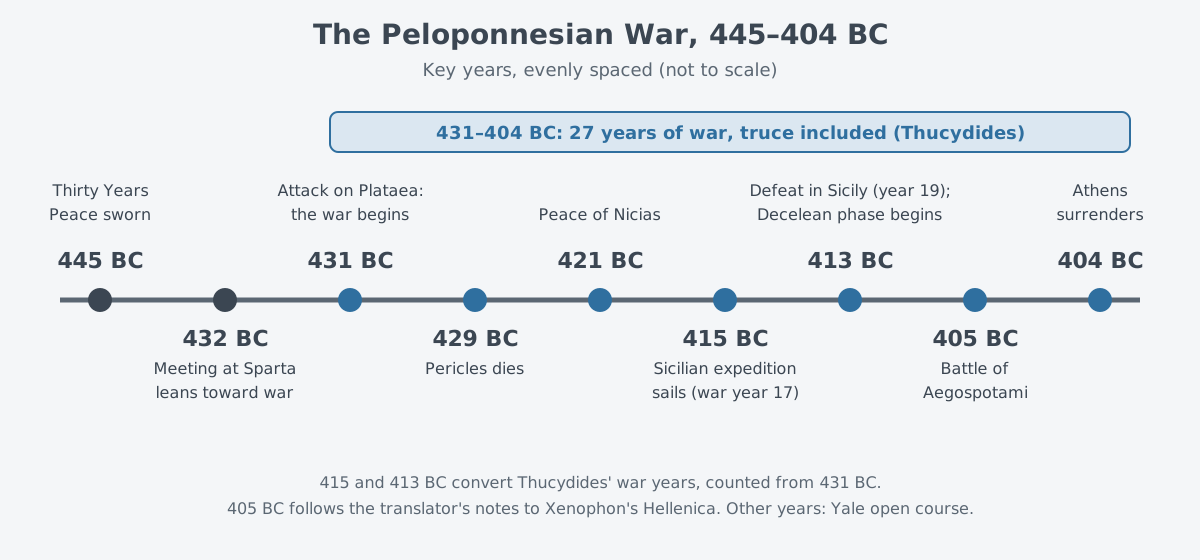
Thucydides' book has no calendar years. It counts the "years of the war" and splits each year into a summer and a winter, telling events in order. The years 415 and 413 on the timeline convert his "seventeenth year" and "nineteenth year" into calendar dates, counting from a start in 431.
In the tenth year of the war came the Peace of Nicias. It took effect in 421 BC but soon broke down. Thucydides held that this truce should count as part of the war. He counted 27 years in all, up to the point when Athens gave up its Long Walls and its port, Piraeus.
In the seventeenth year Athens sent a large expedition to Sicily, and in the nineteenth year that expedition collapsed. The years 413–404 BC that followed are sometimes called the "Decelean" phase. In this period the Spartan king held a fort at Decelea, 14 miles from Athens. The war ended in 404 BC with the surrender of Athens.
Sea power and land power
The two alliances rested on different foundations. Sparta did not collect tribute from its allies; instead it set up oligarchies, rule by a small group, in allied cities to keep them in line with its interests. Athens gradually took away its allies' ships and had them pay money instead. Only Chios and Lesbos were exceptions.
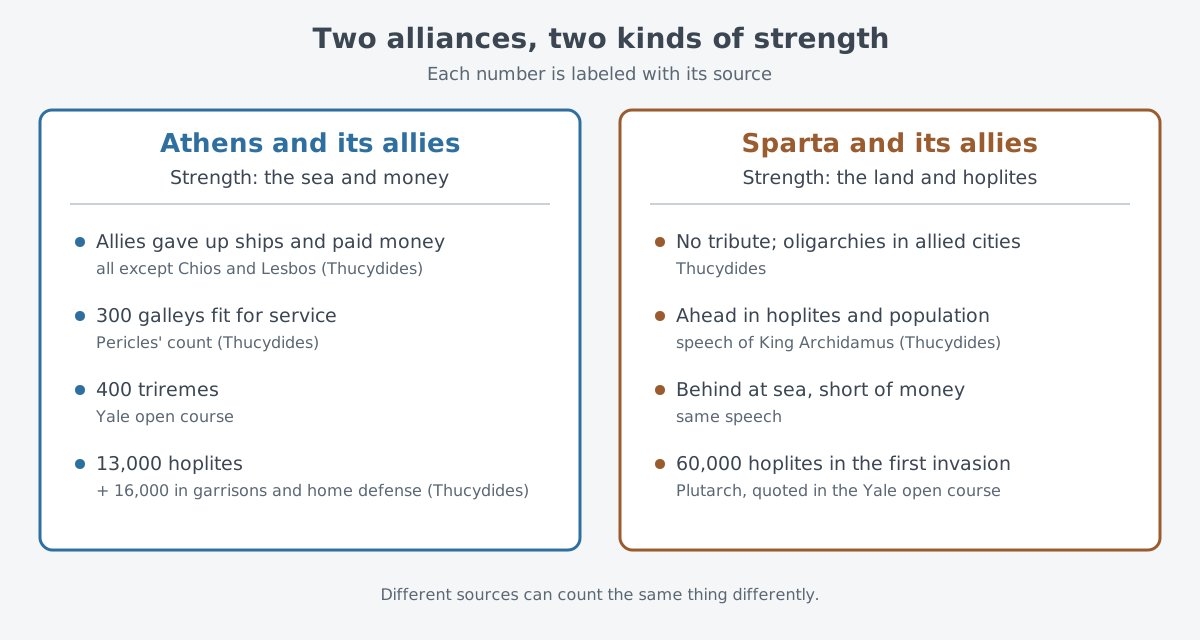
As war approached, Pericles laid out Athens's strength for its citizens, item by item. There were 13,000 heavy infantry and 16,000 more in garrisons and home defense. There were also 1,200 cavalry including mounted archers, 1,600 archers on foot, and 300 galleys fit for service.
The numbers differ by source. The Yale course gives Athens 400 triremes. For the first Spartan-led invasion there is a figure of 60,000 hoplites from the Peloponnese and Boeotia, which the course takes from the ancient writer Plutarch. Note also that Thucydides' 300 ships carry the words "fit for service."
The Spartan king Archidamus made the same kind of count. In a speech before the war, he said Sparta was behind at sea, would need time to catch up, and was even shorter of money. Sparta led in heavy infantry and population, so it could ravage Athenian land. His worry was that Athens had plenty of other land in its empire and could bring in what it needed by sea.
Running a fleet took people, skill and money together. The Corinthians expected to borrow from the temple funds at Olympia and Delphi and lure away Athens's foreign sailors with higher pay. Pericles answered that seamanship is a craft. It cannot be picked up now and then in spare time, and it is so demanding that it leaves no time for anything else.
The time to train crews and the money to pay them set the strength of a fleet. For how today's militaries deal with the same problem, see Military logistics: performance must be sustainable.
The way armies fought on land is worth a look too. Hoplites carried shields and stood in lines with their shields locked against their neighbors'. Describing the battle of Mantinea, Thucydides explained that every army drifts out on its right wing as it goes into action.
The reason is fear. Each man tries to tuck his unshielded side behind the next man's shield, the one to his right. The drift starts with the man at the far right end.
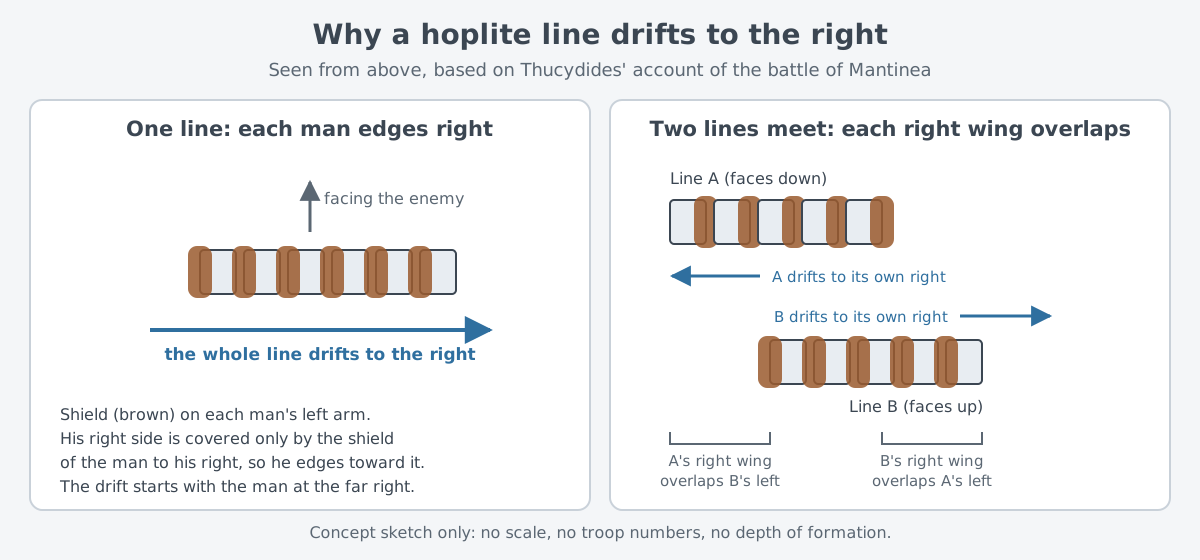
It is a bit like several people sharing one umbrella in the rain, each edging a little to one side. In a real battle line the edging always went to the right, and the drift was large enough to change the shape of the whole line.
The plague and the Sicilian expedition
Pericles' strategy was simple. Do not march out to fight; come inside the walls, defend them, and prepare the fleet, where the real strength lay. He also urged a firm hold on the allies, because the strength of Athens came from the money they paid.
The plan also included raids by the fleet on the coast of the Peloponnese. Then, in the war's second year, a few days after the Peloponnesians again entered Attica, a plague broke out in Athens. Thucydides caught the disease himself and watched it take hold in others.
By his count, through the second outbreak more than 4,400 hoplites in the ranks and 300 cavalry died. The number of other dead was never known. The Yale course holds that the plague eventually wiped out a third of the people of Athens.
When Pericles died in 429 BC, the treasury of Athens was nearly empty. He had lived two years and six months into the war. Pericles had told the Athenians to wait quietly, look after the fleet and attempt no new conquests, and in Thucydides' judgment they did the very opposite.
The Yale course judges a little differently. It calls the strategy defensive and rational, but says it had no offensive plan and missed the fact that war does not always run on reason.
The largest new conquest Athens attempted was the Sicilian expedition. In the seventeenth year of the war, Athens sent a force larger than before to Syracuse in Sicily. In the nineteenth year the expedition collapsed after battles in the great harbor of Syracuse and a retreat. Fleet and army alike were destroyed, and in Thucydides' words, "few out of many returned home."
How it ended and what it left behind
After the disaster in Sicily, the war moved to the eastern seas. Ionian cities that had been allies of Athens revolted, and Persia stepped in. Persian money flowed in large amounts to the Spartan side. Even so, Athens held out for ten more years after the Sicilian defeat.
The final blow came at sea. A Spartan fleet under Lysander defeated the Athenian fleet at Aegospotami on the Hellespont strait. According to Xenophon's Hellenica, the strait there was not quite two miles wide. The battle is dated to 405 BC.
The Hellenica lists four peace terms. Athens had to tear down the Long Walls and the walls of Piraeus, and hand over its fleet except for 12 ships. It also had to let its exiles return and follow Sparta's lead in war and peace. Inside the walls more people were starving to death each day, and in the end the Athenian assembly accepted the terms.
When Lysander sailed into Piraeus, people tore down the walls to the music of flute players. Xenophon wrote that they hailed that day as the start of freedom for Greece.
That "freedom" did not last long. After the war Sparta began to dominate other cities instead of freeing them. Lysander tried to set up pro-Spartan oligarchies in many cities, and many cities grew angry. In Athens, Thrasybulus stood up to Sparta and restored the democracy.
The most lasting thing the war left may be Thucydides' book. He said he wrote it not to win applause for a moment but as "a possession for all time." It shows how sea power and land power, alliances and money, and an unexpected plague can change the course of a war.
Still, it is the record of one man's eyes. Some scholars, like the Yale course, do not take his judgments as given and read them again with care.
What to read next
- Turning points in military technology: moments in much later wars when technology changed the game.
- A history of laser weapons: from chemical to electric lasers: a good next step from ancient fleets to the weapons on today's ships.
- Alexander at Gaugamela: What Set the Macedonian Army Apart: an article on how the Macedonian army differed from the armies before it.