On the morning of 4 June 1942, fourteen TBD torpedo bombers took off one after another from the deck of the US carrier Enterprise. Nine of them, including one flown by Severin Rombach and Wilburn Glenn, were lost with their crews a little over two hours later while attacking Japanese carriers. Yet by that evening, all four of Japan's large carriers had been fatally damaged.
The Battle of Midway was fought from 3 to 7 June 1942 in the seas around Midway, a small atoll at the northwest end of the Hawaiian chain. Six months after Pearl Harbor, how could a smaller American fleet know the Japanese attack was coming and lie in wait? Much of the answer lies in radio intercepts and codebreaking, and the rest in a strange day of carrier against carrier.
Six months after Pearl Harbor
After the Pacific War began in December 1941, Japanese forces struck US, British Commonwealth and Dutch holdings across Southeast Asia and the Pacific. By March 1942 their opening phase was almost done: Singapore, Malaysia, the Philippines, the Dutch East Indies and many central and western Pacific islands had been taken.
On 7–8 May, the war's first carrier battle took place in the Coral Sea. The United States lost the carrier Lexington, Japan lost the light carrier Shoho, and Japan called off its landing attempt. Here too, American cryptanalysts had passed Japan's order of battle and operational messages to Allied commanders.
The Coral Sea led straight to Midway. Historians generally call the battle a tactical draw. But the Japanese carriers Shokaku and Zuikaku were kept out of the Midway operation by the damage and losses they suffered there. Henry Schorreck, a former National Security Agency (NSA) historian, wrote that Yamamoto therefore sailed for Midway with his air striking power cut by one-third.
Midway Atoll sits among the far northwest islands of the Hawaiian chain, over 3,200 miles away from San Francisco. By June 1942 it held PBY Catalina flying boats, B-17 bombers and 4,000 American personnel.
Where was "AF"?
At the time, the US Navy had two radio-intercept units in the Pacific. One was in Melbourne, Australia, and the other at Pearl Harbor, known as "Hypo." They intercepted Japanese naval radio traffic and used traffic analysis and codebreaking to locate major fleet units and land-based air forces.
The intelligence came in two kinds. Decryption Intelligence (DI) was drawn from what a message said. Traffic Intelligence (TI) was drawn from its outer details, such as addresses and signatures. By translating messages and studying patterns, analysts could predict Japan's next operations with some degree of certainty.
From March, the place designator "AF" turned up in partly decoded Japanese messages. On 13 March, American analysts cracked the Japanese navy's main general code and took AF, for the time being, to mean Midway. Commander Joseph Rochefort of Hypo and Lieutenant Commander Edwin Layton, the Pacific Fleet intelligence officer, also believed AF was Midway.
Admiral Chester Nimitz, commander of the Pacific Fleet, was more cautious. He saw Oahu in Hawaii as the likely target and did not rule out the US West Coast.
The best-known way the doubt was settled is the water message. According to Rochefort and Layton, in mid-May they proposed to Nimitz that Midway report in plain language that its distillation plant had broken down and fresh water was urgently needed. The Japanese picked up the message, and a Tokyo intelligence report then stated that "AF is short of water." The exact date of this has never been documented.
Sources also tell the dating story a little differently. The overview by the Naval History and Heritage Command (NHHC) says Melbourne fully confirmed AF as Midway on 22 May. Hypo then found the date cipher and predicted an attack on 4 June.
Schorreck wrote that on 25 May all three intelligence units jointly solved a single message, the last operations order sent to Japanese commanders, and confirmed 4 June. The National WWII Museum gives the date Hypo supplied as "June 4 or 5."
On 28 May, Japan changed its cipher system, and no new intelligence came out until the battle was over. Not everyone was certain, either. The last entry for 27 May in the Pacific Fleet headquarters diary worried that Japan might be fooling the Americans with radio deception on a grand scale.
Not much of the record survives today. Thousands of translated messages once showed Japan's plan to take Midway, yet fewer than a hundred of them have been found.
Yamamoto's plan, Nimitz's preparations
Admiral Isoroku Yamamoto, commander of the Combined Fleet, had once said Japan would fare well in the war's first six months. Beyond eighteen months, he said, he could not promise the outcome. He believed he had to strike a place the United States would defend with everything it had, and that place was Midway.
On 16 April, after months of debate, Yamamoto won the Imperial General Staff's approval for his Midway and Aleutians operation. The American Doolittle Raid on 18 April did little physical damage, but its psychological impact was enormous. It strengthened Japan's belief in a wider defensive line and moved the operation's date forward.
The plan worked like this. First came a feint toward the Aleutian Islands off Alaska, then a landing on Midway. When the US Pacific Fleet rushed in, Japanese carrier and battleship forces hidden west of the island would fall on it and destroy it. If it succeeded, the Pacific Fleet would be out of action for at least a year, and Japan would gain a forward base to give early warning of American moves.
In the National WWII Museum's account, Japan meant to turn Midway into a base for attacks on Pearl Harbor. It would then secure its hold on the region and force a negotiated peace. Japan planned to commit about 200 ships and 700 aircraft in all. They included 11 battleships, 8 carriers, 23 cruisers, 65 destroyers and 20 submarines.
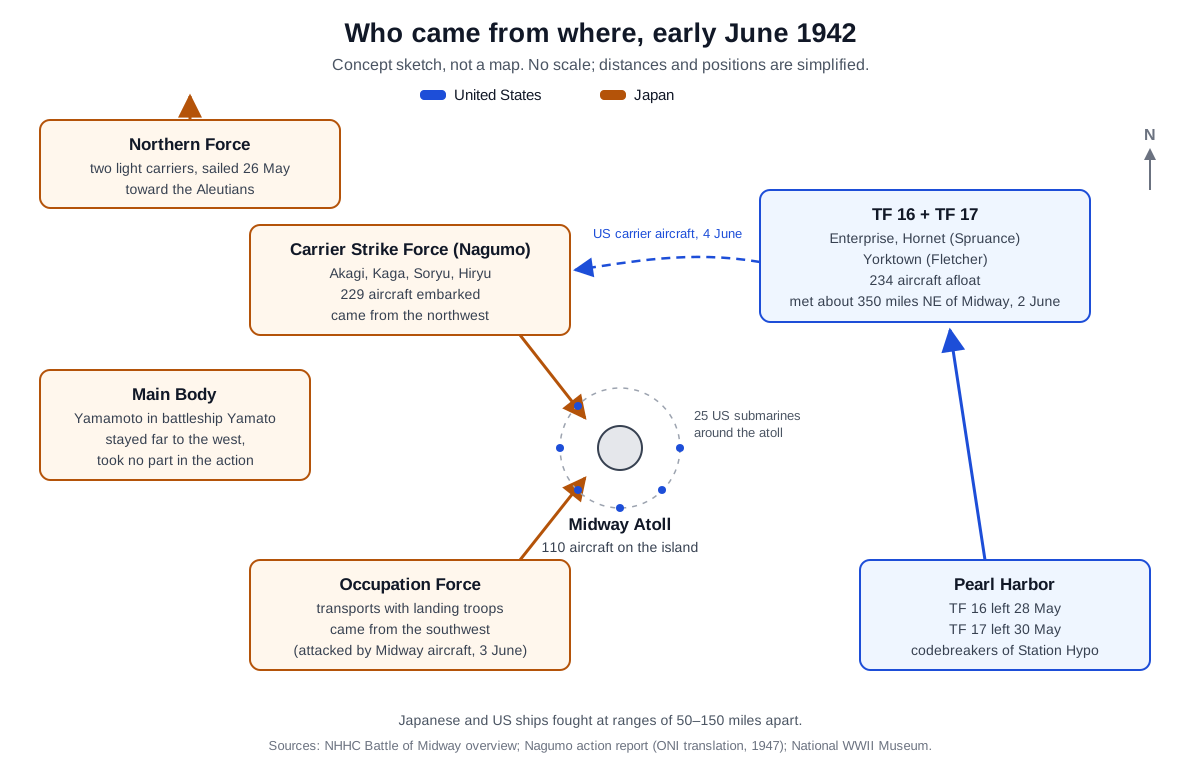
At the center were Akagi, Kaga, Soryu and Hiryu, four large carriers that together carried 229 aircraft. On 26 May, the Northern Force with two light carriers left for the Aleutians, and the next day the forces bound for Midway began to move. Two days later, the Main Body, with Yamamoto aboard the battleship Yamato, left home waters.
The United States moved on its intelligence. Once repairs on Yorktown proved possible, the yard at Pearl Harbor worked on her day and night. On 28 May, Rear Admiral Raymond Spruance's Task Force 16 left Pearl Harbor built around Enterprise and Hornet. Two days later, Rear Admiral Frank Jack Fletcher's Task Force 17 followed with Yorktown.
On 2 June the two forces joined up roughly 350 miles to the northeast of Midway, and Fletcher took tactical command. With floatplanes from the cruisers, the three carriers had 234 aircraft at sea, and Midway held 110 more. Twenty-five US submarines were also placed around Midway.
Japan missed the American moves. Because US ships were at French Frigate Shoals, Japan could not refuel its flying boats for a scouting flight over Pearl Harbor. Japanese radio intelligence guessed that at least one US task force was at sea, but Yamamoto's strict radio silence kept that news from the carrier force.
Admiral Nagumo's carrier force was not well prepared either. His action report after the battle said that heavy turnover of personnel had greatly lowered each ship's fighting efficiency. It added that the Japanese never knew, to the end, where the American carriers were or how many there were.
The morning of 4 June
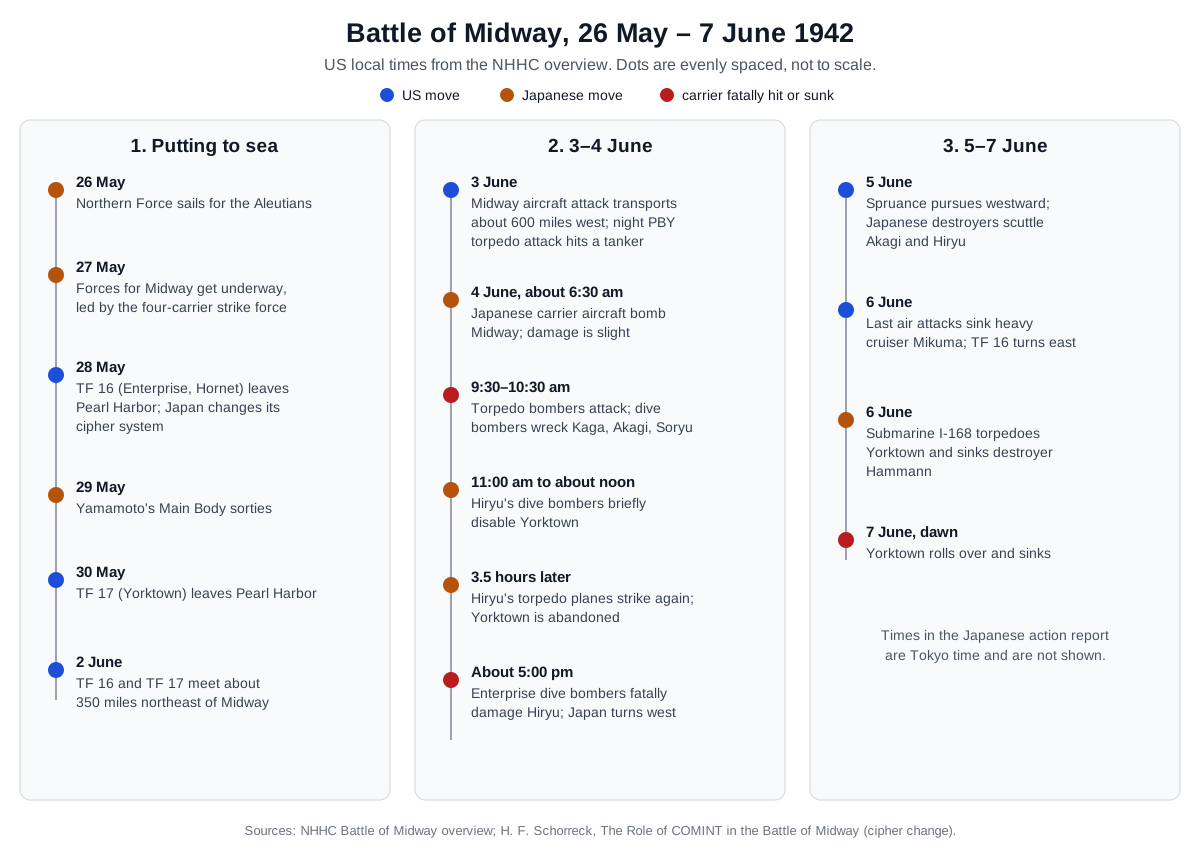
The fighting began on 3 June. Aircraft from Midway found Japanese transports roughly 600 miles to the west and attacked them, but the B-17 bombers did no damage. That night, four PBY flying boats made a torpedo attack on the transports in the dark, and one of them hit a tanker.
Shortly after dawn on 4 June, a patrol plane from Midway sighted two Japanese carriers. Its report read, "Many planes heading Midway from 320 degrees distant 150 miles!" At about 6:30 am, Japanese carrier aircraft bombed the installations on Midway. The Marine Corps fighters defending the island took heavy losses, but the damage to the island's facilities was slight.
Over the next two hours, Marine scout bombers and Navy torpedo bombers from Midway attacked the Japanese carriers again and again. Japanese fighters on patrol and the fleet's antiaircraft fire nearly wiped them out, and Army Air Forces bombers also hit nothing.
Meanwhile, hard choices were being made aboard the Japanese carriers. Nagumo's report says Japan decided to strike Midway a second time and ordered the torpedoes on its carrier attack planes swapped for land bombs. Soon after, a scout plane's reports made it certain that American carriers were close by. The planes already being rearmed could not take off at once, so Nagumo chose to recover the returning Midway strike first and then launch a large attack.
Between 9:30 and 10:30 am, torpedo bombers from all three US carriers, TBD Devastators, went after the Japanese carriers. They were nearly wiped out by Japanese fighters and antiaircraft fire, but they pulled the enemy fighters away and cleared the sky for the Enterprise and Yorktown dive bombers. SBD Dauntlesses from Enterprise fatally damaged Kaga and Akagi, and SBDs from Yorktown wrecked Soryu.
Seen from Akagi, the moment went like this. Three bombers dived from about 2,000 m at about 50 degrees and released their bombs at about 500 m, and the second bomb struck near the elevator amidships. The record called that single hit "fatal."
Hiryu strikes back, and Yorktown
Only one Japanese carrier came through the morning, Hiryu. At 11:00 am she launched dive bombers, and around noon they briefly put Yorktown out of action. About three and a half hours after that, torpedo planes from Hiryu hit Yorktown again, and the crew had to abandon ship.
That afternoon, a scout plane from Yorktown found Hiryu, and Enterprise sent dive bombers. The strike, at about 5:00 pm, fatally damaged Hiryu. With his carrier force gone, Yamamoto gave up the Midway invasion, and the Japanese fleet began to withdraw west.
Nagumo's report recorded the day's result as "2 Carriers of the Enterprise class sunk." In fact, Yorktown was the only US carrier sunk in the battle.
On 5 June, Spruance's Task Force 16 chased the Japanese fleet westward while work went on to save Yorktown. Early that day, Japanese destroyers scuttled Akagi and Hiryu. In the last air attacks on 6 June, dive bombers from Enterprise and Hornet sank the heavy cruiser Mikuma.
The Enterprise torpedo bombers that went along on that strike did not attack. After three torpedo squadrons were destroyed on 4 June, Spruance had given express orders, citing the danger of antiaircraft fire. After recovering its aircraft, Task Force 16 turned east and broke contact.
Yorktown's end came from beneath the sea. On 6 June, the Japanese submarine I-168 torpedoed Yorktown during the salvage work and sank the destroyer Hammann. At dawn on 7 June, Yorktown capsized and went down.
The tools of a carrier battle
At Midway, the big ships never traded gunfire. The five days of fighting spread over an area as big as the 48 contiguous states, with the two sides' ships 50–150 miles apart. Carrier aircraft carried the attacks across that distance.
The group of aircraft a carrier takes to sea is its carrier air wing. Thomas Wildenberg wrote about this in the Naval War College Review in 2005. In his account, a US carrier then flew an average of 72 aircraft in four squadrons: fighter, scout, bombing and torpedo. A Japanese carrier flew an average of 63 aircraft in three 21-plane squadrons: fighter, carrier attack and bombing.
The difference came from the deck park. The early US carrier Langley first followed British practice, keeping the deck clear for landing and striking each plane below as soon as it landed. Under Joseph Reeves, Langley's crew created the deck park, which kept planes on the flight deck, along with the crash barrier and flight-deck teams marked by jerseys of different colors.
This let the United States fly almost as many aircraft as Japan at Midway with one carrier fewer. The extra squadrons let the Americans hit three carriers at once.
There was a cost. The whole strike group had to be launched together, and at Midway the different ranges and cruising speeds of each type, plus the long distance, made a coordinated attack hard. Wildenberg points to these piecemeal attacks and the weak fighter cover as the reasons the torpedo squadrons were nearly wiped out.
The two navies also differed on scouting. Wildenberg writes that Japan failed to see the value of carrier-based scouting and focused on attack alone, and no scouting units were assigned to Japanese carriers. It is worth setting that beside the fact that a Yorktown scout plane found Hiryu on the afternoon of 4 June. Today's color-coded deck crews and carrier groups are covered in Aircraft carriers: turning a ship into an airport.
Reading the numbers, and was it luck?
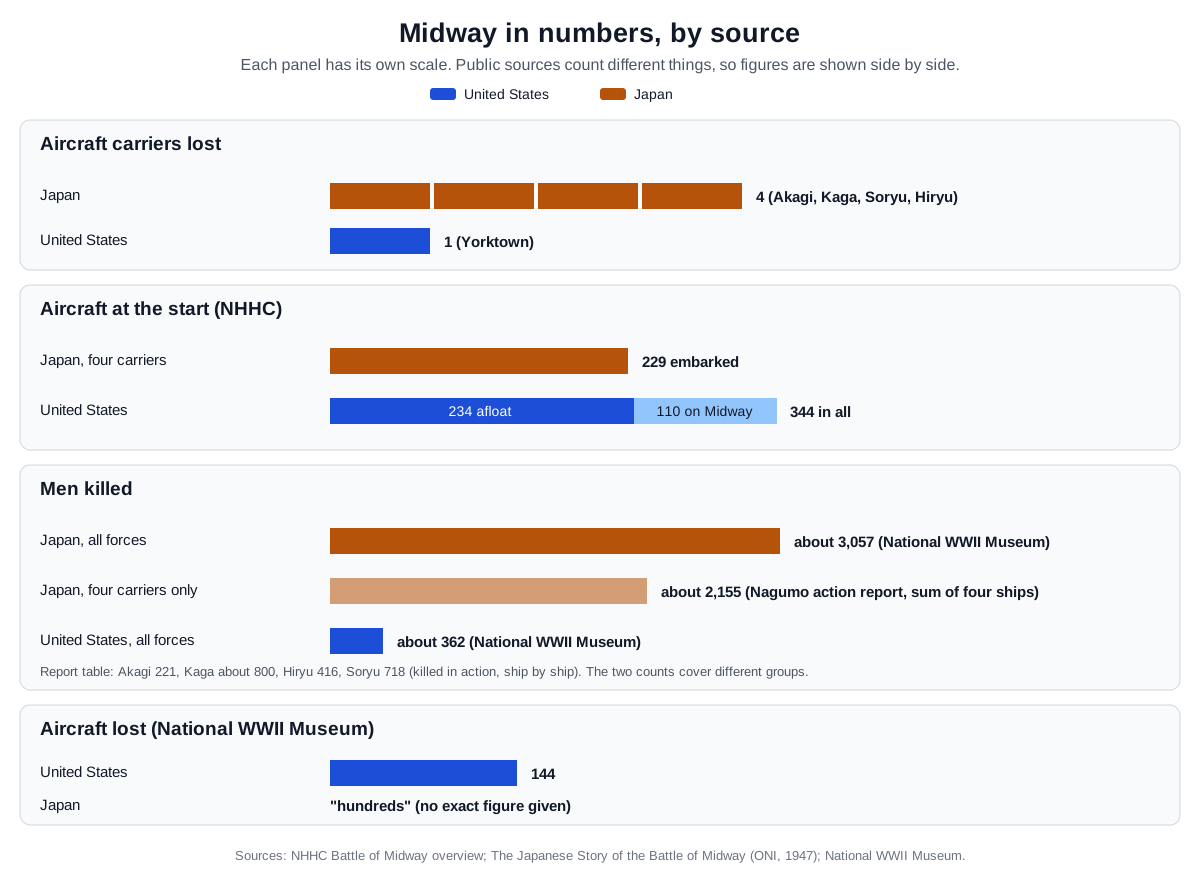
The carrier count is clear. The United States lost 1 carrier and Japan lost 4, all of which had taken part in the Pearl Harbor attack. NHHC names a heavier loss: more than 100 trained Japanese pilots who could not be replaced.
The human toll depends on what each source counts. The National WWII Museum says Japan lost about 3,057 men and the United States about 362. Nagumo's action report lists only the dead of the four carriers: Akagi 221, Kaga about 800, Hiryu 416 and Soryu 718, which adds up to about 2,155.
That table counts only the four ships' crews, so it cannot be set directly against the museum's total. The United States lost 144 aircraft, while the museum gives Japan's aircraft losses only as "hundreds."
Why did the Americans win? The answers branch. The NHHC overview credits communications intelligence, sharp analysis, careful handling of the carriers, and "more than a little luck." It adds that the three US carrier air groups were later judged uneven, but their pilots and crews won the day through courage and sacrifice.
Some put more weight on luck. Wildenberg writes that poor coordination among the US carriers sent squadrons in separately, and that two groups of dive bombers arriving together at the key moment was "extremely fortuitous." He notes that many would call it "sheer luck." Indeed, a third group of dive bombers from Hornet never found the Japanese carriers.
Still, Wildenberg's conclusion is not luck. He holds that once the forces met, better doctrine is what won the battle for the United States. His evidence is the point above: the extra squadrons from the deck park let the Americans strike three carriers at once.
On the share owed to intelligence, Nimitz's own words survive. Schorreck quotes him on what might have happened without early warning of the Japanese moves. Had the carrier forces been caught spread out, possibly all the way to the Coral Sea, "the Battle of Midway would have ended far differently."
What it left
The NHHC overview says the battle derailed Japan's Pacific offensive and put off its planned push toward New Caledonia, Fiji and Samoa. The balance of naval power in the Pacific, it says, started to change. The museum explains that the United States was now positioned to shrink the Japanese empire through years of island-hopping landings and even larger naval battles.
The leading ship of the sea changed, too. Wildenberg sees Midway as the last stage of a revolution in military affairs (RMA), the shift that made the aircraft carrier, not the battleship, the decider of naval supremacy.
Intelligence work changed as well. Later in the Pacific war, a commander who was given communications intelligence and ignored it could face a court martial. In 1943, the Joint Intelligence Center, Pacific Ocean Area, was set up.
People weigh the battle differently. James Schlesinger was US Secretary of Defense from 1973 to 1975. In a 2003 speech marking the 61st anniversary, he argued that without Midway, President Roosevelt could not have kept to his Europe-first policy. The Navy's commemoration materials remember the battle as the one that turned the Pacific war.
Midway Atoll looks different today. In 2000 it became the Battle of Midway National Memorial, and a pillbox, gun positions and old ammunition magazines on Sand Island make up a National Historic Landmark. About 75% of the world's Laysan albatrosses now nest there.
Behind the numbers are names. NHHC publishes a list of the Americans killed in the battle, and under Enterprise's Torpedo Squadron Six appear the names of Glenn and Rombach from the opening. On the Japanese side, the dead of the four carriers are also recorded ship by ship, in groups by rank.
What to read next
- Aircraft carriers: turning a ship into an airport: today's carriers, where the deck park and color-coded deck teams grew up.
- Turning points in military technology: a timeline of moments that changed military technology, from the proximity fuze to unmanned systems, ending with where laser weapons fit.
- The Battle of Jutland: The One Clash of the Dreadnought Fleets: a First World War battle between battleship fleets, before the carrier age.
- The Guadalcanal Campaign: Six Months Over One Airfield: the next chapter of the Pacific War after Midway.