Suppose you want to send light from a satellite at a wavelength that methane absorbs strongly, but no convenient laser material emits that wavelength directly. What then? One option is to build a strong laser at some other wavelength and pass its beam through a crystal that converts it to the wavelength you need.
When a crystal turns one laser beam into two beams of different wavelengths, the effect is called optical parametric generation. Put that crystal between mirrors so the light keeps bouncing back and forth, and you have an optical parametric oscillator (OPO). Optical parametric devices like these can be tuned widely and still deliver enough energy, even in parts of the spectrum where an ordinary laser gain medium fails. For that reason, a team at NASA's Goddard Space Flight Center judged them a good fit for a lidar that would measure methane from orbit.
This article starts with how one photon splits into two. Next comes the difference between an amplifier that crosses the crystal once and an oscillator that traps the light between mirrors. After that come the ways to change the wavelength, the history of the 1960s, and today's uses and difficulties.
One photon splits into two
When light gets very intense, a crystal can produce light at a frequency different from the light that went in. Second harmonic generation, which doubles the frequency of the incoming light, is one example. Adding or subtracting the frequencies of two beams comes out of the same physics.
Optical parametric generation (OPG) is a nonlinear effect that turns a single incoming laser beam into two beams with different energies. It is one of the key effects behind laser sources whose wavelength can be changed smoothly over a range. Inside the crystal, a photon of the incoming pulse divides into two photons.
Think of changing money. Swap one 10,000-won note for a 7,000-won share and a 3,000-won share, and the total stays the same. The difference in a real crystal is that you cannot pick the split freely. Conditions that the crystal and the light must meet together decide it.
Three beams, three names: pump, signal, idler
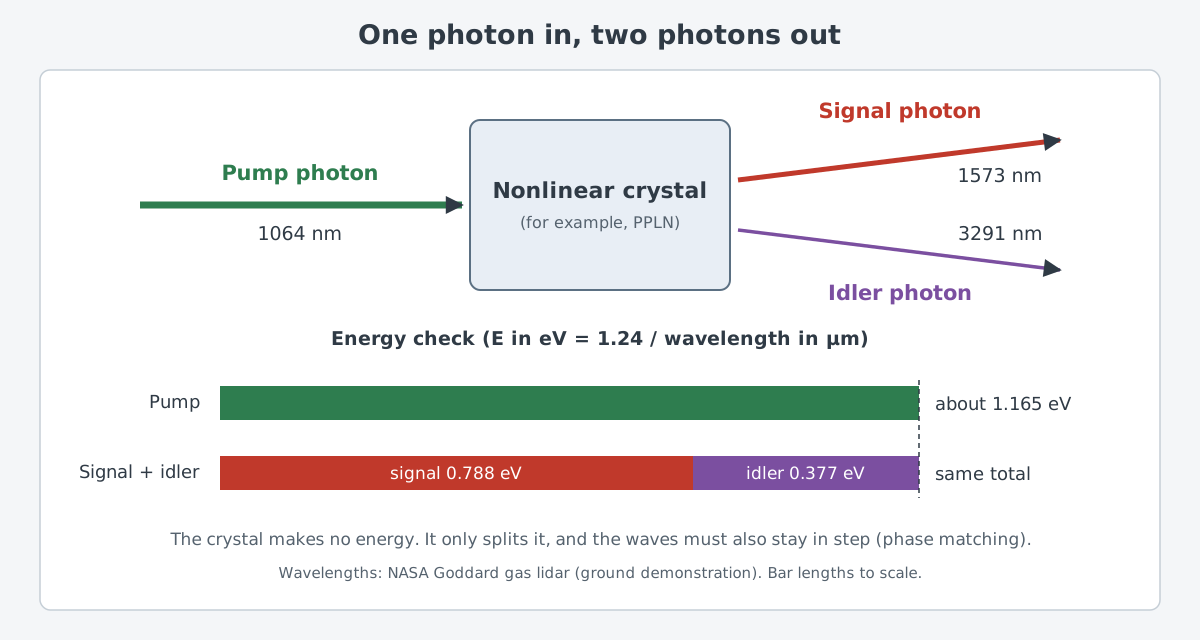
The strong beam sent into the crystal is called the pump. The two beams that come out are called the signal and the idler. In a NASA Goddard gas lidar ground demonstration, the near-infrared output was named the signal and the mid-infrared output the idler.
The wavelengths of these two photons have to satisfy an energy condition in the crystal. A photon's energy is inversely proportional to its wavelength: the energy in electronvolts (eV) equals 1.24 divided by the wavelength in micrometers. Because the energy of one pump photon is shared between the signal and the idler, the condition written in wavelengths becomes this single line.
1/λₚ = 1/λₛ + 1/λᵢ
Here λₚ is the pump wavelength, λₛ the signal wavelength and λᵢ the idler wavelength. Each of the two new photons carries less energy than the pump photon, so both have longer wavelengths than the pump.
One NASA Goddard system makes a good example. A 1064 nm pump produced a 1573 nm signal and a 3291 nm idler; the signal measured carbon dioxide and the idler measured methane at the same time. In energy terms, the pump's roughly 1.165 eV splits into 0.788 eV for the signal and 0.377 eV for the idler, and the sum checks out.
Growing in step: phase matching
Getting the energy right is not enough for the light to build up well. Small waves created all along the crystal have to reinforce one another before the output becomes useful. Their phase, or timing, has to line up. This requirement is called phase matching, and the signal and idler wavelengths must meet the energy condition and the phase matching condition at the same time.
Frequency doubling shows what this means. For the doubled waves to add up constructively, the original light and the doubled light must travel with the same phase velocity. Birefringent crystals, whose refractive index depends on the direction of the light, can meet this condition.
There is another route. A crystal's polarization direction can be flipped at a regular period, so the sign of its nonlinear coefficient alternates between positive and negative. Periodically poled lithium niobate (PPLN) is one such crystal, and the method is called quasi-phase matching (QPM).
The NASA Goddard team noted that quasi-phase-matched devices such as PPLN are strongly nonlinear. Because of that, even a layout that sends light through the crystal only once can make near-infrared and mid-infrared light efficiently.
Put it between mirrors and it becomes an oscillator
There are two main ways to get the split light. The first is the optical parametric amplifier (OPA). Along with the pump, a weak beam from a seed laser goes into the crystal, and both cross it once. In other words, an OPA is optical parametric generation with a seed added.
The light leaving an OPA is a mix of signal, idler and unused pump. Dichroic mirrors send the three beams down separate paths, and depending on the task, the signal, the idler or both are put to use.
The second way is the OPO, the subject of this article. The crystal sits inside an optical resonator made of mirrors, so the light passes through it many times and receives feedback. The word oscillator in the name refers to this structure.
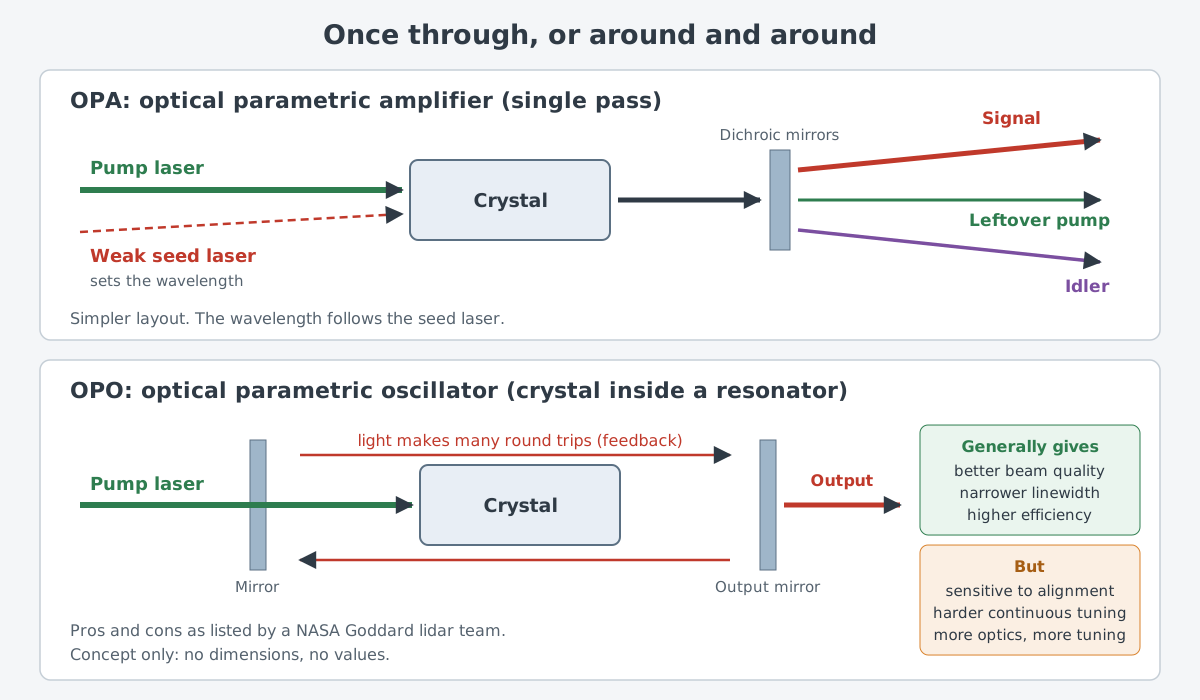
The feedback brings benefits. According to the NASA Goddard team, an OPO generally gives better output beam quality, a narrower output linewidth and higher efficiency in turning electricity into light. On the other hand, it is more demanding. It is sensitive to alignment, it is hard to tune smoothly without jumps, and it needs more optics and electronics plus frequent adjustment.
Knobs that tune the wavelength
OPOs and OPAs are useful because their wavelength can be changed. There are several knobs for doing that.
The most direct knob is the seed. In an OPA, changing the seed laser's wavelength shifts where the signal and idler outputs land. The seed effectively tells the pump which way to divide its energy.
The crystal offers a knob too. Some quasi-phase-matching crystals have a period that changes across their width in a fan shape. Sliding such a crystal sideways, perpendicular to the beam, changes the period at the spot the beam passes through. Fan-shaped structures like this have also been used in OPOs.
Mirrors and seeding can also work together. In a NASA Langley methane lidar project, Fibertek planned a volume Bragg grating as the OPO's output mirror to set the center wavelength roughly. Seed light injected into the OPO would then hold the frequency precisely. One knob gets the wavelength into the right area, and the other keeps it pinned there.
The 1960s: from theory to the first oscillator
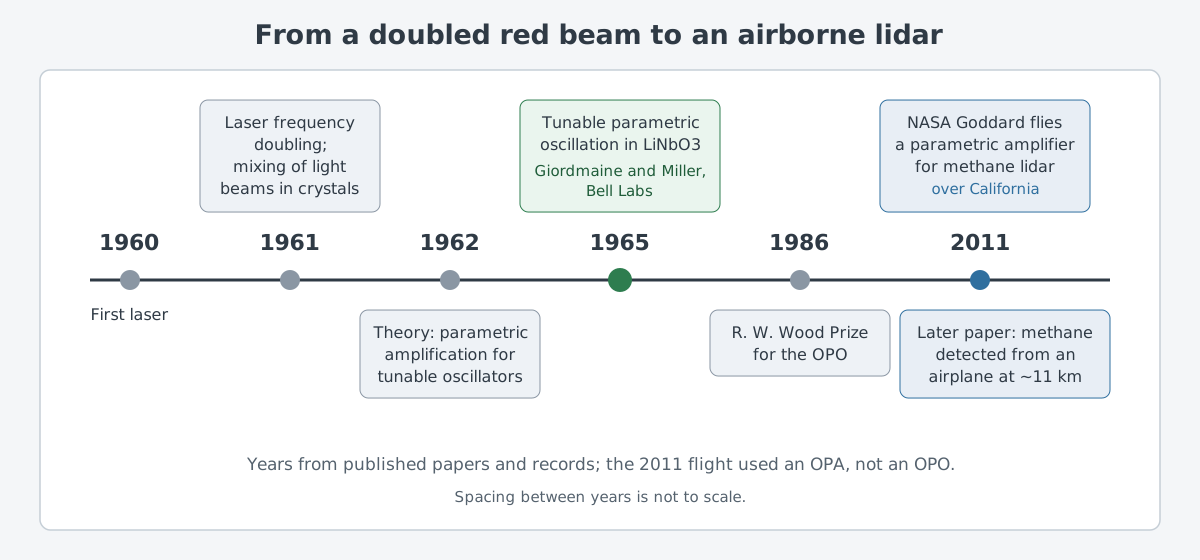
The first laser appeared in 1960. A year later, in 1961, researchers reported a simple experiment in which laser light came out at twice its original frequency. It was the first time a nonlinear optical effect had been shown. That same year, J. A. Giordmaine published "Mixing of light beams in crystals."
In 1962, N. M. Kroll published a paper on parametric amplification in spatially extended media and how it could be applied to designing tunable oscillators at optical frequencies. Other nonlinear effects, such as sum-frequency generation, were also demonstrated in the early 1960s.
Theory became experiment in 1965. Two Bell Telephone Laboratories researchers, J. A. Giordmaine and Robert C. Miller, published "Tunable Coherent Parametric Oscillation in LiNbO₃ at Optical Frequencies" in volume 14 of Physical Review Letters. That was five years after the first laser.
According to Optica, formerly the Optical Society of America, the two developed the optical parametric oscillator and received the R. W. Wood Prize for it in 1986.
Measuring methane from an airplane
Among today's uses of OPOs and OPAs, gas-measuring lidar has some of the most public material. A NASA Goddard team has been developing a nanosecond-pulsed OPA so that a satellite orbiting Earth could one day measure methane from space. Methane is a powerful greenhouse gas.
This OPA was demonstrated in flight tests over California in 2011. In a later paper, the team reported that methane had been detected at ground level and also from an aircraft flying about 11 km up. Another paper said the 2015 flight tests would carry both an OPA and an OPO.
Which approach is better depends on the use and on who is judging. The Goddard team acknowledged that many gas-sensing lidars use OPOs, yet considered the OPA's simple and robust optical layout a strong fit for space use, especially Earth remote sensing. In a NASA Langley 1.6 µm methane lidar project, Fibertek chose an OPO instead, citing higher efficiency and the ability to scale up to high energies.
Ultrashort pulses, telecom bands, quantum noise
OPOs and OPAs are also common in laboratory laser sources. Synchronously pumped dye lasers were once used to cover a wide range of wavelengths, but they are no longer used. Synchronous pumping uses the pulses of another mode-locked laser to raise and lower the gain in step with the time a pulse takes to travel once around the resonator. Solid-state lasers now produce broadly tunable pulses in the near-infrared, and their high output power lets nonlinear conversion in parametric amplifiers and oscillators stretch the reachable spectrum further.
The name also comes up with extremely short pulses. Pulse durations under 6 fs in the visible and near-infrared have been reached separately with several techniques, and optical parametric amplification is one of them. One path toward few-cycle pulses with both high average power and high pulse energy is optical parametric chirped pulse amplification (CPA), or OPCPA. Chirped pulse amplification stretches a pulse in time, amplifies it and then compresses it again, and as the name says, OPCPA does that amplification with optical parametric amplification.
Telecom wavelengths are within reach too. A synchronously pumped OPO has produced picosecond pulses tunable over a wide range around 1.55 µm, with up to 350 mW of average power. All-solid-state OPOs of this kind can reach the S, C and L bands used in optical communications. These bands are named wavelength ranges that telecommunications divides up and uses.
Adding a fiber amplifier on the pump side has also pushed an OPO's repetition rate up to 80 GHz.
A less expected use is in gravitational-wave detectors. Quantum mechanics puts a basic limit on the most precise measurements, including those made in gravitational-wave detectors. That limit comes from random noise in which two quantum effects, shot noise and back-action noise, add together, and it is called the standard quantum limit of interferometry.
Squeezed light is light whose quantum noise has been pressed into a different shape. If the noise of ordinary light is drawn as a circle, squeezing flattens the circle into an ellipse, so the noise measured along one direction goes down.
The detectors have used simple squeezed light to reduce noise for more than ten years. Only now are they starting to use frequency-dependent squeezed light, which can get past the standard quantum limit. A Hannover team at the Max Planck Institute for Gravitational Physics produced frequency-dependent squeezed light by tuning the OPO inside a squeezed-light source away from resonance. The institute did not expect the method to replace the existing combination of equipment in the detectors.
Strengths and difficulties
The strengths are clear. An OPO can produce light at wavelengths where no suitable gain medium exists, and the wavelength can be moved by changing the seed or the crystal period. Instead of searching for a new laser material for each target wavelength, you can start from one well-developed pump laser.
There is a price. First, a separate strong pump laser is required. An OPO with a resonator is sensitive to alignment, hard to tune smoothly without jumps, and needs more parts and more upkeep.
The intensity of the light is a burden as well. In Fibertek's tests, the volume Bragg grating had to be shielded from the strong 1064 nm pump and the 3 µm idler, or it could be damaged. The fact that strong light can damage parts also makes an OPO harder to handle.
What to read next
- "Nonlinear crystals and second harmonic generation: how infrared turns green": the "adding" side of the same crystals, with phase matching in more detail.
- "Why wavelength matters: visible and invisible light": why anyone bothers to change wavelength, and what changes from one wavelength to another.
- "Measuring with lasers: the basics of ranging and lidar": the laser measurement basics behind methane lidar.
- "Ultrashort pulse laser processing: why less heat is left behind": where very short pulses are actually used.
- "Limits of a single fiber ①: nonlinear effects (SBS, SRS)": a case where nonlinear effects become an obstacle inside optical fiber.