A ruler has marks. With evenly spaced 1 mm marks, you measure a pencil by lining it up against them. What kind of ruler would you need to measure the "color" of light, which is set by its frequency? Light oscillates hundreds of trillions of times a second, so the marks must be just as fine and just as exact.
The optical frequency comb takes its name from this question. Spread the light of a short-pulse laser out by frequency and you see thin lines standing in an even row, much like a comb's teeth. Those lines become the marks for measuring light. This article looks at how the comb forms, how its starting point was found, and what it is used for, using a textbook and official sources.
Light that oscillates too fast to count
Frequency is how many times a wave oscillates in one second. Radio waves and microwaves are slow enough for electronic circuits to count one cycle at a time. Light is different.
The atoms used in optical clocks complete about 500,000 billion oscillations every second. That is far too fast for the electronics built for microwave atomic clocks to count.
The standard of time also sits on the microwave side. In the International System of Units (SI), one second lasts 9 192 631 770 oscillations of radiation from a transition between two energy levels of the caesium-133 atom. The official Nobel Prize explainer notes that the caesium clock oscillates about 100,000 times (10⁵ times) more slowly than light.
Linking light to the caesium clock therefore needed a long chain of highly stabilized lasers and microwave sources. The optical frequency comb replaced this complicated harmonic frequency chain with a single mode-locked laser oscillator. Today a comb is a bridge between technologies that use radio waves and microwaves, like clocks, computing and communication links, and light with frequencies 10,000 times higher.
A pulse train seen in frequency is a comb
A comb comes from a mode-locked laser. Such a laser sends out very short pulses at a fixed interval, one after another without end. The number of pulses per second is the repetition rate, and the time between pulses is its inverse.
Spread this pulse train out by frequency instead of time and its shape changes completely. The broad spectrum is not one smooth hill but a row of thin, sharp lines at even spacing. These lines are called comb lines, or comb teeth, and the spacing between them is exactly equal to the pulse repetition rate.
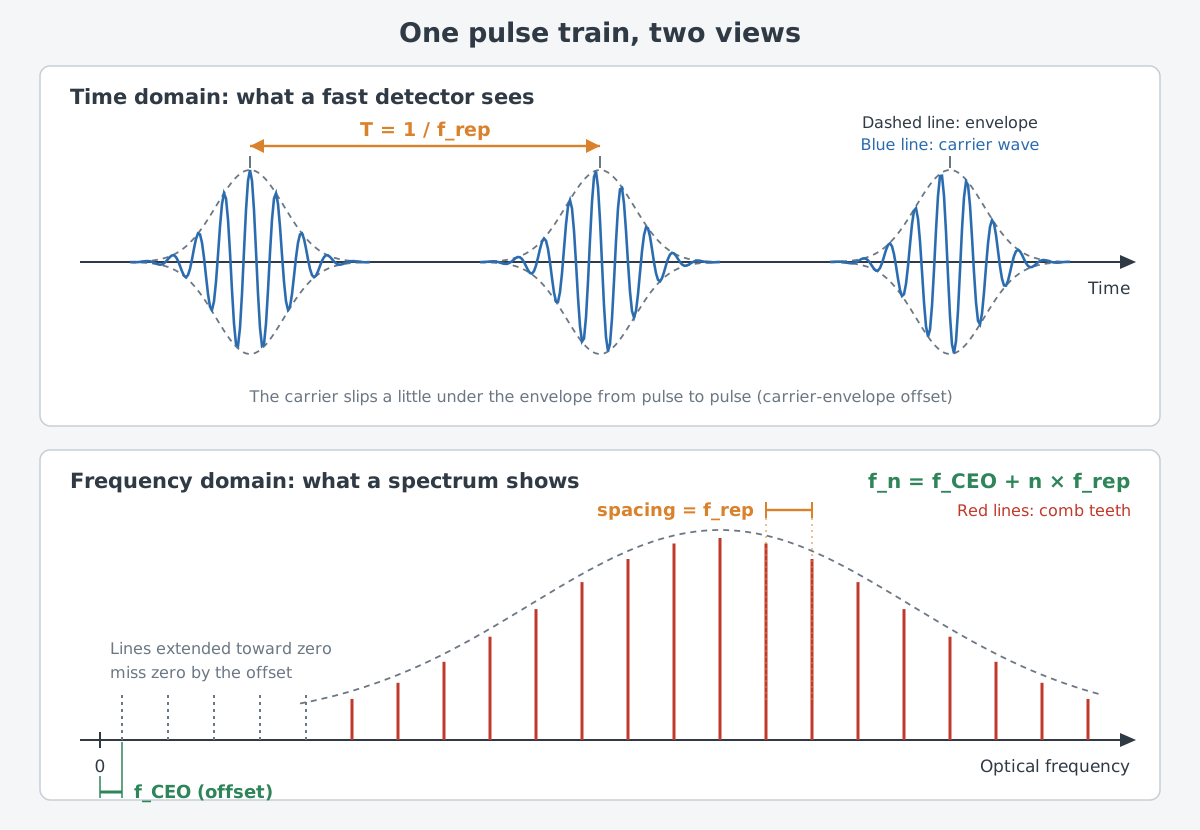
The teeth are even because of mode locking, which sets the many frequencies inside the laser to start in the same phase. The more frequencies are locked together, the shorter the pulse. The Nobel Prize explainer says a single 5 fs pulse ties together about one million separate frequencies, and NIST likewise describes comb pulses as holding a million different colors. How mode locking makes pulses is covered in "Q-switching and mode locking: two ways to make short pulses."
Two numbers that define a comb
The frequency of each tooth is set by two numbers. One is the tooth spacing, the repetition rate f_rep. The other is the offset frequency f_CEO, which says how far the whole comb sits off zero.
fₙ = f_CEO + n × f_rep
Here fₙ is the frequency of tooth number n, and n is a very large integer. CEO stands for carrier-envelope offset.
An ordinary ruler starts its marks at zero, but a comb of light does not. Extend the teeth step by step toward zero and the last one does not land exactly on zero. It sits off to one side, and that gap is f_CEO.
The mismatch comes from inside the pulse. A pulse is made of a fast-oscillating light wave, the carrier, and an envelope that wraps the wave's strength. The wave under the envelope travels at the phase velocity, while the envelope travels at the group velocity. In the crystal and other materials inside a laser, these two speeds are usually not the same.
So on each round trip through the cavity, the wave crest slips a little relative to the envelope peak.
A normal mode-locked oscillator has nothing that ties the envelope and the carrier together. Their phase difference wanders at random, and f_CEO wanders with it. Keller's textbook separates two kinds of wobble. If the pulse arrival time jitters, the evenly spaced comb "breathes" in and out, and if the offset jitters, the whole comb slides sideways.
No matter how exact the tooth spacing is, a ruler with an unknown starting point is no use. To measure an unknown frequency, this common shift has to be known exactly. The problem was a hot topic at a Gordon Conference on nonlinear optics and lasers in 1995, but no solution existed at that time.
Finding the offset: f-to-2f self-referencing
The answer came from making the comb very broad. If the highest frequency in the comb is more than twice the lowest, the comb covers an octave. Then the comb can measure its own starting point.
Here is how. Tooth number n at the low end of the comb passes through a nonlinear crystal that doubles its frequency. That creates 2fₙ, which lands right next to tooth number 2n, f₂ₙ, at the high end. Put both into the formula above: the offset appears twice in 2fₙ and once in f₂ₙ, so their difference is exactly f_CEO.
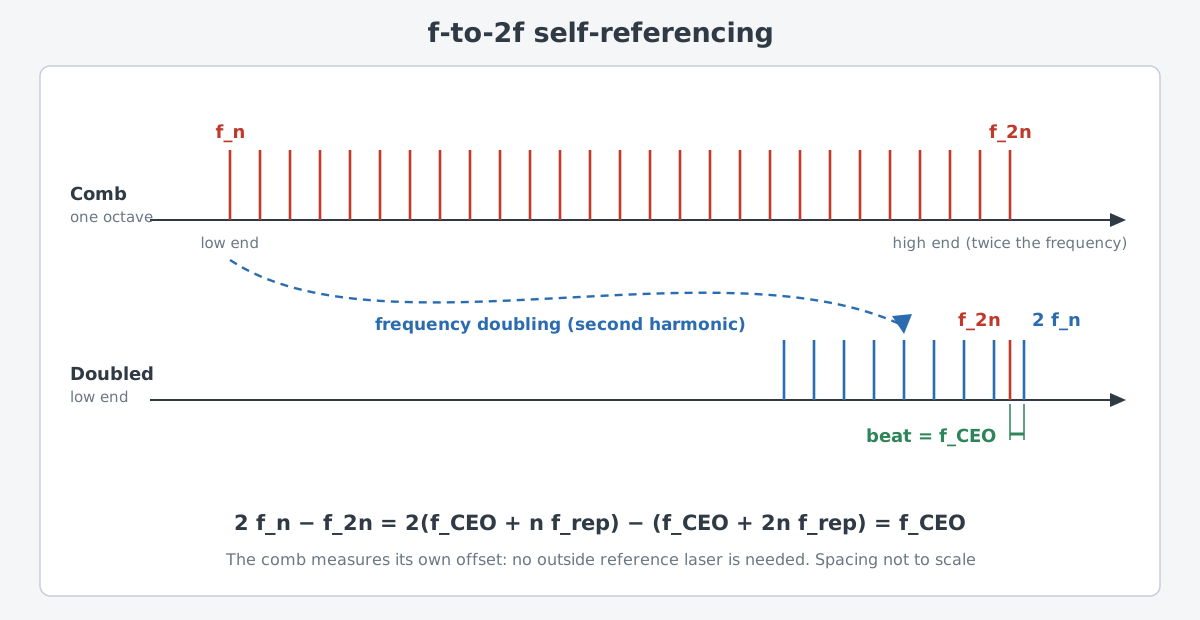
Shine both beams onto one detector and you get a beat signal whose strength rises and falls at their difference frequency. A microwave spectrum analyzer can measure this signal directly. Because the method compares two ends of the comb itself and needs no extra laser, it is called a self-referenced f-to-2f interferometer. How overlapping light changes in strength is covered in "Interference and diffraction: how light adds up and spreads."
There is a price. The method needs a very wide comb, at least an octave across, and the power at the far ends of the spectrum is usually very low. At first, the octave could only be reached by broadening the spectrum through nonlinear effects in a fiber outside the laser. This broadened light, called a supercontinuum, can add a lot of noise, so it must be tuned to keep its coherence.
A hair-thin fiber from a Bell Laboratories team, which delivered more than an octave of frequencies, was the last missing piece.
Measuring unknown light with teeth and beats
Once the comb is ready, it can measure the frequency of an unknown laser. Overlap that light with the comb and it beats against the nearest tooth, at a frequency in the easy-to-handle radio range. The Nobel Prize explainer compares this to two tuning forks. Strike them together and you hear the sound swell and fade at a frequency far lower than either tone.
The comparison has limits. There are two tuning forks, but a comb has about a million teeth. Every tooth frequency is fixed by two radio frequencies, the repetition rate and the offset.
So measuring the frequency of light turns into measuring a few radio frequencies that electronics can count. In the end, a comb finds unknown light by measuring a repetition rate in the radio range.
To use the comb as a ruler, both numbers must be held fixed. The comb from a mode-locked laser has two degrees of freedom, the offset frequency and the repetition rate, and both need to be stabilized. The reference is a stable microwave signal, such as a quartz crystal oscillator, a microwave oscillator steered by a caesium clock, or a hydrogen maser.
It also works in reverse. Lock the comb to a very stable laser and the comb acts as a frequency divider, passing the laser's stability down to the repetition rate in the microwave range. This can produce microwaves with very low noise.
That level of stability does not come for free, though. Keller's textbook gives the example of a 10 cm cavity at a center wavelength of 1.55 µm. To reach a relative stability of 10⁻¹⁵, its length must be held to better than the diameter of a proton. That kind of mechanical stability takes great effort, such as an active anti-vibration system.
From a 1970s idea to the 2005 Nobel Prize
The effort to measure with light went hand in hand with the history of units. In 1960, the General Conference on Weights and Measures retired the measuring bar kept in Paris and defined the metre by wavelengths of one spectral line of krypton gas. In 1983, the speed of light was set to 299,792,458 m/s, an exact value by definition. Even so, linking the frequency of light to the caesium clock still relied on long chains.
The idea of the comb appeared in the 1970s. According to the Nobel Prize explainer, Theodor W. Hänsch realized as early as the late 1970s that pulsed lasers also emit sharp frequencies and could be used for precision spectroscopy, and he showed it in experiments.
V. P. Chebotayev in Novosibirsk reached a similar conclusion. NIST notes that Hänsch put forward a model of the very first comb during his time at Stanford University.
By the mid-1990s, Ti:sapphire lasers, built around sapphire crystals doped with titanium, could produce evenly synchronized frequencies in femtosecond pulses. What remained was the offset.
The year the offset was solved differs slightly between sources. NIST says John L. Hall and colleagues at JILA developed the self-referencing technique in 1999 with the octave-spanning fiber.
The Nobel Prize explainer places the real breakthrough around 1999 and the Hall team's solution around 2000. Keller's textbook says the solution paper appeared in 1999 and that the comb revolution began around 2000 with three key papers.
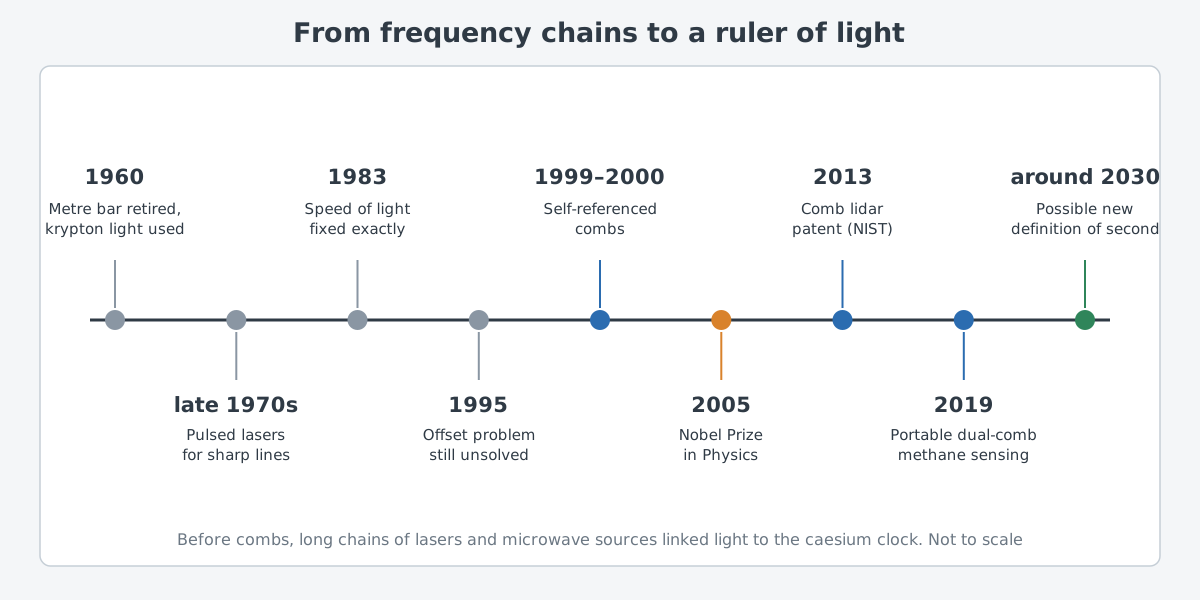
One half of the 2005 Nobel Prize in Physics went jointly to Hall and Hänsch. Hall was with JILA, University of Colorado, and the US National Institute of Standards and Technology (NIST). Hänsch was with the Max-Planck-Institut für Quantenoptik and Ludwig-Maximilians-Universität in Germany. It honored their work on laser-based precision spectroscopy, "including the optical frequency comb technique."
The other half went to Roy J. Glauber for work on the quantum theory of coherence in light. According to the Nobel press release, the work of Hall and Hänsch lets scientists measure frequencies to 15 digits of accuracy.
Clocks, spectroscopy and ranging
The biggest use is in clocks. Because the teeth are even and exact, a comb works like a clock's gears. It divides fast optical frequencies down to the microwaves used by electronics and today's atomic clocks. That lets optical atomic clocks, which count the oscillations of atoms in light, be tied to real time standards.
NIST expects that the second may one day be redefined around optical atomic clocks. The Consultative Committee for Time and Frequency (CCTF) at the International Bureau of Weights and Measures (BIPM) is working on that update. It gives the date as "possibly in 2030."
Better time means better position. GPS satellites and receivers find a location from the timing of signals sent back and forth. NIST writes that scientists hope to fly optical atomic clocks on future navigation satellites so GPS can pinpoint locations within centimeters. For now this is a hope, not a result.
Combs also serve spectroscopy. Each atom and molecule absorbs light at its own particular frequencies, and a comb packs millions of frequencies into short pulses. That lets it quickly study the amount, structure and motion of molecules. In 2019, NIST, LongPath Technologies and the University of Colorado Boulder built a portable dual-comb spectroscopy system to find small methane leaks at oil and gas fields.
A dual comb uses two pulse trains with slightly different repetition rates, and one of its uses is precise optical ranging. In 2013, NIST patented a comb-based lidar that works out how far away an object is from the light it reflects. Other ways to measure distance with light are collected in "Measuring with lasers: range finding and lidar basics." Combs also help the hunt for Earth-like planets by following the precise colors of light from distant stars.
Science with very short pulses needs comb technology too. When a pulse shrinks to just a few light oscillations, the position of the wave under the envelope changes the pulse's strongest electric field. This position is called the CEO phase, and research on making attosecond pulses often depends on it being stable.
Defense research looks at the same underlying technology. The US Defense Advanced Research Projects Agency (DARPA) noted that radar, navigation, geo-location, communication and coherent imaging for defense all rely on stable electromagnetic radiation. It ran the PULSE program, which built on established ultrafast laser techniques. Its goals included portable radio frequency oscillators with low phase noise and techniques for sharing the most accurate optical clocks worldwide.
The program is now complete. A comb is not a device that fires at anything. It is a tool for measuring time and frequency.
Open problems
The first is reaching an octave. Keller's textbook names the Ti:sapphire laser as the best laser for producing an octave-spanning spectrum directly inside the oscillator, but notes that the price is a high-power green pump laser. Other lasers must broaden their spectrum in an outside fiber, and making that supercontinuum can add noise.
The second is the tug-of-war between noise and size. Ultrafast fiber lasers have higher phase noise by nature, but more careful active stabilization can still give excellent noise performance. Fiber combs, built from telecom fiber parts, run continuously and are smaller than the first combs, which made them the "workhorses" of metrology. Many combs today are roughly shoebox-sized, and they are common both inside and outside the lab.
The third is the comb on a chip, the microcomb. A microcomb forms a comb in a very small cavity pumped by a single-frequency continuous-wave laser. Chip-based microcombs have tooth spacings from 20 GHz to more than 100 GHz, and their average power is usually very low, with far less per tooth.
NIST notes that today's microcombs still need off-chip tools like pump lasers, amplifiers and power supplies. The greatest hurdle may be self-referencing, which a comb needs to be accurate.
What to read next
- "Q-switching and mode locking: two ways to make short pulses": how the mode-locked lasers behind combs produce pulses.
- "Continuous-wave and pulsed lasers": the basic numbers of pulsed lasers, such as repetition rate and pulse duration.
- "Measuring with lasers: range finding and lidar basics": ways to measure distance with light, including dual combs.
- "Chirped Pulse Amplification: The Nobel-Winning Way to Boost Pulses": how to amplify short pulses without damage.