In June 1839, three huge trenches lined with stone and timber were dug at Chuanbi, on the bay at Canton. For 23 days, around 500 workers broke balls of opium into pieces, dissolved them in water and let the mix flow out to sea. The drug had come from British merchants: 21,306 chests, about three million pounds by weight.
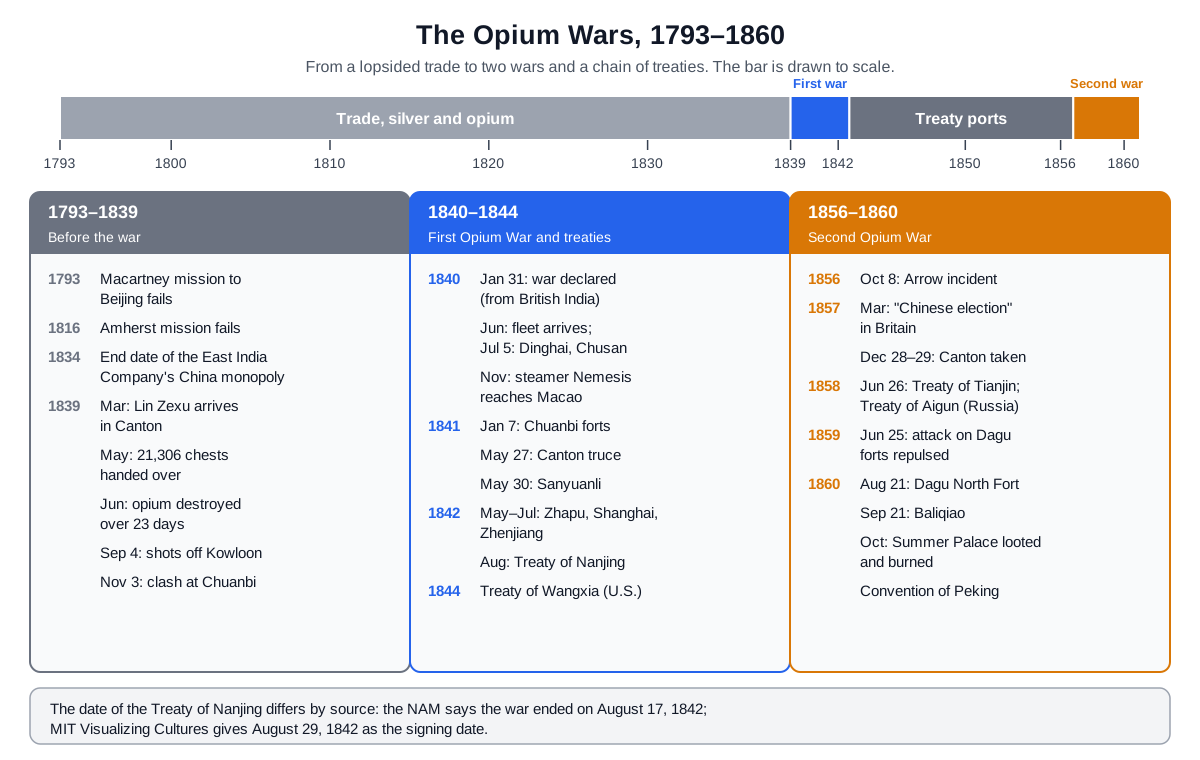
Three years later, in August 1842, with British forces outside the walls of Nanjing, the Qing signed a treaty that opened five ports and gave Hong Kong island to Britain. What happened in between, and in the 18 years that followed? The sections below trace tea, silver and opium, an iron steamship at sea, and the "unequal treaties" of two wars.
The main sources are the U.S. State Department's Office of the Historian and the UK's National Army Museum (NAM). A third is Visualizing Cultures, an open teaching resource made at MIT (called MIT below). The MIT resource itself says that the visual record of this war leans heavily toward the British side. So where numbers differ, they appear side by side instead of being reduced to one.
Tea, silver and opium: a lopsided trade
In the early 1800s, Chinese tea, silk and porcelain earned British merchants a great deal of money. The problem was how to pay for them. China would not take British goods in return and accepted only silver, so Britain's silver reserves slowly ran down.
The volume of tea grew fast. China shipped out 92,000 pounds of tea in 1700, and 2.7 million pounds in 1751. In 1800, the East India Company's yearly purchase reached 23 million pounds of tea, paid for with 3.6 million pounds of silver.
The trade good Britain found to balance this was opium. After taking Bengal in India in 1757, Britain grew opium there on a large scale. The East India Company and other British merchants shipped Indian opium into China illegally, took silver in payment, and used that silver to buy tea. In the NAM's account, by 1839 the money from opium sold in China covered all of Britain's tea purchases.
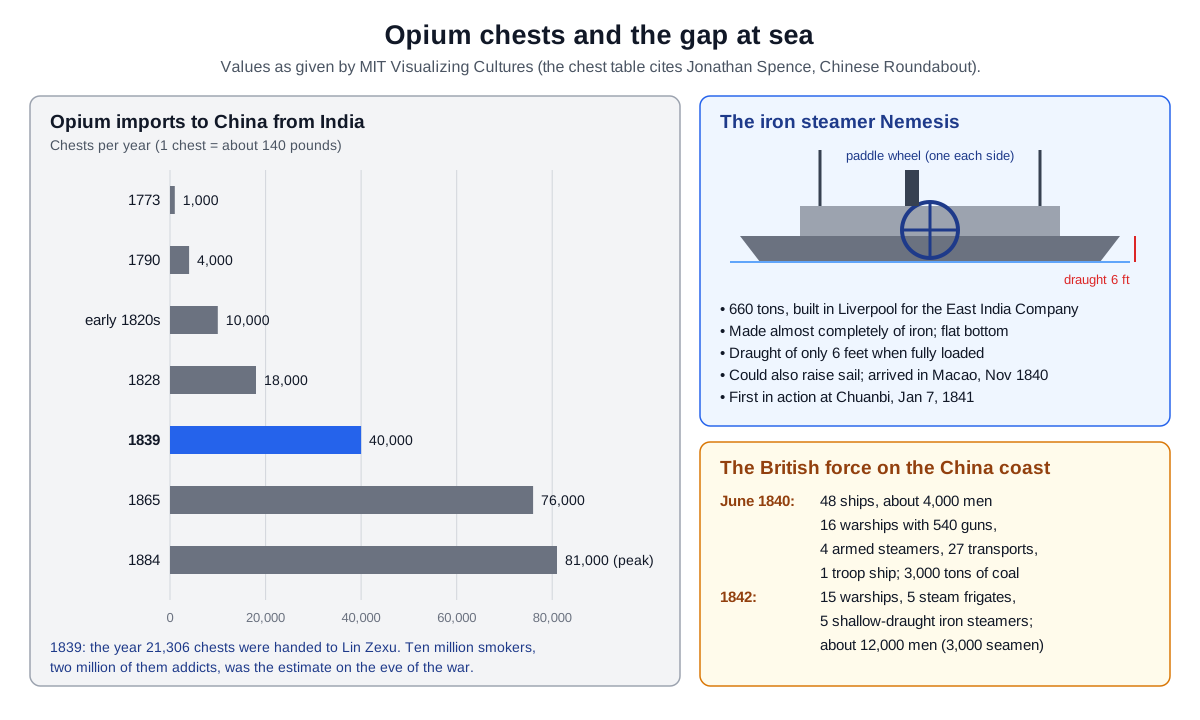
The trade was counted in chests. One chest held about 140 pounds, and the yearly flow rose from 1,000 chests in 1773 to 18,000 in 1828 and 40,000 in 1839. Imports climbed fastest in the 1830s, and 1834 was the end date of the East India Company's monopoly on the China trade. American merchants also carried about 10,000 chests between 1800 and 1839.
For China, both money and people were shaken. As the opium trade grew, China for the first time imported more than it exported. The Office of the Historian traces the First Opium War of 1839–1842 back to this money problem. On the eve of the war, China was estimated to have about ten million opium smokers, two million of them addicts.
Opium spread among officials too. By the 1830s, up to 20% of central government officials and 30% of local officials smoked it, and the Daoguang emperor was an addict himself. Opium imports also seemed to be behind the large outflow of silver that was unsettling the currency.
The Canton system and Commissioner Lin
In the 1700s, the Qing dynasty limited Western traders to one southern port, Canton (Guangzhou). Merchants could live only in a small set area, could not bring their families and could stay only a few months a year. All trade went through the Cohong, a monopoly guild of Chinese merchants, and there was no direct contact with Qing officials and no formal diplomatic relations.
To the Qing emperor, trade was a form of tribute. A country that wanted to trade first had to bring tribute to the emperor, and the European powers refused, demanding Western-style diplomacy based on treaties instead. When the Macartney mission of 1793 and the Amherst mission of 1816 both came home empty-handed, many in Britain grew convinced that only force would open China's ports.
The Qing court argued about opium as well. One side wanted stricter bans, while southern coastal officials and traders pushed to legalize and tax the drug. The Daoguang emperor chose a complete ban, and after 19 audiences he made Lin Zexu an imperial commissioner with full powers. Lin arrived in Canton in March 1839.
Lin ordered the British merchants to hand over their opium, and about 350 foreigners were in effect confined for six weeks. In mid-May, Charles Elliot, Britain's chief superintendent of trade, surrendered 21,306 chests, which were destroyed at Chuanbi over 23 days in June. A woodcut caption in a 1909 Chinese newspaper says the opium was burned. The MIT resource says it was dissolved in water, salt and lime and washed out to sea instead.
Lin also wrote two letters to Queen Victoria describing the harm opium did. He wrongly believed that selling opium was banned in Britain. In fact, opium was widely used as a medicine in Britain and the United States at the time. One letter reached London in January 1840, but the Foreign Office would not accept it, and neither letter ever reached the queen.
How the First Opium War unfolded
When news of the seizure arrived, the debate in Parliament was long and heated. William Gladstone said a war would be "unjust" and a lasting disgrace to the country. Foreign Secretary Lord Palmerston answered that the demand for opium had come from China itself, though he too had doubts about the illegal trade.
The first shots came before any declaration of war. On September 4, 1839, two small British warships fired on Qing war junks off Kowloon. On November 3 at Chuanbi, the 28-gun Volage and the 18-gun Hyacinth fought 29 Chinese vessels (16 war junks and 13 fire-boats, set alight and floated toward enemy ships). One British sailor was wounded and at least 15 Chinese were killed, yet Lin's report to the emperor did not admit any defeat.
The formal declaration of war came on January 31, 1840. British officials in India issued it for the government at home; London did not issue it itself. In June a fleet of 48 ships and about 4,000 men arrived, and on July 5 it bombarded and took Dinghai on Chusan (Zhoushan) island. The fleet sailed north to deliver Britain's demands off Tianjin, and an angry Daoguang emperor stripped Lin of his post in September.
His successor, Qishan, took a softer line. On January 7, 1841, the battle for the Chuanbi forts ended in an hour, with an estimated 500 or more Chinese killed. On January 20, Qishan agreed to cede Hong Kong and pay six million dollars, but neither government accepted this Convention of Chuanbi. Qishan was sentenced to death before the sentence was reduced, and Palmerston dismissed Elliot in April.
In May 1841 the British took the forts guarding Canton and began shelling the city, and local officials and merchants paid six million dollars for a truce on May 27. Three days later, near the village of Sanyuanli, militia from about 100 villages, at their peak some 10,000 men, surrounded a unit of Indian sepoys in a downpour. One sepoy was killed and 15 were wounded; British records treated the clash as minor, but in China it is still remembered as a major victory of the war.
The new British envoy, Sir Henry Pottinger, demanded payment for the seized opium, the costs of the war, more open ports and diplomatic relations. British forces took Xiamen in August 1841 and Chusan, Zhenhai and Ningbo in October, then Zhapu on May 18, 1842, Shanghai on June 19 and Zhenjiang on July 21. At Zhenjiang, close to 3,000 Manchu, Mongol and Chinese soldiers faced a British force of around 7,000.
At Zhapu and Zhenjiang, families who heard of the defeat lost women and children as well. Looting followed the British advance wherever it went, much of it by foreign troops and some by Chinese crowds. The MIT resource notes that both sides abused prisoners and plundered. With Nanjing now open to attack, the Qing asked for peace.
The iron steamer Nemesis and the gap at sea
In November 1840, an iron ship reached Macao after a dangerous voyage from England. It was the Nemesis, owned by the East India Company, which the MIT resource describes as the first iron warship ever built to use both steam and sail. Built in Liverpool, it weighed 660 tons, was driven by two paddle wheels, one on each side, and was made almost entirely of iron.
Its real strength showed in shallow water. The hull had a flat bottom, and its draught (how deep it sits in the water) was only 6 feet when fully loaded, which suited China's shallow rivers and coasts. Only its three top officers came from the Royal Navy; the other officers and the crew were civilians. In its first action, at Chuanbi on January 7, 1841, it landed about 600 sepoys, joined the bombardment and blew up a war junk with a Congreve rocket.
The steamers did several jobs. Because they could move against wind and tide, they towed the big sailing warships into firing range of coastal forts. Their shallow draught let them close in on war junks, and they carried troops. Like other steam warships, the Nemesis also raised sail at times, and by the end of the war several more iron steamers were working alongside it.
One way to picture a steamer is as a tugboat and a warship in one, able to move on a day with no wind. The difference is fuel. The June 1840 fleet brought 3,000 tons of coal for its steamers and its troops.
Qing weapons were a mix. The Sanyuanli militia carried hoes, spears and only a few matchlock guns. On the other side, the sepoys' flintlock muskets misfired in that day's heavy rain. In 1857, a British newspaper reported that first-class war junks, armed mainly with matchlocks 20 years earlier, now carried guns with a larger bore than any British ones.
The Nemesis left a mark in Chinese records as well. A Chinese scroll in the British Library holds a sketch of the ship and a 55-line poem. The poem says the ship moves by burning coal and turns like a galloping horse, and that its shape astonishes everyone who sees it.
Disease was the British force's worst enemy. Official hospital records for July 13 to December 31, 1840 show 5,329 admissions and 448 deaths. A large share of the British force were sepoys from India, and Irish and Scottish units were also large.
The Treaty of Nanjing and the five ports
Under the Treaty of Nanjing, China opened five ports: Canton, Xiamen, Fuzhou, Ningbo and Shanghai. It agreed to pay 20 million silver dollars, abolished the Cohong monopoly and accepted a fixed schedule of customs duties. Britain gained the right to hold Hong Kong in perpetuity, its only outright territorial gain from the war. Sources give different dates for the signing.
Of the 20 million dollars, 12 million covered Britain's war costs, 3 million covered debts owed to British merchants, and the rest paid for the seized opium. Yet the treaty said nothing about the opium trade itself. The issue that had started the war was left in place.
Other countries soon followed. In 1844 the United States signed its first formal treaty with China at Wangxia, near Macau, and France signed its own that same year. The five treaty ports became the first places where foreigners and foreign firms could own land in China. In the Wangxia treaty, the United States agreed that Americans in the opium trade would face Chinese law, while other Americans gained extraterritoriality.
Three pillars stood at the center of these treaties. Extraterritoriality took foreigners out of Chinese law, most-favored-nation status let every power claim any privilege another had won, and a fixed tariff kept duties low. According to the Office of the Historian, the Qing at first supported the extraterritoriality and most-favored-nation clauses as a way to keep foreigners in line.
The Arrow incident and the Second Opium War
On October 8, 1856, port officials at Canton arrested the crew of a small boat called the Arrow on suspicion of piracy. The boat was Chinese-owned and its crew were all Chinese, but it was registered in British Hong Kong, and it carried no papers. Britain said its flag had been insulted and used the incident as a pretext for a new war.
Even the war's name depends on who is speaking. The British usually called it the Arrow War and the French the Anglo-French War, while the term "Second Opium War" was first used by Karl Marx. France joined Britain, citing the execution of the missionary Auguste Chapdelaine, while Russia and the United States turned down the invitation to fight.
There was strong opposition inside Britain. On February 26, 1857, Richard Cobden told the House of Commons that Britain had no legal right to attack China, and Parliament passed a motion of censure. Palmerston dissolved Parliament and won the "Chinese election" that March. The dispatch of troops was delayed by the Indian Rebellion of 1857.
On December 28, 1857, British and French warships bombarded Canton, and troops who landed the next day took the city. The Anglo-French force lost 15 dead and 120 wounded, and around 600 Chinese defenders were killed. Ye Mingchen, the imperial commissioner at Canton, was captured and sent to India, where he died in 1859.
The allies shelled the Dagu (Taku) forts in the north and sailed up to Tianjin, where the Treaty of Tianjin was signed on June 26, 1858. China agreed to pay reparations, open more ports, let traders and missionaries move freely inland and receive foreign diplomats in Beijing. Opium imports were legalized with an 8% tariff. France, Russia and the United States also signed treaties at Tianjin that year, and new ports opened along the coast, on Taiwan and Hainan, and along the Yangtze River.
Also in 1858, China signed the Treaty of Aigun with Russia, giving up over 600,000 km² of Manchuria, and ratified it in 1860. The Tianjin agreements also set low tariffs on imports. The Imperial Maritime Customs Service, set up by British and U.S. merchants, ran trade in foreign merchants' favor while giving the Qing government a steady income.
Ratifying the treaty did not go smoothly. On June 25, 1859, Admiral Sir James Hope's amphibious force (2,200 troops and 21 ships) tried to pass the reinforced Dagu forts. Low tide and soft mud stopped the landing, several gunboats were sunk, and the attackers pulled back with 91 dead and 355 wounded. That same year, U.S. diplomat John Ward exchanged treaty ratifications through negotiation, without force.
In 1860 Britain sent 11,000 British and Indian soldiers and 173 ships, joined by 6,000 French troops. They landed at Beitang on August 1, took the North Fort at Dagu on August 21 (the attackers lost 17 dead and 184 wounded) and entered Tianjin on August 23. On September 18 the Qing seized a British negotiating team that included Harry Parkes, and several of its members died in captivity. On September 21, at Baliqiao (Palikao) near Beijing, about 10,000 Qing troops were defeated.
On October 6, troops from Britain and France plundered the Xianfeng emperor's Summer Palace, the Yuanmingyuan, outside the capital. Twelve days later, as revenge for prisoners who had been tortured and killed, they burned most of it, but they spared the Forbidden City. On October 13 the gates of Beijing were opened, and Prince Gong took charge of negotiations for his brother, the emperor, who had fled.
The Convention of Peking of 1860 confirmed the Treaty of Tianjin and gave up more. The Kowloon Peninsula, across from Hong Kong Island, passed to Britain, the whole country opened to British traders, and most foreign imports were freed from internal transit duties. Unlike the treaty of the first war, which never mentioned opium, the treaties that ended the second war in 1860 made the opium trade legal in plain terms.
Numbers that differ by source
For many battles, the sources do not agree. Take British losses at Zhenjiang on July 21, 1842. The NAM gives 34 dead and 107 wounded, while official reports cited by MIT give 38 killed and 126 wounded. The naval surgeon Edward Cree guessed in his journal that about 200 had been killed, noting an unusual number of deaths from sunstroke that day.
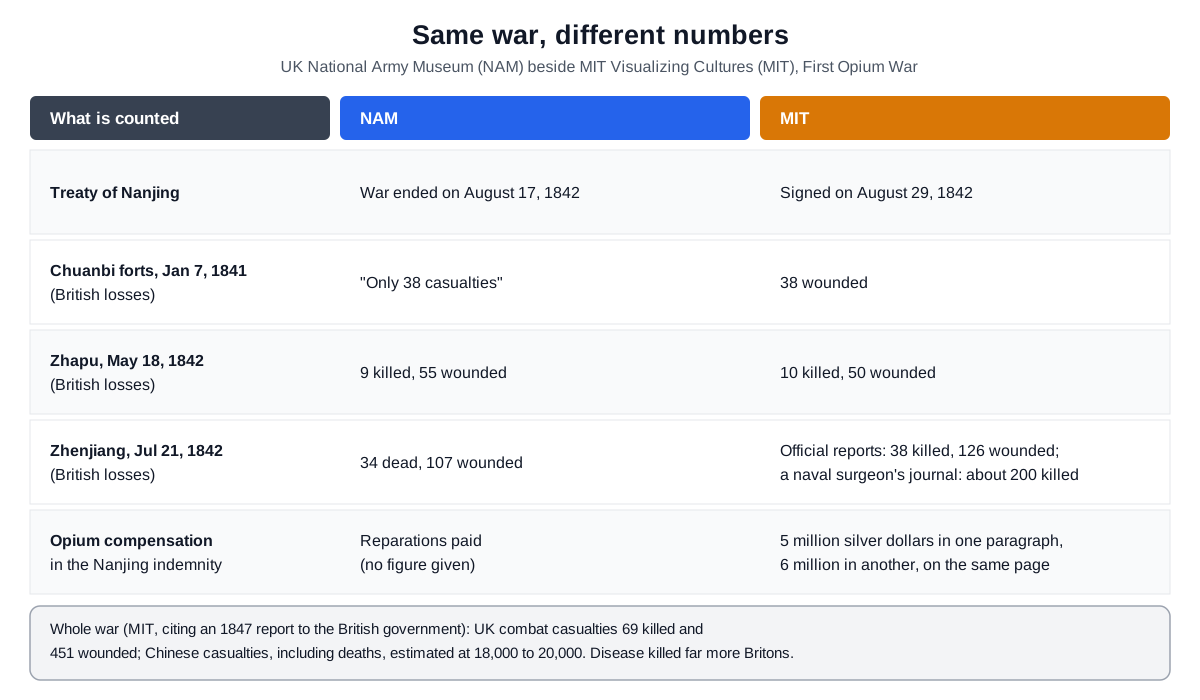
For Zhapu, the NAM gives 9 killed and 55 wounded, and MIT gives 10 killed and 50 wounded. For the Chuanbi forts on January 7, 1841, the NAM writes "only 38 casualties," while MIT writes "38 wounded." Even within one MIT page, the opium compensation is 5 million dollars in one paragraph and 6 million in another.
For the war as a whole, the gap is wider. An 1847 report to the British government, cited by MIT, put British combat casualties at 69 killed and 451 wounded. It put the Chinese toll, deaths included, at an estimated 18,000 to 20,000. Chinese figures could only ever be estimates, and MIT notes that more than a few battles amounted to massacres.
What the unequal treaties left behind
The treaties that followed the Opium Wars came to be called "unequal treaties" because in practice they gave foreigners privileges and extracted concessions from China. They worked to open trade, but they were also a major source of anger at Western imperialism. They also marked the start of an era in which China dealt with other countries through treaties rather than the long-standing tribute system.
Inside China, the shock was great. Britain's easy victory badly hurt the Qing dynasty's prestige, and the NAM sees this as one cause of the Taiping Rebellion (1850–64). The MIT resource dates the Taiping Rebellion to 1853–1864 and describes it as a civil war with 20 to 30 million dead. Foreign pressure from outside and disorder within together began the road to the fall of the Qing in 1911.
The two countries still remember the war differently. Britain widely saw the First Opium War as a great triumph and struck a gold medal for it, while China held no such celebrations. The historian Immanuel Hsü wrote that the war and the Treaty of Nanjing "introduced a century of humiliation for the Chinese people."
Chinese historians have seen the two wars as foreign power unjustly forced on a Qing empire that had grown weak. In the 1900s, the Republic of China worked to end the unequal treaties and removed most of them during World War II. This phase only ended completely with the return of Hong Kong in 1997. Standard Chinese textbooks date the start of modern Chinese history to 1842, when the First Opium War ended.
Still, the MIT resource adds that looking only at what the West imposed gives too narrow a picture. The opium trade involved not just Britain and the United States but also Turkey, India, Southeast Asia and Chinese merchants. It is a war in which casting one side only as hero or villain leaves out a great deal.
What to read next
- Turning points in military technology — The technologies that changed warfare after steam and iron.
- Destroyers and frigates: why warships have different names — How warships were sorted into types after sail and paddle steamers.
- Military logistics: performance must be sustainable — Like a fleet that brought 3,000 tons of coal, a distant war depends on supply.
- A history of laser weapons: from chemical to electric lasers — A very different line of weapons that came after gunpowder and steam.