At 4:30 a.m. on April 12, 1861, a Confederate 10-inch mortar at Fort Johnson in Charleston Harbor, South Carolina, fired the first shot at Fort Sumter. The fort could not answer effectively. At 2:30 p.m. the next day, its commander, Major Robert Anderson, surrendered. No one was killed while the bombardment went on.
Today the National Park Service (NPS) sums up the war in a short line: "4,000,000 freed. 750,000 dead." How did a fight that began without a single death become the bloodiest war in American history? The sections below follow secession over slavery, the uneven strength of North and South, rifled muskets, ironclads and railroads, emancipation and Black soldiers, and the numbers that never quite agree.
The sources are public records of U.S. government agencies. They include NPS battlefield pages, original documents at the National Archives (NARA), and the diplomatic history series of the State Department's Office of the Historian.
Slavery and secession
On November 6, 1860, Abraham Lincoln was elected the sixteenth president. He was the first Republican president, and his party opposed the spread of slavery into the western territories. His victory set off calls to leave the Union across the slaveholding South.
South Carolina left first, on December 20. Of the 169 delegates at the convention that voted for secession, 153 held slaves in 1860. Four days later the state issued a declaration that described Lincoln as a man "whose opinions and purposes are hostile to slavery." The NPS sums up the declaration's reason for secession as threats, both real and perceived, to slavery.
In January 1861, Mississippi, Florida, Alabama, Georgia, Louisiana and Texas followed. On February 4, delegates from these states met in Montgomery, Alabama, and formed the Confederate States of America. It is usually called the Confederacy, and on February 18 Jefferson Davis became its provisional president. Lincoln took office on March 4.
The South's argument about "states' rights" had a history of its own. Citing the rights of the states, South Carolina had voted to declare the federal tariffs of 1828 and 1832 void, and a compromise tariff ended that crisis in 1833. The state learned then that threats of disunion could work as a political weapon.
The public and historians still see the causes differently. The NPS website carries an essay by historian James Oliver Horton, professor emeritus at George Washington University. In his view, slavery was not the only cause the South fought for, but it was central to secession and war.
He notes that scholars hardly dispute this, yet in the public mind slavery and the war are often kept apart. The South Carolina convention of 1860, he adds, did not complain about tariff rates.
Ending slavery was not the North's aim at the start either. Lincoln and most Republicans wanted to stop slavery from expanding. At first the North fought to stop secession and keep the Union whole, and ending slavery was not a war goal.
The guns at Fort Sumter
Fort Sumter held 80 Union soldiers, and 500 Confederates surrounded it. On April 10, Confederate Brigadier General Beauregard demanded its surrender, and Anderson refused. Once the firing began, the fort could not reply effectively, and after surrendering on April 13 the garrison left the next day.
No one was hurt during the bombardment itself. On April 14, though, a cannon firing a salute during the evacuation went off early, killing one Union artilleryman and wounding three (one mortally). The NPS battle record calls the bombardment the opening engagement of the Civil War and lists the result as "Indecisive."
On April 15, Lincoln declared that an insurrection existed and called for 75,000 militia. In response, Virginia, Arkansas, North Carolina and Tennessee left the Union within weeks. In late May, Richmond, Virginia, became the Confederate capital.
The Confederacy grew to 11 states. Maryland, Delaware, West Virginia, Kentucky and Missouri, which had slavery but stayed loyal, were called the Border States.
North and South: what was different
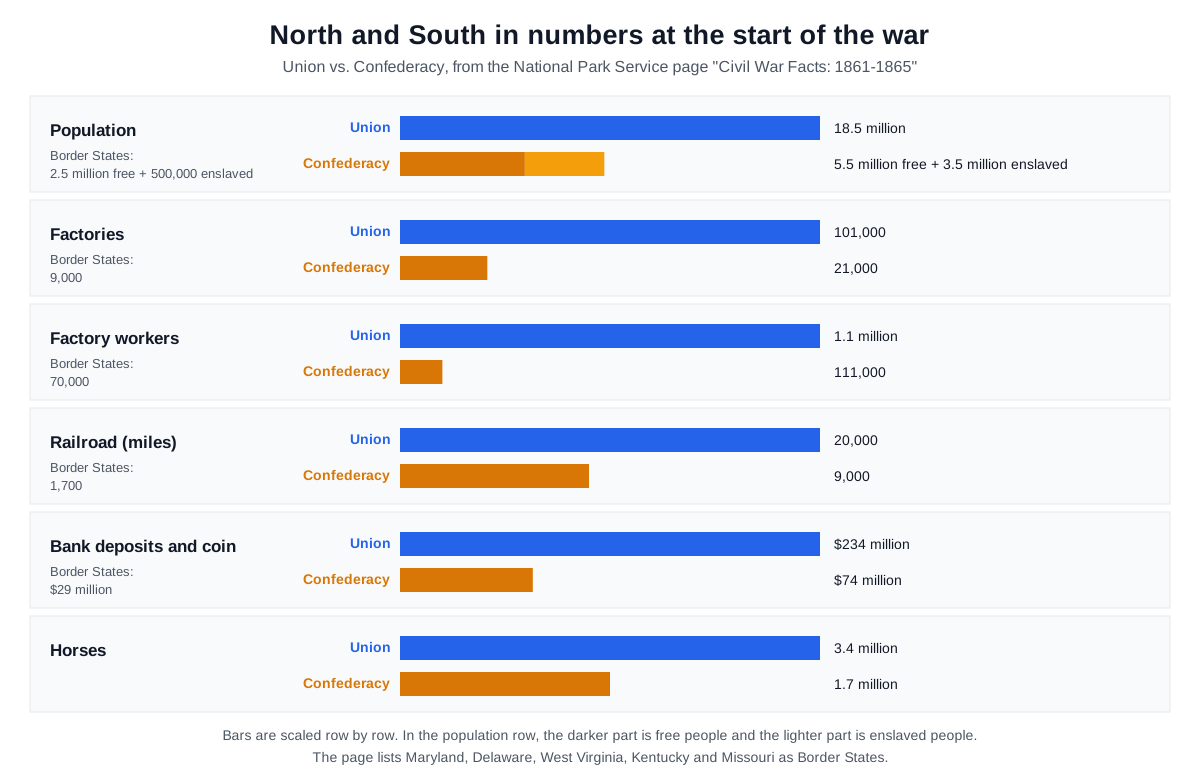
The NPS page "Civil War Facts" gives the Union a population of 18.5 million, and the Confederacy 5.5 million free people and 3.5 million enslaved people. The Union had 101,000 factories to the Confederacy's 21,000, and 1.1 million factory workers to 111,000. It had 20,000 miles of railroad to 9,000, and $234 million in bank deposits and coin to $74 million.
The gap was even wider in the power to make weapons. In 1860, northern states produced 90% of the nation's manufactured goods, and the North made 32 times more firearms than the South. The South grew two-thirds of the world's cotton, but it had little manufacturing, about 29% of the railroad track and only 13% of the banks.
That does not mean the South was poor. In 1860, the money value of enslaved people in the United States was greater than everything invested in the nation's railroads, factories and banks combined. Its wealth was tied up in a system of owning people.
The armies drifted apart in size as the years passed. In July 1861 they were nearly equal, with fewer than 200,000 soldiers each. At the peak in 1863 the Union army was twice as large, and two years later the Confederate army had fallen to about 200,000. About 75% of Southern men fought in the war, compared with about half of Northern men.
A timeline, 1861–1865
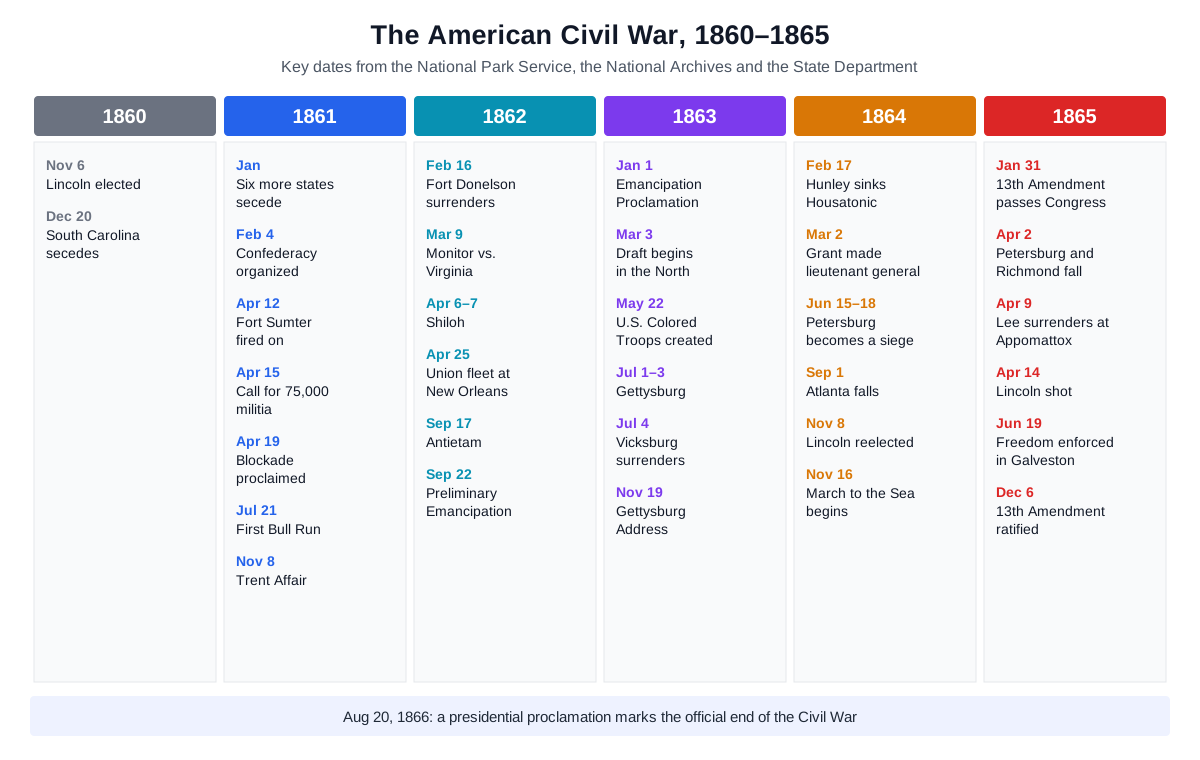
The first big battle came on July 21, 1861, at Bull Run (First Manassas) in Virginia. The Union army under General McDowell pushed forward at first, but after Confederate troops under Joseph E. Johnston arrived, it fell back in panic to the forts guarding Washington.
In 1862 much of the war moved along rivers. Fort Donelson in Tennessee surrendered on February 16, and General Ulysses S. Grant earned the nickname "Unconditional Surrender" Grant there. The Battle of Shiloh was fought on April 6–7, and on April 25 Admiral David Farragut's Union fleet reached New Orleans.
Antietam in Maryland, on September 17, was the bloodiest single day of the war, and it turned back General Robert E. Lee's first push into the North. Five days later, on September 22, Lincoln issued the preliminary Emancipation Proclamation.
Two big events landed within two days in early July 1863. Gettysburg in Pennsylvania, fought on July 1–3, was the bloodiest battle of the war and ended Lee's hope of winning on Northern soil. On July 4, Vicksburg, Mississippi, surrendered to Grant, and the United States gained control of the whole Mississippi River. Earlier that year, on March 3, the draft began in the North (the South had started one the year before).
In March 1864, Grant was made lieutenant general and took command of all Union armies. After four days of attacks on the rail hub of Petersburg, Virginia, in mid-June, he accepted that only a siege could cut the city off.
In the West, Atlanta fell on September 1, Lincoln was reelected on November 8, and on November 16 General William T. Sherman's army began the "March to the Sea," reaching Savannah on December 10. The NPS essay says Sherman's campaigns did massive damage to Southern industry, farms and infrastructure, and Sherman himself later put the damage at $100 million.
Rifled muskets, ironclads, railroads and the telegraph
Infantry in this war mostly carried rifle muskets. These guns had spiral grooves (rifling) cut inside the barrel and were loaded one shot at a time through the muzzle.
The Union's M1861 Springfield was the most popular infantry arm of the war, and in the right hands it could fire three times a minute. A park page on weapons in the Shenandoah Valley gives its effective range as 400–500 yards. The gun Confederate soldiers used most was the British-made 1853 Enfield, and about 900,000 were imported, mostly for the Confederacy.
What made rifled guns practical for whole armies was the bullet. The Minié bullet, which Captain Claude Etienne Minié of the French Army brought out in 1848, was a cone-shaped lead slug a little more than half an inch across. Its hollow base spread out when fired and gripped the rifling. In 1855 the United States Army adopted an improved design that James Burton made at the Harpers Ferry armory.
In an NPS interview, a park guide compares the two kinds of gun. A smoothbore musket had an effective range of 75–100 yards, while a rifled gun firing the Minié ball could hit from at least 400 yards. Even so, he says, armies still lined up shoulder to shoulder, and 75% of wounds in the war came from the Minié ball. Range figures come with different conditions on different pages, so they are best not compared on their own.
The most-used cannon was probably the 12-pound "Napoleon." It had a bronze smoothbore barrel and fired solid shot, shell and canister.
The 3-inch Ordnance Rifle was built up from wrought iron. It was light, durable, accurate and unlikely to burst, and it became the most popular cannon of the war, with a range of more than two miles. Artillery in the war fired more than 70 types of projectiles.
At sea, the shape of warships changed. On March 8, 1862, the Confederate ironclad Virginia (the former Union frigate Merrimack, covered with iron plate) sank two Union ships at Hampton Roads and ran one aground. The next day the Union's Monitor arrived, riding only 18 inches above the water. The two ships fired at each other for four hours, but the shots bounced off their armor and neither was seriously damaged.
It was the first fight between ironclads, and a sign that the age of steam-driven iron warships had come. Neither ship lasted long. Retreating Confederates scuttled the Virginia two months later, and the Monitor was lost at the end of that year, sinking in bad weather off Cape Hatteras in North Carolina.
Something new happened under the water as well. On February 17, 1864, off Charleston, the Confederate submersible H.L. Hunley, with a crew of seven, sank the Union warship Housatonic. It was the first successful submarine attack of the war, and the Hunley was lost too; it was found only in 1995.
On land, railroads and the telegraph changed the pace of war. The nine-month siege of Petersburg shows how. The Union laid 21 miles of new track and ran 25 locomotives and more than 275 cars. They kept an army of over 100,000 men supplied, along with over 65,000 horses and mules.
The main cargo was food, weapons and ammunition. By the end of the war, the United States Military Railroad was the largest railroad system in the world. Assistant Secretary of War Charles A. Dana called the telegraph "one of the most useful accessories of our army."
The blockade and Europe
On April 19, a week after Fort Sumter, Lincoln proclaimed a blockade of Southern ports. It was meant to stop cotton exports and the smuggling of war materials, and by July 1861 every major Southern port was blockaded. In the view of the State Department's historians, the blockade leaked somewhat, but it kept the South from getting the weapons it needed. Until the Union captured Fort Fisher in 1865, Confederate armies still got some supplies through blockade runners.
Confederate leaders were confident that cotton's place in the world market would bring Britain and France to their aid. Textile regions in both countries that depended on Southern cotton did suffer high unemployment. Yet both stayed neutral, and later in the war they found new cotton in Egypt and India. In Britain, strong antislavery feeling held the government back from doing more for the Confederacy.
There were tense moments. Britain recognized the Confederacy as a belligerent on May 13, 1861. On November 8, U.S. Navy officer Charles Wilkes stopped the British mail ship Trent and seized two Confederate envoys. Britain protested a violation of its neutrality, and the crisis eased only when the envoys were released a month later.
Emancipation and Black soldiers
The document that changed the nature of the war was the Emancipation Proclamation. Lincoln issued a preliminary version on September 22, 1862, a few days after the victory at Antietam. On January 1, 1863, he declared that enslaved people in the areas in rebellion "are, and henceforward shall be free." He did so as commander in chief, as a military measure.
That gave it limits. It applied only to the states that had seceded and did nothing about slavery in the Border States that stayed loyal. The proclamation also exempted parts of the Confederacy already under Union control. The freedom it promised depended on Union victory.
Enslaved people did not simply wait. From the first days of the war they acted to win their own freedom, and in the summer of 1862 they crossed into Union lines seeking it. U.S. policy and war aims changed along the way and finally came to include the end of slavery.
The proclamation also opened the Army and Navy to Black men. Early in the war, Black volunteers had been turned away because a federal law from 1792 kept them from carrying arms in the U.S. Army. War Department General Order 143 created the United States Colored Troops on May 22, 1863.
By the end of the war, about 179,000 Black men (10% of the Union Army) had served in the Army and 19,000 in the Navy. Close to 40,000 Black soldiers died, 30,000 of them from infection or disease.
Discrimination followed them into the ranks. Black soldiers were first paid $10 a month minus $3 for clothing, or $7, while white soldiers received the full $13. Congress made pay equal in June 1864, backdated to the start. Units were segregated and usually led by white officers, and the Black commissioned officers numbered nearly 80.
Captured Black soldiers were usually treated more harshly than white prisoners. At Fort Pillow, Tennessee, in 1864, Confederate soldiers shot and killed Black Union soldiers they had captured. By the end of the war, 16 Black soldiers had received the Medal of Honor.
Appomattox and after
On April 2, 1865, Lee abandoned Petersburg and Richmond and moved his army west. On April 9, at Appomattox Court House, Virginia, he met Grant in the parlor of Wilmer McLean's house and signed the surrender. Confederate soldiers gave up their weapons, equipment and flags, and officers kept their horses, side arms and personal property. The men were paroled and sent home rather than to prison camps, and Grant sent 25,000 rations for three days.
Lee surrendered his own army, not the Confederacy. On April 14, Lincoln was shot at Ford's Theater in Washington and died the next morning. Joseph Johnston surrendered in North Carolina on April 26, and Jefferson Davis was captured in Georgia on May 10. The remaining armies had all surrendered by early June.
On June 19, 1865, Union troops arrived in Galveston, Texas, to enforce the freedom declared more than two years earlier. More than 250,000 enslaved people in Texas became free, and the day is remembered as Juneteenth. The last Confederate warship, the Shenandoah, surrendered in Liverpool, England, on November 6. A proclamation by President Andrew Johnson on August 20, 1866, marked the official end of the war.
The Emancipation Proclamation alone could not end slavery across the nation. The 13th Amendment passed the House 119 to 56 on January 31, 1865, and was ratified on December 6 of that year, abolishing slavery in the United States. NARA groups it with the 14th and 15th Amendments as the three "Civil War amendments" that greatly expanded Americans' civil rights.
Numbers that differ by source
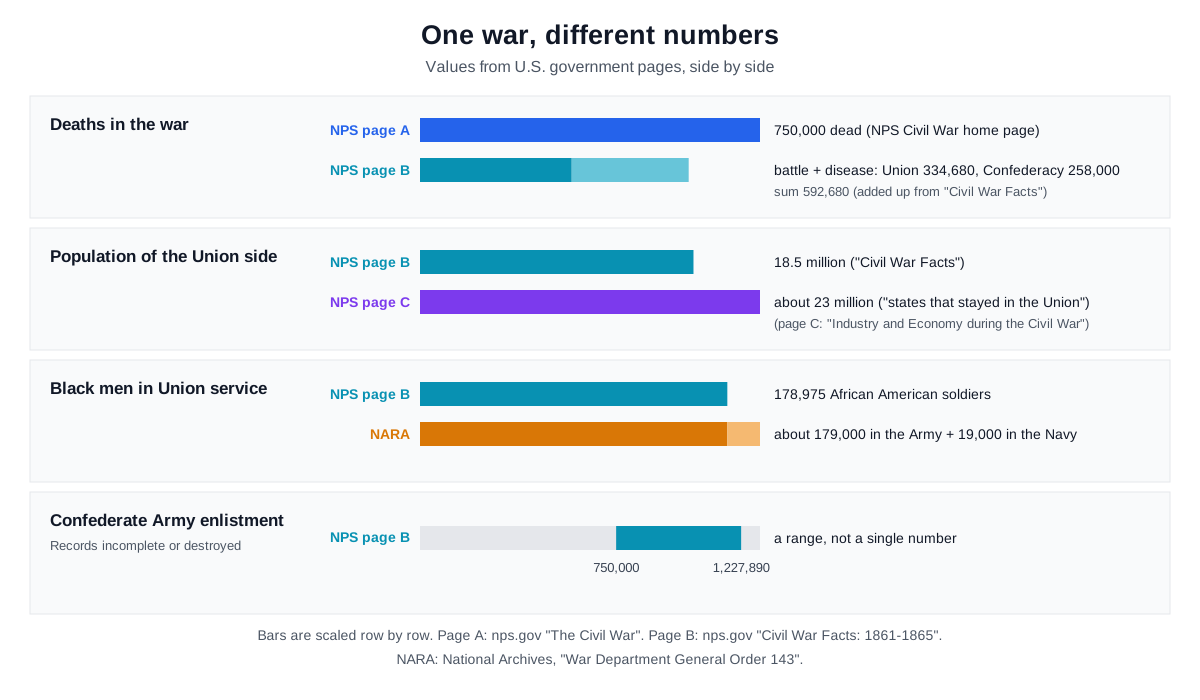
Numbers for this war differ from page to page, even within one agency. Deaths are the clearest case.
The NPS Civil War home page says 750,000 dead. The NPS "Civil War Facts" page lists 110,100 Union soldiers killed in battle and 224,580 dead of disease. For the Confederacy it lists 94,000 killed in battle and 164,000 dead of disease. Added together, the four numbers come to about 590,000.
"Casualties" and "deaths" are also different things. Casualties include the wounded and the captured as well as the dead. The same page counts 642,427 Union casualties and 483,026 Confederate casualties. It names the bloodiest battles as Gettysburg (51,116), the Seven Days (36,463), Chickamauga (34,624), Chancellorsville (29,609) and Antietam (22,726), and only Antietam was a single day.
Population figures differ too. "Civil War Facts" gives the Union 18.5 million, while the essay on industry and the economy gives about 23 million for the states that stayed in the Union.
For Black soldiers the numbers nearly agree. "Civil War Facts" lists 178,975 African American soldiers in the Union Army, and NARA gives about 179,000 in the Army and 19,000 in the Navy. Confederate enlistment appears only as a range, from 750,000 to 1,227,890. Confederate enlistment records are incomplete or destroyed, so the makeup of that army is not known.
Many also died in prison camps. In all, 30,218 Union soldiers and 25,976 Confederate soldiers died in prison, and the death rates for prisoners were 15.5% and 12%. When numbers disagree, it is more accurate to note which agency and which page each value comes from than to pick just one.
What to read next
- The Battle of Gettysburg: Three Days at a Turning Point. A closer look at the three days of July 1863.
- The Monitor and the Virginia: the first fight between ironclads. The two days at Hampton Roads, told through the ships themselves.
- Rifled muskets and the Minié ball: why Civil War casualties were so high. The rifle and bullet touched on here, explained in depth.
- Military logistics: performance must be sustainable: like the railroad at Petersburg, why feeding and moving an army is the base of any war.
- Turning points in military technology: the big changes in weapons technology in the 20th century, after the ironclads.
- A history of laser weapons: from chemical to electric lasers: how laser weapons, the core subject of this site, developed.