On 22 June 1941, German and allied troops crossed the Soviet border all at once, along a front from the Baltic Sea to the Black Sea. The country under attack had promised Germany in August 1939, less than two years earlier, that neither would attack the other. The United States Holocaust Memorial Museum (USHMM) calls the invasion Germany's biggest military operation of the Second World War.
Its code name was Barbarossa. Germany expected a war of a few weeks, but in December it was hit by a counteroffensive before Moscow and pushed back. Why did Germany turn east, and how far did the three thrusts reach? This article follows the campaign through public records, from tanks, horses and railways to what happened behind the front.
Two signatories and a plan aimed east
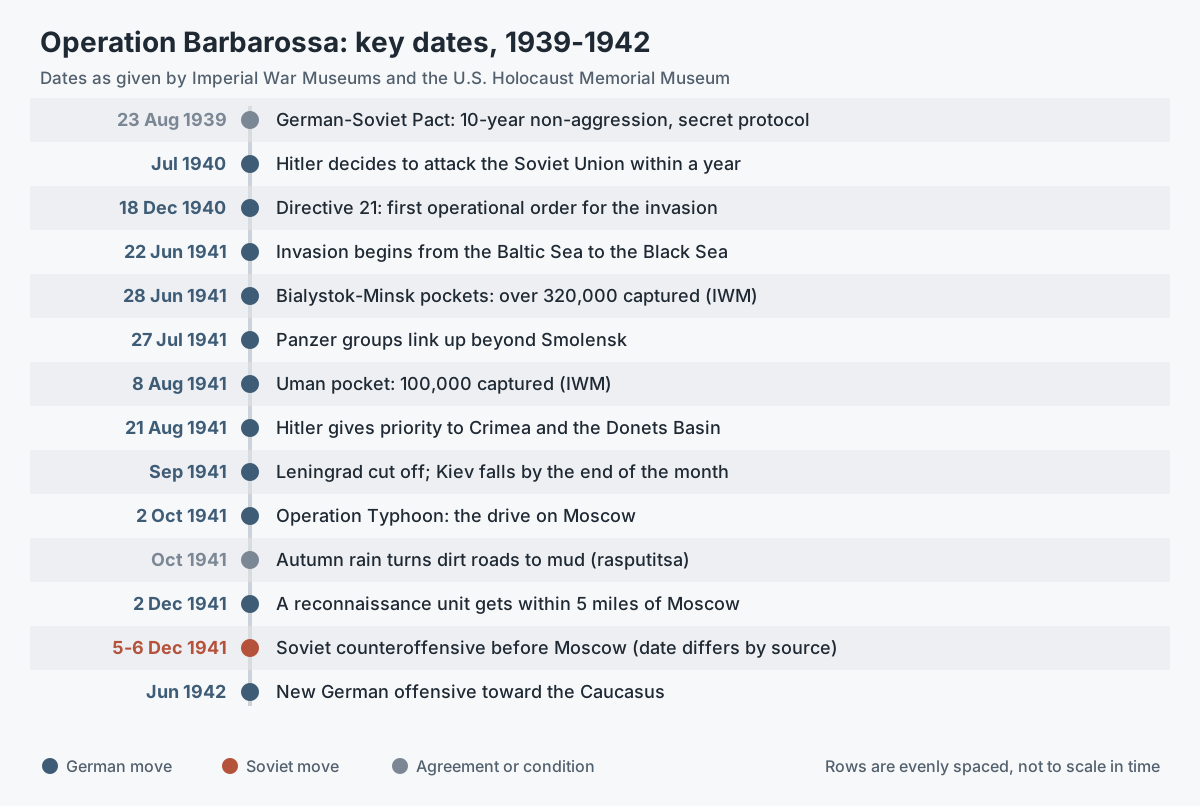
On 23 August 1939, Hitler's Germany and Stalin's Soviet Union signed the German-Soviet Pact. The public part promised ten years without attacks on each other. A secret protocol split eastern Europe into German and Soviet spheres of influence. Other nations were stunned, since the two regimes stood at opposite ideological poles.
For eighteen months after that, the deal also paid off for the German economy. The Soviet Union shipped grain and oil and received German manufactured goods in return. For Hitler, though, the pact was a temporary tactical move. He and the Nazis had long aimed to destroy the Communist Soviet Union and seize "living space" (Lebensraum) in eastern Europe.
The decision came in July 1940. A few weeks after conquering France and the Low Countries, Hitler resolved to invade within a year. The plan meant subjugating and enslaving the Slavic peoples of the Soviet Union, a program of "Germanisation" and economic plunder meant to last well beyond the military victory.
Directive 21 and three army groups
Hitler signed Directive 21 on 18 December 1940. It was the first order that set the invasion in motion. The goal was to advance to an imaginary line from the northern port of Archangel down to Astrakhan, on the Caspian coast, known as the A-A line. Most of the Soviet population and economic capacity lay on the near side of that line.
The operation was named after Frederick I, a medieval Holy Roman Emperor. After a five-week delay to finish the campaigns in Greece and Yugoslavia, the attack began on 22 June 1941.
Germany divided its invasion force into three army groups. Army Group North would push through the Baltic States toward Leningrad. Army Group Centre would go through Minsk and Smolensk toward Moscow, and Army Group South into Ukraine toward Kiev and the Donbas industrial region. Hitler expected to reach these objectives in about ten weeks.
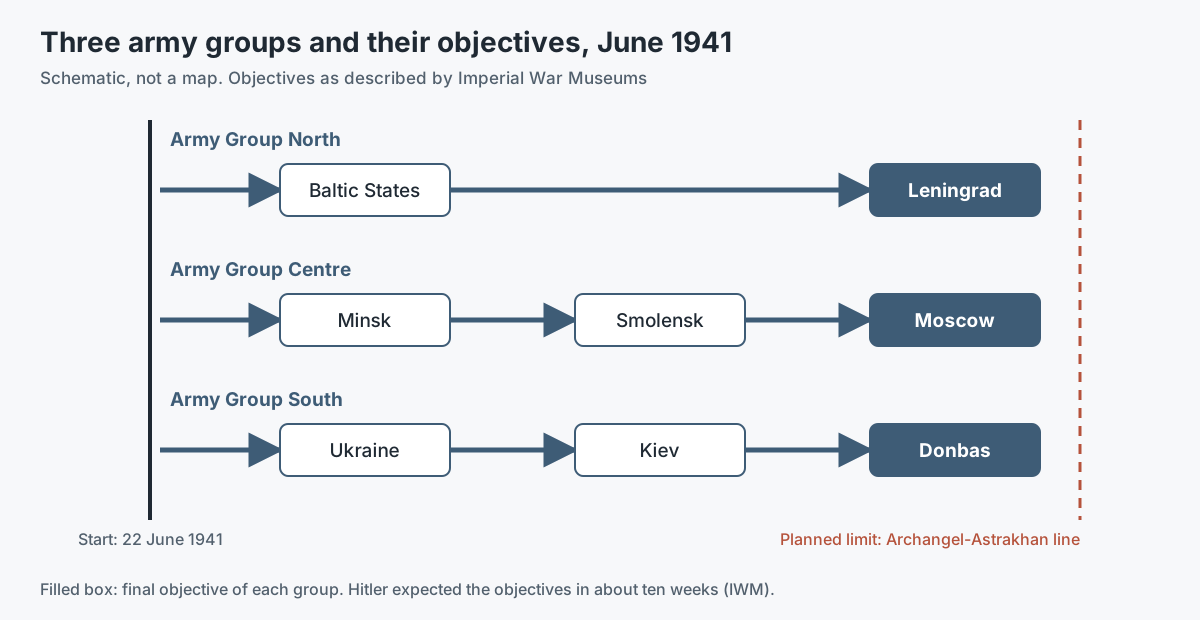
Speed was a necessity. In a video talk, a curator at Imperial War Museums (IWM) explains the plan. Germany hoped a blitzkrieg would end Soviet resistance within six to eight weeks. It lacked the reserves of men and materiel for a long war of attrition.
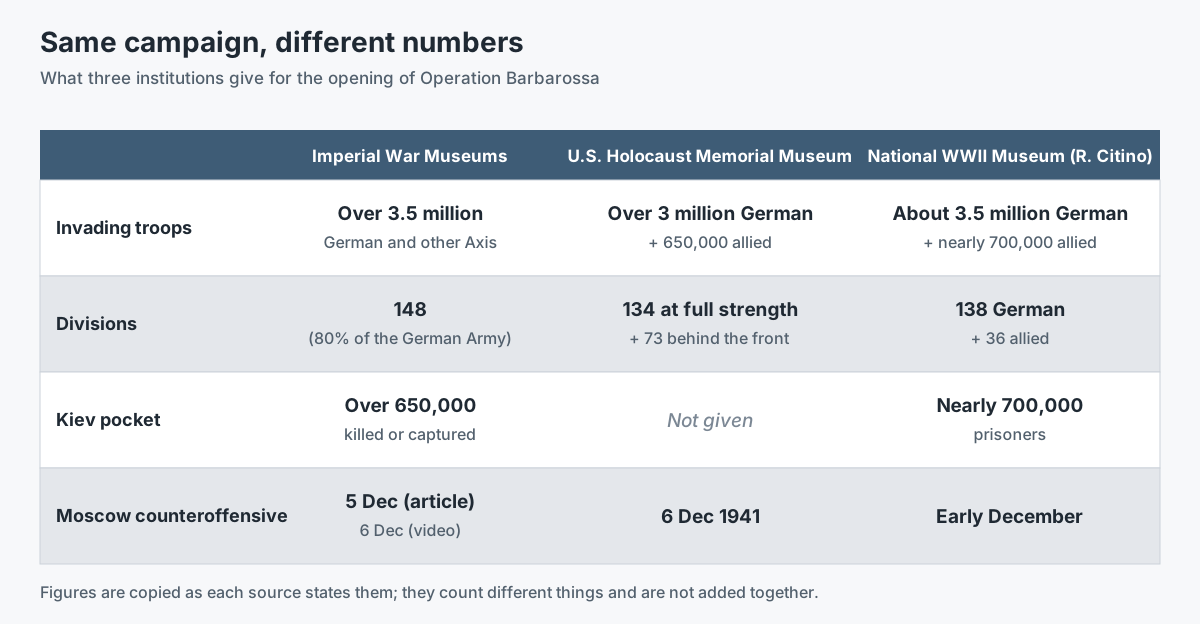
How large was the force? The numbers vary by institution. IWM gives more than 3.5 million troops from Germany and its Axis partners in 148 divisions, while USHMM gives over 3 million German soldiers plus 650,000 Finnish and Romanian troops. Robert Citino, a former senior historian at the National WWII Museum, counts about 3.5 million Germans and nearly 700,000 allied troops.
Seventeen panzer divisions with 3,400 tanks led the way, backed by 2,700 aircraft. The front ran 1,800 miles (about 2,900 km). The Soviet Union had gathered large forces along its western border, yet those troops had been told to avoid anything that might provoke Germany. With about 5 million men available at once and 23,000 tanks in total, the Red Army was still not ready when the blow fell.
Summer 1941: huge encirclements
There were warnings. In March 1941, U.S. Under Secretary of State Sumner Welles warned Soviet Ambassador Constantine Oumansky of a coming Nazi attack. Stalin distrusted Hitler, yet he did not expect an attack so soon, even as German troops massed and intelligence warnings kept coming.
The result was almost complete surprise. The first day alone cost the Soviets 1,800 aircraft, most of them caught on their airfields. With control of the air, German panzer forces drove deep behind Soviet lines and encircled millions of soldiers.
One pocket followed another. By 28 June, three Soviet armies were trapped in the Bialystok-Minsk pockets, and over 320,000 men were captured. The two panzer groups met again beyond Smolensk on 27 July and took another 300,000 prisoners. In the south, 100,000 men were captured in the Uman pocket on 8 August.
In the north, German armor advanced 500 miles (804 km) within three weeks and by mid-July stood 60 miles (96 km) from Leningrad. In September, with Finnish help, the Germans cut the city off, but they lacked the strength to take it. Hitler ordered it starved into submission, and the siege lasted 890 days.
Even so, the Soviet Union did not collapse as the Nazi leadership had expected. The losses of the first six weeks were catastrophic, but Soviet resistance stiffened from mid-August 1941.
The turn to Kiev and winter before Moscow
By August, Army Group Centre's supply situation had become critical. Hitler halted the advance on Moscow and chose to reinforce the northern and southern groups. The panzers stood only 220 miles from Moscow, so the German High Command protested hard. Hitler valued Ukraine and its resources more, and on 21 August he gave priority to taking Crimea and the Donets Basin.
The turn south trapped five Soviet armies around Kiev. The city fell by the end of September. IWM puts Soviet losses there at over 650,000 killed or captured, while Citino counts nearly 700,000 prisoners alone.
Judgments of this decision cut both ways. IWM sees it as militarily sensible to a degree, since Army Group Centre was weakened after Smolensk and exposed on its flanks. The turn also surprised the Soviets and destroyed huge forces. Yet IWM also writes that it cost Germany its one real chance of winning outright.
Heinz Guderian, who led a panzer group, argued that encirclement battles gave the Soviets time to bring up fresh reserves and urged a direct drive on the capital.
On 2 October, Hitler launched Operation Typhoon against Moscow. The reinforced Army Group Centre had 1,700 tanks and 1 million men. The Soviets fielded almost a million troops but had little armor or air power left; they ringed the capital with layered defenses and mobilized its citizens. The first blows still captured over 600,000 Soviet soldiers in two encirclements near Bryansk and Vyazma.
Then the rain came. Autumn downpours turned unpaved roads into streams of mud in the rasputitsa, the "quagmire season." Wheeled vehicles and horse-drawn wagons got hopelessly stuck. Meanwhile, the Soviets brought in reservists as well as troops from Siberia and the far eastern frontier.
In mid-November, with the ground frozen hard, German armor tried one last pincer move to surround Moscow. The northern arm came within 12 miles of the capital, and on 2 December a scouting unit came within 5 miles. That was the limit of the whole advance.
The counterattack came in early December, on 5 or 6 December depending on the source. Over a million Soviet troops took part, and Army Group Centre was driven back as much as 150 miles from the capital. Hitler dismissed the army's commander-in-chief, Walther von Brauchitsch, and took the post himself.
Tanks, horses and rails: weapons and supply
Despite the word "blitzkrieg," much of the German army moved on horses. Infantry divisions relied on them to haul guns and supplies, and Barbarossa used some 700,000 of them.
The tanks were not as modern as the image suggests either. In 1940, Germany halved the tank strength of its panzer divisions to double their number. More than half of the tanks sent east were outdated light models or Czech designs, and by mid-1941 German factories turned out only 250 new tanks a month.
Soviet tanks were numerous but mostly old. Most of the roughly 10,000 that met the Germans that June were light BT tanks or the outdated T-26. A new generation, the T-34 and KV-1, was just entering service, and the T-34 came as a complete shock when the Germans first met it in July. Yet the Soviets had fewer than a thousand T-34s when the attack began, and most were lost in scattered actions by crews with too little training.
Supply was a fight against distance. The distances were far greater than in the French campaign, and the Soviet transport network was much poorer. Russian railways used a different gauge, and German engineers had a hard time changing the track so their trains could run on it. Trucks and wagons had to use dirt roads that became almost impassable after long rain.
Winter was not in the plan. Counting on a quick Soviet collapse, the planners had not prepared their troops for winter fighting, and winter clothing sat in Poland while fuel and ammunition took priority. Tank and vehicle lubricants froze in record cold.
Getting weapons and supplies to the front on time is called logistics, and IWM counts it among the most important factors in the German defeat.
The Soviets moved their factories. Despite the huge upheaval of shifting tank, aircraft and munitions plants east to the Urals, Soviet war production rose sharply in the second half of 1941.
Outside help began to arrive as well. The first Arctic convoys reached Murmansk and Archangel with supplies from Britain.
In the United States, the War Department warned President Roosevelt that the Soviets would collapse within six weeks. His trusted aide Harry Hopkins went to Moscow, met Stalin and urged Roosevelt to help anyway. The first Lend-Lease shipments for the Soviet Union were under way by late October.
Mass murder and prisoners behind the front
This was not only a war for territory. From the start of planning, USHMM explains, German army and police leaders intended a war of annihilation. It was aimed at the Soviet state and its people, above all the Jews. The German military planned for tens of millions of people in the Soviet Union to starve to death as an intended result of occupation policy.
The Einsatzgruppen followed the army. These Security Police and SD units, the SD being the SS intelligence service, are known above all for murdering Jews in mass shootings across Soviet territory. During the war's first nine months, they organized or took part in shootings that killed over half a million people, most of them Jews.
The 3,000 men of the four groups did not act alone: Waffen SS units, the Order Police, the German army, Romanian forces and local collaborators took part.
The killing did not happen only between strangers. Killers and victims were often neighbors or coworkers who knew each other. In two days of September 1941, Jews were shot en masse at Babyn Yar, a ravine outside Kyiv, and reports sent to Berlin recorded 33,771 murdered in those two days. On Soviet territory, shootings and gas vans killed at least 1.5 million Holocaust victims, and perhaps more than 2 million.
Prisoners fell under the same policy. Surviving records indicate that about 5.7 million Soviet soldiers were captured by Germany during the war, and 3.3 million of them, about 57%, were dead by its end. Germany also held 231,000 prisoners from Britain and the United States, and about 8,300 of them (3.6%) died. USHMM writes that the Soviet deaths did not happen by chance or simply because of the war; the Nazi state intended them.
Even in the shorter span from June 1941 to February 1942, about 2.8 million Soviet prisoners died, mostly because they were deliberately starved and left exposed to the cold. The "Commissar Order," which called for shooting every captured political officer, only hardened Soviet resolve.
Why it failed and what it left
Barbarossa did not destroy Soviet fighting power or force a surrender, and IWM gives several layers of reasons. Strategic planning assumed a short war, and intelligence kept underestimating Soviet numbers and strength. Supply lines ran long over poor roads, and planners did not properly account for weather and terrain. In IWM's view, the most important reason was probably the stubborn fight the defenders put up.
The intelligence failure was specific. The German High Command planned only against the Soviet western army groups and disregarded reserves in the interior and on the eastern borders. By Christmas 1941, Germany had taken three million Soviet soldiers prisoner, and the Soviets were still fighting.
The cost was huge on both sides. IWM puts German casualties in Barbarossa at over 750,000, with some 200,000 killed, against 30,000 German dead in the 1940 campaign in the west. Citino puts Red Army casualties at four million by December 1941, and German casualties on the Eastern Front at one million by then.
The war went on. In June 1942, Hitler launched another major offensive toward the Caucasus mountains and the Baku oil fields beyond, and in September German troops reached the outskirts of Stalingrad. That was as far as German rule in Europe ever reached in the war.
Some historians give the Eastern Front even greater weight, and Citino argues that it is where the German army lost the war. His evidence: through most of the war, the East held 75–80% of the Wehrmacht. Of the roughly five million German soldiers who died in the war, about four million died there. He adds that Americans and British sometimes take offense at such talk.
What to read next
- Military logistics: performance must be sustainable: the supply problems of rail gauge and winter clothing, seen through today's idea of logistics.
- Main battle tanks: is it all about the gun?: the history of the tank that follows the T-34 and the German light tanks.
- Turning points in military technology: how technology changed the battlefield after World War II, year by year.
- A history of laser weapons: from chemical to electric lasers: how a weapon of a later generation than tanks and aircraft grew up.
- The Road to World War II: Aggression and Appeasement in the 1930s: the decade that led to the German-Soviet Pact.
- The Battle of Stalingrad: The City That Turned the War: the city the 1942 southern offensive reached.