On October 14, 1962, a U.S. U-2 spy plane photographed ballistic nuclear missile sites under construction in Cuba. The photos reached the White House the next day. What followed brought the United States and the Soviet Union closer to nuclear conflict than at any other moment of the Cold War. The crisis ended on October 28, when the Soviet Union announced that it would dismantle its missiles in Cuba and take them home.
Through those two weeks, both sides held onto one idea: nuclear deterrence. It is the calculation that "if you strike, something you cannot bear will come back," and it is meant to keep the other side from moving first. This article looks at what deterrence aims at and why the power to strike back after being hit became so important. It then asks what each treaty the Cold War left behind was meant to limit.
What deterrence aims at
Deterrence targets the calculation inside an opponent's head. If the opponent comes to believe that the cost of attacking far outweighs anything it could gain, it drops the attack on its own. The goal is not to win a fight but to keep the fight from starting.
NATO names deterrence as the fundamental purpose of its nuclear forces. If the fundamental security of any Ally is threatened, NATO says it has both the means and the will to make an attacker pay a price it could not accept. Those costs would far outweigh any benefit an adversary hoped for.
Next to that, the text calls the circumstances for using nuclear weapons extremely remote. It lists the purpose of the nuclear capability as preserving peace, preventing coercion and deterring aggression.
The key word here is "believe." Capability does not change anyone's calculation if the other side does not believe in it. That is why NATO puts resolve next to capability and promises to take every step needed to keep its nuclear deterrent mission credible.
Deterring by punishment, deterring by denial
There are two broad ways to change the calculation. One is to raise the cost. Holding off an attack with the threat that a heavy penalty will follow is called deterrence by punishment.
The other is to lower the chance that an attack succeeds, so the opponent expects it will not work. This is called deterrence by denial. The 2022 U.S. Missile Defense Review (MDR) placed the two side by side. It describes U.S. nuclear weapons as a believable threat to impose costs, while ballistic missile defense (BMD) contributes to deterrence by denial.
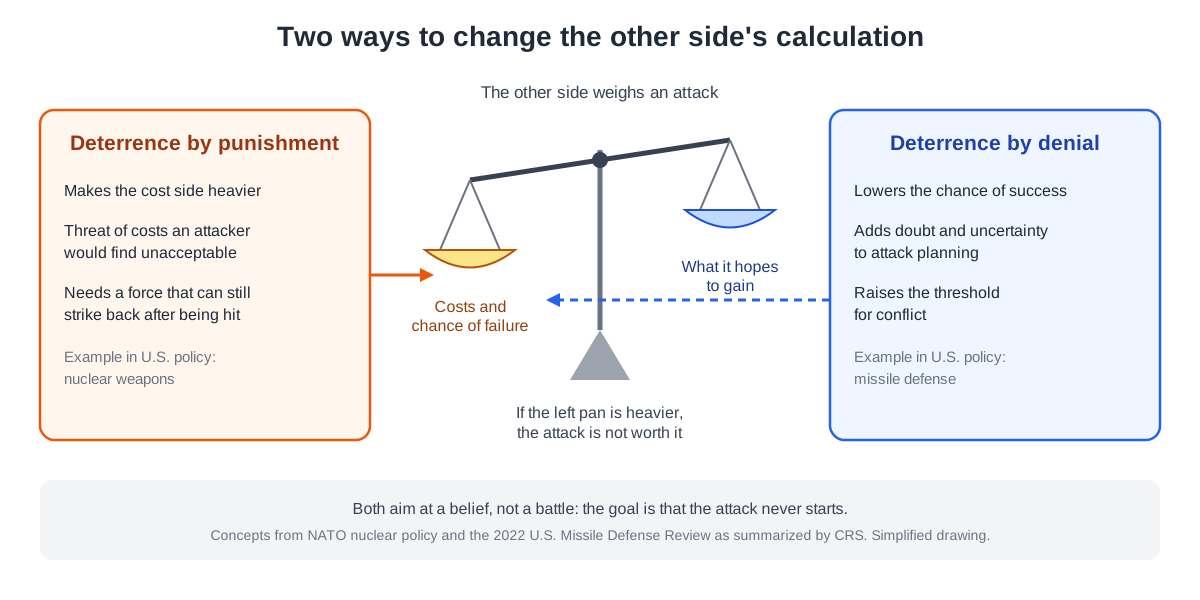
The same review explains how missile defense deters. It introduces doubt and uncertainty into an adversary's strike planning, lowers the probability that an attack succeeds and raises the threshold for conflict. How defenses are stacked in several layers is covered in Layered Missile Defense.
Being able to answer back
Deterrence by punishment comes with a condition. Some power to strike back has to survive being hit first. If a single first strike could wipe out every means of retaliation, the opponent would find the threat of answering back hard to believe.
During the Cold War, Washington and Moscow both held huge arsenals and could still hit back after taking a blow. The State Department's Office of the Historian concludes that any strike would probably have ended in mutually assured destruction. That gave every power a strong incentive not to start a nuclear war. It also notes the worry that more nuclear-armed states could upset this balance and threaten the system of deterrence.
This logic changed how people looked at missile defense too. In January 1967, President Lyndon Johnson revealed that work had started on a limited Soviet anti-ballistic missile (ABM) defense around Moscow.
The concern was that such a defense could let one side strike first and then shoot down the incoming missiles sent in reply. Defense Secretary Robert McNamara warned that reacting to each other's buildup was "an insane road to follow." The idea that limiting both offensive and defensive strategic systems would bring stability then led into negotiations.
Survivability stayed at the center after the Cold War. The 2010 U.S. Nuclear Posture Review (NPR) judged that the force mix helps strategic stability, since warheads carried on submarines that can survive an attack keep an "assured second-strike capability."
Why three legs: the triad
From the early 1960s on, U.S. strategic nuclear weapons have been spread across three kinds of carrier. They are land-based intercontinental ballistic missiles (ICBMs), submarine-launched ballistic missiles (SLBMs) on strategic nuclear submarines, and long-range heavy bombers. Together they are called the triad.
It did not start from a grand design. Congressional Research Service (CRS) material says the three types arose early in the Cold War in large part because each military service wanted a share of the nuclear arsenal. Analysts and the Defense Department refined the reasons later. Each basing mode has different strengths and weaknesses that cover for one another, complicate an attacker's planning and let a large part of the force survive a first strike.
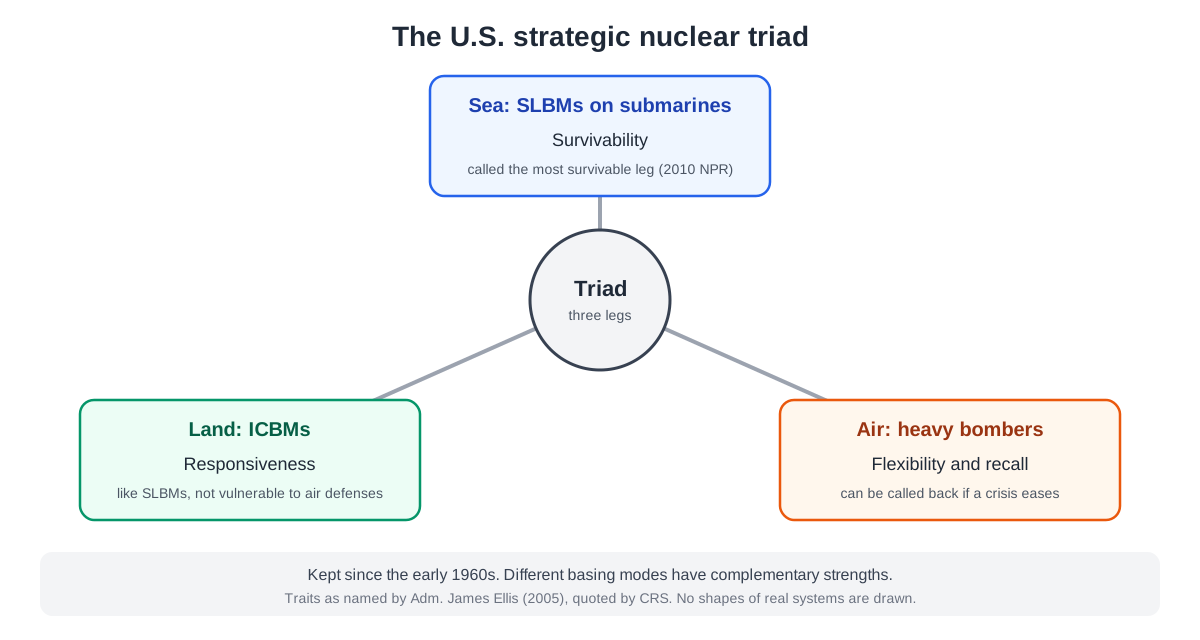
Each leg has a short summary. Admiral James Ellis, a former head of U.S. Strategic Command, gave one in a 2005 interview. ICBMs give responsiveness, SLBMs give survivability, and bombers give flexibility plus the option to recall them.
Bombers can be called back to base if a crisis does not turn into conflict. The 2010 NPR added that visibly sending bombers forward can serve, in a crisis, as a signal that strengthens deterrence and reassures allies.
Extending deterrence to allies
Stretching deterrence to cover allies as well as one's own territory is called extended deterrence. Because it depends on the opponent believing that "an attack on our ally is an attack on us," the promise comes with arrangements that make it visible.
Three NATO members count as nuclear-weapon states under the NPT: France, the United Kingdom and the United States. NATO calls the Alliance's strategic nuclear forces, especially those of the United States, the supreme guarantee of its security. The independent forces of the United Kingdom and France add separate centers of decision, which complicates an adversary's calculations.
U.S. nuclear weapons are forward-deployed in Europe, but the United States keeps absolute control and custody of them. The Allies keep political control of every aspect of nuclear decision-making, and the Nuclear Planning Group (NPG) that handles this work was founded in 1966.
The same words are used on the Korean Peninsula. In the Washington Declaration of April 26, 2023, South Korea said it trusted U.S. extended deterrence pledges fully and reaffirmed its obligations under the NPT. The United States stated that its extended deterrence for South Korea rests on every kind of U.S. capability, nuclear included. The two presidents also announced a new Nuclear Consultative Group (NCG) meant to make that deterrence stronger.
What came after the Cuban crisis
One lesson of the Cuban crisis was surprisingly simple. Throughout the crisis, the two leaders and their advisers struggled to understand each other's true intentions. To keep that from happening again, a direct line was set up linking the White House with the Kremlin, and it became known as the "Hotline."
The second result concerned nuclear testing. In 1963, the United States, the Soviet Union and the United Kingdom signed the Limited Test Ban Treaty (LTBT). It outlawed every nuclear test in the air, in outer space and under water, and the State Department's historians count it as the Cold War's first arms control deal.
Underground tests were left out for a reason. Earlier talks kept stalling on verification. The United States and Britain held that without on-site inspections there was no way to tell Soviet underground tests from the region's frequent earthquakes. The Soviet Union was reluctant to allow those inspections.
Once underground testing was dropped from this first treaty, agreement came quickly. In practice the treaty did little to slow how nuclear weapons were developed or how they spread, but it set a precedent that later arms control could build on. The 1974 Threshold Test Ban Treaty (TTBT) limited underground tests with a yield above 150 kt. In September 1996, the Comprehensive Nuclear-Test-Ban Treaty (CTBT) opened for signature, and it enters into force only after all 44 states listed in its Annex 2 have ratified it.
Keeping it from spreading: the NPT
By the early 1960s, the know-how for nuclear weapons was close to spreading widely. Five countries had the bomb by 1964: the United States, the Soviet Union and the United Kingdom, plus France, which exploded its first bomb in 1960, and China in 1964. Deterrence was thought workable while only the United States, Britain and the Soviet Union could launch a nuclear strike, so a growing number of nuclear states was itself a worry.
The answer was the Treaty on the Non-Proliferation of Nuclear Weapons (NPT). Nuclear-armed signatories agreed not to pass nuclear weapons or the technology to any other state, and non-nuclear states agreed not to receive, develop or otherwise acquire them. All signatories agreed to accept safeguards from the International Atomic Energy Agency (IAEA), which uses inspections to check that states keep to the treaty. The UN Office for Disarmament Affairs calls nonproliferation, disarmament and the peaceful use of nuclear energy the treaty's three pillars.
The NPT opened for signature in 1968, entered into force in 1970 and was extended indefinitely on May 11, 1995. According to the UN disarmament office, 191 states have joined, including the five nuclear-weapon states, and the treaty's operation is reviewed every five years. It was not complete from the start. At signing, the nuclear powers France and China and a number of non-nuclear states stayed out, and in 1974 India exploded its first nuclear weapon.
A line was drawn in space around the same time. Four years after the Limited Test Ban Treaty, the two powers agreed to an Outer Space Treaty. It kept nuclear weapons systems from being placed in space as satellites.
Treaties that capped numbers
After tests and spread came the number of weapons. On May 26, 1972, in Moscow, Richard Nixon and Leonid Brezhnev signed the ABM Treaty and the interim SALT I agreement. For the first time in the Cold War, the two countries agreed to cap how many nuclear missiles each side kept.
The ABM Treaty carries the retaliation logic seen earlier. It held each side's strategic missile defenses to 200 interceptors and allowed only two defense sites, one protecting the national capital and one protecting an ICBM field. It handled the earlier worry, that a large defense could be used to block retaliation, by fixing how big the defense could be.
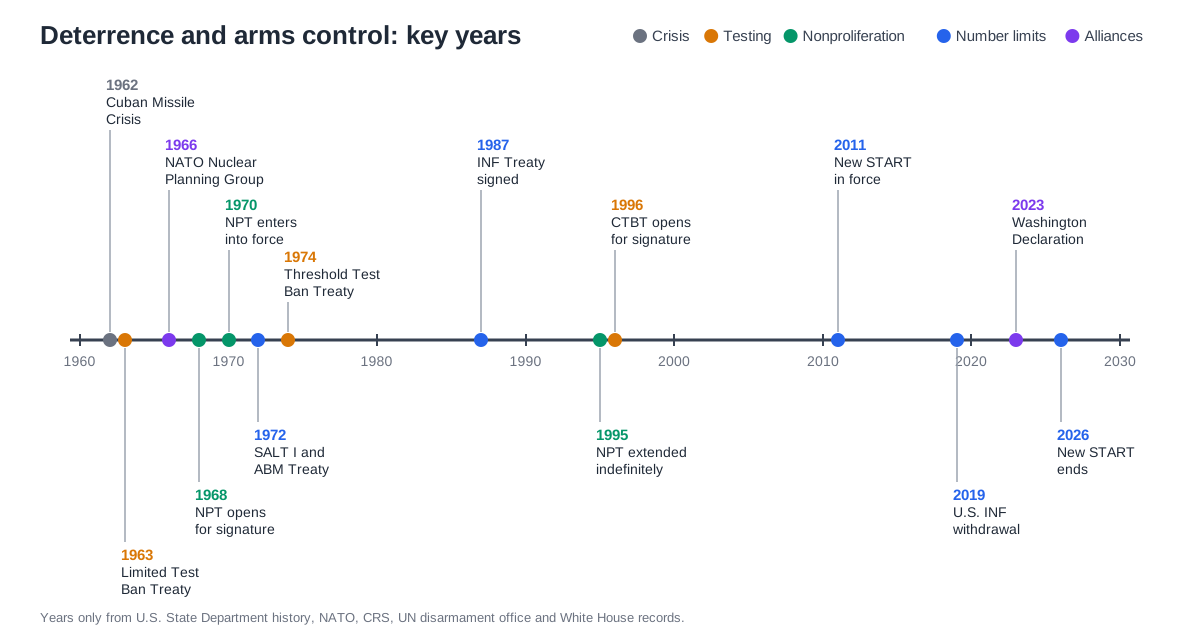
Later treaties counted in more detail. The INF Treaty, signed on December 8, 1987, required the elimination of ground-launched ballistic and cruise missiles with ranges of 500–5,500 km by June 1, 1991. It ended when the U.S. withdrawal took effect on August 2, 2019.
New START, from 2011, limited U.S. strategic forces until February 5, 2026. What these two treaties counted and how they were checked is covered separately in the series article "Arms Control Treaties: What INF and New START Limited."
Where this meets lasers: a weapon banned before use
The nuclear treaties in this article all came after nuclear weapons had been built and tested again and again. Limits on testing, on spread and on numbers followed one after another. Lasers offer an example in the opposite order.
In 1995, Protocol IV on blinding laser weapons was adopted under the Convention on Certain Conventional Weapons (CCW). The UN Office for Disarmament Affairs points to it as a case where a weapon was outlawed in advance, before anyone used it. How the protocol defines a "blinding laser weapon" is explained in Eye safety and international rules: the protocol on blinding laser weapons.
What to read next
- ICBM: what kind of missile the land-based leg of the triad is.
- SLBM: the submarine-launched missile known as the survivable leg.
- Layered Missile Defense: how missile defense, the working form of deterrence by denial, is put together.
- Arms Control Treaties: What INF and New START Limited: the counting rules and checks behind the two treaties.