Equipment brochures and defense news sometimes mention names like MIL-STD-810 or MIL-STD-461. What does a short code followed by a number promise? Is it a guarantee that the equipment is tough, or a guide to how it should be tested?
These names are document numbers of military standards used by the U.S. Department of Defense (DoD). This article looks at how a specification differs from a standard and what one openly available document record tells you. It then follows how the system began in law and changed direction in 1994. It also covers the rules allies share and Korea's defense specifications.
Specification or standard: what is the difference
The two are often named together, but they do different jobs. A 1994 report by the U.S. General Accounting Office (GAO) explains that a military specification describes the physical and operational characteristics of a product. A military standard details the processes and materials used to make it. A standard can also set out how the making and testing of a part should be managed.
A wire makes the difference easy to see. A specification might say what kind of wire goes into an electrical circuit. A standard might say how that wire is fastened in the circuit and what tests the circuit should get. In the United States, the two together are called "milspecs."
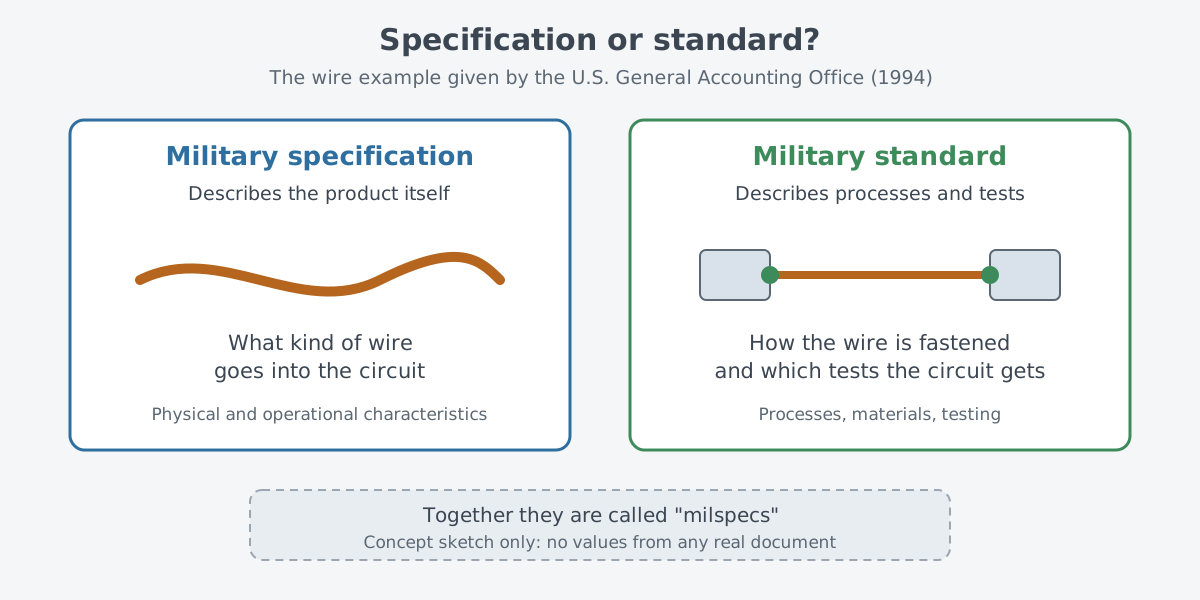
Why write such documents at all? The first of the four main purposes the report lists for milspecs is making sure products work with each other, known as interoperability. The others are getting products that perform in extreme conditions, guarding against contractor fraud, and widening competition among contractors. DoD's standardization program also tried to cut the variety of items it bought by fixing certain design details.
Reading one document record
The Defense Logistics Agency (DLA) runs ASSIST Quick Search, a public website where anyone can look up defense and federal specifications, standards, handbooks and related documents. In most cases, documents cleared for public release can be downloaded there. ASSIST, the system behind it, is the official source for the specifications and standards DoD uses.
Take the record for MIL-STD-461, an interface standard that deals with electromagnetic interference. Its title is "Requirements for the Control of Electromagnetic Interference Characteristics of Subsystems and Equipment." The scope field covers electronic and electrical equipment that DoD designs or buys. It says the standard sets requirements, and ways to verify them, for controlling how much electromagnetic interference (EMI) the equipment gives off and how sensitive it is to interference.
The revision list is worth a look. It runs from Revision C in 1986 through D in 1993, E in 1999, F in 2007 and G in 2015, to Revision H in 2026. Since the 1986 entry, the number 461 has stayed the same and only the letter at the end has changed.
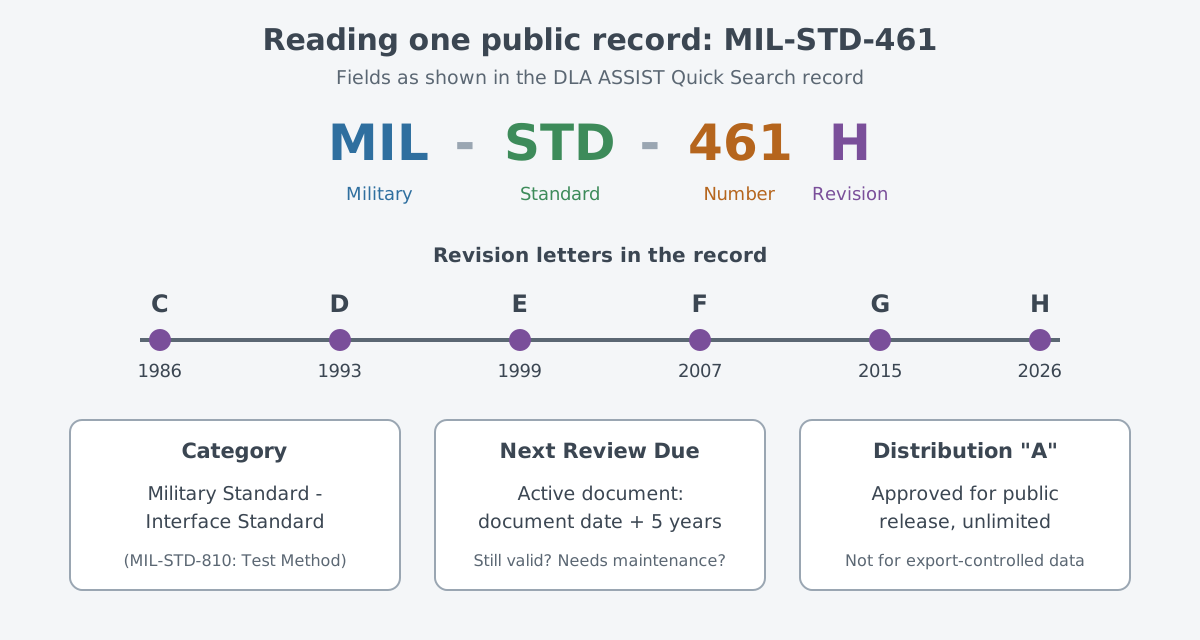
Each record also carries a next review date. According to the ASSIST help page, an active document is due for review five years after its document date, to see whether it is still valid or needs maintenance. The "A" in the distribution column of the revision list means the document is approved for public release with unlimited distribution. This marking is not used for classified technical information or export-controlled technical information.
Standards come in different categories. MIL-STD-810, which covers environmental testing, is listed as a "Test Method Standard," and its preparing activity is the U.S. Army Test and Evaluation Command (ATEC). Revision H Change 1, from 2022, runs to 1,107 pages.
Even so, the scope field for 810 states plainly that it sets no design or test specifications of its own. Instead, it describes a tailoring process: designs and test methods are chosen to match what the equipment has to do. The name "810 testing" alone does not show which methods and conditions were chosen.
MIL-STD-1553 is another example. It is an interface standard for a digital data bus in which devices share one line by taking turns, under a command and response scheme. Revision B came out in 1978 and Revision C in 2018.
Standardization that began in law
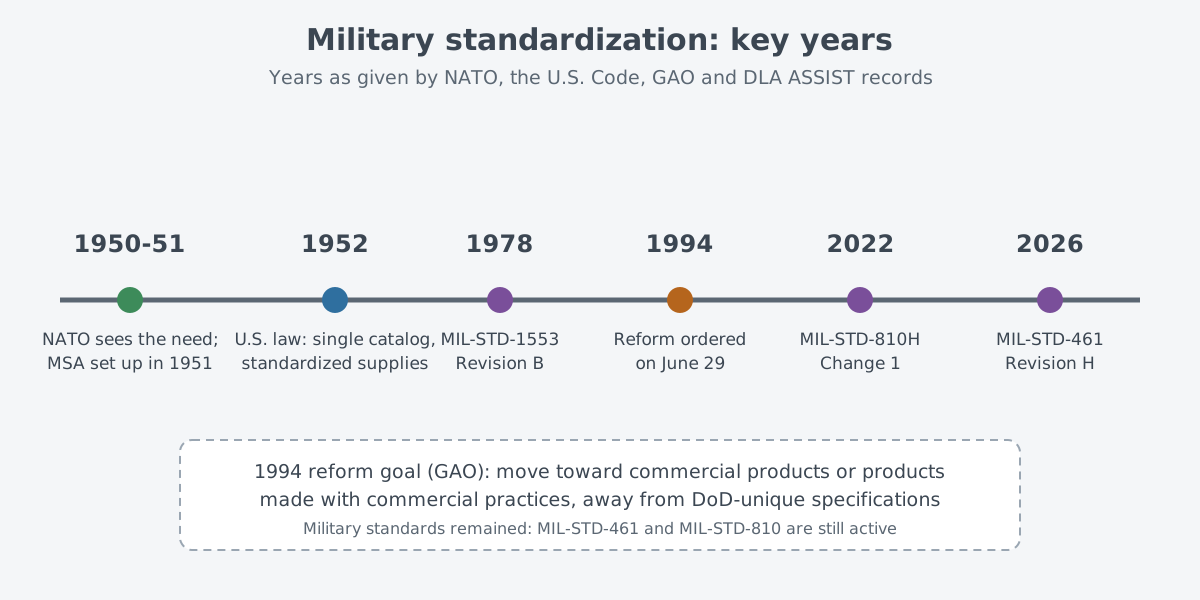
In the United States, defense standardization is a duty written into law. Title 10, Section 2451 of the U.S. Code tells the Secretary of Defense to build one catalog system for DoD, along with a program to standardize its supplies. The source credit for this section goes back to a law of July 1, 1952.
The standardization the law asks for is quite specific. To the highest degree practicable, DoD is to use single specifications for items used across the department. It is also to drop overlapping and duplicate specifications and cut down how many sizes and kinds of similar items exist. In other words, one item should not end up with several sets of specifications.
The 1994 change of direction
The 1952 law called for single specifications; the 1994 reform pointed toward relying less on military ones. On June 29 of that year, the defense secretary ordered each military service and DoD agency to put a new milspec reform program into effect. The GAO report notes that DoD had already spent more than 20 years trying to lean less on these documents, with only modest success.
Studies over those 20 years accepted that milspecs were needed. They also judged the department's process to be complicated and frequently inflexible, and said it kept commercial products and methods out. The goal of the reform was to stop buying items built to DoD-unique specifications and move toward commercial products, or products made with commercial practices.
The reform rested on an April 1994 report by a Process Action Team (PAT), "Blueprint for Change." Of its 24 recommendations, 13 were marked as principal. A few of them:
- ACAT1 programs for new systems and similar efforts state their needs as performance specifications.
- Military specifications and standards are not used in any ACAT program unless the service acquisition executive or a designee authorizes it.
- DoD partners with industry groups on nongovernment standards, which take the place of military standards where that is practical.
Traces of this remain in document numbers. According to the ASSIST help page, acquisition reform is why a document that used to start with MIL-C may now carry MIL-PRF or MIL-DTL instead. Document categories also list performance specifications and detail specifications separately.
Military standards did not disappear, though. MIL-STD-461 and MIL-STD-810 are still active documents, and both have had new revisions since 2015.
Alliance standards and Korean standards
When forces from several countries work together, their rules have to match across borders too. NATO says multinational operations need shared standards, covering ammunition sizes, rail gauges and even the words troops use with each other. It treats interoperability as the final aim of standardization. The NATO document that records member countries' agreement to put a standard into effect is a Standardization Agreement (STANAG).
NATO recognized the need for standardization in 1950, a year after it was founded, and set up the Military Standardization Agency (MSA) in 1951. Some international agreements, including NATO standards the United States has ratified, can be reached through ASSIST, but they do not appear in the public Quick Search. What this means for equipment that shares information between countries continues in Tactical data links.
In Korea, Article 26 of the Defense Acquisition Program Act covers the standardization of military supplies. The Minister of the Defense Acquisition Program Administration must draw up a standardization plan so that military supplies are acquired efficiently. The plan must reflect Korean Industrial Standards wherever they can apply. Under that plan, the Minister designates or removes standard items and establishes, revises or abolishes specifications for military supplies.
Article 31 of the Act's Enforcement Decree calls these specifications "defense specifications" (gukbang gyugyeok). Creating one starts with a request from a set body.
For items whose development was led by the Agency for Defense Development, the request comes from that agency. For items whose development was led by a company, it comes from that company. For force support system items acquired by the Ministry of National Defense or the armed services, it comes from the ministry or the service.
There are also set conditions for changing one. A defense specification can be revised or abolished when it loses its usefulness. The reason can be that domestic industrial technology has changed and advanced, or that the services now require a different defense specification. It stands out that civilian industrial standards and technology change are both written into the legal text.
Where this meets lasers: surviving the test lab first
What laser equipment has to withstand once it leaves the lab is covered in Environmental durability. Keeping optics aligned on a moving platform is covered in Vibration and shock. Both articles run into the name MIL-STD-810.
Put together with this article, they give you questions to ask when you read that equipment "meets military standards." Which document, and which revision? Does that document set the test conditions, or does it give a way to choose them?
What to read next
- Environmental durability: rain, dust, heat, cold and salt: how the name and scope of MIL-STD-810 connect to environmental testing of laser equipment.
- Vibration and shock: protecting optics on a moving platform: what shaking does to optical alignment.
- Simulation versus testing: why CG is not proof: how to tell test results apart from other kinds of evidence.