At 21:40 on 23 October 1942, almost a thousand British field and medium guns opened fire at once on the north coast of Egypt. They fired at the enemy batteries for fifteen minutes. At 22:00 the infantry began walking toward the minefields. The night was clear, and the moon was almost full.
The battlefield took its name from a small stop on the desert railway: El Alamein means "the twin cairns," and it was only 60 miles (about 97 km) from Alexandria. Why did the two armies meet here, of all places? For two years both sides had moved back and forth along the coast road of Libya and Egypt. Much of the reason lies in fuel, water and the distance to the nearest port.
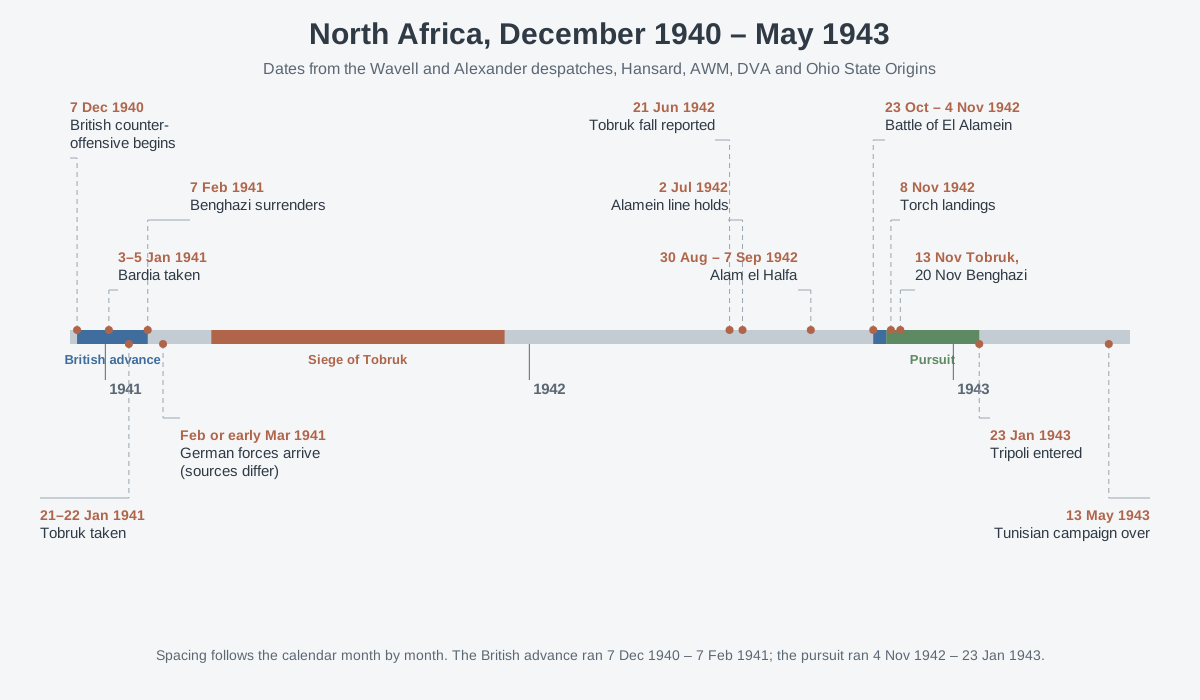
This piece runs from the first British counter-offensive in December 1940 to the surrender in Tunisia in May 1943. Most of the numbers come from a British commander's despatch, the record of the House of Commons and Australian government sources. Enemy losses are British estimates, and the text says so where they appear.
A desert between three continents
Britain kept its Middle East forces in Egypt, at the crossroads of Europe, Africa and Asia. After France was defeated and Italy entered the war, the defense of the region fell to Britain alone.
Home was far away. General Harold Alexander served as Commander-in-Chief of the Middle East Forces. In his postwar despatch he put the sea route back to Britain at 12,000 miles (about 19,300 km). He compared his command to a "beleaguered garrison."
The Libyan desert where the fighting took place offered almost nothing. Distances were great, roads were scarce and water was scarce. Men, ammunition, fuel and even water had to be hauled from the rear, so logistics set the size and pace of every offensive in this campaign.
1940–1941: back and forth along the coast road
Before Wavell's counter-offensive began, the Italian army had advanced into Egypt as far as Sidi Barrani. The counter-offensive started on 7 December 1940. Transport was short, so the British first built dumps of ammunition, water and fuel in the desert between their own lines and the enemy. Supplies for the whole force for several days sat 20–30 miles ahead of the fortified line.
The attack then rolled west along the coast. Bardia fell on 3–5 January 1941 and Tobruk on 21–22 January, and Benghazi surrendered on 7 February. Australia's Department of Veterans' Affairs describes Bardia as the first major land battle Australians fought in the Second World War.
Prisoner counts differ slightly between records. For Bardia, the despatch of General Archibald Wavell, the Commander-in-Chief in the Middle East, gives 45,000 prisoners, while the Australian department gives over 40,000. Wavell reported that in two months his army advanced 500 miles (about 805 km) and took 130,000 prisoners, 400 tanks and 1,290 guns. British losses were 500 killed, 1,373 wounded and 55 missing.
Wavell also gave the navy its own credit. The navy kept the sea lanes open and opened the ports of Sollum, Bardia and Tobruk. Without that, he wrote, the supply problems of such a fast 500-mile advance could not have been overcome.
German forces soon arrived. The Alexander despatch says the German 21st Panzer Division first reached Africa in February 1941 under the name 5th Light Division. The Australian department says Erwin Rommel came with the Afrika Korps in early March.
After the Germans arrived, Tobruk came under siege. Between April and August 1941, about 14,000 Australians were under siege in the port town. While Tobruk held out, the other side had to haul most of its supplies by land from Tripoli harbor, crossing about 1,500 km of desert.
The besieged town breathed through the sea. British and Australian ships kept a route open that became known as the "Tobruk ferry." Two destroyers, three sloops and 21 smaller vessels were lost on it. The siege ended on 10 December 1941.
The Australian War Memorial records that the Australian 9th Division lost 749 killed, 1,996 wounded and 604 prisoners between 8 April and 25 October 1941. Looking back on this period, Alexander wrote that westward offensives had twice cleared Cyrenaica, the eastern part of Libya, and twice lost strength to other theaters. In 1941 it was the Balkans, and in early 1942 the Far East.
Summer 1942: from Tobruk to El Alamein
In mid-May 1942 each army in the desert had roughly 100,000 men. In the figures Prime Minister Winston Churchill gave the House of Commons on 2 July, Britain had 100,000 and the other side 90,000, of whom 50,000 were German.
In June the British were driven back hard. After the fighting at Gazala, Tobruk and its garrison of about 25,000 men fell in a single day. On the night before, General Claude Auchinleck had telegraphed London that 90 days' supplies were available. Churchill received the report of the fall on the morning of Sunday, 21 June, in Washington.
In the same speech Churchill said that more than 50,000 men had been lost in Cyrenaica and Egypt over the past two weeks, most of them as prisoners. Rommel had advanced nearly 400 miles (about 644 km) through the desert.
The place where the Eighth Army stopped was the El Alamein line. The position had been built in 1941. Its southern end was covered by the Qattara Depression, the dried-up bed of an ancient inland sea. Its quicksands and salt marshes stopped even a loaded camel almost everywhere, and its eastern end came within about 40 miles (about 64 km) of the coast.
For the desert this was an unusually short line, and no one could go around its southern end. Water was still a problem: the Taqa plateau position in the south had no water source inside it. Even a short isolation would have meant surrender from thirst, so it had to be given up. On this line the Eighth Army stopped the enemy's attempt to break through on 2 July.
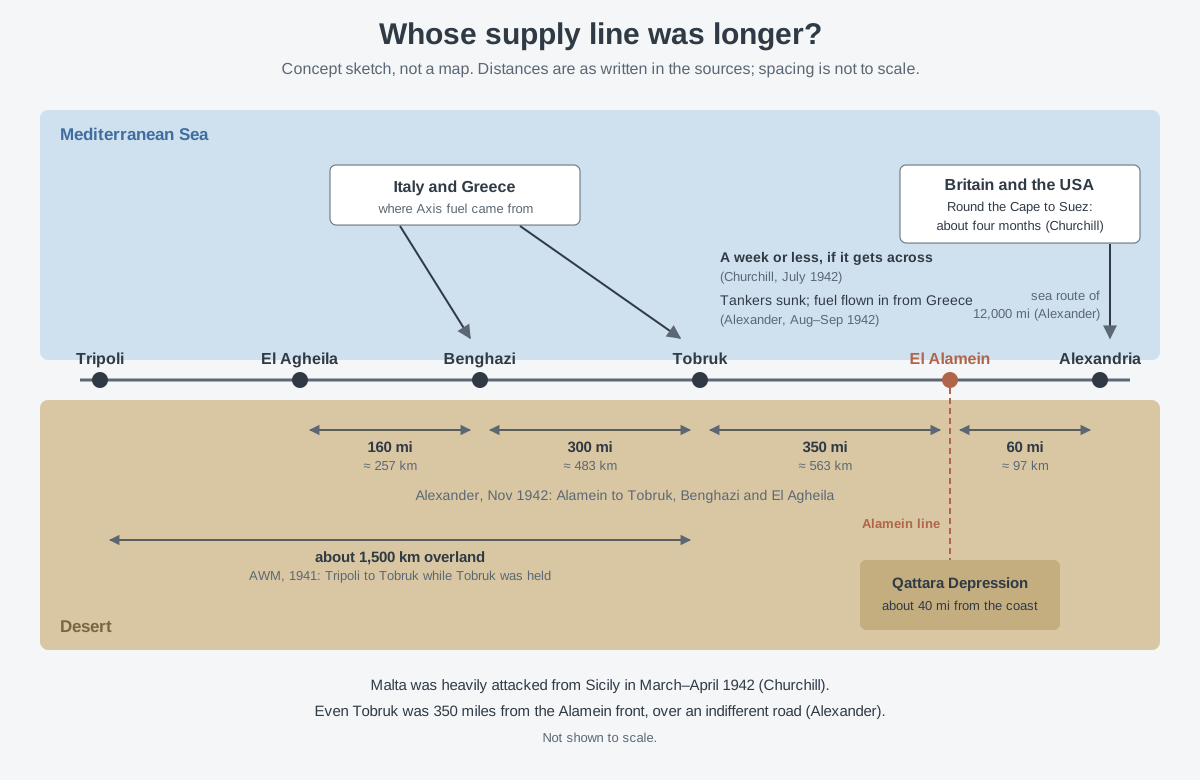
Sea lanes and desert roads: whose line was longer
In his speech of 2 July, Churchill put the difference between the two routes in one sentence. Sending a weapon round the Cape took four months, while sending it across the Mediterranean took a week or less, provided it got across. British tanks and guns came the long way around Africa to Suez. The 300 American Sherman tanks that reached Suez on 3 September 1942 were also shipped round the Cape.
The Axis sea route was short, but it came with that condition: "provided it gets across." Churchill mentioned Malta in the same breath. At the end of March and through April 1942, the enemy gathered a powerful air force in Sicily and attacked Malta. It did not take Malta, but it got a lot of material across to Africa.
In front of El Alamein the Axis supply line was stretched further than ever. Fuel was where the strain showed most. Fuel in dumps or in truck convoys was fairly safe from air attack, but to get from Italy to Africa it had to travel in tankers.
That made tankers the first priority for air attack. The Royal Air Force, helped by bombers of the US Ninth Air Force, went after them, and during that period more were sunk than arrived. The Germans even had to fly fuel in from Greece.
Arriving safely was not the end of it. The Axis mainly used the ports of Tobruk and Benghazi, and Tripoli only to a very small extent. Yet even Tobruk was 350 miles (about 563 km) from the Alamein front, over a poor road. When the RAF bombed Tobruk almost every night, much of the shipping was diverted to Benghazi, which lengthened the haul by truck.
Manpower was another strain. The Alexander despatch gives the British view. About 5,000 men a week arrived by destroyer and aircraft, but they could not keep pace with the very high rate of sickness. Dysentery and jaundice were extremely common, and some units had up to 25% of their strength sick.
The British route was long, but it ended at a large base. Middle East ports were handling 466,000 tons of military stores a month, and Alexandria was only 60 miles behind Alamein. One side had a short but fragile sea crossing followed by a long desert road. The other had a very long voyage followed by a short desert road.
Desert equipment: tanks, anti-tank guns, mines and trucks
In summer 1942 every German formation in front of El Alamein was motorized except the newly arrived 164th Division. Italian divisions were not, apart from the three in XX Corps. German armored divisions used the Mark III and Mark IV tank, and a few of the Mark IVs were a newer type with a high-velocity 75 mm gun. The Italian M13 tank weighed 13 tons and carried a 47 mm gun.
What struck Alexander most about German and Italian infantry divisions was their large number of anti-tank guns. The desert allowed movement in any direction, and flanks were nearly always open. Even small units had to be ready for a tank attack at any moment.
In defense, minefields mattered most. Alexander wrote that, "as always in the desert," minefields of anti-tank and anti-personnel mines were the most important part of the enemy's field works. By October a belt 5,000–8,000 yards (about 4.6–7.3 km) deep, thick with mines and defended posts, stretched from the coast to the Deir el Mreir depression.
Trucks drew less attention but mattered as much. Any advance led into a desert with nothing in it except some poor water, and all supplies had to come from the same base. By 23 August the Eighth Army had the equivalent of 46 General Transport companies and 6 tank transporter companies, with 7 more transport companies held in reserve.
A footnote in the despatch preserves the rule of thumb of the time. In theory, one General Transport company could maintain one division 50 miles from a railhead or port. That assumed seven days a week, ten hours a day and good roads, and in the desert one company's work sometimes needed six.
Repair was part of fighting strength too. Repaired and reconditioned tanks, trucks and guns poured out of the workshops. The repair figures from the battle itself appear again in the section on numbers and interpretations.
Alam el Halfa: an offensive short of fuel
Alexander expected the enemy to attack around 25 August, the night of the full moon. That had been the plan, but fuel shortages pushed it back. Around 3 September, the enemy had built up only two weeks' supplies at operational scales for this offensive.
The offensive opened on the night of 30 August. The British 13th Corps in the south and the enemy's striking force were evenly matched in armor and artillery. Each side had about 300 field and medium guns and 400 anti-tank guns. The enemy had 500 medium and light tanks, half German and half Italian, and 13th Corps had 300 medium and 80 light tanks.
On 2 September a new crisis hit the Axis fuel situation. Three tankers were sunk in two days. The Germans never came closer to the Nile Delta than this.
The fighting was called off at 07:00 on 7 September. The enemy had gained four or five miles of desert but left behind 42 German and 11 Italian tanks, nearly 700 vehicles, 30 field guns and 40 anti-tank guns. The British estimated enemy killed and wounded at 2,000 Italians and 2,500 Germans, and 300 were taken prisoner.
British losses were 68 tanks and 1,640 killed, wounded and missing. Alexander judged the battle far more important than any statistics of gains and losses would suggest.
From the night of October 23 to November 4
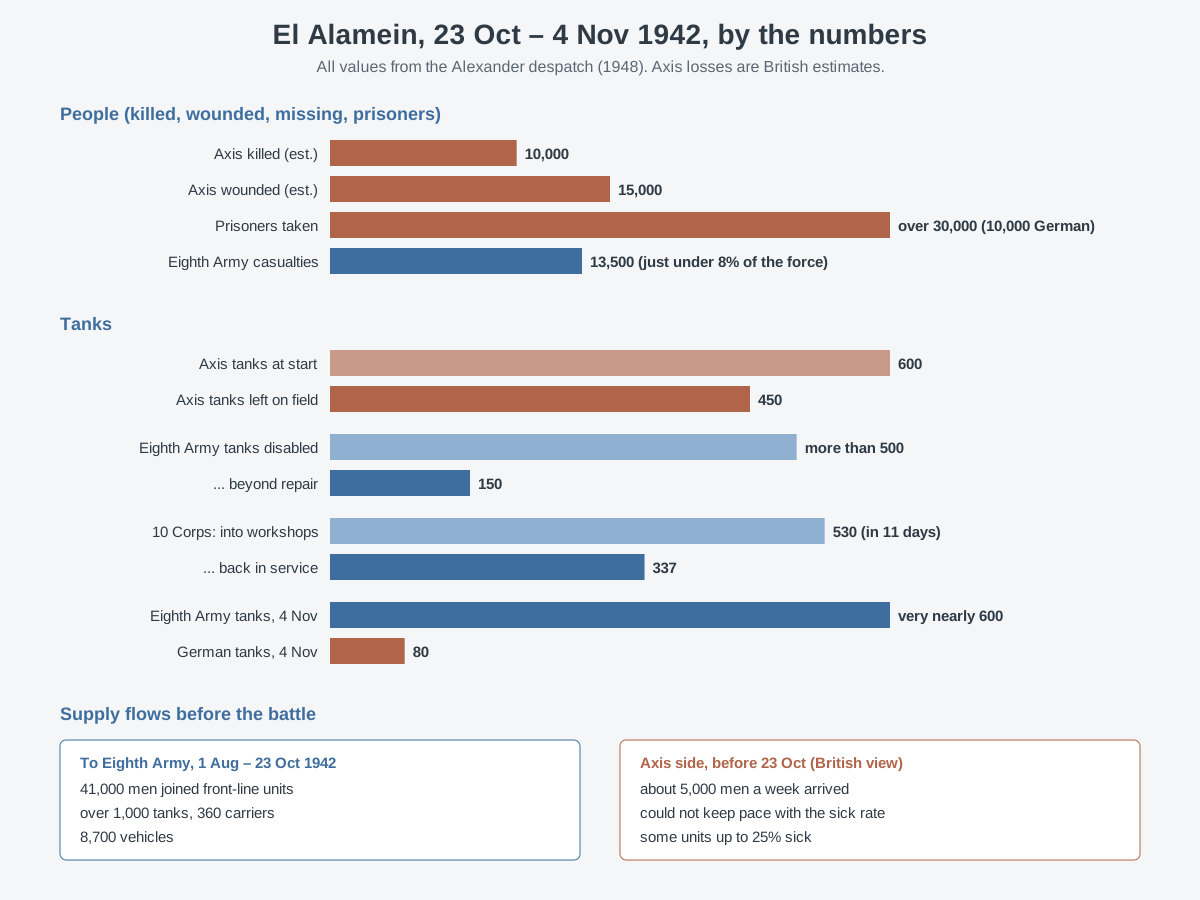
Meanwhile the British build-up grew quickly. Between 1 August and 23 October, 41,000 men joined front-line units, not counting those who came with new formations. The Eighth Army also received over 1,000 tanks, 360 carriers and 8,700 vehicles in those weeks, and the flow of men to the front far exceeded battle casualties.
The moon set the date. The infantry had to take the minefields and clear lanes at night, and lifting mines quickly and accurately needed good moonlight. The full moon fell on 24 October, and Alexander, in agreement with Eighth Army commander Bernard Montgomery, chose 23 October.
Another calculation went into the date. Operation Torch, the American and British landings in French North Africa, was scheduled for 8 November, and the Alamein offensive was planned to come just over two weeks earlier.
The preparations had to be hidden. Behind the northern sector, 7,500 tons of fuel, stores and ammunition had to be concealed. In the south, a dummy pipeline made of old fuel cans was built from 27 September. Alexander judged the deception entirely successful; only on the third day of the attack did the enemy concentrate all his strength against the real thrust.
The first phase finished 24 hours behind schedule. The main reason was how densely the ground had been mined. By dawn on 25 October, 30th Corps in the north had opened a breach six miles wide in the enemy defenses.
The last major attack was called Supercharge. Because the moon was waning, it went in three hours later than on the first night, at 01:05 on 2 November. Alexander wrote that the fighting of 2 November was decisive and that the enemy must have decided that night to withdraw.
Sources record that decision a little differently. The Australian department says Rommel had to order a general retreat on 2 November. The British saw signs of a withdrawal early on 3 November, and the Battle of El Alamein closed with the fighting near Ghazal on 4 November.
Supplying the pursuit: Tobruk, Benghazi, Tripoli
On 4 November the Eighth Army could field very nearly 600 tanks, and the Germans had 80 left. Alexander wrote that the main problem was not finding enough strength to beat a fleeing enemy, but keeping the pursuit from outrunning its supplies.
The distances ahead were long. Tobruk was 350 miles from Alamein, Benghazi another 300 miles (about 483 km) beyond it, and El Agheila another 160 miles (about 257 km) further west. As expected, the coastal wells up to the frontier had been fouled with oil, and the water pipeline from Alexandria could no longer be relied on. The front-line units could be supplied only by road.
At 09:00 on 13 November, British troops entered Tobruk without opposition. 10th Corps had advanced 220 miles (about 354 km) in six days, and the road and railway had been heavily demolished. Even so, supplies came ashore at Sollum, and Matruh and Bardia harbors were working again two days after they were taken. That gave one leading brigade enough to keep going.
On 20 November the British entered Benghazi, and on 25 November patrols made contact with the next enemy position at El Agheila. All of Cyrenaica was now in British hands.
Alexander wrote that Agheila was far from the forward ports, so building up reserves for an attack took time. That was one reason it had twice marked the limit of a British advance. Here he puts Agheila 150 miles from Benghazi, slightly different from the 160 miles given earlier.
This time British supply kept up. Railhead opened at Capuzzo on 21 November and at Tobruk on 1 December. By then 3,000 tons of Nile water a day were being delivered to a point 25 miles west of Matruh.
The ports came back quickly too. Four days after each port was taken, the first ships came into Tobruk and Benghazi. Within two weeks Tobruk was working at its full capacity of 1,000 tons a day, and within three weeks Benghazi was unloading twice that.
At 05:00 on 23 January 1943, British troops entered Tripoli. At 09:00, just outside the city, Italian officials formally surrendered it to Montgomery. Unlike Benghazi, which the Italians had evacuated, Tripoli's civilian population had all stayed.
Public services still worked, but food was short, and British soldiers were not allowed to buy food meant for civilians. Damage to the port was especially widespread.
Operation Torch and Tunis
On 8 November 1942, American and British forces landed on beaches and at ports across French North Africa. An article in Origins, a history publication of Ohio State University, calls it the largest and most complicated landing from the sea that the world had seen up to then. Some 670 vessels and 107,000 soldiers came ashore at three sites near Casablanca, Oran and Algiers.
An armistice was signed on 11 November, and Morocco and Algeria were in Allied hands. Allied casualties were just over 2,000. The plan was for the landed forces to strike east and take Tunisia before German and Italian reinforcements could arrive. Tunis lay more than 500 miles from Algiers.
The end came in May 1943. Mass surrenders followed on 12 May, and the Italian general Giovanni Messe held out until the morning of the 13th. Alexander wrote that a quarter of a million men surrendered unconditionally and 663 escaped, and that Allied casualties in the final battle were fewer than 2,000.
At 14:15 on 13 May, Alexander signaled Churchill that the Tunisian campaign was over. The message ended: "We are masters of the North African shores."
Numbers and interpretations
The losses at El Alamein come from British records. Alexander judged that just under a third of the Axis army got away, and he estimated enemy losses at 10,000 killed and 15,000 wounded. Over 30,000 prisoners were taken, 10,000 of them German.
Of 600 enemy tanks, 450 were left on the battlefield, and over 1,000 guns were destroyed or captured. Eighth Army losses were 13,500 killed, wounded and missing, just under 8% of the force engaged. All the figures for the other side are British estimates.
The repair figures are worth a look. More than 500 Eighth Army tanks were disabled, but only 150 were beyond repair. In 10th Corps alone, 337 of the 530 tanks received in workshops went back into service during the 11 days of the battle.
Behind the numbers are people. More than 3,000 Australians died in North Africa alone. Commonwealth war cemeteries hold 2,312 Australians in Egypt and 856 in Libya.
Views of the campaign differ. The Australian War Memorial describes the battles around El Alamein from July to November 1942 as "the turning point of the campaign in North Africa." Alexander looked earlier, to the moment the Afrika Korps began to fall back at Alam el Halfa, which he saw as the first westward ebb of the Axis tide. A few months later, he wrote, the same ebb began in the Caucasus and on the Volga steppe.
Two days after the Torch landings, Churchill said in a speech in London: "Now this is not the end. It is not even the beginning to the end. But it is, perhaps, the end of the beginning." Alexander applied the phrase to the whole campaign through Tunis and called it "the first wholly successful campaign against the Axis."
Other views exist too. The Origins article notes that Torch is often overshadowed by Normandy. It is sometimes portrayed as the start of "a long, grinding journey through the Mediterranean" or as "a costly sideshow of limited strategic value." Its authors still call it a watershed, and they add that many people wondered then, and have wondered since, whether the route through Northwest Africa was necessary.
What to read next
- Military logistics: performance must be sustainable: what it takes to keep weapons in use, and what that costs.
- Main battle tanks: is it all about the gun?: how today's tanks fit firepower, protection and mobility into one vehicle.
- Turning points in military technology: from the proximity fuze to unmanned systems, the technologies that changed how wars are fought.
- A history of laser weapons: from chemical to electric lasers: how research into weapons that use light has developed.
- The Battle of Stalingrad: The City That Turned the War: the Eastern Front story of the same autumn of 1942.