On 5 June 1944, the Supreme Allied Commander, Dwight Eisenhower, wrote a short press statement by hand on a notepad. It was meant for use if the landings failed.
"Our landings in the Cherbourg-Havre area have failed to gain a satisfactory foothold and I have withdrawn the troops," it begins. The last line reads: "If any blame or fault attaches to the attempt, it is mine alone." The note is dated by mistake "July" 5 instead of June 5.
The note was never used. At dawn the next day, Allied forces crossed the English Channel and came ashore on five beaches on the Normandy coast of France, the day now known as D-Day. Why was this landing put off for more than two years, and why Normandy and why 6 June? How did the day differ from beach to beach, and why do the numbers differ from source to source?
A landing put off for more than two years
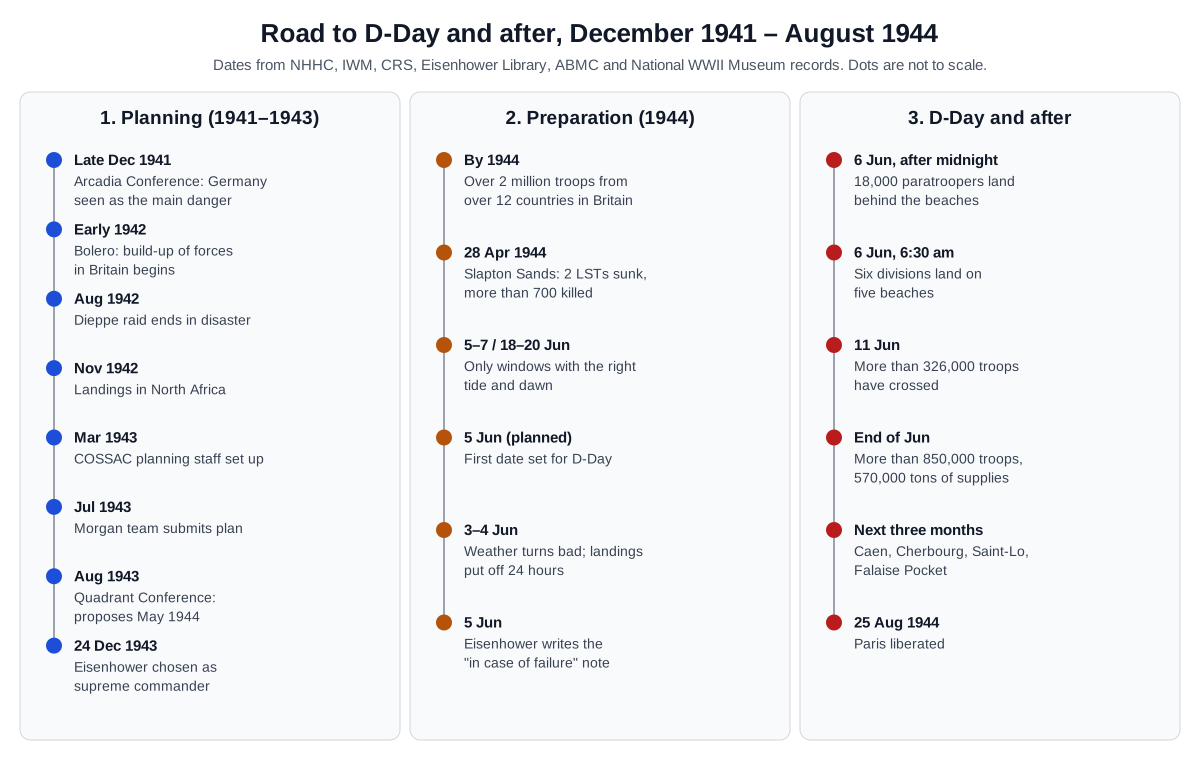
In late December 1941, the Arcadia Conference met in Washington, DC. There the Allies built their strategy on treating Germany as the greater threat. If so, a large British and American landing in northwestern Europe would come sooner or later.
From early 1942, an effort called Bolero began gathering forces in Britain. A concept called Roundup, which would seize broad beachheads on the French Channel coast and break out inland, later became Operation Overlord. Britain, however, was slow to commit to a big assault on the German heartland. The British and Canadian raid on Dieppe, France, ended in disaster in August 1942 and hardened that reluctance.
Prime Minister Winston Churchill argued for striking first at the edges of southern Europe, and that path led to the North Africa landings in November 1942. The Mediterranean campaigns of 1942–1943 in fact held back the gathering of forces in Britain.
A planning body was set up in March 1943. It was a combined staff called COSSAC, and British, American and Canadian officers led by Lieutenant General Frederick Morgan submitted an invasion plan in July 1943. In August, the Quadrant Conference in Quebec proposed May 1944 as the date.
Until then, the Soviet Union had carried most of the fighting against Germany. After the Tehran Conference, held from November to December 1943, the Western Allies promised a second front against Germany for the summer of 1944. On 24 December, President Roosevelt chose Eisenhower as supreme commander.
Imperial War Museums (IWM) explains that a second front would ease the burden on the Soviets in the east, and that freeing France would weaken Germany's hold on western Europe. A foothold in Normandy would give the Allies a lasting presence in northern Europe again, the first since the Dunkirk evacuation of 1940.
There are two names to keep apart. Overlord was the code name for the whole operation, combining land, sea and air. Neptune was the code name for one part of it, the seaborne assault across the Channel. The "D" in D-Day simply marks the first day of a major operation, so other operations had D-Days of their own.
Why Normandy
COSSAC narrowed the choice to two areas. One was the Pas-de-Calais and the Picardy coast. The other was the Bay of the Seine and the Calvados coast of Normandy, stretching from Caen west to the Cotentin Peninsula. Normandy had no major port, but it had broad beaches, and in the end it was chosen.
The missing port was made up for with hardware. The Allies built the concrete and steel parts for two artificial harbors, called Mulberries: one for the American beaches and one for the British and Canadian sector.
Fuel needs after the landings were expected to exceed what ships could carry, so undersea pipelines called PLUTO (Pipeline Under the Ocean) were also made ready. Logistics was as large a part of the plan as the fighting.
Preparations this large could not all be hidden from German reconnaissance aircraft. So the Allies used decoys and deception to confirm the German leadership's belief that the main landing would come in the Pas-de-Calais. According to the Congressional Research Service (CRS), most German defending forces sat 150 miles from the landing sites in Normandy. Even in July 1944, the Germans still expected the main Allied force to come ashore elsewhere.
People and supplies piled up as well. In the first six months of 1944 alone, about 9 million tonnes of equipment and supplies were shipped from North America to Britain. More than 1.4 million American servicemen arrived in 1943 and 1944 for the landings. By 1944, more than 2 million troops from more than 12 countries were waiting in Britain.
Tide, dawn and weather: the conditions for a date
The Army and the Navy disagreed about the landing time, or H-hour. The Army wanted to land at high water, to cut the time spent crossing open beach. The Navy wanted to land at low tide, with craft grounding outside the beach obstacles so that demolition teams could clear them.
They settled on a first landing no later than three hours after low tide, timed between just before dawn and 90 minutes after it. Only two windows fit those conditions: 5–7 June and 18–20 June. Planners saw that the weather might force a sudden delay, and that an earlier date left more room to adjust, so D-Day was first set for 5 June.
The weather did turn bad. Low cloud ruled out bombing and close air support, and waves were high enough to flood landing craft. With most ships already underway, Eisenhower put the landings off for 24 hours and called the task forces back. Smaller vessels returned to port, larger ships circled off the English coast, and the troops stayed on board.
There were losses during the preparations too. On 28 April at Slapton Sands in Devon, England, a German surface attack hit American landing ships. Two tank landing ships (LSTs) sank and a third was badly damaged, and more than 700 US Navy and Army personnel were killed and at least 200 wounded.
The Atlantic Wall and two ideas of defense
Germany tried to hold the northern coast of France with fortifications it called the Atlantic Wall. Despite the name, it was hardly a continuous wall, but the likely landing areas were heavily defended. Erwin Rommel, who arrived in November 1943 to command Army Group B, pushed hard on building fortifications and beach obstacles.
The obstacles were designed to stop or wreck landing craft, and many of them carried mines. At high tide they were hidden under the water. That did not make the defense equally strong everywhere. The German defenses were often incomplete and short of men.
German commanders also disagreed about how to defend. According to postwar interrogations of German officers, Gerd von Rundstedt, the German Commander in Chief, West, favored letting the enemy land and then counterattacking quickly with concentrated reserves. Rommel believed in a belt of troops along the shore that would fight the landing itself.
In the same recollections, Rommel inspected the coast in December 1943. He named the Scheldt estuary, the Somme estuary and the western Bay of the Seine as the three most likely landing sites. Another passage says he ultimately hoped to plant between 50 and 100 million mines. Even so, the German high command was looking for the landing in the Pas-de-Calais, where the Channel is narrowest.
June 6: a night drop and five beaches at dawn
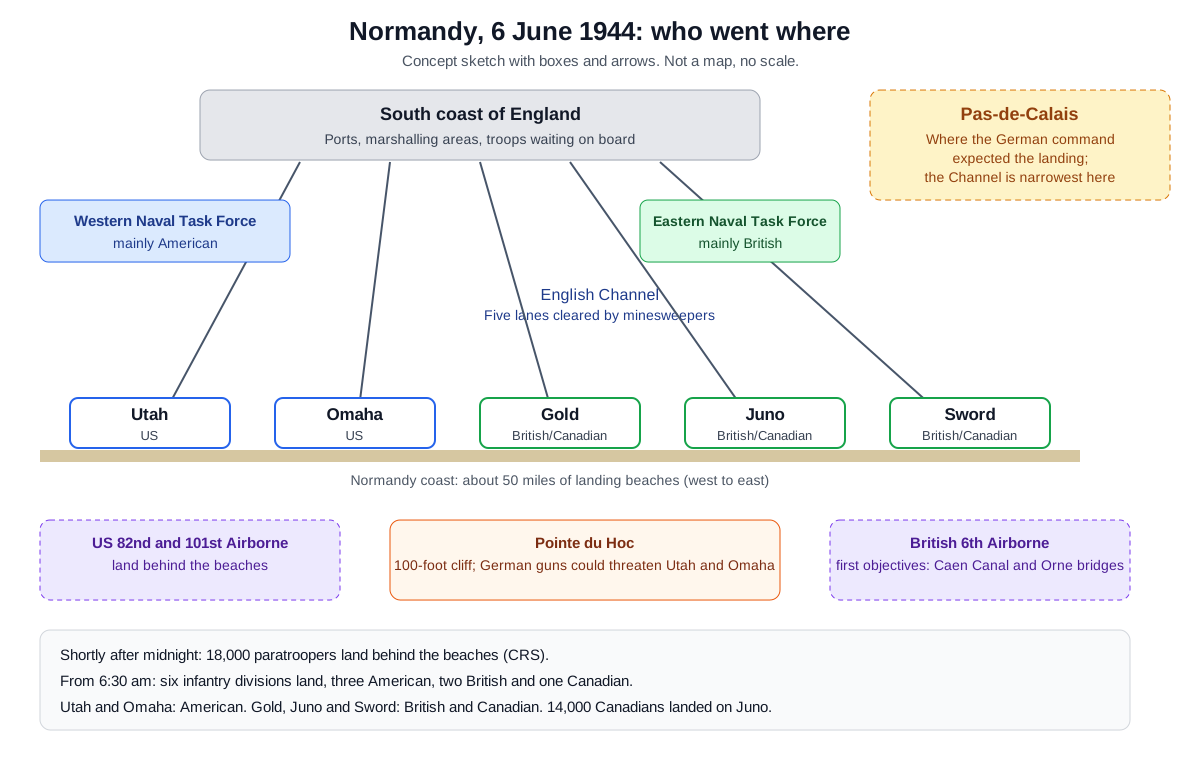
Shortly after midnight on 6 June, airborne troops went in first. Some 18,000 paratroopers of the US 82nd and 101st Airborne Divisions and the British 6th Airborne Division came down behind the landing beaches. The National WWII Museum writes that about 23,400 airborne troops came into Normandy in 822 aircraft and gliders.
British airborne troops went first for the bridges over the Caen Canal and the Orne River. The aim was to secure the routes inland from the beaches and to block a German counterattack. Paratroopers were scattered far from their planned drop zones. The scattering actually confused the German command and made many believe a far bigger force had come down.
At dawn, nearly 7,000 US and British ships and craft lay off the Normandy coast carrying close to 160,000 troops. After the one-day delay, the fleet had crossed the Channel along five lanes cleared beforehand by minesweepers. German commanders had overrated the effect of the bad weather and expected the landings farther northeast, in the Pas-de-Calais, so the dawn took them by surprise.
Cruisers and battleships first shelled the coastal forts and strongpoints, and aircraft attacked after them. Off Utah, the battleship Nevada fired 337 shells from its 14-inch guns and nearly 2,700 from its 5-inch guns. Yet most of the Navy's and the Army Air Forces' shells and bombs landed well behind the German positions.
From 6:30 am, six American, British and Canadian infantry divisions landed on five beaches spread along about 50 miles of coast. In the west, Utah and Omaha went to the Americans, and Gold, Juno and Sword to the British and Canadians. From Utah, the US 4th Infantry Division moved inland, and the British and Canadian divisions moved ahead from Gold, Juno and Sword. According to Veterans Affairs Canada, 14,000 Canadians landed on Juno and 359 Canadian soldiers were killed that day.
Pointe du Hoc is a 100-foot cliff where German guns could threaten both Utah and Omaha. More than 200 men of the US 2nd Ranger Battalion climbed it. At the top, the guns had been replaced with wooden dummies, and the real guns had been moved farther inland. Overhead, Allied air forces flew more than 14,000 sorties that day.
Morning on Omaha Beach
Omaha was the beach with the most Allied casualties. Under the plan, 64 amphibious tanks were to reach the beach five minutes ahead of the first wave of infantry. More than 34,000 Americans landed at Omaha alone that day.
According to H-Gram 031, written by Sam Cox, director of the Naval History and Heritage Command (NHHC), 27 of them sank in the heavy seas. Seven other tank landing craft (LCTs) put 28 tanks into the water, and only two of those made the 2–3 mile swim to the beach. Some officers chose on their own to carry their tanks all the way in.
The bombardment before the landing was short as well. H-Gram 031 says the shore bombardment at Omaha lasted only 30 minutes, not enough to knock out most of the well-hidden German gun positions. The NHHC Neptune essay says the Navy was given an hour to bombard the American beaches, so the two essays give different figures. The Army put the highest priority on cutting the time German reserves would have to react.
Just before the landing, 450 B-24 heavy bombers arrived to strike the beach, but because of overcast, 13,000 bombs fell too far inland. The beach was also held not by the weak garrison division the Allies expected but by the 352nd Infantry Division. IWM gives two reasons the Americans came close to defeat at Omaha. The air and sea bombardment before the landing did not destroy the strongest German positions, and the German troops were highly effective, with hard experience from the Eastern Front.
The teams sent to clear obstacles also suffered badly. At Omaha, 16 teams were to open 16 gaps, but they opened five, and all the gaps were not cleared until two days later. The tide rose one foot every ten minutes. Navy demolition men lost 31 killed and 60 wounded at Omaha, and 6 killed and 11 wounded at Utah.
By about 8:30 am, Omaha Beach was littered with wrecked landing craft, tanks and vehicles and with uncleared obstacles. Hundreds of dead lay on the beach and in the rising tide. The senior surviving Navy beachmaster halted all further landings except assault troops.
Destroyers had begun to move a little earlier. From around 8:00 am, destroyers started firing on German positions, and several moved in on their own initiative until they were 800–1,000 yards off the beach. At 9:50 am, every US destroyer and three British ones received orders to move in toward the beach. Earlier still, in the opening phase, the destroyer Corry hit a mine and went down in under 30 minutes, and 24 of its men died with it.
On the beach, soldiers who had lost many of their leaders battled up the 100-foot bluffs behind it. The American Battle Monuments Commission (ABMC) says the US 1st and 29th Infantry Divisions fought on a beach crowded with obstacles. They crossed open ground of up to 200 yards and climbed steep bluffs, and when the day ended, the American hold on Omaha was still fragile. Colonel Stanhope Mason, chief of staff of the 1st Infantry Division, said that without the destroyers' gunfire the troops could not have crossed the beaches.
Numbers and interpretations
How many troops landed on D-Day? The answer depends on the source. The NHHC Neptune essay gives nearly 132,500, IWM over 132,000, and the Eisenhower Presidential Library almost 133,000. The National WWII Museum's fact sheet gave 156,000 in its 2017 edition and nearly 160,000 in its 2024 edition.
The NHHC overview's "close to 160,000" counts the troops aboard the ships offshore at dawn, while the other sources count troops landed. None of the sources explains why their figures differ.
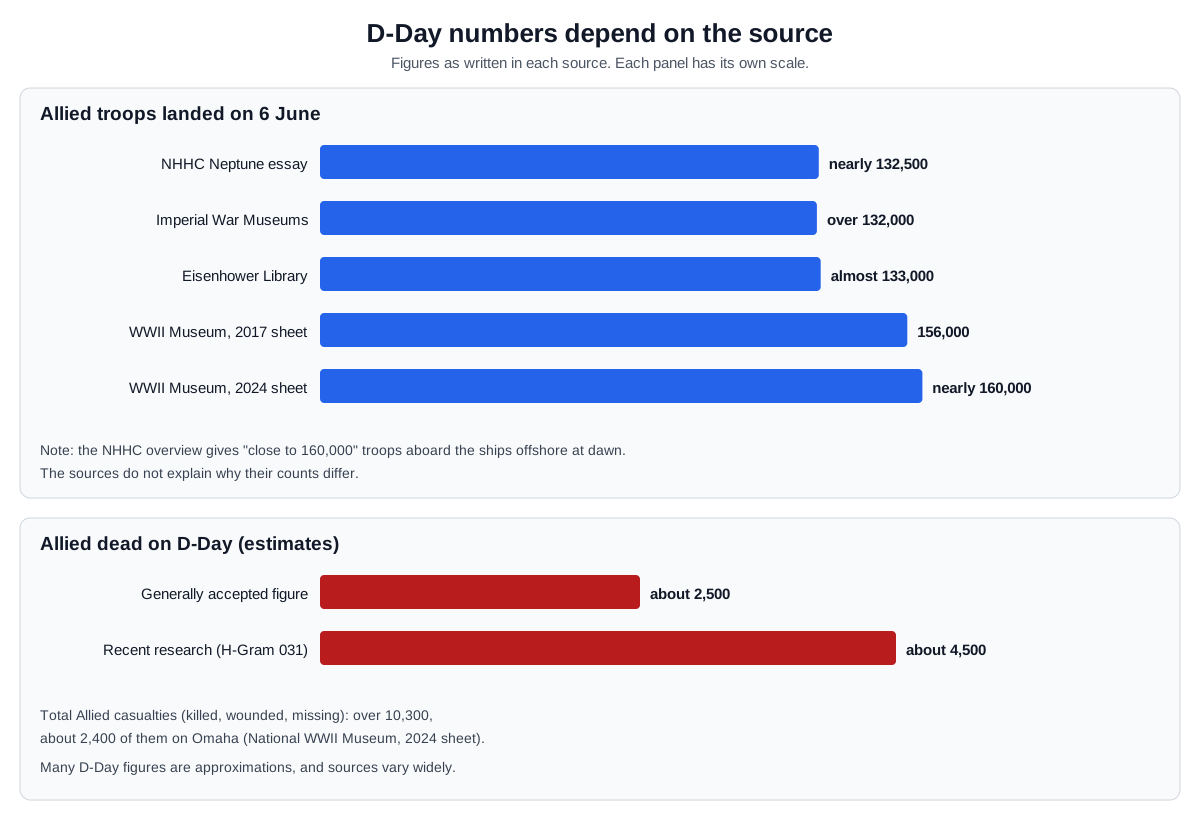
Casualties are harder still. The museum's 2024 fact sheet puts Allied casualties (killed, wounded or missing) at over 10,300, about 2,400 of them on Omaha. The 2017 edition, which also counts prisoners, listed the United States at 6,603 (1,465 killed), the United Kingdom at 2,700 and Canada at 1,074 (359 killed). It estimated the German figure at 4,000 to 9,000.
The count of the dead differs even more. H-Gram 031 says the usual view is about 10,000 casualties with 2,500 dead, but that recent research suggests about 4,500 dead, most of them at Omaha.
Most D-Day force and casualty figures are approximations, and sources vary widely. Gordon Harrison, author of the US Army's official history, judged that accurate losses by unit were unlikely ever to be available. The V Corps history gave the corps' D-Day losses, including the 1st and 29th Divisions, as 2,374.
What about interpretation? IWM calls D-Day the biggest seaborne invasion in the history of war, and CRS notes that it is widely regarded as history's largest amphibious assault. Other fronts mattered too. The Soviet Operation Bagration, launched just after Overlord, destroyed the German Army Group Centre.
Looking only at D-Day can hide the meaning of the Normandy campaign as a whole. The NHHC overview writes that Neptune and the hard breakout that followed paved the way to freeing western Europe and to the final victory of May 1945. The day's place shows only when the landing, three months of fighting and the Eastern Front are seen together.
Afterward: the Battle of Normandy and remembrance
The landing was only the start. By 11 June, with the beachheads secure, over 326,000 Allied troops and over 100,000 tons of equipment had crossed. By the end of June, more than 850,000 troops and 570,000 tons of supplies were ashore in Normandy. For vehicles, the museum gives nearly 150,000 and the Eisenhower Library 148,000.
At sea, the period after the landing was more dangerous. The biggest US Navy ship sunk on D-Day was the destroyer Corry, but the week after D-Day cost the Navy more than D-Day itself. Ships guarding the flow of troops and supplies were sunk, mostly by mines.
On land, fighting went on across Normandy for three months. The British and Canadians freed Caen, the Americans liberated Cherbourg, and the Americans broke out near Saint-Lô. Together with French and Polish units, the Allies encircled German troops in the Falaise Pocket. The bocage of Normandy, with sunken lanes between high, thick hedgerows, was hard to break through and favored the German defenders.
According to Veterans Affairs Canada, more than 90,000 Canadians fought in the Battle of Normandy, over 5,000 were killed and over 13,000 wounded. Paris was liberated on 25 August. By the end of August the German Army was retreating from France, but by September the Allied advance had slowed too. Germany surrendered on 8 May 1945.
At Colleville-sur-Mer, on the plateau the troops reached by climbing up from Omaha Beach, now stands the Normandy American Cemetery. It is one of 14 permanent World War II cemeteries that the United States keeps abroad, and the French government granted the land for all time without charge. Its rows hold 9,388 headstones, and the names of 1,557 missing are carved on its tablets. The cemetery was dedicated on 18 July 1956.
Eisenhower called the effort "the great crusade." The failure note he wrote on 5 June was never needed, and today the Eisenhower Presidential Library makes it public.
What to read next
- Military logistics: performance must be sustainable: links the weight of supply shown by the Mulberries and the pipelines to the modern idea of logistics.
- Destroyers and frigates: why warships have different names: where the name of the ship type that closed on Omaha came from.
- Turning points in military technology: follows technologies that began in World War II and ends with where laser weapons stand.
- The Dunkirk evacuation: the moment in 1940 when the Allies left the continent. Normandy was the first return after it.
- The Battle of the Bulge: the German counteroffensive in the Ardennes in December 1944, after Normandy.