One talk reports 10 kW from a single fiber in a single mode. Another asks how to make pump diodes cheap enough for a laser fusion power plant. Both come from LASE, the laser side of SPIE Photonics West 2027. The seven conferences in this issue fall between January 31 and February 4.
The conferences have not happened yet. The abstracts, however, are already on the SPIE website. Issue No. 1 of this newsletter reads those 269 abstracts and picks out five trends, the talks worth watching in each field, and the numbers the abstracts state.
Every talk comes with its number. In 14439-3, the first five digits are the conference and the rest is the talk's place in that conference. The number is enough to find the original abstract on the SPIE site.
The conference at a glance
The seven LASE conferences and their talk counts are below. A talk in a joint session shared by two conferences is counted once.
| Conference | Number | Dates | Talks |
|---|---|---|---|
| Fiber Lasers XXIV | 14439 | Feb 1–4 | 85 |
| Solid State Lasers XXXVI | 14438 | Jan 31–Feb 1 | 40 |
| High-Power Diode Laser Technology XXV | 14442 | Jan 31–Feb 1 | 40 |
| Laser Resonators, Microresonators, and Beam Control XXIX | 14445 | Feb 2–3 | 32 |
| High Power Lasers for Fusion Research IX | 14440 | Feb 1–3 | 29 |
| Components and Packaging for Lasers and PICs XIII | 14441 | Feb 1–2 | 23 |
| Optical Power Delivery III | 14455 | Feb 2–3 | 20 |
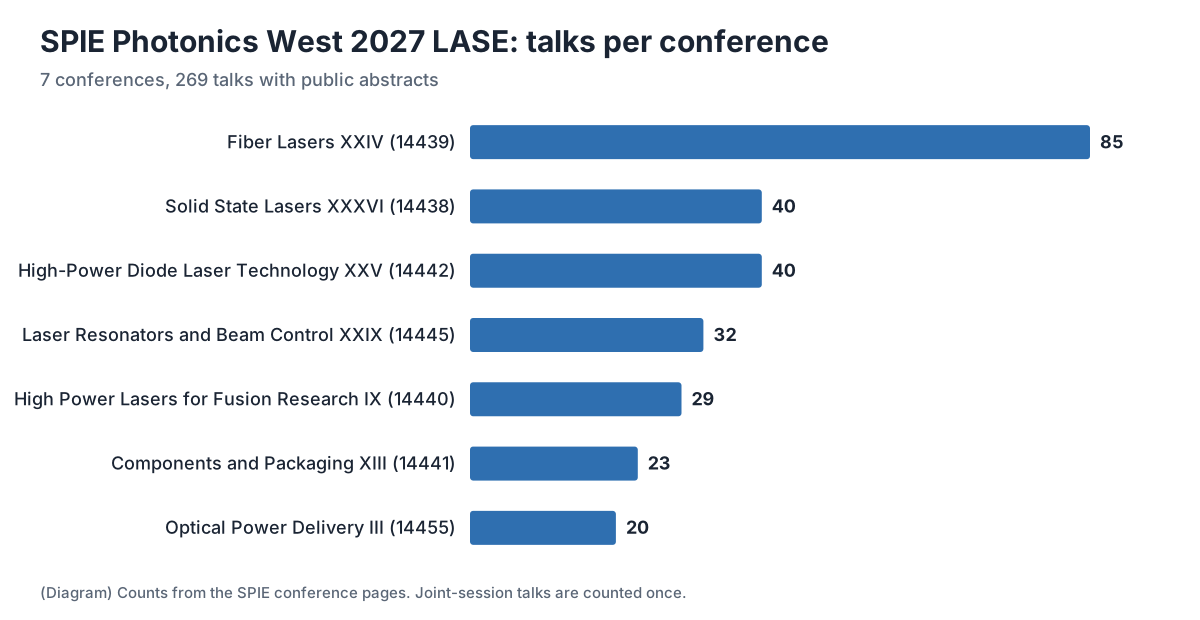
The fiber laser conference alone has 85 talks, a little under a third of all 269. Solid-state lasers and high-power diodes follow with 40 each.
By affiliation type, companies account for 118 talks, universities for 88, government labs for 57 and military bodies for 4. For the remaining 2 talks the type is not given. By country, the United States leads with 111, followed by Germany with 50, the United Kingdom with 23 and Canada with 15. A talk with institutions from several countries counts once for each country.
Five trends at this conference
Each trend ends with a line or two compared with earlier years. The 2022–2026 counts come from this site's LASE notes, which count only talks with a paper in the proceedings, and cover five conferences only. The 2027 counts cover every abstract in the program, so counts and tags show direction rather than size. Tags for 2024–2026 were also assigned automatically by word rules, while this year they were assigned after reading each abstract, so read the year-to-year changes as rough trends only.
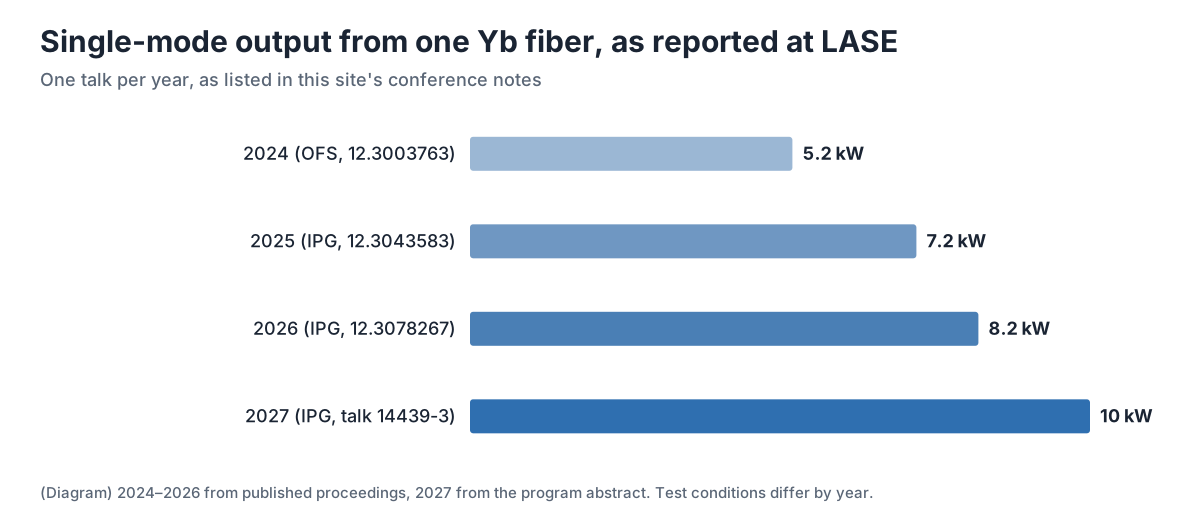
One: 10 kW from a single fiber. IPG Photonics took one channel of a directly diode-pumped ytterbium-doped fiber (YDF) laser from 8 kW to 10 kW in a single mode. Through that step, the beam quality figure M² stayed at 1.1 (14439-3). Fujikura and Kawasaki Heavy Industries sent 10 kW-class light through a delivery fiber longer than 5 m (14439-2).
Delivery stands out as much as power. Two Fujikura talks use photonic bandgap fibers that filter out light created by stimulated Raman scattering (SRS), so that strong light can travel farther (14439-2 and 71).
Why is the output of one fiber so hard to raise? The longer strong light runs through a thin core, the more of it the glass turns into longer-wavelength light, and built-up heat shakes the beam. A longer delivery fiber also gives SRS more distance to grow. "Limits of a single fiber (1): nonlinear effects (SBS, SRS)" walks through this limit step by step.
Earlier years show the pace. In this site's LASE notes, single-mode output from one fiber was 5.2 kW from OFS in 2024, 7.2 kW from IPG in 2025 and 8.2 kW from IPG in 2026. The 10 kW in this year's abstract is the next step on that line.
Two: fiber-limit research that looks at heat and scattering together. Transverse mode instability (TMI) and stimulated Brillouin scattering (SBS) are usually treated as separate limits. The Optoelectronics Research Centre (ORC) in the UK reports a new regime in very narrow-linewidth amplifiers. There, backward SBS triggers TMI even at low power (14439-50).
Fiber designs that hold back both effects also appear. Technologies Luqia in Canada built a narrow-linewidth amplifier with a polarization-maintaining ytterbium fiber designed to block SBS and TMI together (14439-51). The Indian Institute of Science and partners look at narrow-linewidth amplifiers meant to be merged with other beams. Leftover polarization loss there broadens the spectrum, and the talk covers layouts that reduce it (14439-53).
The two limits meet because their conditions pull against each other. SBS grows stronger as the linewidth narrows, while TMI arrives once average power and heat build up. Where narrow-linewidth light must be amplified to high power, as when many beams are phase-matched and merged, both have to be avoided at once. "Limits of a single fiber (2): heat and mode instability" explains how TMI arises, with diagrams.
The TMI tag peaked at 18 talks in 2023 and fell to 5 in 2026, and this year it is 7. In 2023, TMI models and raising the threshold were a big topic at Fiber Lasers. This year one talk reports a new regime where SBS triggers TMI (14439-50).
Three: many beams into one, a contest of efficiency and cost. In beam combining, which merges many beams into one, talks aim both to raise efficiency and to lower cost. The University of Michigan presents "coherent beam stacking." It claims close to 100% efficiency for tiled-aperture coherent beam combining (CBC), where beams sit side by side like tiles (14439-5). Fraunhofer IOF and the University of Jena in Germany run the phase control with analog circuits only, without costly digital converters, to cut cost (14439-59).
ORC and TRUMPF Laser UK did coherent combining with a seven-port tapered fiber bundle and used neural-network control to steer and shape the beam (14439-57). Lockheed Martin Aculight laid out a simpler oscillator-amplifier channel for a 50 kW-class spectral beam combining (SBC) directed energy source (14439-4).
There is a reason efficiency and cost come up together. In CBC, the phase of every beam must be held within a range much smaller than a wavelength, so phase controllers multiply as beams are added. In SBC, each beam gets its own wavelength and a grating overlaps them, so every channel's wavelength and linewidth must be set. The principles are in "Why beam combining is needed, and its three approaches" and "Coherent beam combining: the principle, from published reviews".
By tag count, CBC fell from 11 talks in 2022 to 4 in 2026 and is back at 11 this year. SBC had 0–4 talks a year in 2022–2026 and has 9 this year. In 2022–2023, most CBC work was on ultrafast lasers, and in 2026 Lockheed Martin compared CBC and SBC for a 100 kW-class laser weapon.
Four: laser fusion is the big new customer for pump diodes. The diode conference set up two joint sessions devoted to fusion pumps. The first is about performance. It has kW-class diode bars run in quasi-continuous wave (QCW) mode, which switches on and off in short bursts (14442-22), and diode stacks above 50 kW (14454-1).
The second is held with the fusion conference. It has a lifetime test protocol from institutions in several countries (14442-25), AI-based defect inspection (14442-27) and a path to lower cost through volume production (14440-1).
A plant design gives a sense of the demand. The Lighthouse design from Focused Energy in Germany would use 1152 beams of diode-pumped solid-state lasers to deliver about 1.6 MJ to the target, 10 times a second (14440-21).
With more than a thousand beams, the diodes that pump them are needed in bulk. So the questions in these sessions are cost, lifetime and production yield, not just output. "Pump diodes: the part that turns electricity into light" explains what these parts are.
In the records, this trend is still young. A kW-class diode bar for inertial fusion appeared in 2025, and in 2026 talks on fusion diode stacks and pump outlooks grew to several. This year the topic has two joint sessions of its own.
Five: wavelengths spread to 2 µm and the mid-infrared. Thulium (Tm) and holmium (Ho) fibers appear in 17 talks. One study scales a thulium fiber amplifier to drive an extreme ultraviolet (EUV) source (14439-12). Another source uses holmium-doped germanate fiber to make mJ-class single-frequency pulses at 2.08 µm, aimed at coherent lidar (14439-18). A group around Université Laval in Canada reached up to 20 W in the 3–3.5 µm band with a diode-pumped all-fiber laser (14439-84).
The thulium and holmium tag rose from 8 talks in 2022 to 17 in 2023, then fell from 14 in 2024 to 7 in 2025. After 9 in 2026, it is back at 17 this year. The 2024 notes include a talk that used beam combining to get past the 1 kW wall for a single thulium fiber.
Highlights by field
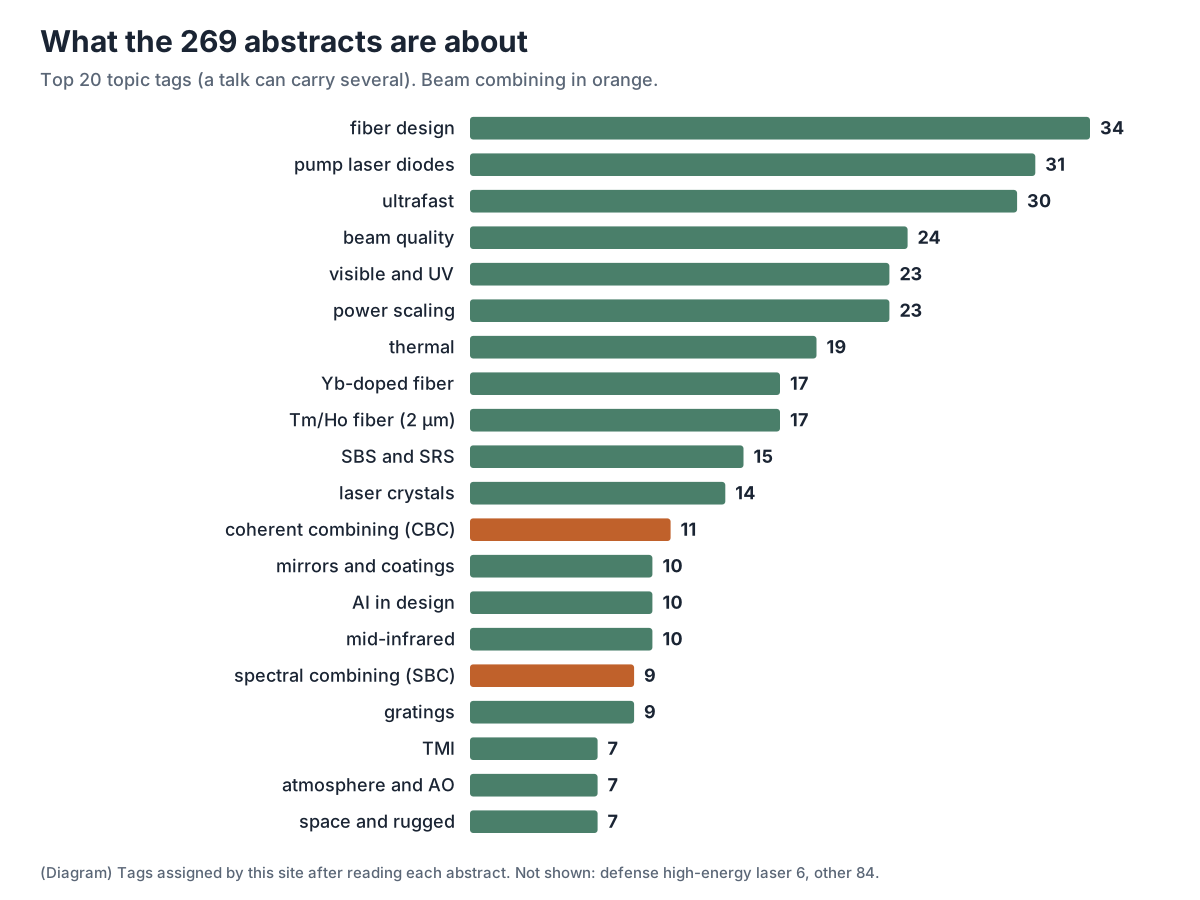
By topic, fiber design, pump laser diodes and ultrafast lasers lead with about 30 talks each. The tags in the chart below are this site's own labels, assigned after reading each abstract, and one talk can carry several.
Fiber lasers. There is more than one way around the limits. An ORC experiment shows that just changing the mode of the light first launched into the amplifier makes TMI appear much later (14439-6). A Jena group tunes the phase between cores of an amplifying multicore fiber by adjusting the power in one core (14439-24).
Solid-state lasers. How do you make a crystal that survives strong light? Many talks at this conference answer with materials. Northrop Grumman SYNOPTICS covers TGG and KTF crystals for the Faraday rotator, the part that stops light from going backward. It points out the advantage KTF has for thermal lensing at high power (14438-21).
Another group answered the same question at the surface. TelAztec etched nanostructures into crystal end faces and raised their pulsed damage threshold by a wide margin (14438-22).
One talk takes a different angle. Endeavour Laser Technologies built a laser design model from code written by a large language model. Its conclusion is that the model speeds the work up, but physics calculations and experiments still have to do the checking (14438-1).
Pump diodes. How did high-power diode efficiency climb over the past 25 years? nLIGHT and FBH in Germany trace that path (14442-7).
Two pump modules this year aim in different directions. The TRUMPF Photonics 500 W module keeps its wavelength locked over wide temperature and current ranges, for fast switch-on of counter-drone fiber lasers (14442-3). Fujikura packs 362.8 W into one module by combining three wavelengths, putting brightness ahead of conditions (14442-5).
Lawrence Livermore National Laboratory (LLNL) in the US digs into lifetime. One talk sets out a way to measure how much returning light damages a diode (14442-26). Another projects how the failure lifetime of kW-class semiconductor bars shrinks as power rises (14442-28).
Components and packaging. In high-power optics, a single flaw can seed damage. That is why OptiGrate–IPG Photonics brought a machine-vision tool that inspects the whole surface of a part automatically (14441-12). Shincron in Japan presents a process that makes damage-resistant, ultra-low-index SiO2 coatings ready for volume production (14441-14). Fibertek lists the launch loads, heat and radiation that a fiber laser for space lidar must survive as flight hardware (14441-10).
Beam combining. By tag, CBC has 11 talks, SBC has 9 and incoherent beam combining (IBC) has none. CBC is not limited to fibers. The University of Central Florida (UCF) phase-locks a tapered diode array with a Talbot cavity (14442-19). It also locks 12 blue diodes into a nearly diffraction-limited coherent state (14442-30) and combines large semiconductor arrays for power beaming (14455-7), three talks in all.
On the SBC side, Suzhou Everbright Photonics in China combined tapered diode chips, each tuned in wavelength by its current, into a 100 W-class direct diode source (14442-20). UCF and KYOCERA SLD Laser propose combining 7 W blue single emitters at 450 nm by spectral and coherent combining (14442-32).
Talks close to defense. Most abstracts are about sources and parts, not weapon systems. Six talks carry the defense high-energy laser tag, led by the 50 kW-class SBC channel (14439-4) and the counter-drone pump (14442-3) seen above. Of these, the counter-drone pump talk puts switch-on time and temperature range ahead of output.
The refractive index of air shifts slightly with temperature, so the wavefront wrinkles and the beam blurs as light passes through. The Sadovsky Institute of Geosphere Dynamics in Russia corrected atmospheric turbulence with adaptive optics that fixes low-order aberrations from focal-spot intensity alone, without a wavefront sensor (14445-31). "Adaptive optics: restoring a blurred beam" explains how a mirror smooths out a wrinkled wavefront.
At the power-beaming conference, the US Defense Advanced Research Projects Agency (DARPA) and Overview Energy outline a concept (14455-1). A geostationary satellite would send a wide near-infrared beam to a solar plant on the ground, with intensity kept below eye-safety limits. PowerLight Technologies presents a system that beams power to drones by laser to extend flight time, along with its field tests so far (14455-9).
The numbers
These are standout numbers stated in the abstracts and talk titles.
| Number | What | Talk |
|---|---|---|
| 10 kW, M² 1.1 | Directly diode-pumped single-channel, single-mode ytterbium fiber laser | 14439-3 |
| 10 kW-class, over 5 m | High-beam-quality CW light sent through a delivery fiber | 14439-2 |
| 50 kW-class | Channel design for a spectrally combined directed energy source | 14439-4 |
| Close to 100% | Efficiency of tiled-aperture coherent combining (coherent beam stacking) | 14439-5 |
| 20 W at 3–3.5 µm | Diode-pumped all-fiber mid-infrared laser | 14439-84 |
| mJ-class at 2.08 µm | Single-frequency pulsed holmium fiber source | 14439-18 |
| 500 W | Pump module with wavelength locked over wide temperature and current ranges | 14442-3 |
| 362.8 W | High-brightness pump module combining three wavelengths | 14442-5 |
| 100 W-class | Direct diode source from spectrally combined tapered diode chips | 14442-20 |
| 450 nm, 7 W | Blue single-emitter diode | 14442-32 |
| 875 nm, over 50 kW | Diode stacks for fusion pumping | 14454-1 |
| 1152 beams, 10 Hz, about 1.6 MJ | Targets of the Lighthouse fusion plant design | 14440-21 |
Each value comes from different test conditions and measurement methods. So the numbers cannot be lined up to decide who is ahead. A value from a design is also not a value from a built device.
Reading abstracts with care
An abstract is a preview filed months before the conference. At the talk itself, numbers may change or grow, and some talks are withdrawn. Read this issue as a preview limited to the abstracts made public before the conference.
Numbers in company talks are the company's own figures. No other institution has rechecked them under the same conditions. The topic tags and affiliation types are also this site's own sorting of the abstracts, so someone else sorting them might get slightly different counts.
- "Why beam combining is needed, and its three approaches": how CBC, SBC and incoherent combining differ.
- "Coherent beam combining: the principle, from published reviews": what matching the phase means, before the Michigan and Jena talks.
- "Pump diodes: the part that turns electricity into light": what the diode bars and stacks in the fusion session are.
- "Limits of a single fiber (1): nonlinear effects (SBS, SRS)": background to Fujikura's SRS-filtering fibers and the ORC talk on SBS.
- "Limits of a single fiber (2): heat and mode instability": why TMI caps the power.
- "Adaptive optics: restoring a blurred beam": helpful for the turbulence-correction talk.
- "Isolators and fiber components: keeping light from going backwards": ties in with the Faraday rotator crystal talk.
- "Fiber laser trends through SPIE, 2022–2027": follows, at length, the year-to-year changes this issue compares in a line or two.
Next issue
After the conference, issue No. 2 will cover the results. It follows the same talk numbers to see what numbers the talks actually presented and what changed from the abstracts.