On the evening of 18 June 1815, near the village of Waterloo in what is now Belgium, the French Imperial Guard halted, wavered and broke. The National Army Museum in London says the battle brought 23 years of war to an end. Count back 23 years and you reach 1792. Yet Napoleon only took power in France in 1799.
So the "Napoleonic Wars" carry one man's name, but they began before him. Two systems held this long war together. One was conscription, which called up men of twenty by drawing lots. The other was the army corps, which split one big army into several smaller ones.
This article sets both on a single timeline. It shows how they came about and how far they worked at sea, in the Iberian Peninsula and in the Russian snow. It also looks at why death tolls differ so much from source to source.
A war born of a revolution: where to start counting
In 1791 several European monarchies formed a coalition against France. They wanted to contain the ideas of the Revolution and protect monarchy as a form of government. In 1792 France declared war on the coalition, and the coalition wars (Koalitionskriege) began, lasting until 1815. The German Historical Museum (Deutsches Historisches Museum) notes in its teaching material that from 1799 these wars are also called the Napoleonic Wars, after France's new ruler.
Some institutions start the count later. Royal Museums Greenwich, introducing the Battle of Trafalgar, gives the Napoleonic War as 1803–1815. Counted from 1792, the wars last 23 years; counted from 1803, 12 years. The length depends on whether you include the wars of the Revolution years.
The fighting was not constant either. From 1792 to 1815 France was at war except for a few brief periods of peace. Along the way, on 18 May 1804, Napoleon Bonaparte was proclaimed Emperor of the French.
From 1792 to 1815 on one timeline
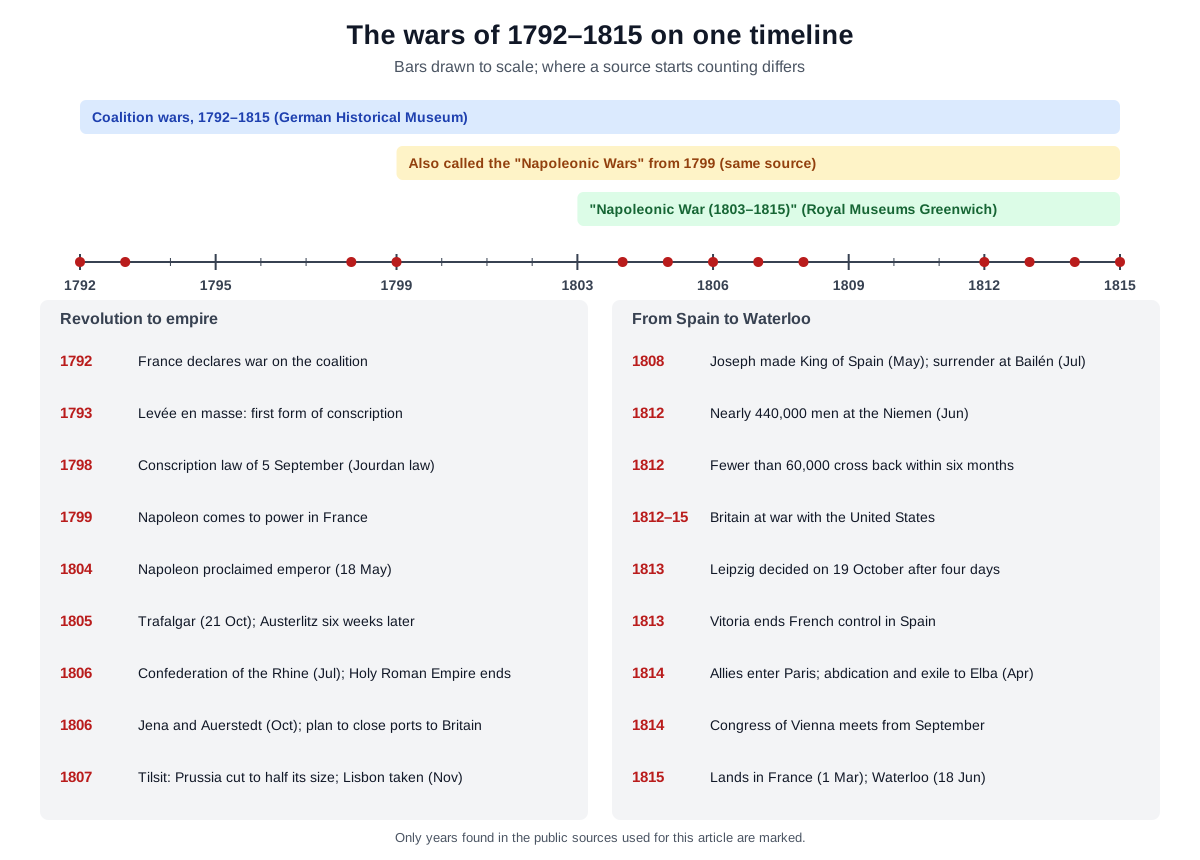
In 1805 the war went one way at sea and the other way on land. On 21 October, off Cape Trafalgar, the British fleet defeated the combined French and Spanish fleet. Six weeks later, at Austerlitz, Napoleon inflicted a heavy defeat on the Russian and Austrian armies.
The map of the German lands then changed fast. In July 1806 several German princes formed the Confederation of the Rhine under Napoleon's protection and left the Holy Roman Empire. Emperor Francis II declared the Empire dissolved and laid down a crown that was centuries old. That October the Prussian army was beaten at Jena and Auerstedt, and after the talks at Tilsit in 1807 the Kingdom of Prussia was left at half its former size.
In 1806 Napoleon decided to strike at Britain's economy by making the states of continental Europe shut their harbors to British trade. Portugal kept trading with Britain. A French army took Lisbon in November 1807. In February 1808 French troops entered Spain and soon took Madrid, and in May Napoleon made his brother Joseph King of Spain.
In June 1812 Napoleon crossed the Niemen River and invaded Russia. The campaign collapsed, and the next year, in October 1813, four days of fighting at Leipzig ended in a decision on the 19th. In early April 1814 the Allies entered Paris, and Napoleon abdicated and went into exile on Elba.
The story had one more act. From September 1814 the great powers met at the Congress of Vienna to settle the post-war order. On 1 March 1815 Napoleon landed in France again with 1,000 men. After his defeat at Waterloo on 18 June, he lived out his days in exile on St Helena, an island in the South Atlantic.
Conscription: drawing lots among men of twenty
When war broke out in 1792, the government of the Revolution needed more soldiers. In 1793 France ordered the levée en masse, which the German Historical Museum sees as the first form of conscription. The results fell short. According to Alain Pigeard, writing for the Fondation Napoléon, the 1793 levy produced 165,000 men of the 300,000 expected, and the levée en masse 425,000 of the planned million.
The system was rebuilt by the conscription law passed on 5 September 1798, often called the Jourdan law (loi Jourdan-Delbrel). It called up citizens aged 20 to 25 in five age classes. General Jourdan, at the center of the committee that drafted it, wanted many men to be called but few to actually serve. The law went on to be the basis of French army recruitment for two centuries.
Here is how it worked. Young men of twenty were entered on a list, and conscripts (conscrits) were chosen from it by drawing lots. Those chosen had a medical examination before a review board. Service lasted five years.
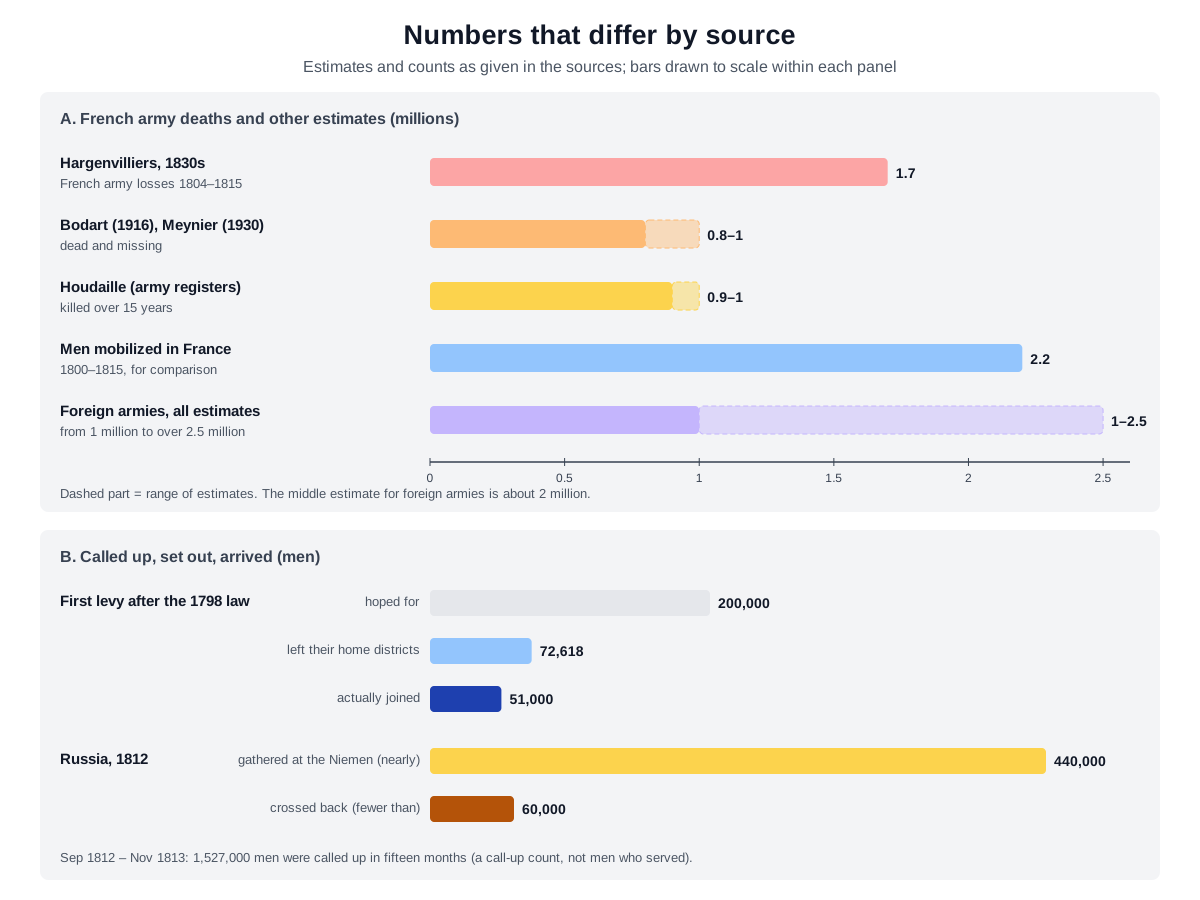
The law on paper and the law in practice were not the same. Once the law was applied, far more conscripts refused to march than expected. In the first levy after the law, the government hoped for 200,000 men; 72,618 left their home districts and only 51,000 actually joined.
There was also a way to pay your way out: hiring a replacement, banned at first and allowed from 1802. A replacement cost between 2,000 and 10,000 francs on average, and the price varied widely. For a poor peasant or farm laborer, that was two to ten years of income. In practice only about 4% of conscripts used it in 1807–1811, falling to 1–2% at the end of the Empire.
The burden changed from year to year. From 1805 to 1809 the numbers called were still limited; they rose from 1810–1811, and 1812–1813 were the heaviest years. In the fifteen months from 1 September 1812 to 20 November 1813, 1,527,000 men were called up. That is a count of men called, not of men who joined units and fought.
Across the whole Empire, about 2.2 million men were called up under this system. Fairly well accepted at first, conscription grew heavier and more resented over time. In 1814 one of Louis XVIII's first measures was to abolish it. The Gouvion Saint-Cyr law brought it back on 10 March 1818, and that framework lasted until 1872.
The men who were called still had to be turned into soldiers, so each regiment gained a depot battalion to train recruits. Veteran non-commissioned officers taught them to handle the musket, the 1777 model as modified in 1801, 1.51 m long and weighing 4.37 kg. They also drilled them at the level of the soldier, the platoon and the battalion. According to Jean-Paul Bertaud, the war ministry planned in 1805 for a wartime strength of 526,918 men, more than half of them recent conscripts.
The corps: one big army made of smaller armies
Moving hundreds of thousands of men as one mass is hard. The French army first relied on a unit called the division. Created in 1793, a division brought together infantry, cavalry and artillery regiments.
From about 1805, several divisions could be grouped again to form an army corps (corps d'armée). One general would command two or three infantry divisions, one cavalry brigade and one artillery detachment. In effect, one big army was split into several small armies, each with its own infantry, cavalry and artillery.
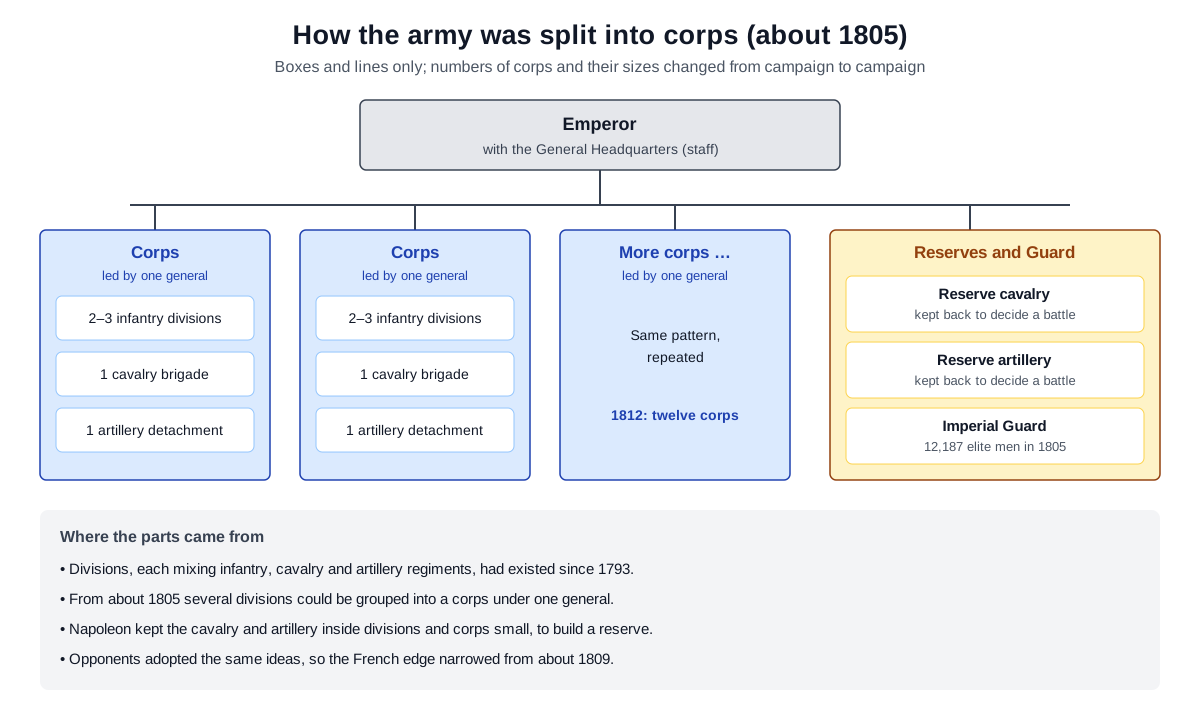
A corps, however, was not an army that did everything on its own. Napoleon deliberately kept the cavalry and artillery attached to divisions and corps small, so that he could build a separate reserve of cavalry and artillery to decide a battle. The Imperial Guard (Garde impériale), 12,187 men in 1805, was also "a small army within the army" under Napoleon's sole command.
The heaviest blow came from the cuirassiers. These heavy cavalrymen wore iron breast and back plates and carried two pistols and a straight saber; their charge aimed to open the enemy front for the infantry. In 1805 there were 12 cuirassier regiments with 8,472 men. A further 33,202 light cavalrymen handled reconnaissance and pursuit.
Why build the army this way? Napoleon created the corps as a new level of command for concentrating quickly at one point, says historian Jean-François Brun in a 2023 interview with the Fondation Napoléon. To command it all, he also set up a staff, the Grand Quartier Général or General Headquarters. Brun sees this organizational lead, together with the emperor's tactical skill, as the reason France dominated the early campaigns.
The system came at a price. Speed required a light load, so supply convoys were cut back and the army relied on "living off the land." Brun notes that this suited the rich German lands well but was already harder in Poland in 1807. The Grande Armée was an expeditionary force built for fairly short conventional campaigns in western Europe.
It is also hard to call the corps simply "Napoleon's invention." Brun does describe it as his creation, but its building block, the division, had existed since 1793. The other side did not stand still: as opponents adopted the same innovations, the wars grew steadily harder for France from about 1809. By 1814, tactics could no longer make up for the gap in men and materiel.
An army that moves in separate parts is weak when communication fails. On 16 June 1815, battles were fought at Ligny and Quatre Bras on the same day. Poor staff work left a whole French corps marching to and fro between the two battlefields, attacking neither. The National Army Museum suggests that without this, the Prussians might have lost even more heavily.
Sea, peninsula and snow: where the limits showed
Conscription and corps were systems for war on land. At sea things were different. At Trafalgar on 21 October 1805 the British fleet had fewer men and guns. The combined fleet had nearly 30,000 men and 2,632 guns; Nelson's fleet had 18,000 men and 2,148 guns.
When firing stopped at 5.30pm, 17 ships of the combined fleet had been captured and one more was a blazing wreck. The British lost 449 men killed and 1,217 wounded. The French and Spanish lost 4,408 dead and 2,545 wounded, and some 20,000 were taken prisoner. Nelson was hit by a shot on Victory at 1.15pm; he died at 4.30pm.
Even so, Royal Museums Greenwich judges that the victory had little overall effect on how the war went. Six weeks later Napoleon confirmed his hold on Europe with victory at Austerlitz. Still, Trafalgar sealed Britain's name as master of the seas, and by 1809 more than 140,000 men were serving on 732 Royal Navy ships.
In the Iberian Peninsula, in July 1808 about 12,000 French troops surrendered at Bailén, the first setback for French armies that had not been beaten until then. When French troops took food from the land, the Spanish were angered and support for the guerrillas grew.
By 1812 France had over 350,000 soldiers in the peninsula, yet 200,000 of them were guarding supply lines rather than serving at the front. However large the numbers on paper, the French could never gather enough troops in one place for a decisive victory. Napoleon called the conflict the "Spanish Ulcer." After the Allied win at Vitoria in 1813, French rule in Spain was effectively over.
Civilians suffered at the hands of more than one side. Wellington insisted on paying for what his army took, yet plundering remained a constant disciplinary problem in his own army. In April 1812, after storming the fortified town of Badajoz over its walls, Allied soldiers massacred hundreds of civilians.
In Russia the same weakness showed on a larger scale. According to Marie-Pierre Rey, nearly 440,000 men gathered on the banks of the Niemen in June 1812, after more than a year of preparation. Napoleon himself set the strength of his twelve corps in careful detail. The army mixed soldiers from pre-imperial France, conscripts from regions newly joined to the Empire and contingents from allied states: twenty nations in all.
As food and fodder ran short, soldiers searching for supplies strayed further and further from their units, and many fell to ambushes and raids. The clothing Napoleon ordered from Vilnius on 13 July included nothing warm for the winter. On 1 June he had written that it would all be over in three months.
Within less than six months, fewer than 60,000 of his soldiers crossed the Niemen back. Brun points to the sheer size of the theater. He also points to the retreat from Moscow, which followed the same route as the advance, through country already stripped of supplies.
How many died? Numbers that differ by source
There is no single agreed death toll for these wars. The figures here come from a short summary of recent research published by the Fondation Napoléon. Because the foundation is devoted to Napoleon's history, the summary's figures are given here together with the studies they come from.
The first serious count came in the 1830s. Hargenvilliers, who had headed the conscription division under the Empire, put French military losses for 1804–1815 at 1.7 million, and that figure was accepted for a long time. Bodart in 1916 and Meynier in 1930 thought it too high and recounted the dead and missing at 800,000 to 1 million.
Jacques Houdaille, working in historical demography, took another path. Army registers list, regiment by regiment, every man mobilized and what became of him. He sampled 1 in 500 of about 3 million register entries and arrived at 900,000 to 1 million killed over 15 years. Close to 50% of those losses came in 1812–1814.
Death came more often in hospital than on the battlefield. Only a minority died in battle; the great majority died in hospital of wounds or disease. Over the same period, about 2.2 million men were mobilized in France.
Losses in other countries' armies are thought to be higher, but estimates range from 1 million to more than 2.5 million. The middle estimate is about 2 million. Civilian deaths are almost impossible to count. For Spain in 1808–1814, recent studies estimate 215,000 to 375,000 civilians killed out of a population of 12 million, or 2.4–4.2%.
The Congress of Vienna, and what remained
The Congress of Vienna, which met from September 1814, rebuilt the broken order. The German Historical Museum explains that the great powers did not try to restore the old map. Instead they divided states, resources and people to create a stable balance of power on the continent. Alexander I, who had defended Russia in 1812, led the Allied armies into Paris in March 1814 and raised Russia's influence at the Congress.
After Waterloo, except for the short Crimean War (1854–1856), a general European peace held until 1914. Across the Atlantic, Britain and the United States were at war from 1812 to 1815, and neither side won a clear military victory.
The changes in the German lands were especially large. More than 300 territories of the Holy Roman Empire were merged into larger states. For the occupied states, the war soon became a fight to throw off French occupation, and the fighting from about 1813 is also called the Befreiungskriege, the Wars of Liberation. German historians of the 19th century saw these wars as the birth of the German nation, an interpretation of their own era.
Both systems lasted too. Conscription was abolished for a time and then restored, and it remained the basis of French recruitment. Brun argues that, purely in terms of organization, the corps became the framework of modern armies in the 19th and 20th centuries.
What to read next
- The Battle of Trafalgar: The Day Nelson Broke the Line — a closer look at the day Britain won at sea.
- The Battle of Austerlitz: The Battle of the Three Emperors — the battle that gave the corps system its best-known result on land.
- The 1812 Russian Campaign: Why the Grande Armée Didn't Come Back — the six months in which 440,000 men shrank to fewer than 60,000.
- Military logistics: performance must be sustainable — the supply problems that an army "living off the land" ran into, in today's terms.
- Turning points in military technology — moments since the 20th century when new technology changed war.
- A history of laser weapons: from chemical to electric lasers — how laser weapons, another branch of weapons technology, developed.