If you could look under the water behind a passing ship, you might see a long line running down at a slant from the stern. There is no net and no hook at its end. Instead, the line carries a number of hydrophones, which are underwater microphones.
A row of hydrophones pulled behind a ship like this is called a towed array, and sonar (SONAR) that listens through one is called towed array sonar. Towed arrays serve as passive sonar, which listens without sending any sound, and also as receivers for low-frequency signals in an active system. Submarines also carry passive sonar such as towed hydrophone arrays.
What do you gain by lining up many microphones instead of using one? This article looks at how differences in arrival time give a direction and what question a single straight line cannot answer. It then follows the public history of the move from fixed ears on the seafloor to ears on a tow line. It also visits science surveys that use the same gear to count whales.
Many hydrophones on one line
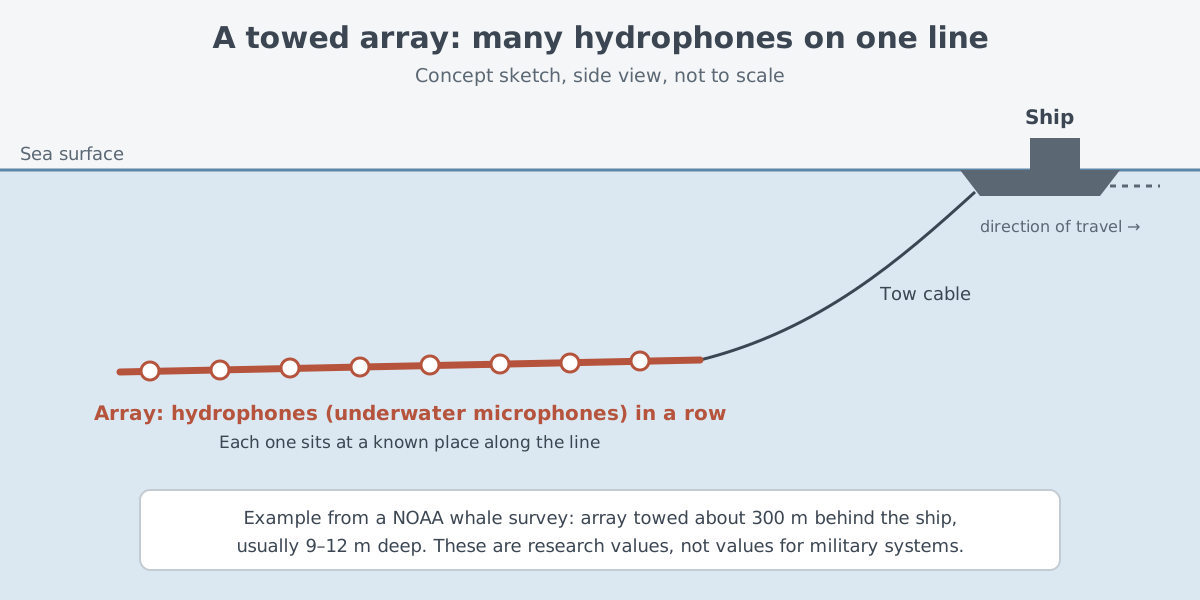
A hydrophone array is a set of hydrophones placed in known locations. They can be laid out in several ways. They can lie in a line on the seafloor, hang in a vertical line in the water, or trail in a horizontal line behind a boat or ship. The last of these is a towed array.
The uses go beyond weapons. Hydrophone arrays help locate submarines and track marine mammals. They are even used to study global climate change by picking up differences in water temperature.
Keep the phrase "known locations" in mind. You need to know where each hydrophone is before you can work out where a sound came from. On a towed array, those positions shift easily, and that story comes up a little later.
Finding direction from differences in arrival time
When someone calls your name from the side, you know which way to turn before you move your head. The sound reaches the nearer ear first and the farther ear a moment later. People do this all the time with a "receiving array" made of two ears.
A hydrophone array does the same job. Sound from a distant source, such as a submarine, reaches each hydrophone at a slightly different time, depending on the direction it comes from. This gap is called the time-of-arrival difference, and it can be turned into a direction.
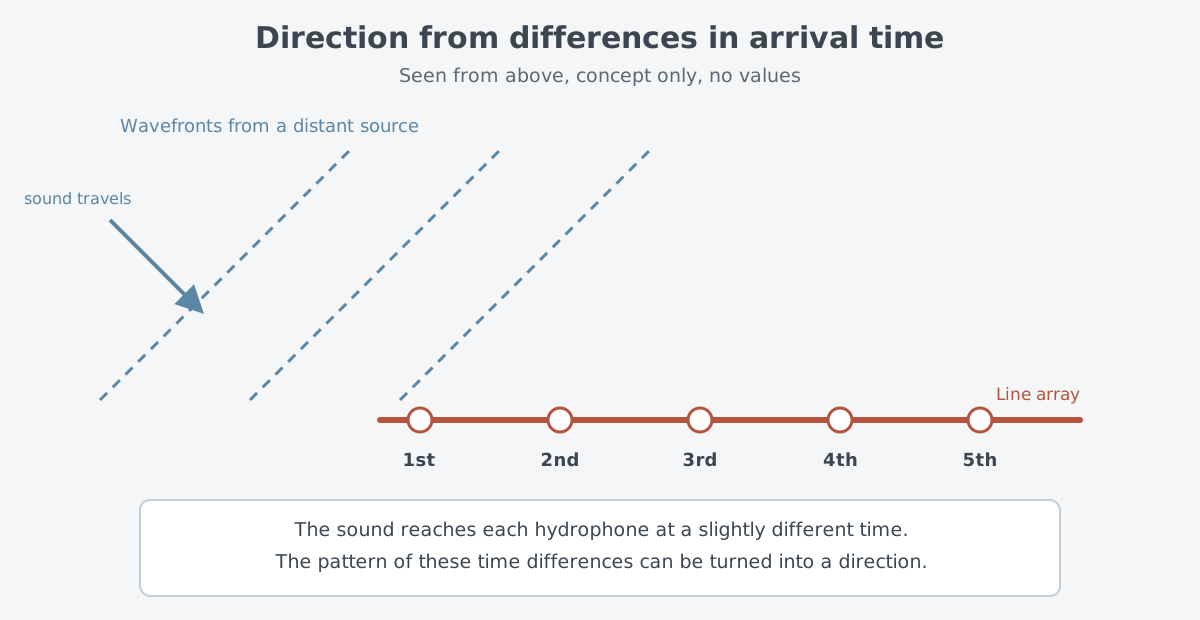
Even two hydrophones give a rough direction. Combining what every hydrophone in the array hears lets you pinpoint the direction the sound comes from. The ear comparison has limits, though. You have only two ears, fixed to your head, while an array spreads many hydrophones along a line whose positions must be known in advance.
There is a second reason to group them. When the goal is to pick out one particular sound, an array does far better than a single hydrophone. It can filter out noise coming from all around and focus on sound from one direction. With the higher signal-to-noise ratio, sounds that a single hydrophone would miss can be heard.
Listening away from the ship
A ship is itself a source of sound. A history of underwater acoustics in the Acoustical Society of America's magazine makes this point. The flow of water is closely tied both to a ship's own noise and to the sound it sends out into the sea. That outgoing sound is exactly what passive sonar picks up.
A towed array moves the listening point away from the ship. Take the array used for whale surveys by the Southeast Fisheries Science Center of the U.S. National Oceanic and Atmospheric Administration (NOAA). It trails about 300 m behind the vessel and typically rides 9–12 m deep. These figures come from one science survey, not from any warship.
A line's limit: left or right?
There is one question a straight line cannot settle. It is well known that the beam response of a line array has a built-in left-right ambiguity. A 1994 abstract on sea trials, presented at an Acoustical Society of America meeting, takes this as its starting point.
A picture shows why. Imagine a sound source on one side of the line, and a second source in the mirror-image spot on the other side. Sound from both spots reaches every hydrophone on the line in the same order and with the same time differences. Time differences alone cannot tell the two apart.
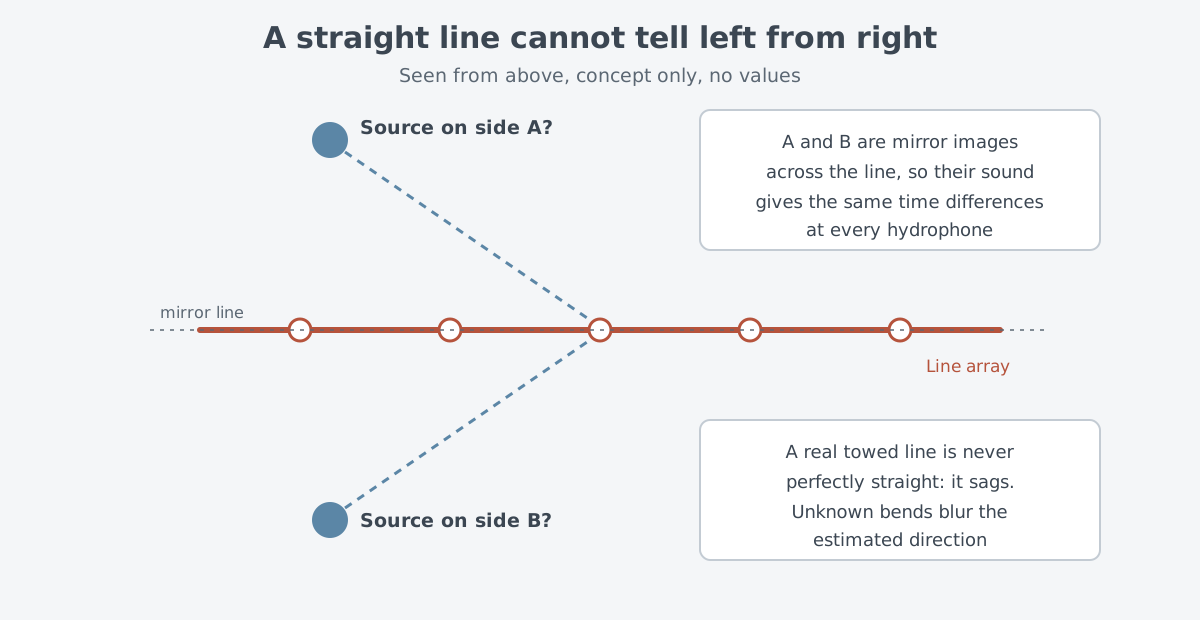
A real line is not straight, either. According to the abstract, any bending of the array distorts the estimated direction, and the arrays measured at sea were never a straight horizontal line. Even at a steady towing speed, the line took roughly the shape of a rope hanging between two points, called a catenary.
If the position of each hydrophone were known at every moment, the bends could be corrected. For some array shapes, it might even be possible to resolve the left-right ambiguity. In practice, measuring those positions accurately enough is extremely difficult. The "known locations" from the first section turn out to be the hardest part of a towed array.
From ears on the seafloor to ears on a tow line
Before towed arrays, there were arrays on the seafloor. During the Cold War, early in the 1950s, the U.S. Navy placed SOSUS (Sound Surveillance System), a network of passive hydrophone arrays, in strategic areas of the continental shelf. The first full-size SOSUS prototype went down off the island of Eleuthera in the Bahamas in January 1952. The arrays were linked to shore stations where the sound data were analyzed.
The network of fixed arrays was later backed up by acoustic surveillance ships that deployed towed arrays. That system is SURTASS (Surveillance Towed Array Sensor System). It is a passive sonar system that listens for noises made by submarines, using a long string of hydrophones towed behind a ship. Together, SURTASS and SOSUS form part of the Integrated Undersea Surveillance System (IUSS).
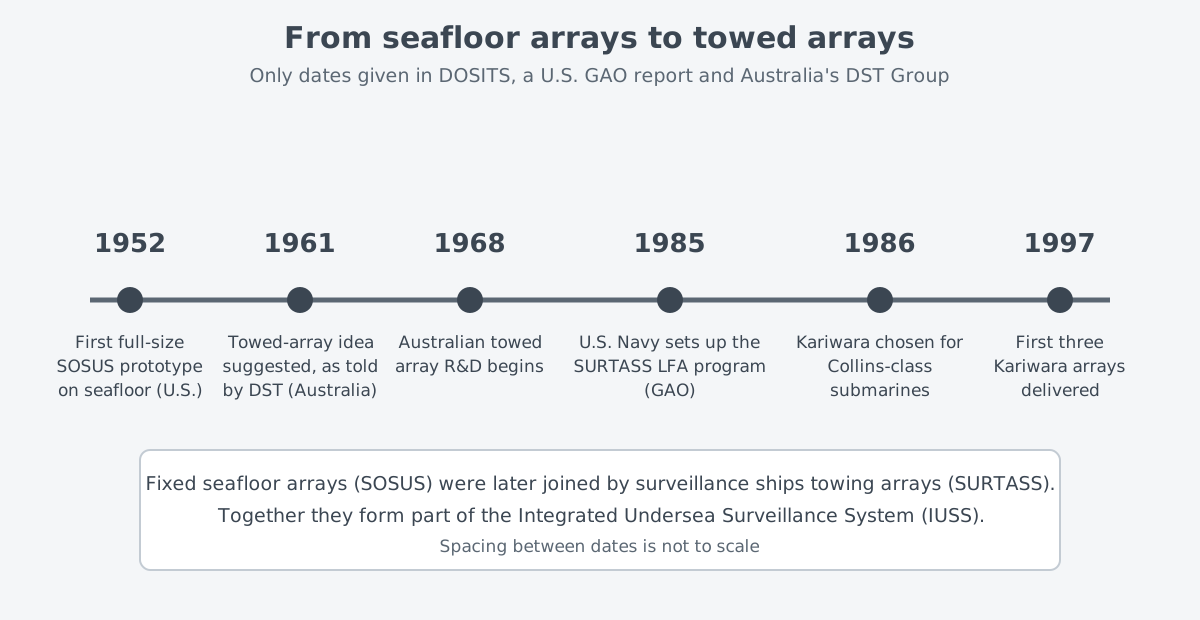
A 2002 report by the U.S. General Accounting Office (GAO) shows what came next. In 1985, the U.S. Navy launched the SURTASS Low Frequency Active (LFA) sonar program. Its aim was to find newer, quieter Soviet submarines, both nuclear and diesel.
In the passive part, the hydrophones of a receiving array trailing the ship pick up noises or returning echoes from objects underwater. In the active part, transducers suspended by cable beneath the vessel send out low-frequency sound. The Navy designed T-AGOS-23, an ocean surveillance ship, to carry SURTASS.
Australia started down this road early as well. Australia's Defence Science and Technology Group (DST) says the idea of towed arrays was first put forward in 1961 by a former Chief Defence Scientist. Australian towed array research and development began in 1968, when the Royal Australian Navy Research Laboratory (RANRL) bought an array from a company. By 1970, serious problems had shown up in the array and its handling systems.
Next came 'Boolee', a five-year study with the U.S. Defense Advanced Research Projects Agency (DARPA) that focused on long towed arrays for finding quiet targets at long range. Those trials led to a decision to concentrate on thin-line towed arrays for submarines, and the result, developed in the 1970s, was Kariwara.
In 1986 the Royal Australian Navy named Kariwara as government-furnished equipment for its Collins-class submarines, and industry delivered the first three arrays in 1997. The technology later spread to civilian work such as seismic surveys.
The name turns up in other countries' public records too. The UK government announced that all eight Type 23 frigates carrying towed array sonar tails were to be based at Devonport. South Korea's Agency for Defense Development (ADD) lists a Towed Array Sonar System (TASS) among the maritime and underwater weapon systems on its English website.
Towed arrays that count whales
The same principle helps count sea life. Acoustic scientists at NOAA's Southeast Fisheries Science Center deploy a towed hydrophone array during line-transect surveys for whales and dolphins. The array picks up the sounds of toothed whales and dolphins and helps find where they are.
Each of its several hydrophones records sounds as they come in. The differences in arrival time at each hydrophone give the direction of a sound. As the ship keeps moving along its track, the direction to the sound changes, and that change lets scientists find where whistles and echolocation clicks came from.
One direction alone does not give a distance, but laying several directions from a moving ship on top of each other does reveal a position. The data gathered this way help estimate where each species lives, how densely, and in what numbers.
Where this meets lasers: many acting as one
The strength of a towed array lies in the group, not in any single hydrophone. When the sounds picked up by many hydrophones are handled together, the array can focus on sound from one direction and filter out noise.
Lasers have a similar idea. Coherent beam combining matches the phases of several laser beams so that they come together like a single beam. Both technologies are alike in making many parts work as one.
The differences are large, though. A towed array receives sound coming in from outside, while beam combining sends light out. The waves are different too: sound in water on one side, light on the other.
What to read next
- Sonar: why sound is used to see underwater: the basics of active and passive sonar and why sound is used underwater.
- Coherent beam combining: the principle, from published reviews: how matching the phases of several beams brings them together as one.
- Diesel-electric, AIP and nuclear submarines: how the submarines a towed array listens for move underwater.