How do you hit something on the far side of a hill? Fire straight at it and the hill is in the way. Send the round high into the sky so it comes down from above, and the problem looks different.
A mortar is a gun built for that high path. Today it also sits inside infantry companies and battalions, as a gun those units handle themselves. This article uses the projectile motion of a physics textbook to explain what "firing high" means. It then looks at a design made of one tube and a baseplate, and follows mortars from a fifteenth-century siege to today's infantry battalion.
Cannon, howitzer, mortar
At the Battle of Yorktown in the American War of Independence, the American, French and British forces used three types of artillery. They were the cannon, the mortar and the howitzer. The National Park Service (NPS) guide to Yorktown explains that mortars differed from cannon both in how they looked and in how they fired.
A mortar of that time sat on a flat bed that looked like a large block of wood. A wedge raised the barrel so it could throw an exploding shell, called a "bomb," on a high trajectory. Fired well, the bomb flew over the earthworks and burst while still in the air.
Field guns, a kind of cannon, fired on a fairly flat trajectory. The howitzer mixed the two. It could fire on a flat path or on a high one.
Mortars and howitzers took their size names from the inside width of the barrel. Pieces of 8, 10, 12 and 13 inches were used at Yorktown.
A mortar's usual job is indirect fire. That means aiming and firing without a direct line of sight between the gun and the target. A mortar round is aimed by working out azimuth and inclination, and the aim can be corrected by watching where the rounds fall. The larger guns that also do indirect fire are covered under self-propelled howitzer.
What changes when you fire high
Throw a ball and you can feel the difference. With the same effort, a low throw travels almost level with the ground. A high throw climbs into the sky and comes down much later.
A physics textbook puts this neatly. On flat ground, at the same launch speed, two launch angles that add up to 90° give the same range.
In the textbook's figure, shots at 15° and 75° land in the same place. What differs is the height. The flatter shot peaks lower.
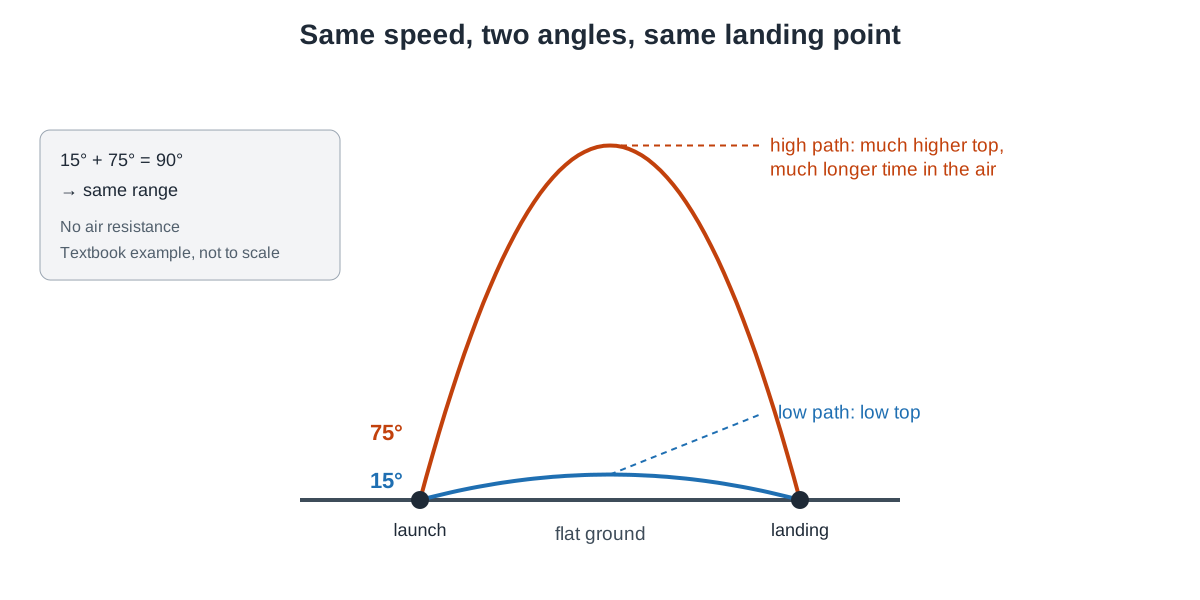
Time in the air differs too. How long a projectile stays up depends on its vertical motion alone, and its peak height depends only on the upward part of its launch speed. A shot at 75° puts most of its speed into going up, so it climbs far higher than a shot at 15° and stays up far longer.
This picture comes with one condition: air resistance is left out. The textbook result that 45° gives the longest range also holds only without air resistance. With air resistance, that best angle is somewhat smaller. Real shells fly through air, so they do not land as neatly as the drawing shows.
One tube, a baseplate, two legs
A mortar looks simple. The M2 60 mm mortar used by American troops during World War II, held by the Australian War Memorial (AWM), has three main parts. They are the tube, a two-legged bipod that holds it up, and a baseplate that rests on the ground. At the bottom end of the tube is a ball-and-socket joint that fits into the baseplate.
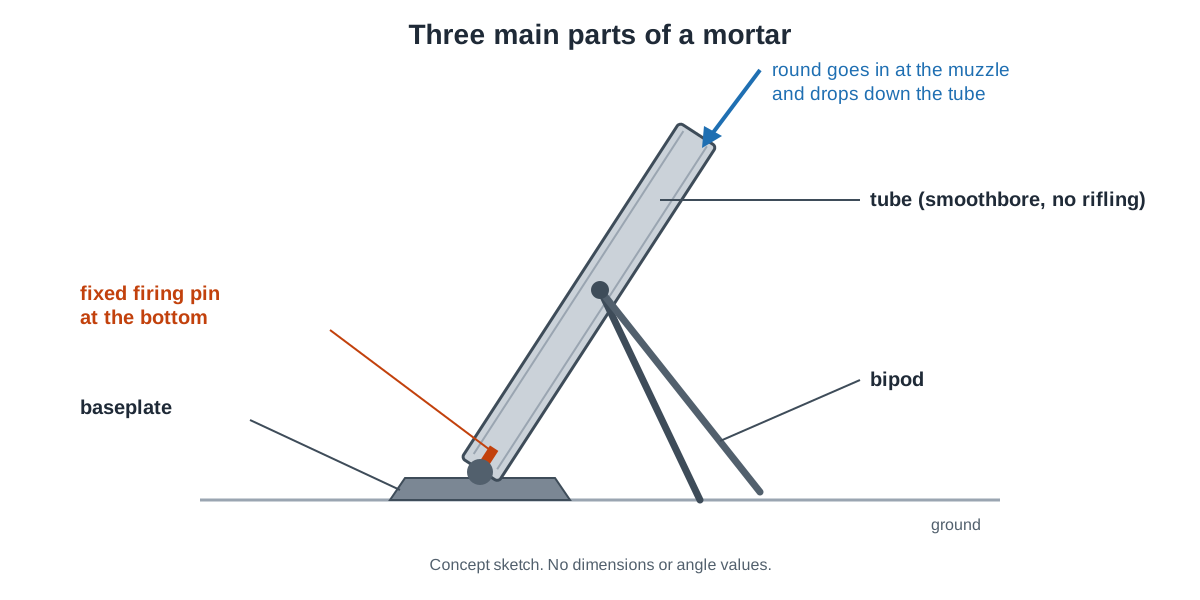
The inside of the tube is smooth. Rifling is a set of spiral grooves cut inside a barrel, and these mortar tubes have none. The Stokes 3-inch barrel from the First World War and the M2 barrel are both smoothbore, with a firing pin fixed at the bottom.
The record for the 81 mm M29, standardized by the Australian and U.S. armies in 1970, says this fixed pin is there for "drop firing." The round goes in at the muzzle, the open top end of the tube. The Japanese Army used the Type 94 heavy mortar throughout the Second World War. Its record also describes a smoothbore weapon, loaded from the muzzle, whose firing pin is fixed in place.
The round is shaped to match. The Stokes 3-inch round, which joined the British Army in 1916, is a steel canister shaped like a tube. At the rear it has a detonator and a holder for the firing cartridge, and at the front it has a fuze. The cartridge holder has a row of holes along it to let gas out.
From sieges to the trenches
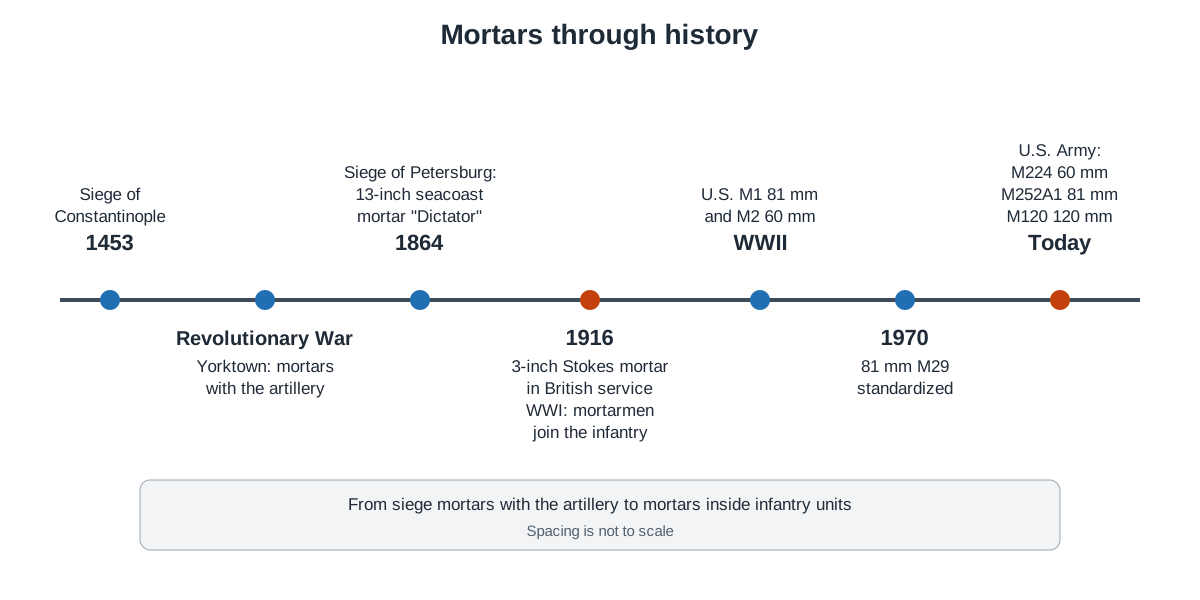
The mortar is an old weapon. A National Guard article says mortars were first used as early as 1453, by the Ottomans at the siege of Constantinople. Since then the weapon has gone through many changes and improvements.
Sieges also saw some very large mortars. At the siege of Petersburg in the American Civil War, Union forces used "the Dictator," a 13-inch seacoast mortar. It was set on a rail car in July 1864 and fired 218 shells over the river before it was moved in September. The mortar now on that spot is not the original one, but the same kind of weapon from the same era.
Up to then, mortarmen belonged to the artillery, not the infantry. American use of mortars goes back to Yorktown in the War of Independence, but mortarmen only joined the infantry during the trench warfare of the First World War.
The trenches were the reason. Historian Virgil Nye, quoted in a U.S. Army article, describes it this way. Both armies dug in and faced each other across trench lines with heavy wire and fortifications. The need for close artillery support run by the infantry itself then appeared almost at once.
The Minenwerfer, the first trench mortar, was a German invention. In Britain, engineer Wilfred Stokes created the Stokes 3-inch mortar. Its high-explosive round joined the British Army in 1916 and stayed on the Western Front until the war ended.
Heading into the Second World War, the United States studied the French Brandt Mle 27/31 mortar and turned it into the M1 81 mm and M2 60 mm mortars. Both saw wide use in that war. Even the mount of the M29, standardized in 1970, was named after the pair: a Stokes-Brandt adjustable bipod.
Mortars beside today's infantry
A U.S. Army article splits today's mortar units into two groups. One group is the mortarmen attached to a battalion's line companies, who move with them. They use 60 mm rounds because they are easier to carry, and their current system is the M224.
The other group is the single mortar platoon in each battalion. It uses 81 mm and 120 mm rounds and gives indirect fire support to the battalion's companies and attached units. The article's photos show the M252A1 81 mm mortar, and a National Guard live-fire article shows the M224 60 mm and the M120 120 mm mortars in use.
Both groups live inside infantry units. The role born in the First World War trenches, close artillery support run by the infantry itself, still carries on. That is what "the closest artillery" in the title means.
Where this meets lasers: a falling mortar round
From the defender's side, a mortar round is something to stop. At a forward operating base in Afghanistan in 2013, the U.S. Army used two systems together. Counter rocket, artillery and mortar (C-RAM) detected incoming fire and gave early warning, while the Land-based Phalanx was built to engage incoming rockets, artillery shells and mortars. The Phalanx story at sea is told in close-in weapon systems (CIWS).
Mortar rounds also show up often in laser weapon tests. A U.S. Army article from September 2014 said high-energy laser (HEL) research had been going on since the 1960s. It added that demonstration systems were now reaching the point of shooting down mortars and drones with lasers.
The truck-mounted HEL MD demonstrator had a record of hitting and destroying mortar rounds. Years before, in the summer of 2000, a system known as THEL (Tactical High Energy Laser) brought down an artillery rocket for the first time.
A demonstration is not the same as fielding. The same article says THEL was a technical success, yet officials decided not to deploy it. It needed toxic chemicals to run, and that hurt its reliability, logistics, cost and safety. How laser weapon programs have moved from demonstrations toward fielding is covered in public laser weapon programs.
What to read next
- Self-propelled howitzer: the story of howitzers that ride on vehicles.
- Counter-battery radar: radar that finds incoming shells and mortar rounds.
- Public laser weapon programs: where demonstrators like HEL MD led next.
- "Exterior Ballistics: How a Shell Flies Through Air": how the air resistance left out of the textbook figure changes a trajectory.