On Saturday, 8 March 1862, the sailors of the Union blockading squadron at Hampton Roads, Virginia, were washing their clothes. Blue and white clothing hung drying in the rigging. Shortly after noon, a strange shape came slowly down the river, trailing smoke. One witness said it looked "like the roof of a very big barn belching forth smoke as from a chimney on fire."
It was the Confederate ironclad CSS Virginia. That evening the Union ironclad USS Monitor arrived under tow from New York, and the next morning the two ships fought for four hours. How did the first battle between iron-armored warships come about, who won it, and what did it change?
From a burned frigate to CSS Virginia
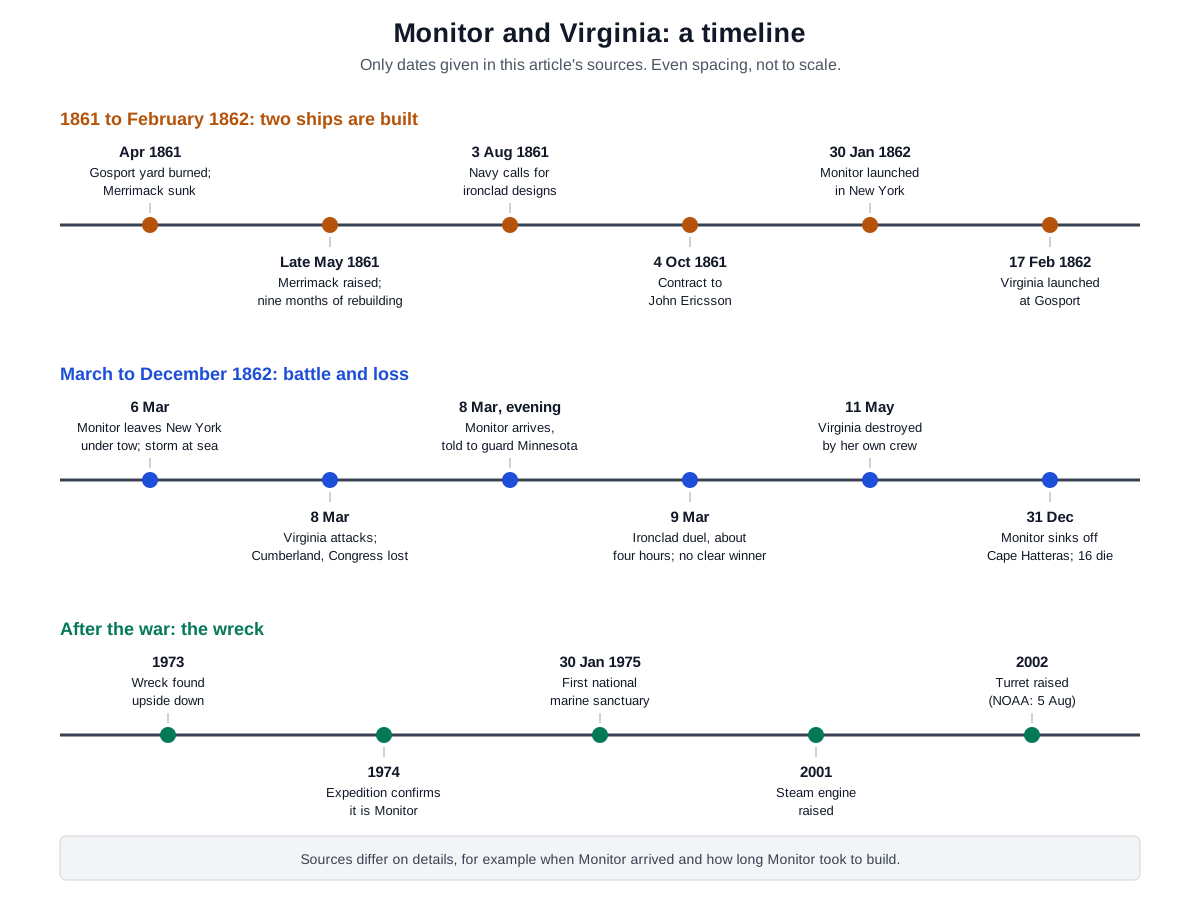
Virginia began life as the Union steam frigate USS Merrimack. Launched in 1855 at the Boston Navy Yard, she was out of commission in April 1861 and waiting for repairs at the Gosport Navy Yard in Portsmouth, Virginia.
The yard's commander, Charles McCauley, feared an uprising among local people and decided to abandon the yard. Before leaving, his men burned it, spiked the cannons and sank every ship, Merrimack included. The retreating Federals failed to destroy one thing: the dry dock used to repair ships. It stayed in Confederate hands.
The Confederate navy faced a hard problem. The Union held Fort Monroe and blockaded the entrance to Hampton Roads, and the South had neither the yards nor the supplies to build a larger fleet. Its only hope was better technology. In May 1861 the Confederate navy secretary, Stephen Mallory, wrote that both economy and naval success favored "fighting iron against wood."
In late May 1861 the Confederates raised Merrimack. Over the next nine months, yard workers turned the burned hull into a casemate ironclad ram and renamed her CSS Virginia. The casemate was a sloped iron roof over the guns, and the ram was an iron beak on the bow for striking other ships. Iron plating covered everything above the water, and its weight gave her a deep draft of 22 feet.
Virginia was launched at Gosport on 17 February 1862. A shortage of gunpowder delayed her first sortie. The work was no secret. All through the summer of 1861, reporters and ordinary visitors came to watch, and newspapers in both North and South printed updates.
A ship in about 100 days: Ericsson's Monitor
The North followed the news closely. If the South launched an armored ship, no Union warship could match her. On 3 August 1861, Navy Secretary Gideon Welles asked designers to send in plans for ironclad warships.
The United States had considered ironclads before. According to The Mariners' Museum, the first ironclads successfully launched for U.S. service came in the summer of 1861. They were river gunboats for the Mississippi, built under the Army Quartermaster Corps rather than the Navy. Navy leaders, though, stayed cautious about iron ships.
The Ironclad Board first turned down the design of John Ericsson, a Swedish-born engineer, as too outlandish. Ericsson then came before the board and defended it himself. His design became one of three recommended for approval. The contract was worth $275,000, with one condition: the ship had to be finished in one hundred days.
The main contract was signed on 4 October 1861. The Continental Iron Works in Greenpoint, New York, built the hull, Delamater & Co. built the engines, and Novelty Iron Works built the turret. The turret walls were built up from eight layers of 1-inch iron plate. Ericsson chose the name Monitor, meaning "an individual who warns or instructs," as a warning to the Confederacy and to Britain.
Monitor went into the water on 30 January 1862 and entered service on 25 February, with Lieutenant John L. Worden in command. Sources give the building time a little differently. A NOAA sanctuary page says "almost 100 days," a 2017 NOAA article says 98 days, and The Mariners' Museum says just over a hundred days.
On 6 March the tug Seth Low left New York towing the unsteady Monitor. On the second day a storm sent water over the deck, and the blowers that pushed air below deck stopped. Without them, no one could work below. Chief engineer Alban Stimers played a large part in fixing them, and the ship, nearly lost, reached Hampton Roads on the evening of 8 March.
8 March: a day of wooden ships
8 March was also Virginia's trial trip. Averaging just five knots, she crept down the Elizabeth River. Across the water lay five large Union warships, all built of wood.
Only Minnesota and Roanoke had auxiliary steam engines. Cumberland, Congress and St. Lawrence relied on sails alone.
Under Franklin Buchanan, Virginia went first for the sailing sloop Cumberland. Most Union shots glanced off Virginia's sloped sides. Virginia struck the right-hand side of Cumberland with her ram, and Cumberland began to sink.
Her gun crews kept firing as she went down. Buchanan himself later reported that the Union sailors kept "gallantly fighting her guns as long as they were above water."
Next came the frigate Congress. She ran aground while trying to get under way, fought back, and raised the white flag at 4 pm. Records differ on how long she fought.
Two Naval History and Heritage Command (NHHC) accounts say an hour. The Mariners' Museum says nearly two hours and adds that she surrendered after most of her crew, including Lieutenant Joseph B. Smith, her commanding officer, had been killed or wounded.
While the surrender was under way, gunfire from the shore hit several men on both sides, Buchanan among them. Buchanan ordered Congress burned, and Lieutenant Catesby ap Roger Jones, his second in command, took over. Late that night the fire reached the powder magazine of Congress and she blew up. The NHHC operations account puts this shortly after midnight; the NHHC photo archive puts it about two hours after midnight.
Meanwhile, three Union frigates ran aground as they moved toward Newport News. Tugs pulled two of them free, but Minnesota stayed stuck on the shoal. Virginia's deep draft kept her more than a mile away, and when darkness fell the Confederate ships withdrew. The National Park Service (NPS) sums up the day in one line: two Union ships sunk and a third driven onto the shoal.
The first day was costly. Virginia destroyed Cumberland and Congress and killed more than 240 of their crewmen. Her own casualties were fewer than two dozen. Two of her guns lost their muzzles, and most fittings on her outer surfaces were carried away or ruined, yet she could still fight.
That evening Monitor arrived, reported to Captain John Marston of Roanoke, and was ordered to protect Minnesota. In the words of The Mariners' Museum, Monitor arrived too late to catch Virginia at anchor and sink her there. She was not too late for the next day.
9 March: iron meets iron
Thick fog on 9 March held Virginia back until 8 am. Many of Monitor's crew had gone more than 24 hours without sleep. An officer on the Confederate ship Patrick Henry described Monitor as "an immense shingle floating on the water with a gigantic cheese box rising from its center." In his eyes the ship had no sails, paddle wheels, funnel or visible guns.
When Monitor opened fire, every wooden Confederate ship pulled back, leaving Virginia alone. The two ironclads then circled each other for four hours. The crews fought in extreme heat and poor ventilation inside their iron hulls, and at one point the ships came close enough for Virginia to try to ram Monitor.
Inside Monitor's turret, everything was new. The turret turned well, but once it started it was hard to stop. The gunners finally let it keep turning and fired as the target swung into view.
Chalk marks on the deck showing directions were wiped out by sweat. Worden, in the pilothouse, still gave orders the old way, such as "on the starboard beam," which helped little inside a turning turret.
Both ships had problems. A shot carried away Virginia's smokestack, making a slow ship even slower. Monitor's early mechanical troubles reduced the effect of her two 11-inch guns, and ammunition supply problems forced her to pull back into shallow water for a time. Virginia, with her deep draft, could not follow, and Monitor kept guarding Minnesota.
Soon after noon, Virginia's gunners aimed at the pilothouse of Monitor, a little iron box close to the bow. A shell burst against it and wounded Worden. Temporarily blinded, he handed command to his executive officer, Lieutenant Samuel Dana Greene. During the change, Monitor moved into the shoals.
To Jones on Virginia, this looked like the perfect moment to go after Minnesota again. His officers, however, urged him to pull out because the tide was going down and the ship was damaged. Greene had strict orders to stay on the defensive and protect Minnesota, so he did not give chase.
Jones believed Monitor had left the fight, and Monitor's crew saw Virginia leaving. Both sides claimed victory.
Early on 10 March, tugs finally pulled Minnesota off the sand bar.
How the two ships differed
Both were ironclads, but they differed in shape and origin. Virginia was a former 40-gun frigate with a sloped iron roof built over her hull. She sat deep in the water, and her 22-foot draft kept her out of shallow channels. Most of her iron ram tore off when she struck Cumberland on 8 March.
Monitor was a new design from the keel up. According to the NPS, her deck rose only 18 inches above the water, and a 20-foot cylindrical turret stood in the middle of the flat iron deck. Her only guns were the two 11-inch Dahlgrens inside it.
She ran on steam alone, with no sails. Her length is given as 172 feet in the DANFS ship dictionary and 173 feet on the NOAA page.
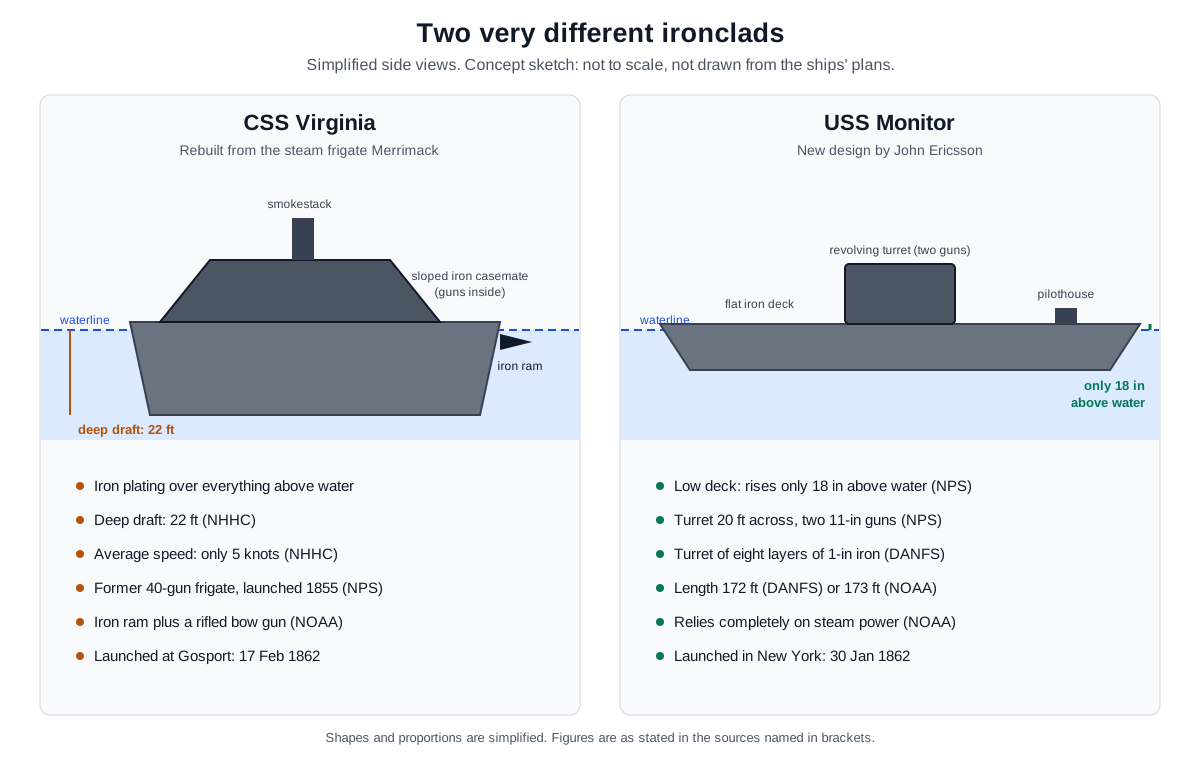
Virginia kept her guns inside the sloped casemate, while Monitor carried hers in a revolving turret. The Mariners' Museum notes that the old customs of naval fighting soon went by the wayside in this battle. As the scene inside Monitor's turret on 9 March shows, the new way did not run smoothly at first.
The result of the clash was simple. The two ships fired at each other all morning, and their armor turned the shots aside. NOAA describes the cannon shots as bouncing off and leaving "little more than some dents." Neither ship was seriously damaged.
Who won? Two answers
There is no one-line answer. The NHHC first says that neither ironclad clearly won. Then it gives two answers side by side.
In tactical terms, the Union won. Minnesota was out of danger, Monitor had done its job of protecting her, and Virginia had failed to destroy her. In strategic terms, the Confederacy won, but not completely. The South had destroyed Cumberland and Congress, yet the Confederate army did not coordinate with Virginia's attack, so the Union kept Fort Monroe and the blockade stayed in place.
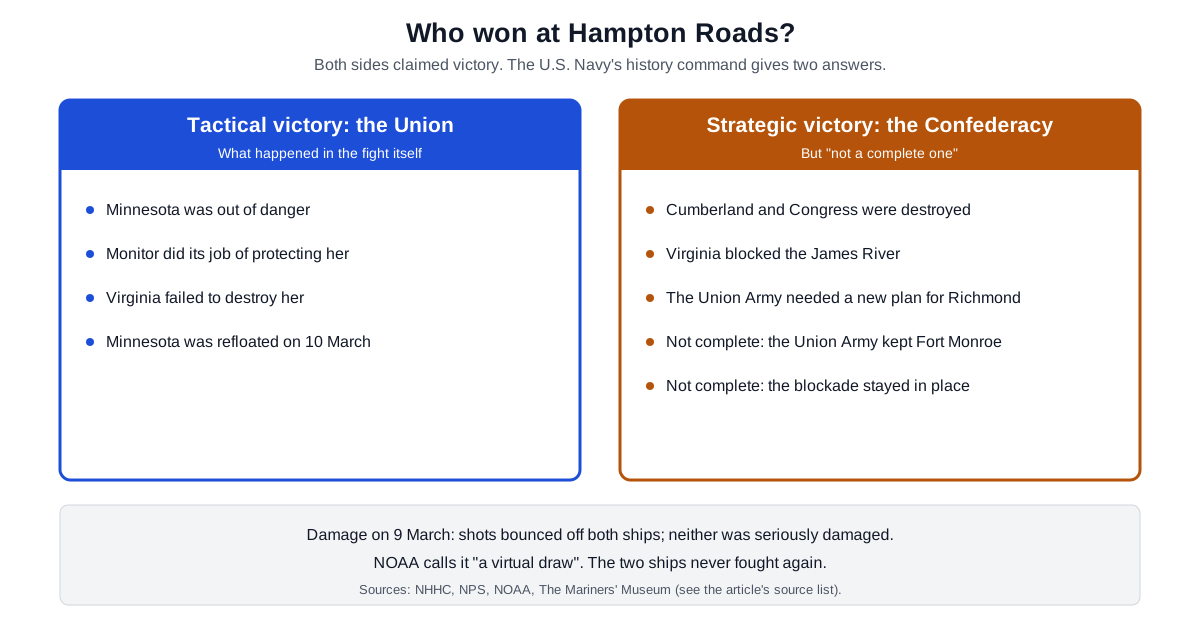
While Virginia remained, Union ships could not enter the James River. George McClellan, who led the Union army on the Virginia Peninsula, had to find another way. On 17 March 1862 he landed his army and its supplies at Fort Monroe to begin a new campaign toward Richmond. A naval battle had changed the army's route.
The Mariners' Museum sees both ships as reaching part of their goals. Virginia sank important Union ships and kept the James River shut for some time. Monitor spared the fleet more losses and kept Virginia bottled up in Hampton Roads. One Minnesota sailor even had his gravestone shaped like Monitor.
How both ships ended, and Monitor on the seabed
The two ships never fought again. On 11 April, Virginia came out with four gunboats and two tugs and stopped near Sewell's Point, but Monitor followed orders and did not attack first. Each held the other in check until the Confederates pulled back toward Richmond.
After Norfolk fell to the Union, Virginia was left on her own. Her deep draft meant she could not go up the James River to Richmond. On 11 May 1862, Flag Officer Josiah Tattnall had the ship destroyed; she was set on fire and soon blew up. Tattnall was later court-martialed for it and acquitted.
Monitor's end came at sea. On 29 December 1862 she left Hampton Roads under tow by the side-wheel steamer Rhode Island. On New Year's Eve, off Cape Hatteras, the wind and waves rose.
Leaks flooded the engines and steam pressure dropped. The crew worked pumps and even bailed with buckets, then raised a red lantern to signal for help.
The only way out from below was through the turret, and many men were swept away by the waves as they dashed across the deck. The ship sank just after midnight, early on 31 December. Of 62 men on board, 46 survived and 16 died. DANFS lists the dead as four officers and 12 men.
In 1973, scientists aboard the Duke University research vessel Eastward found the wreck lying upside down about 16 miles off Cape Hatteras. A 1974 expedition confirmed it was Monitor, and on 30 January 1975 the site became the first U.S. national marine sanctuary.
In 2001, a joint team from NOAA, the U.S. Navy and The Mariners' Museum brought up the steam engine. In July and August 2002 they raised the turret; NOAA gives the date it came up as 5 August. About one-fifth of the ship, more than 200 tons of material, is now under conservation at The Mariners' Museum, which stands in Newport News, Virginia.
The remains of two sailors were found inside the turret. When NOAA released reconstructions of their faces in 2012, their names were still unknown, and the other 14 lost crewmen had left no trace that searchers could find. The same release adds that at least one African American served in Monitor's crew.
What it left: the end of the wooden warship
Monitor and Virginia were not the world's first ironclads, and The Mariners' Museum says plainly that ironclads existed before them. What the battle added was the first fight between ironclads. On 8 March it showed how helpless unarmored wooden warships were against an ironclad, and on 9 March a fight between armored equals ended in a draw.
The NHHC photo archive sees this result, set against the previous day's mismatch, as a symbol of industrial-age warfare. Both the public and naval professionals came to rate existing ships of the line and frigates far lower. Ironclad building programs already under way in America and Europe sped up.
The armored warship race that followed lasted about eighty years, into the 1940s. The Union alone had about 50 ironclads by the end of the war.
Both ships became models for later vessels. Confederate ironclad rams and Union turret ships fought in the Atlantic, the Gulf and the western rivers. Until the end of the century, monitor-type ships stayed the leading warships for coasts and rivers across the Americas, Europe and Russia.
The war at sea also felt different to the men in it. Monitor's paymaster, William Keeler, wrote to his wife, "There isn't enough danger to give us glory," and a later Confederate ironclad officer said "the poetry of the profession is gone." In a poem published in 1866, Herman Melville pictured the fight as one that ran "by crank, pivot, and screw." The Mariners' Museum sees that day as the start of a new phase of naval war in which machines and armament came first.
What to read next
- The American Civil War at a Glance: 1861 to 1865: places the Hampton Roads blockade and the Richmond campaign within the whole war.
- The Battle of Trafalgar: The Day Nelson Broke the Line: compares a sailing-ship battle in line half a century earlier.
- The Rifled Musket and the Minié Ball in the Civil War: looks at the weapons that changed on land in the same war.
- Destroyers and frigates: follows how warship names and roles split after the ironclad age.
- Composite and reactive armor: shows what armor that began as plain iron plate has become today.
- Turning points in military technology: traces, year by year, the twentieth-century technologies that followed shifts like this one.