A well-made diode driver does not send out light the moment you switch its output on. It waits a few seconds and then raises the current slowly to the value that was set. When it switches off, it ties the output leads to the diode together. That is a lot of care for a chip tinier than a grain of rice.
There is a reason for the care. A laser diode (LD) reacts strongly to the current fed into it, and it is an expensive, delicate load. A driver is the power source that delivers current to that diode accurately. The word "driver" usually means a current source, while a "controller" usually means a current source and a temperature control combined in one unit.
This article starts with why a diode is run on current. It then covers how light grows with current and what a driver protects against. After that come fast switching of light, the history since 1962 and the link to laser weapons.
Why current, not voltage
The output of a laser diode depends on two things: the injected current and the temperature. For this reason a laser diode is normally run from a stable current source. Voltage sources and general-purpose power supplies are too noisy for most uses. They can also produce swings and sudden spikes, called transients, that can damage the diode.
The reason lies in how a diode behaves. At the point where most laser diodes work, a tiny change in voltage makes a big change in current. A white paper from ILX Lightwave describes this as a "low differential impedance (dV/dI)." It explains that a voltage source therefore gives unstable output and raises the risk of pushing too much current through the diode.
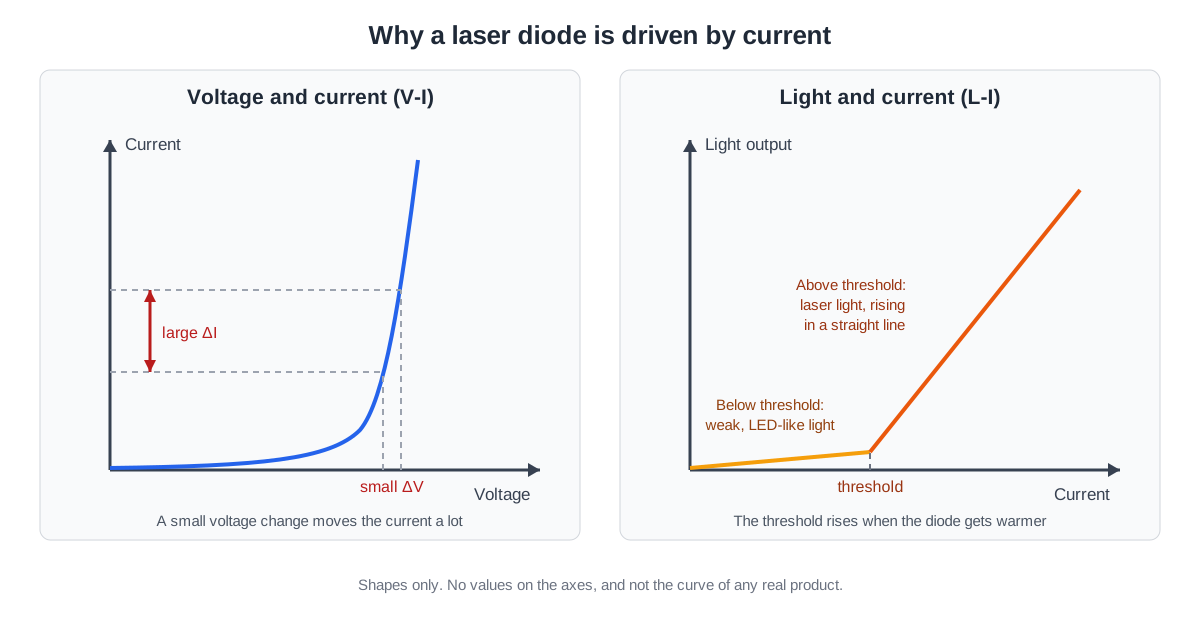
Picture a very touchy water tap. If a small turn of the handle sends water gushing out, it is safer to set the tap by measuring the flow than by the angle of the handle. A real diode is different from water: a little too much current can destroy it, and the whole curve shifts with temperature.
A current source works the other way around. It holds the current fixed and adjusts its own output voltage as the load changes. From the diode's side, the same amount of charge keeps arriving.
The L-I curve: lasing starts at a threshold
The most important property of a laser diode is how its light output (L) responds to the injected current (I). The plot of this relation is called the L-I curve. A diode's data sheet lists values read from it: the current where lasing begins, the current needed for a given output, and the maximum current the device can take.
The curve has a bend. The current at that bend is the threshold current. Below the threshold, the diode gives weak, LED-like light from spontaneous emission. Above it, stimulated emission produces coherent laser light, and from there the current and the light output rise in direct proportion.
Electricity below the threshold barely turns into light. A NASA guideline for high-power diode arrays puts the wall-plug efficiency at zero under the threshold. Above it, the efficiency climbs steeply and typically settles at about 50% when the output is at its maximum.
The curve does not stay put. The threshold current depends strongly on temperature and rises exponentially as the diode warms. So the same current can give less light when the diode gets hotter.
Current also changes the color. When the drive current changes, the center wavelength of the light shifts too. According to a Newport technical note, temperature and center wavelength follow a straight-line relation, with a typical coefficient of 0.3 nm/°C. Output and wavelength stay steady only when current and temperature are both held.
Constant current and constant power
The user picks what the driver keeps steady. One choice is constant current (CC) mode, which holds the current through the diode fixed. The other is constant power (CP) mode, which holds the light output fixed.
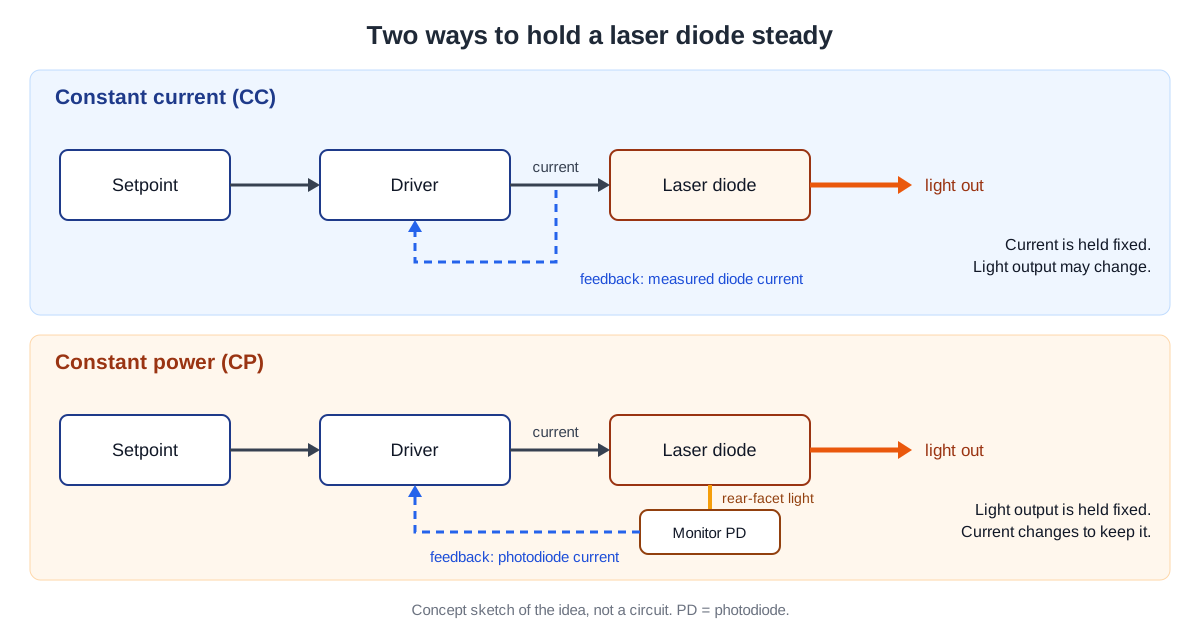
Constant power mode needs an eye that measures light. A laser diode usually emits from both ends of its cavity. So a monitor photodiode inside the package catches the light leaking from the rear facet, and its current serves as the feedback signal. When the light drops, the driver raises the current to bring the output back.
That eye is not perfect. The monitor photodiode's current is only "somewhat" proportional to the laser output, and the ratio varies widely from package to package. The same photodiode current can mean a different real light output in another diode.
The two modes look different as a diode ages. The NASA guideline notes that a slowly aging diode shows falling light output and a rising current needed to hold a set output. In constant current mode this appears as fading light. In constant power mode it appears as a current that slowly creeps up.
What a driver protects against
Laser diodes have become far more reliable over the years, but they can still be damaged in many ways. The failure list in the NASA guideline includes electrical overstress from electrostatic discharge (ESD), current that spikes suddenly during operation, and overheating.
Static electricity is dangerous even when it is small. The "zap" you feel when you touch a metal doorknob after walking on carpet is a common example. A discharge too small for a person to feel can still ruin a laser diode.
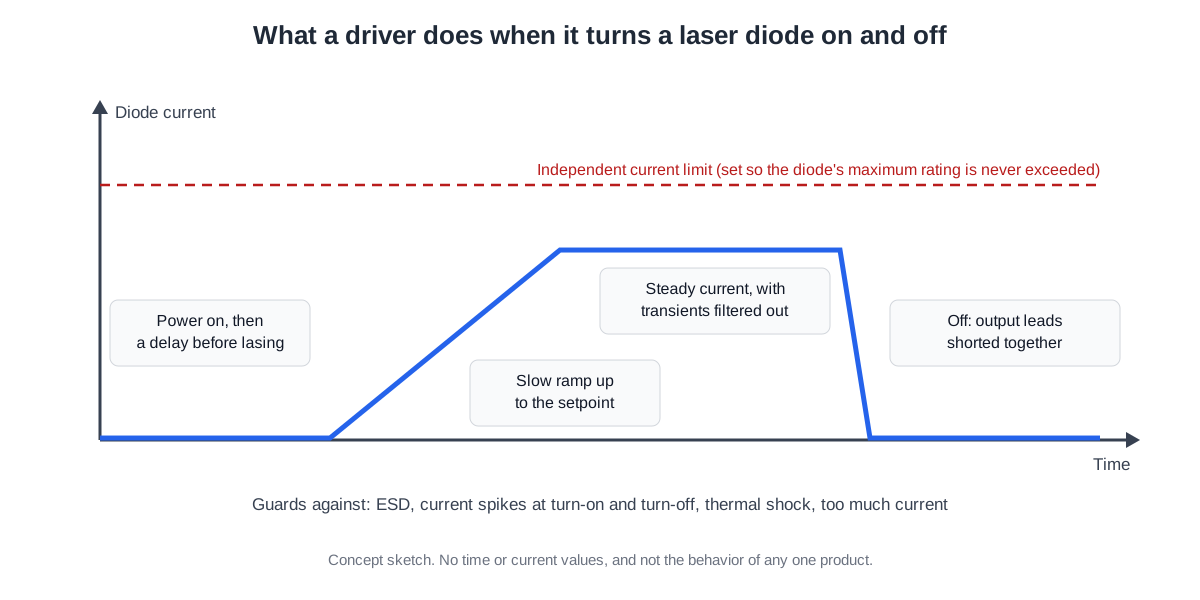
So a driver is especially careful at the moments it switches the diode on and off, because brief transients can arise inside it then. A good driver shorts its output to the diode whenever the current is off, keeping both leads at the same potential. When it turns on, it waits a few seconds and then raises the current slowly.
The slow start also has to do with heat. Laser diodes can be harmed by thermal shock. A driver usually also includes a stage that filters noise coming in from the AC supply and a stage that suppresses fast transients.
The last fence is the independent current limit. Going past the maximum operating current on the data sheet damages the diode. The current limit takes priority over any condition that could push the output current above that rating. Some drivers hold the current at the limit and keep running; others cut the current entirely.
Features that protect people are built in as well. Wavelength Electronics explains that government regulations in many countries require two things of more powerful laser systems. Lasing must not start the instant power is applied; a delay has to come first. A protective housing or entry door also needs an interlock, so that opening it turns the laser off.
The ILX white paper warns that the slow start, which protects the diode, is not the same as the turn-on delay, which protects people. It also notes that interlocks can watch coolant flow on a chiller.
Switching light fast: modulation and pulses
Above threshold the L-I curve runs straight, and that is very useful. When the current wiggles, the light wiggles with it, so a diode can be modulated directly through its current. Newport explains that a suitable driver can modulate a diode at up to several GHz or produce pulsed output.
Current is also a fast control knob. When the knobs used to stabilize a laser are compared, laser temperature is a very slow one, while the injection current of a diode-pumped laser is a fast one. The same diode can be steered slowly by temperature and quickly by current.
High-power diodes run in two main output modes: continuous wave (CW) and quasi-continuous wave (QCW). QCW can be thought of as a pulsed mode that switches on and off again and again.
High-power diode arrays have traditionally run in QCW mode. In QCW, wavelength and output settle to steady values, yet the temperature never settles.
The advantage is much higher output than in CW, where internal heating and the ability to shed heat limit the output. The drawback is far greater thermal and mechanical stress from heating up and cooling down over and over.
So the driver has to match the mode. The ILX white paper warns that running a QCW laser from a CW source can cause a catastrophic failure. Even a CW diode produces much less heat during testing when its power is applied in pulses.
From a crystal in liquid nitrogen to today's drivers
The first semiconductor lasers appeared in the autumn of 1962. Three labs reported first demonstrations independently: GE, MIT Lincoln Laboratory and the IBM Thomas J. Watson Research Center. The IEEE Milestone citation calls the laser tinier than a grain of rice and says it runs on direct current injection, so it was driven by current from the start.
The early devices looked very different from today's. In a GE photo shown in an IEEE Photonics Society article, a small crystal hangs in a glass vessel of liquid nitrogen, which kept the device cold.
Current was a problem too. According to the scientific background paper for the 2000 Nobel Prize in Physics, the first semiconductor lasers were p-n homojunction lasers. They were not very efficient and needed a rather high current to turn on. That made it hard to keep them running continuously at room temperature.
The way forward was the heterostructure. It cut the threshold current sharply and allowed continuous operation without extra cooling.
In May 1970, a group at the Ioffe Institute in the Soviet Union reported continuous operation at room temperature. A group at Bell Laboratories in the United States reported the same in June 1970. The same paper says heterostructure lasers are far more common than any other laser type.
As the threshold fell, the semiconductor laser became a part that could be left running at room temperature on current alone. The slow start, output shorting, current limit and interlock of today's drivers are there to keep this small, sensitive device from being damaged. The structure of the chip itself is covered in "Inside a Laser Diode Chip: Active Layer, Waveguide and Facets."
Where this meets laser weapons
Laser diodes are widely used as pump sources for other lasers. The NASA guideline lists pumping of double-clad fiber lasers, solid-state lasers and other devices among the uses of laser diodes in the 0.8–1.06 µm range. Those lasers go into equipment for telecom, aerospace, the military and medicine. A diode used this way is called a pump diode.
The current at which a pump diode runs ties into the laser's lifetime and efficiency. The fiber laser maker IPG says it puts the right number of diodes into its lasers so they run at an ideal current. In IPG's words, this extends laser lifetime and raises electrical efficiency. This is the company's own description, but it shows that where the current sits is one of the things laser design weighs.
Public descriptions from the weapons side go as far as where the electricity comes from. In a 2022 U.S. Army article, an official of the developing organization says the vehicle carries a thermal and power system that sheds heat and recharges the batteries. The laser fires from those batteries.
For how that share sets the size of a system, see "Power and efficiency: the share of electricity that becomes light sets the size of the system". The path from chip to effector is in "Following One Laser Weapon: From Chip to Effector".
The electricity a diode fails to turn into light stays behind as heat. Dealing with that heat is the job of thermal management.
What to read next
- "Pump diodes: the part that turns electricity into light": how the diode that a driver feeds actually makes light.
- "Power supplies and chillers: the equipment behind a laser": the power units and cooling gear that sit next to a driver.
- "Thermoelectric Coolers and Temperature Control: Why Lasers Care About Heat": the other half of a controller, temperature control.