A single dot sits on a radar screen. It tells you that something is out there, at a certain spot in the sky. It does not tell you whether that something is a friendly aircraft, a passing airliner or an enemy plane.
Identification friend or foe (IFF) was built to answer that question. The idea is simple. One side asks by radio, and a friendly aircraft carrying the right equipment answers by radio.
So what about a dot that sends no answer? What you can and cannot say when no answer comes back is the key to understanding this device.
Radar knows something is there, not who
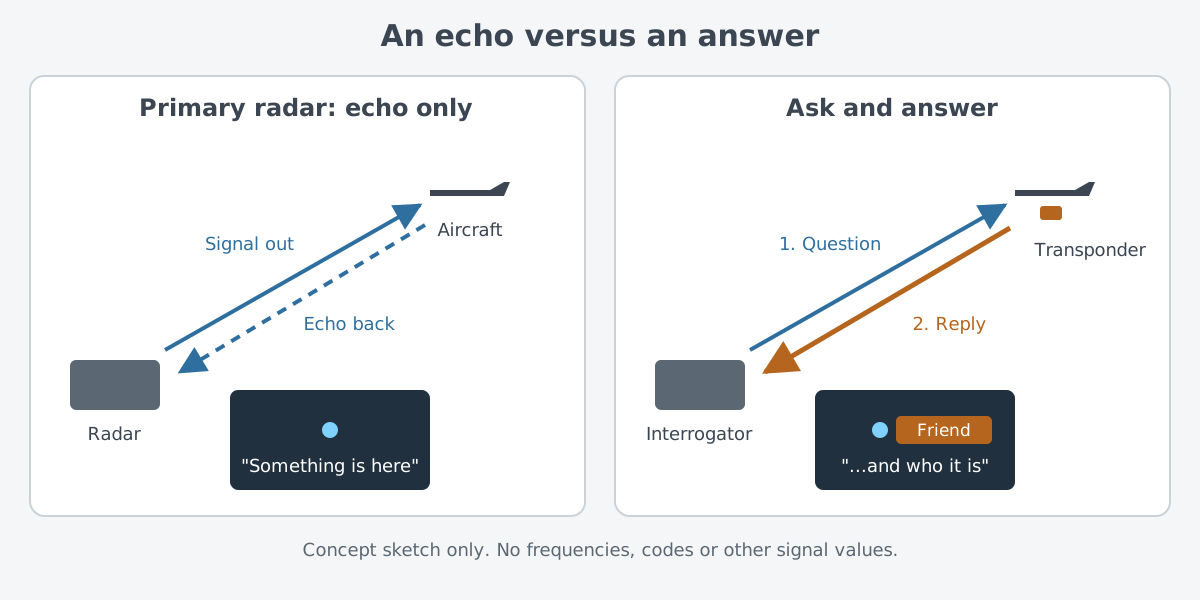
A primary radar sends out radio waves and picks up the echo that bounces back from an object such as an aircraft. That echo shows up as a "target" on the controller's screen. The echo tells where the object is, but the object does not give its own name.
That makes it hard work to tell who is who from echoes alone. The Federal Aviation Administration (FAA) Aeronautical Information Manual calls identifying primary radar targets, and keeping them identified, "a long and tedious task" for the controller. How radar measures distance and motion is covered in Radar: measuring distance and motion with radio waves.
Ask and answer
Instead of waiting for an echo, IFF asks the other side directly. A 1995 report by the U.S. General Accounting Office (GAO) describes cooperative question-and-answer identification this way. A shooter or observer sends a question to a target, and identification happens when the target replies and names itself as a friend.
The key word is "cooperative." Any object returns an echo, but only a prepared one sends an answer. Identification works only when the other side carries matching equipment and replies.
It is a bit like a phone call where you ask "Who is this?" and someone you know gives their name. The real thing is different. No person speaks: the aircraft's equipment sends a radio signal back on its own, and that signal must use a format the asking equipment can match.
The same idea in civil skies: secondary surveillance radar
Civil air traffic control uses the same idea every day. The Air Traffic Control Radar Beacon System (ATCRBS), also called secondary surveillance radar, has three parts. They are a ground-based interrogator, a transponder on the aircraft and the controller's radar screen.
The interrogator turns in step with the primary radar and keeps sending signals that ask transponders to reply. The transponder picks up those signals automatically and answers in a set format. Its reply arrives separately from the primary radar echo and is much stronger than it.
The replies are mixed with the primary echoes and shown together on the same screen. Compared with primary radar alone, targets stand out more clearly and identification is faster. Transponders on aircraft greatly improve how well radar systems work.
Early days: British skies in 1940
According to the Royal Air Force Museum, Royal Air Force aircraft carried a radio transponder called IFF Mk II in 1940. It sent a distinctive radar signal back to Britain's Chain Home radar stations and was used to tell friendly planes from enemy ones during the Battle of Britain.
More than 50 years later, around 1995, the U.S. military's aircraft identification system was Mark XII, and whatever came next also had to work with future civil air traffic control. Military aircraft also have to fly in airspace run by civil controllers.
No answer does not mean enemy
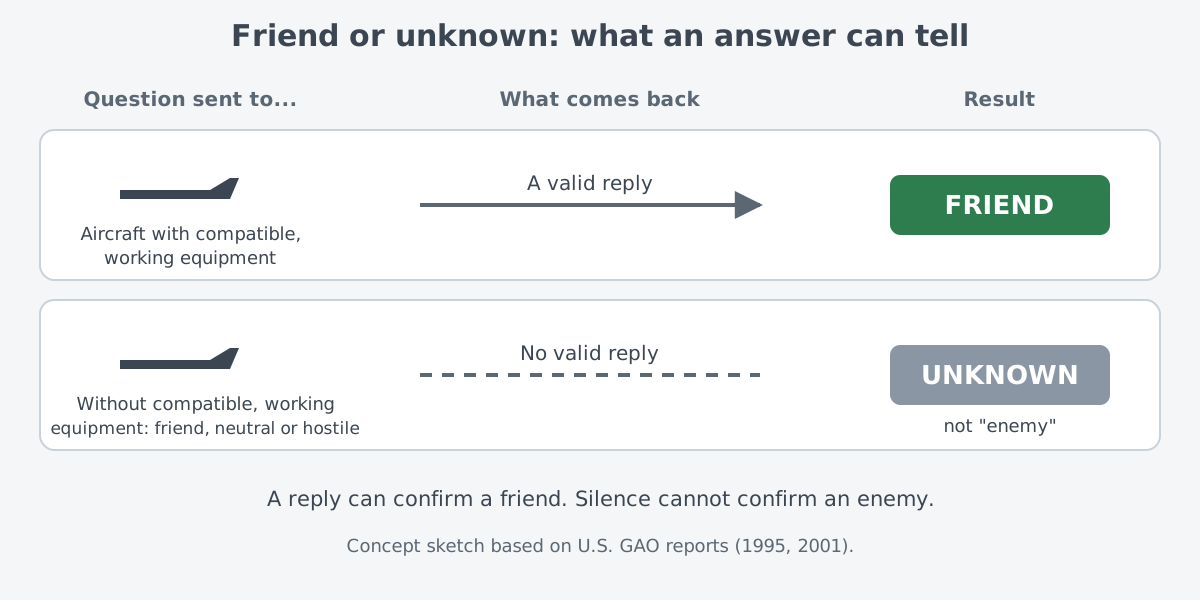
The ask-and-answer method has a clear limit. The 1995 GAO report points out that a cooperative question-and-answer system can identify only friends that carry compatible and operating systems. That is why such a system gives only two results: "friendly" or "unknown."
Notice that "enemy" is not one of the results. When a reply comes back, you can say "friend." When no reply comes back, all you can say is "unknown."
A friend whose equipment is missing, mismatched or not working falls into that group. So can a neutral country's aircraft, and so can an enemy plane. A reply can confirm a friend, but silence does not confirm an enemy.
Friendly fire and combat identification
Friendly fire is costly. In the 1991 Operation Desert Storm, friendly fire incidents caused about 24% of U.S. deaths. The GAO cited that figure in 2001 from a 1993 congressional Office of Technology Assessment (OTA) study. That rate appeared very high compared with past conflicts.
A more recent case is the 1994 shootdown of two Black Hawk helicopters over Iraq by friendly forces during Operation Provide Comfort. Incidents like these can come from failures of command and control, failures of navigation, or misidentified targets. Of the three, misidentification is the one that identification equipment such as IFF tries to reduce.
The U.S. military has handled the problem under a wider heading called combat identification. The definition quoted in the 1995 GAO report describes it as a way to tell friendly, hostile and neutral platforms apart with certainty. Its aims are fewer friendly-fire losses from misidentification and weapon systems that work as well as they can. The services expected the answer to be a "system of systems," with cooperative question-and-answer systems as one part.
The 2001 GAO report sorts these systems into three broad families. The first identifies friends through questions and answers. The second uses data such as radio emissions or sounds to mark targets as friendly or unknown. The third, called situational awareness, updates position data at regular intervals to show where friendly forces are.
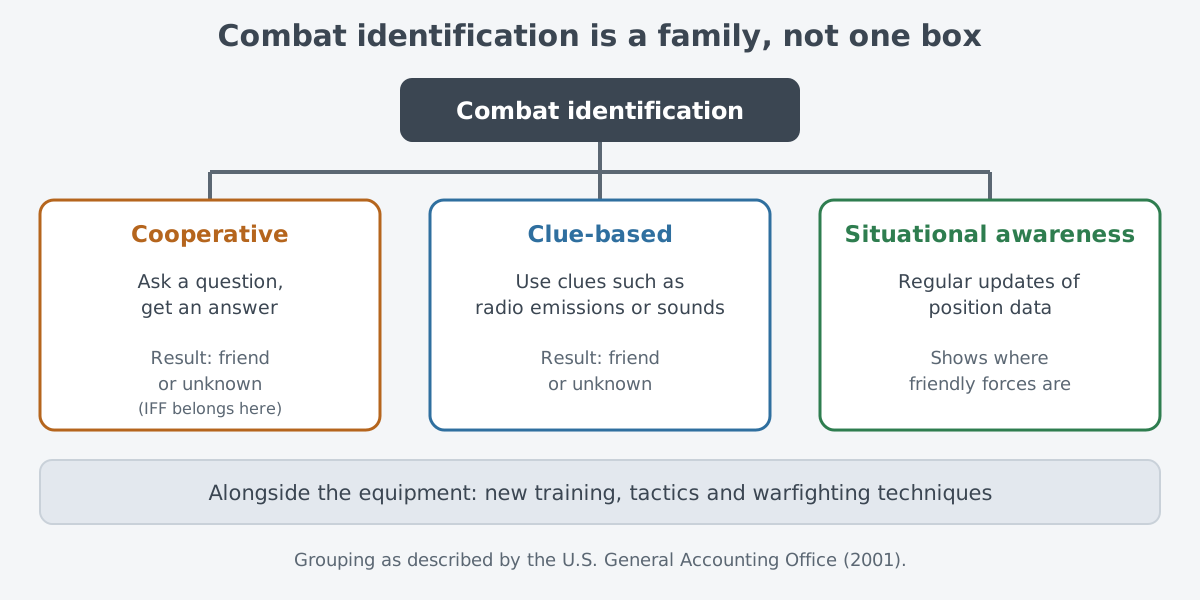
Equipment is only part of it. Around 1995, the services were looking for both equipment and non-equipment solutions. The equipment side includes several kinds of cooperative and noncooperative systems for identifying targets, and the other side covers how troops train, plus their tactics, techniques and procedures.
Where lasers meet it: asking with light
The question does not have to go out by radio. The 1995 GAO report includes one example passed on by a Defense Department official. A North Atlantic Treaty Organization (NATO) ally had demonstrated a way for ground forces to identify each other. The question goes out by laser, and the answer comes back by radio.
Sending light out and reading what comes back is a familiar idea on the laser side too. Lidar measures distance from the round-trip time of pulsed laser light. Lidar reads reflections, though, so it is closer to primary radar than to IFF. The principle continues in Measuring with lasers: range finding and lidar basics.
What to read next
- Radar: measuring distance and motion with radio waves: how primary radar measures distance and motion from echoes.
- Drone or bird: what sensors look at: what sensors use to sort out objects that do not answer any question.
- Integrated air defense and sensor fusion: how information from many sensors is merged into one picture.