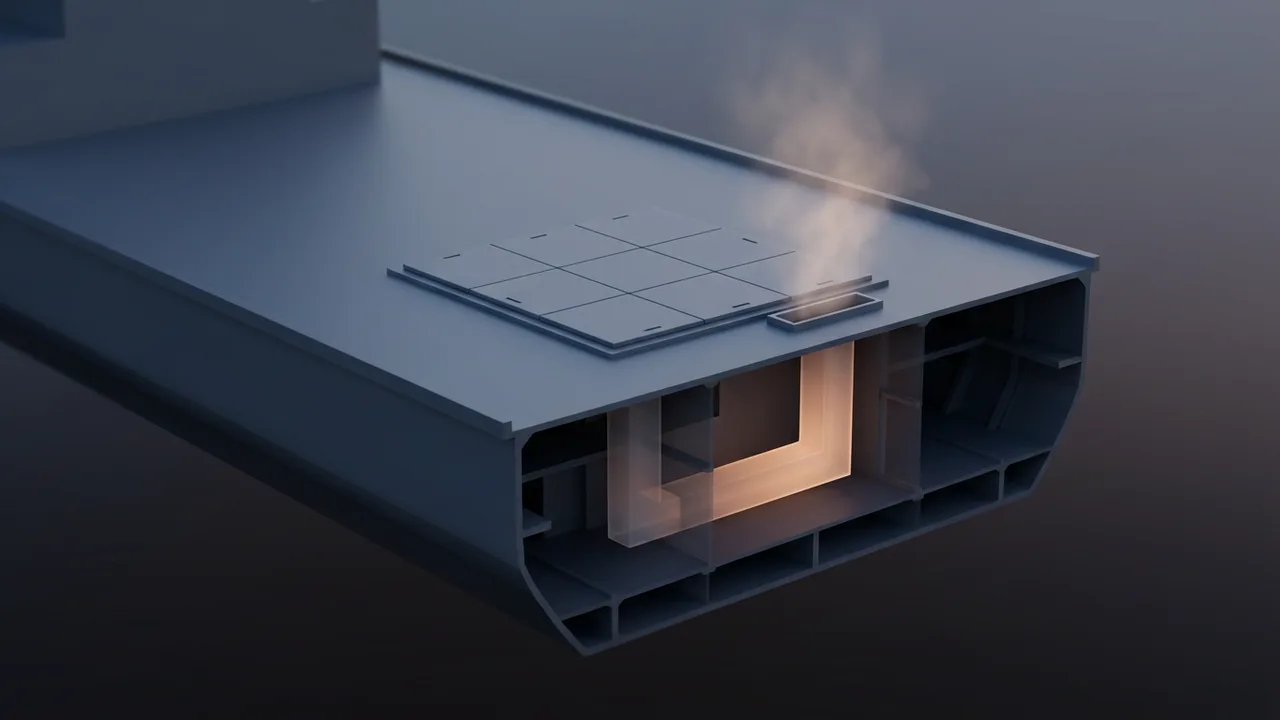
Cold launch pushes a missile out with an outside force first and lights the motor only after the missile clears the launcher. Hot launch sits at the other end. The missile lights its own rocket motor right inside the tube and leaves under that thrust.
It looks like a simple change of order, but it leaves a different problem behind. When the motor lights inside, the flame and hot exhaust are also made inside the tube. For a launcher buried below a ship's deck, the first question is where that gas should go. This article follows what hot launch means, the path the gas takes, and the trade-offs between the two methods, using Korean conference and journal papers and maker material.
What hot launch is: the motor lights inside the tube
There are two broad ways to get a missile out of its launch tube. A 2017 paper at a Korean Society of Propulsion Engineers conference calls one the "booster launch method (hot launch)," which uses part of the rocket motor's thrust for ejection. It calls the other the "ejection launch method (cold launch)," which uses a separate power source. The first one is the hot launch of this article.
In a hot launch, the force that moves the missile out of the tube also comes from its own motor. From the moment the motor lights, the missile moves under its own power. Unlike cold launch, there is no separate power source to push the missile out, and that is the starting difference.
Picture a car that starts its engine inside a garage and drives out. The car leaves under its own power, but the exhaust fills the garage first. In reality a missile's flame is hot and at high pressure, so opening a window is not enough. A dedicated passage is needed that can survive the flame and lead it outside.
Side by side with cold launch
What separates the two methods is when and where the motor is lit. Hot launch lights it inside the tube, and cold launch lights it after the missile clears the launcher. This one difference changes what else the launcher needs.
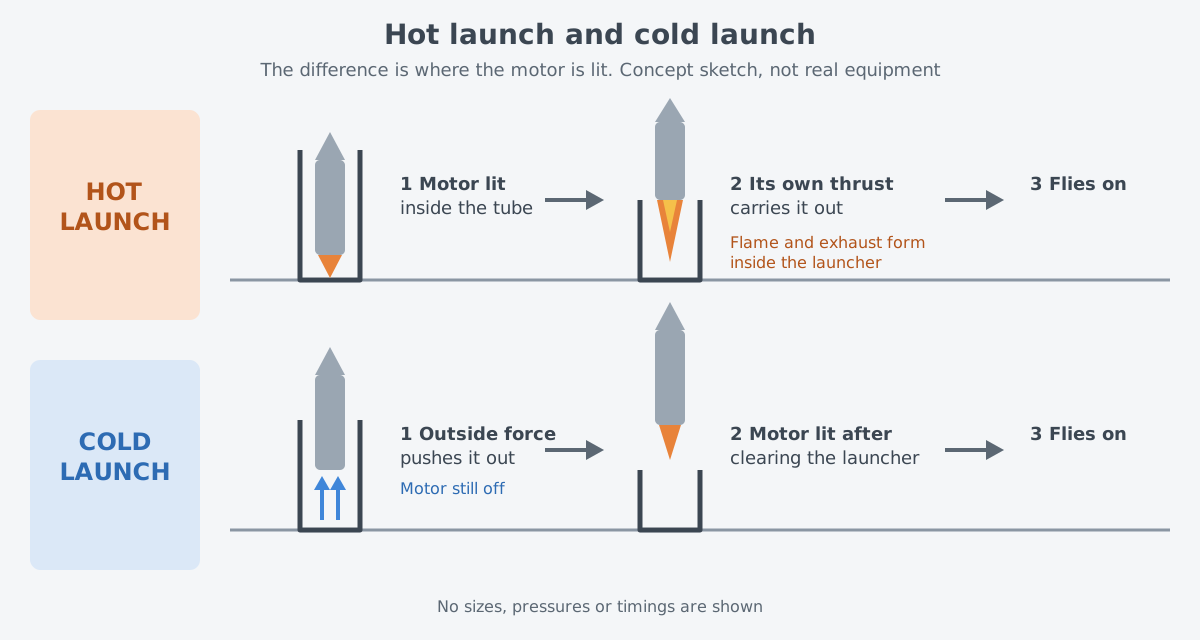
| Item | Hot launch | Cold launch |
|---|---|---|
| Force that moves the missile out of the tube | Thrust from the missile's own rocket motor | A separate power source |
| When the motor is lit | Inside the tube | After clearing the launcher |
| Booster flame inside the tube | Yes | No |
| What a shipboard launcher also needs | A path to carry flame and exhaust away | A pushing device and its energy source |
The submarine example runs in the opposite order. A Lockheed Martin history article says underwater launches needed very different technology from launches on land. Polaris left the submarine pushed by compressed air streams, and its first-stage engine lit only once it was a safe distance away.
Some launchers take both methods. Roketsan describes its naval vertical launch system, MİDLAS, as able to fire several types of guided missiles with either hot or cold launch. So one launcher is not always tied to a single method.
Where the flame and exhaust go
A shipboard vertical launching system (VLS) is a device installed inside a ship to fire guided missiles straight up. Because the tubes sit below the deck, a motor lit inside sends its flame down into the lower part of the ship first. The gas management system (GMS) vents this flame safely out of the ship.
According to a 2013 paper by a researcher at Korea's Agency for Defense Development, the main parts of a gas management system are the plenum and the uptake. The plenum takes the flame coming out below the missile and guides it toward the uptake. The uptake is the passage that carries the flame out of the ship.
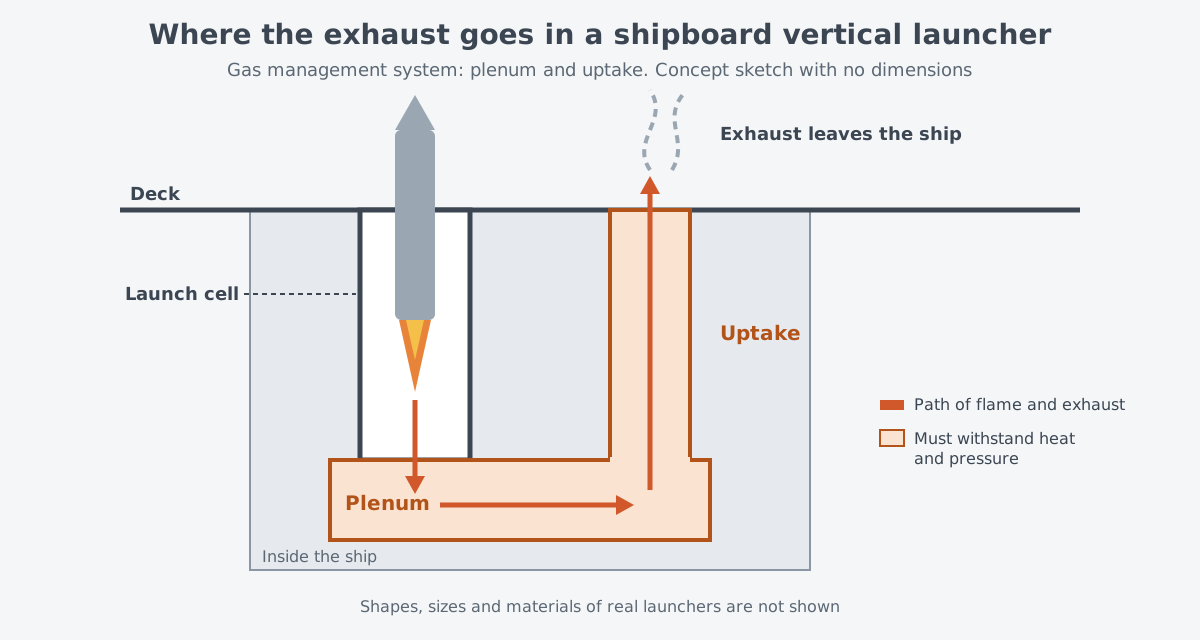
Both parts take the hot, high-pressure flame head-on. They have to be protected from heat, and they also have to hold the pressure pushing from inside. In terms of the car picture, this is the garage's vent duct, except the duct itself has to stand up to fire.
What the launcher has to withstand
The gas management system has to carry two kinds of load. One is the repeated hot, high-pressure thermal shock that comes with every launch. The other is the thermal shock of a restrained firing.
A restrained firing is a case where the missile stays held in the tube while its motor burns all the way through. In a normal launch the missile soon leaves the tube, but here the flame stays inside the launcher from start to finish. The plenum and uptake must be able to contain and survive even such a full-burning restrained firing.
The flame causes trouble outside the launcher too. A 2014 Agency for Defense Development paper in the Korean aerospace society's journal notes that rocket plumes can seriously damage launch equipment and nearby structures. It then analyzes how the plume affects a nearby structure when a missile is fired from a ship.
Exhaust also comes up in news about a new Korean ship launcher. According to Janes, South Korea held a ceremony marking the end of the development program for the KVLS-II, a ship launcher built for the next generation of guided missiles. The report says the KVLS-II grew out of the Korean vertical launching system (K-VLS) that the country developed itself. It copes better than the older launcher with the hot, high-pressure exhaust of launches, so it can also hold larger missiles.
Choosing a method: trade-offs named in the sources
The 2017 paper says each method has its own strengths and weaknesses, and the choice depends on the launch platform. The weak point of cold launch is its structure. It needs a separate energy source instead of the motor, so more devices are added and the design gets more complex.
In return, cold launch saves the motor energy that would otherwise go into getting the missile out of the tube. Seen the other way, hot launch spends part of the motor's energy on leaving the tube. Because of that, it does not need a separate pushing device.
Flame is another dividing line. With no booster flame, the ejection side can improve the survivability of both the launch platform and the missile. On the hot-launch side, the gas management system described above takes that flame.
Makers list more advantages for the cold-launch side. L&T MBDA says the soft vertical launch (SVL) of its Sea Ceptor offers better performance and safety than "the conventional Hot Vertical Launch." The company adds that it gives a smaller launch signature and puts less stress on the deck. The MBDA CAMM datasheet also says the technology reduces system weight.
All of these are companies speaking about their own products. As the conference paper puts it, the sources fit better with choosing a method to suit the launch platform, and some launchers, such as MİDLAS, take both.
What to read next
- Cold launch: why some missiles pop out before igniting: the order of steps on the push-out side, with public examples on submarines, ships and land-based silos.
- Cooling and thermal management: where the heat that did not become light goes: where to send unwanted heat is a question laser weapons have to answer too.