Steel is more than seven times as dense as sea water. Yet a submarine built of steel floats on the surface, slips under it, and comes back up again. Do the propellers drag it down and haul it back?
The core of the answer is weight. A submarine lets sea water into tanks on its body and pushes it out again, making itself heavier or lighter. These are called ballast tanks.
This article starts from the buoyancy chapter of a physics textbook and follows what ballast tanks do. The submarine layout comes from a 1946 article in Caltech's engineering magazine about U.S. fleet-type submarines. Today's submarines can differ from boat to boat.
Why a steel ship floats
Underwater, pressure grows with depth. So the push up on the bottom of a submerged object is larger than the push down on its top. That difference is a net upward force, the buoyant force. It acts on an object whether the object floats or sinks.
Archimedes' principle tells how large the buoyant force is. It equals the weight of the water the object pushes aside. When the buoyant force beats the weight, up it goes; when the weight wins, down it goes. When the two match, the object stays at that depth.
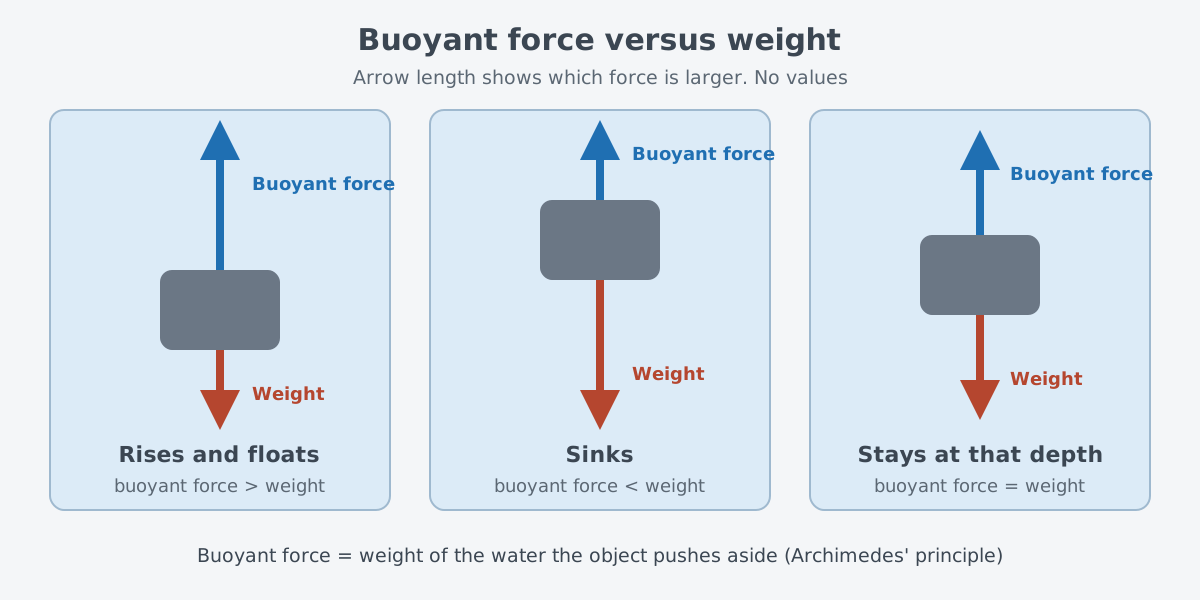
Drop a lump of clay into water and it sinks. Shape the same clay into a boat and it floats. The boat shape pushes aside more water than the lump, so it gets a larger buoyant force. A steel ship floats for the same reason.
Average density decides floating and sinking
What finally decides whether something floats is its average density. If its average density is lower than that of the surrounding water, it floats; if higher, it sinks. For a hollow ship, the steel and the air inside are counted together.
In the textbook's density table, steel is 7.8 g/mL and sea water is 1.025 g/mL. Steel on its own is far heavier than sea water. But a whole ship holding plenty of air floats if its average density stays below that of sea water.
A submarine is a ship that changes this average density itself. The textbook gives the submarine as an example of an object with adjustable density and names ballast tanks as the means. When sea water replaces air in the tanks, the same volume carries more weight and the average density goes up.
The 1946 Caltech article says that to understand submarines you need four kinds of buoyancy. An object that floats has positive buoyancy, and one that sinks has negative buoyancy. Neutral buoyancy describes an underwater object that displaces water weighing exactly as much as itself.
The fourth is reserve buoyancy. It is the weight a floating object must take on before it goes under. For a submarine, reserve buoyancy equals the weight of water that has to fill the tanks for the boat to dive with neutral buoyancy.
Main ballast tanks: let the air out and the water comes in
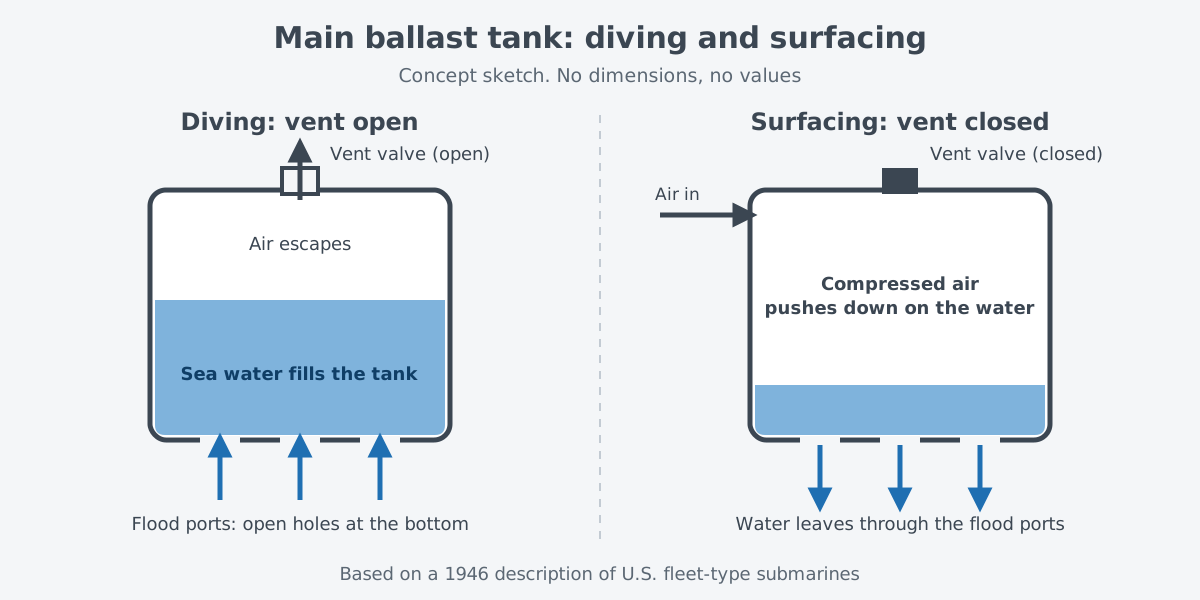
The tanks that take on water for a dive are the main ballast tanks. In the 1946 fleet-type submarine, most of them sat between the outer hull and the inner hull. Along the keel, the bottom of each tank had many large holes called flood ports.
With holes in the bottom, why does the tank not fill while the boat rides on top of the sea? The pressure of the air kept inside holds the water back. Open the vent valves on top to let that air out, and the tank floods quickly. That is how a submarine dives.
Put a straw into a glass of water with a finger over the top, and only a little water gets in. Lift the finger, the air escapes, and the water rises. A real tank is a large space wrapped around the hull, and a valve rather than a finger opens and closes the path for the air.
Surfacing: compressed air pushes the water out
Surfacing runs the other way. With the vent valves closed, high-pressure air is blown into the top of the tanks, and the air presses the water down and out through the flood ports. The boat carried this compressed air in steel cylinders.
The tanks were not emptied at this stage. Only enough water was blown out to bring the boat up with the main deck awash.
The 1946 article gives cost as the reason: squeezing air to a very high pressure and then letting large volumes out at low pressure is very uneconomical. So the rest of the water was blown out by a large, low-pressure blower.
Holding depth underwater: trim tanks and diving planes
Does filling the main ballast tanks alone put the boat at the depth it wants? Only if the weight just before the dive is right. Even while the boat travels on the surface, its weight keeps changing. Fuel is used up, and water is distilled and moved to other parts of the boat.
So fleet-type submarines made up for all these weight changes before diving. The aim was to keep reserve buoyancy close to how much water the main ballast tanks could hold. Then, once the main tanks were full, the boat would be near neutral buoyancy.
Even so, perfect neutral buoyancy cannot be reached in practice, the 1946 article notes. Trim tanks bring the boat close. This boat had three of them, at the bow, at the stern and in between where the boat's weight is centered. A pump linked them, so the front-to-back balance and the overall weight could be set together.
The front-to-back balance matters for a reason. A submerged submarine is stable from side to side but has no such stability from front to back. The same article adds that these boats could be made to work in fresh water, which required a change of ballast. When the density of the water changes, the buoyant force on the same volume changes too.
The small difference that remains is handled on the move. The boat keeps depth by driving forward through the water and using its diving planes. These are horizontal surfaces at the bow and stern that tilt to control the boat's depth and angle. The water in the tanks takes care of weight, and the planes of a moving boat take care of what is left.
Two hulls and pressure that grows with depth
In the ocean, pressure rises the deeper you go. The U.S. National Oceanic and Atmospheric Administration (NOAA) explains that pressure climbs by one atmosphere with each 33 feet (10.06 m) of depth. A submarine hull has to stand up to this pressure.
The 1946 fleet-type submarine had two hulls, and each had its own job. The flood ports are simply open holes, so when the boat sits underwater with its main tanks full, sea water touches the outer hull on both sides. With no pressure difference across it, the outer hull was built light.
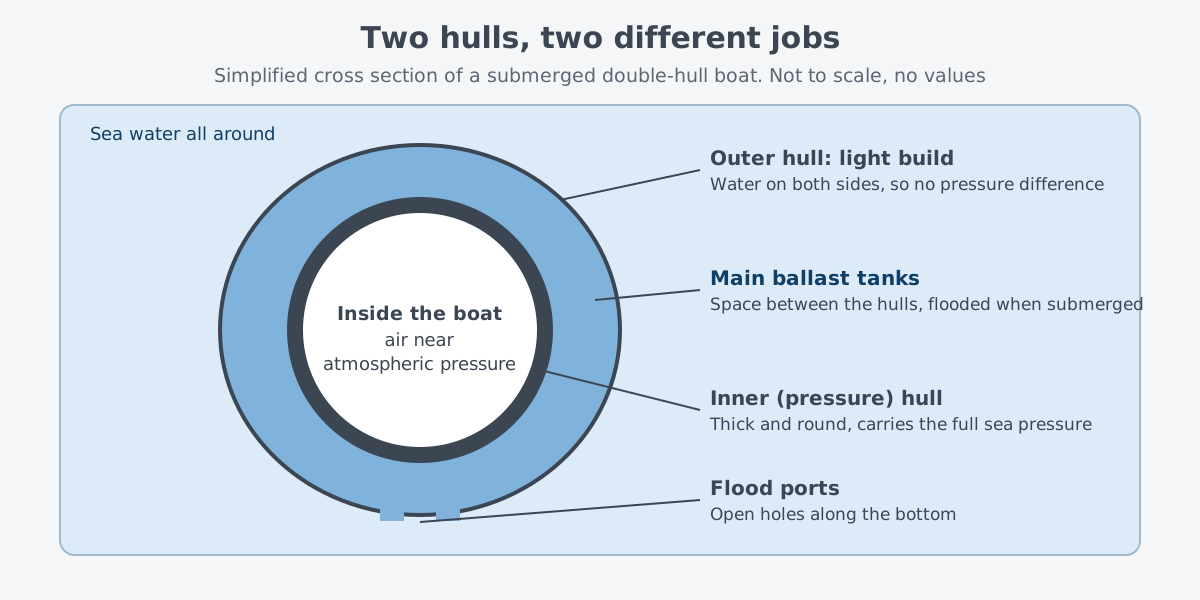
The inside, where the crew lives, is another matter. Inside, the air stays near atmospheric pressure, so the inner hull takes the full pressure of the sea. To withstand the pressure at depth, this inner hull, the pressure hull, was made thick and round in cross section.
Where this meets lasers: light does not go far underwater
When a submarine goes under, it leaves the world of light behind. According to NOAA, light can still be picked up as deep as 1,000 m, yet below 200 m hardly any meaningful light remains. Underwater, sound travels farther than radar waves or light. That is why sonar is used to look around underwater.
The light that most laser articles on this site deal with travels through air. Even in air, light is absorbed, scattered and made to waver. Reading those articles alongside the picture of light fading fast underwater makes it clearer why the path light takes matters so much.
What to read next
- Diesel-electric, AIP and nuclear submarines: what moves a submarine forward underwater, where there is no air.
- Sonar: why sound is used to see underwater: how sound takes the place of light underwater.
- Light through air: absorption, scattering, turbulence, thermal blooming: what happens to laser light as it passes through air.