Edinburgh Castle, Scotland, 30 October 1681: a salute is fired to mark a birthday. It honors the man who will later become King James VII. As the gun fires, its barrel bursts.
A powerful charge of gunpowder was to blame, and it was the last time the gun ever fired. Its name was Mons Meg. Some 200 years earlier, it had been a cutting-edge siege gun, hauled out to break castles.
Gunpowder did not start out as a force for breaking castles. It was once festival fire and flames tied to arrows. How did this powder end up changing the shape of armies?
This article follows Chinese fire arrows, Goryeo's Hwatong Dogam, Europe's great guns and star-shaped forts, and the road from matchlock to percussion cap. At the end, it looks at where historians part ways over the term "military revolution."
From festival fire to fire arrows
By one report, people in China already had an early, simple gunpowder during the first century A.D. NASA's teaching material on rocket history says at religious festivals they packed the mixture into bamboo tubes and threw the tubes into a fire. Some tubes may have failed to explode and skittered out of the fire instead.
The next step was to tie the tubes to arrows. At first they were shot from bows, but people soon found that the tubes could fly on their own. The first recorded use of true rockets dates to 1232.
At the time, China was fighting the Mongols. In the battle of Kai-Keng, Chinese forces drove back the Mongol army with "arrows of flying fire." How well these fire arrows worked as weapons is not clear, but their psychological effect on the Mongols was probably strong.
Afterward the Mongols made their own rockets, and they may be the ones who carried rockets to Europe. Europe has many records of rocket experiments from the 13th to the 15th century. Roger Bacon, an English monk, was among those working to improve gunpowder.
By the 16th century, rockets were seldom used in war anymore, but fireworks kept them alive. Meanwhile, gunpowder spread along other paths: the cannon that broke castles and the gun in the foot soldier's hands. The story of rockets becoming weapons again continues in Solid and liquid rockets.
Gunpowder in Goryeo: Choe Mu-seon and the Hwatong Dogam
The first person in Korea to make and use gunpowder and gunpowder weapons was Choe Mu-seon (1326–1395), a military officer of late Goryeo. What drove him was the raiding of the waegu pirates. The Encyclopedia of Korean Culture says he came to see gunpowder and guns as urgently needed to stop the raiders, and began his research.
China was already making and using gunpowder. Choe decided to learn from China, met Yi Won, a man from the Jiangnan region of China, and picked up the craft from him. Yi Won was a saltpeter specialist from the Yuan dynasty.
In 1377, on Choe's proposal, Goryeo set up the Hwatong Dogam, a temporary office for making gunpowder and gunpowder weapons. The number of weapon types it produced differs between entries in the same encyclopedia. The Hwatong Dogam entry says about 20 types, and the Choe Mu-seon entry says 18.
The list includes guns such as the Daejanggun, Ijanggun and Samjanggun and projectiles such as the hwajeon fire arrow. It also includes a rocket weapon called the juhwa.
The office did more than make weapons. Goryeo also formed a separate corps, the Hwatong Bangsagun, that specialized in handling them. In 1380, when the raiders came into Jinpo at the mouth of the Geum River with more than 500 ships, Choe led warships armed with gunpowder weapons and defeated them.
The weapons also proved powerful at the battle of Jindo in 1383. The Hwatong Dogam was closed in 1388. The book Choe left, the Hwayak suryeonbeop, does not survive.
Guns that broke castles
Back to Edinburgh Castle. Mons Meg is a siege gun that weighs six tonnes. It takes its name from Mons, the town in Belgium that produced it. Historic Environment Scotland explains that in 1457 Duke Philip "the Good" of Burgundy gave the gun to King James II of Scotland.
Mons Meg could fire a 150 kg gunstone up to 2 miles, and it was seen as cutting-edge military technology at the time. It saw action against Roxburgh, Dumbarton and Norham castles. Its last service was with the navy of King James V, and it retired around 1550.
Guns like this were aimed at castle walls. What great guns did at the siege of Constantinople in 1453 is covered in another article in this series, "The Fall of Constantinople, 1453: Great Guns Against Thousand-Year Walls."
Mons Meg's end is the scene that opens this article. In the 1681 salute, its barrel burst. The force that broke castles could also break the gun itself.
Forts against cannon: the star-shaped fort
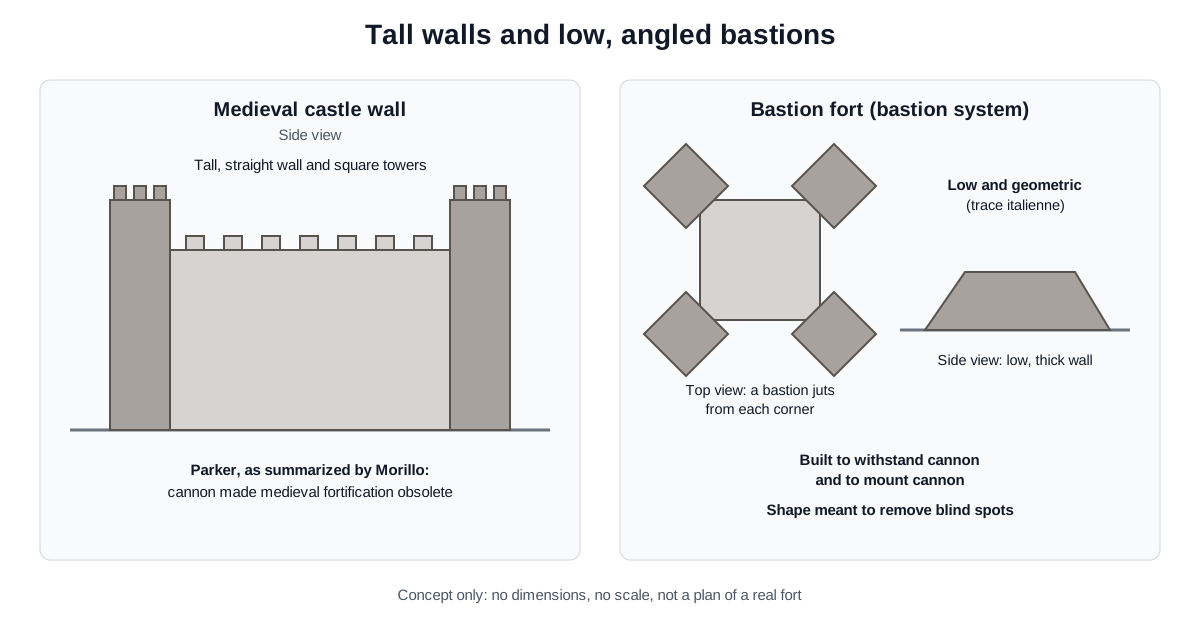
The builders did not stand still. Seen from above, the Castillo de San Marcos in St. Augustine is a square with a diamond-shaped point jutting from each corner, forming a star. The U.S. National Park Service (NPS) explains that this star-shaped design began in 15th-century Italy and came from architecture adapting to technology.
Gunpowder weapons asked two things of a fort. It had to withstand or avoid cannon shot, and it had to carry cannon of its own to drive off attackers. The most widely used answer was the bastion system, which added angled points called bastions to the fort walls.
The shape was meant to remove blind spots where an enemy could approach or take cover. That is why the engineers who designed such forts had to know their geometry.
The Castillo is the only surviving 17th-century military building in the United States and the country's oldest masonry fort, and the NPS counts it as a model Vauban-style fortification. When the English laid siege, more than 1,500 people stayed inside for 51 days.
Its building material is worth a look too. It is made of coquina, a light and porous limestone. Granite or brick hit by cannon shot would have shattered into flying shards, but here the balls burrowed into the rock and stuck.
The NPS compares this to a BB fired into Styrofoam. In reality, the material alone did not hold the fort. Along with the thick walls, the star shape itself, laid out to withstand cannon and to carry cannon, was the fort's answer.
Gunpowder in the hand: from matchlock to flintlock
If cannon changed walls, guns came into the hands of foot soldiers. The simplest firing mechanism was the matchlock, which used a burning match cord. Finds described by the Virginia Department of Historic Resources (DHR) show it in use in the North American colonies throughout the 17th century.
In early 17th-century England, the "English lock," which made its spark with flint, became popular. It counts as the earliest true flintlock. The flintlock stayed the infantry's weapon for a long time, and in the early and middle 1840s the infantry at Fort Scott were still issued .69 caliber flintlock muskets.
What pushed the flintlock aside was the small brass percussion cap of the 1830s. The cap carried its own charge, so neither flint nor separate priming powder was needed. Over time, flintlock arms became obsolete.
A gun alone did not make the infantry. In infantry formations, pikemen with long spears held a central role for a long time. Historian Stephen Morillo explains that only after the bayonet, a blade fixed to the muzzle, could musketeers stand up to charging cavalry without pikemen beside them.
The Fort Scott page adds that the bayonets there mattered more for their effect on the mind than for practical use.
The "military revolution" and the debate around it
Someone gave this age of changing cannon, forts and muskets a name. Historian Michael Roberts coined the term "military revolution" in The Military Revolution, 1560-1660, published in Belfast in 1956.
The term covers changes in warfare between roughly 1450 and 1800 that kept giving western European powers a military edge. Massed infantry took center stage on the battlefield for the first time since Rome, and heavily armored cavalry lost ground. Forts and siege methods changed quickly, and armies grew steadily larger.
Historians broadly agree on these core changes. The argument starts with why they happened.
At one end is the view that technology was the cause. In Geoffrey Parker's case (1988), as Morillo sums it up, musket-armed infantry broke the charge of heavy cavalry, and cannon made medieval fortification obsolete.
The low, geometric fort from Italy, the trace italienne, brought back long sieges and called for larger armies. Raising and feeding those armies then pushed governments to become more efficient.
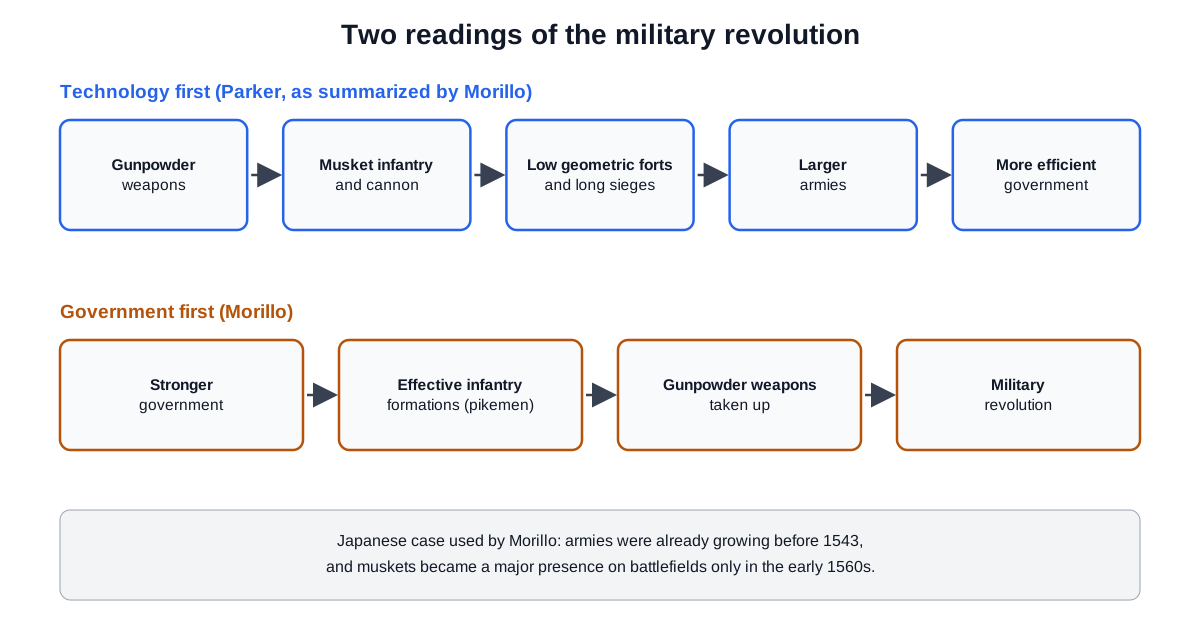
The criticism on the other side is just as strong. Crediting muskets alone for the return of infantry misses the central role of pikemen. The first infantry that could advance on cavalry without losing formation were Swiss pikemen, armed with pikes, not guns.
There is also disagreement over how armies grew. John Lynn argues that armies did not grow all at once but in three stages, with stable periods in between. Other research finds that disease did much to give Europe the upper hand in the Americas.
Some go further and hold that Europe's military dominance in the world was a product of industrialization and appeared only in the 19th century.
The case of Japan: what came before the guns
In a 1995 paper, Morillo chose Sengoku Japan (roughly 1477–1600) for comparison. Applied to Japan in 1543, the two European explanations give different predictions. The first guns bought in Japan were two weapons in 1543, and Japan's first guns were copies of them.
Here is the order Morillo reads in Japan. The size and makeup of armies were already changing well before 1543. Muskets only became a major presence on battlefields in the early 1560s, and even in 1560 they were "still in very limited use" in Oda Nobunaga's army.
Guns did not spread upward from the ranks. From the start, strong daimyo bought them, and later had them made.
Castles followed the same pattern. Azuchi Castle is counted as the first castle built to stand up to gunpowder weapons; Nobunaga started it in 1576, and it was completed three years later. Morillo judges that the cannon, often treated as the key to the European story, had little influence on military change in Japan.
His conclusion is short: "In Japan, better government preceded guns."
This reading then turns back to Europe. In late medieval Europe, governments grew stronger and built effective infantry formations first, and gunpowder weapons were taken up by armies already organized to use them. Still, Morillo also writes that once introduced, gunpowder weapons clearly affected the course of history.
The two explanations do not split over whether gunpowder mattered. They split over the order of cause and effect.
What the gunpowder revolution left behind
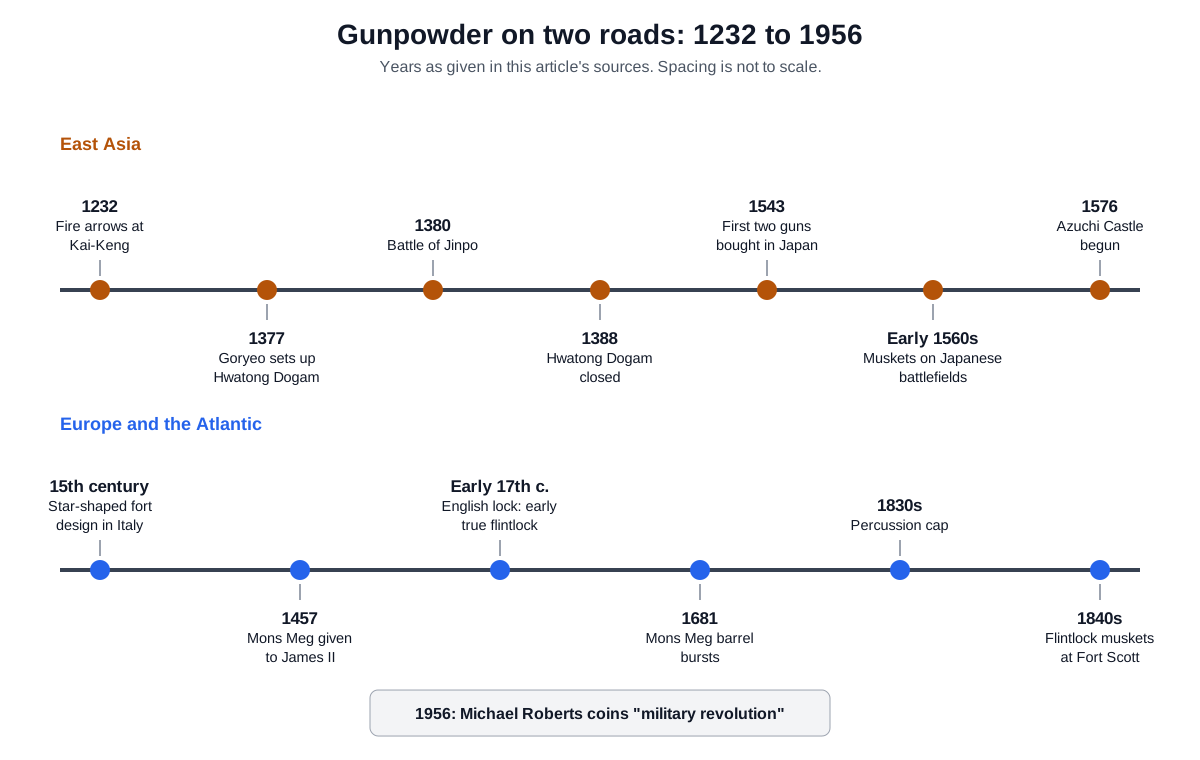
Laid out on a timeline, the road by which gunpowder changed armies is not a single line. The fire arrows of 1232 and the Hwatong Dogam of 1377 belong to East Asia. The star-shaped fort of the 15th century and Mons Meg in 1457 belong to Europe. In Morillo's reading, armies in Japan were already growing when guns arrived there in 1543.
Weapons were not the only thing that changed. New forts took a low, geometric shape. Pikemen held the center of infantry formations for a long time, and only after the bayonet could musketeers face cavalry without pikes.
If Parker is right, governments also changed as they raised the larger armies. Which came first is still answered differently by different historians.
The weapons themselves were not perfected all at once. From the early flintlock of the early 17th century to the percussion cap of the 1830s alone took around 200 years. Barrels could burst under too strong a charge, as Mons Meg's did.
New weapons came with limits, and reducing those limits took a long time. Other major turning points in weapons technology continue in Turning points in military technology.
What to read next
- "The Fall of Constantinople, 1453: Great Guns Against Thousand-Year Walls": follows the siege where great guns faced thousand-year walls, through the records of three people.
- "Crécy and the Longbow: The Real Story Behind Bows Beating Knights": a story of foot soldiers facing knights before gunpowder.
- Self-propelled howitzers: guns that move themselves: how today's artillery moves.
- A history of laser weapons: from chemical to electric lasers: another long story of a new weapon working down its limits.