In the autumn of 1600, rain fell all night on Sekigahara, a small valley in the middle of Japan's main island, Honshu. By morning a thick fog lay over it. The U.S. National Park Service (NPS) article on the battle says the more than 150,000 soldiers gathered there could not see beyond about 100 feet.
Half a day after the fog lifted, one army had collapsed. The winner, Tokugawa Ieyasu, became shogun three years later, and his family's shogunate lasted until the Meiji Restoration of 1868. That is why people in Japan often call it "Sekigahara, the battle that divided the realm."
This article follows why the battle happened, how the day unfolded and what it left behind. It draws on public material from Japan's National Diet Library, the Agency for Cultural Affairs, a museum run by Gifu Prefecture and the U.S. National Park Service. It also looks at the places where sources give different dates and troop numbers.
After Hideyoshi
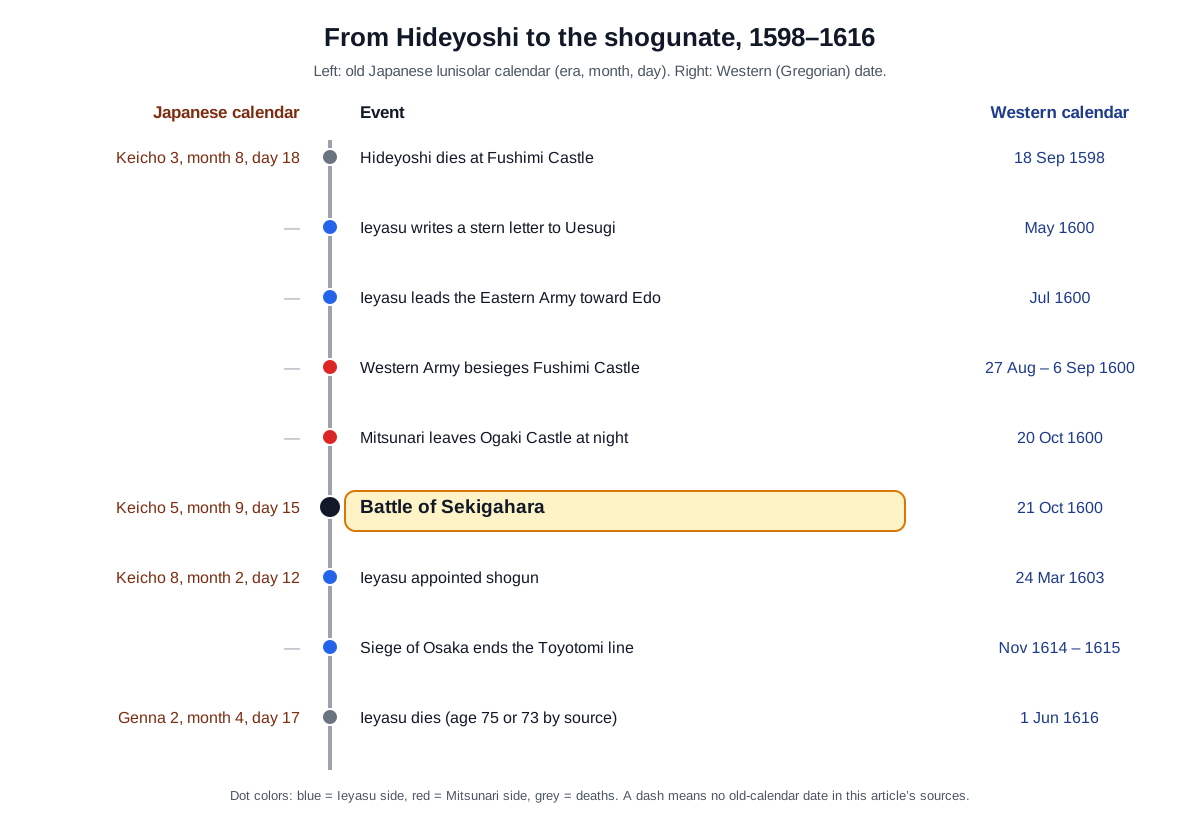
Toyotomi Hideyoshi died at Fushimi Castle in 1598, on the 18th day of the 8th month of Keicho 3. He was 63. His son Hideyori was too young to run the country.
Government passed to the Council of Five Elders, five great lords, and to the Five Commissioners, who handled day-to-day affairs. The elders were Tokugawa Ieyasu, Mori Terumoto, Maeda Toshiie, Ukita Hideie and Uesugi Kagekatsu. Over time, Ieyasu took the lead in running the government.
Ishida Mitsunari, one of the commissioners, was unhappy with this. He gathered a faction against Ieyasu, and that faction raised an army with the elder Mori Terumoto at its head. The NPS timeline describes the same group as "Toyotomi loyalists, headed by Ishida Mitsunari," so the sources put a slightly different person at the front.
Just before this quarrel came a war with Korea. Koreans call it the Imjin War and the Jeongyu War; in Japan it is known as the Bunroku and Keicho campaigns. A large number of those who later fought at Sekigahara were veterans of this war, which ran from May 1592 to December 1598. Ieyasu kept his own men out of it and so kept his strength and wealth.
During the Keicho campaign, the commander-in-chief of the Japanese forces sent to Joseon was Kobayakawa Hideaki. Two years later, this young general would decide the battle at Sekigahara.
An army marches east, another rises in the west
From here on, dates in 1600 are given in the Western calendar used today. That May, Ieyasu sent a stern letter to Uesugi Kagekatsu in northeastern Honshu, demanding to know why he was building up his forces. Kagekatsu was working with Mitsunari. In July, Ieyasu led his "Eastern Army" from Osaka toward Edo.
While Ieyasu moved east, Mitsunari's "Western Army" besieged Fushimi Castle from 27 August to 6 September. Torii Mototada, Ieyasu's retainer, kept a large part of the Western force tied down there. Fighting over other castles along the road also left several thousand men away from the main armies by the day of the battle.
On 20 October, the Eastern Army reached Ogaki Castle. Mitsunari, inside, wanted to avoid a siege and to stop Ieyasu from slipping past him to Osaka. So he left the castle late that night and marched west.
Why Sekigahara? In 1600 it was a small town on the Nakasendo. This inland road between Edo and Kyoto and the coastal Tokaido were the two most important roads in the country at the time. Ieyasu was aiming for Mitsunari's base at Sawayama and for Osaka, both at the far end of that road, so he had to face the Western Army waiting near Sekigahara.
Positions in a foggy valley
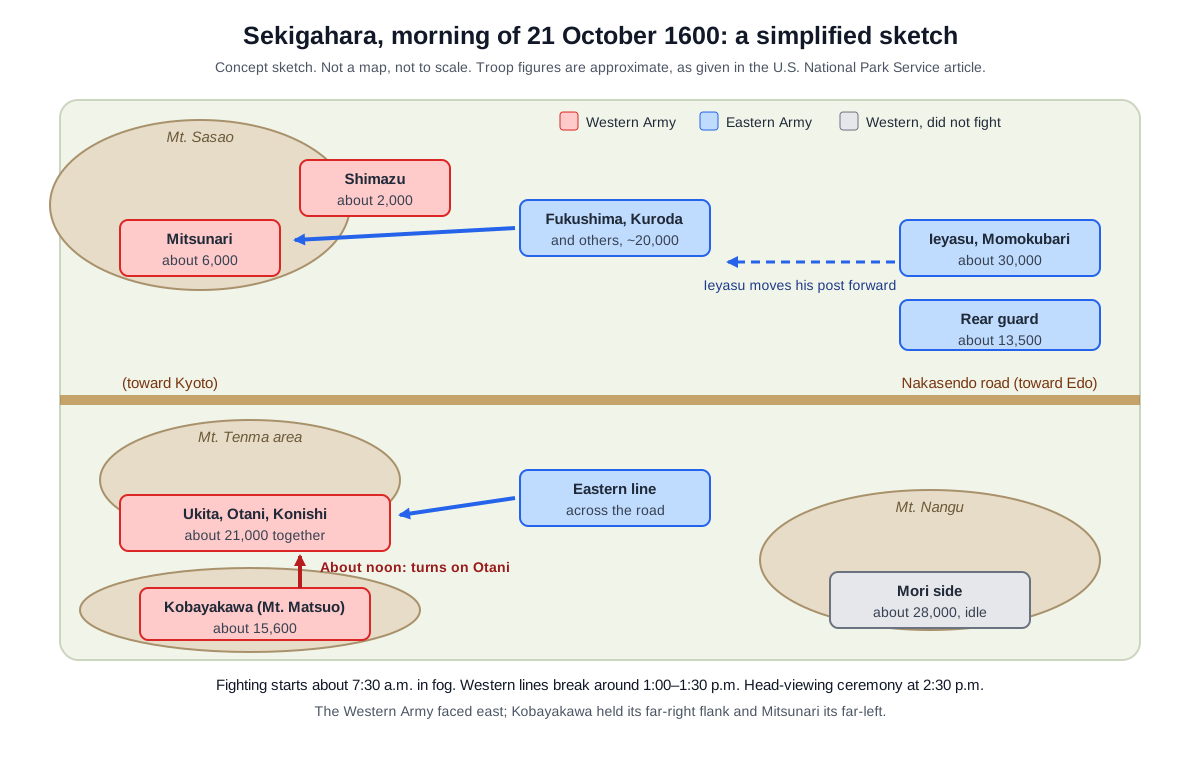
Through the rainy night, about 80,000 Western troops took up positions around four hills overlooking the valley. Mitsunari stood on Mount Sasao at the far left with 6,000 men under his direct command. To his right were Ukita, Otani and Konishi with about 21,000 together, and at the far right, on Mount Matsuo, Kobayakawa Hideaki led about 15,600. A few miles east, the Mori side waited on Mount Nangu with about 28,000 men.
By about 4:30 a.m., a Western wall stood across the Nakasendo. Judging by the ground alone, Mitsunari seemed to have the edge. Yet no one knew what Mount Matsuo would do.
Several days earlier, Hideaki had sent word to Ieyasu that he would join the Eastern Army when the time came, in return for great wealth and land. Hearing rumors, Mitsunari got a separate promise from him to charge the Tokugawa flank once a signal fire was lit.
Ieyasu began following Mitsunari at about 2:00 a.m. and set up his command post on Momokubari, a small hill next to Mount Nangu. About 30,000 men were under his direct command, and about 13,500 guarded the road behind him in case the Mori side broke its promise. About 20,000 under Fukushima Masanori, Kuroda Nagamasa and others faced Mitsunari. The Eastern generals lined up across the Nakasendo, facing the Western forces in a parallel row.
Half a day of fighting
The battle began at about 7:30 a.m. on 21 October 1600. When the fog cleared, the Eastern Army moved first. Ii Naomasa told others that he and his 30 men were only scouting, then rode at the 17,000 men of Ukita Hideie's line. Fukushima's men opened fire, and the battle began in earnest.
The Agency for Cultural Affairs' note on the national historic site records the same opening. On the morning of the 15th day of the 9th month of Keicho 5, the Eastern vanguard under Fukushima Masanori challenged Ukita Hideie at the southern foot of Mount Tenma. Western generals such as Konishi Yukinaga and Shimazu Yoshihiro fought back at its eastern foot.
Neither side had much time to plan a larger strategy. For the first few hours, exchanges of gunfire mixed with brutal hand-to-hand fighting. About 90 minutes in, Shima Sakon of the Western Army was hit in the chest and elbow by Eastern matchlock fire and fell from his horse. Ieyasu shifted his headquarters closer, to the edge of the village, to lift his troops' spirits.
A large share of the Western Army did not move. Around Mount Nangu, about 25,000 men waited for Kikkawa Hiroie, at the front, to act first. The NPS article tells how Hiroie answered three times that he was not ready, because his men were eating lunch. Shimazu Yoshihiro's 2,000 also stayed put, and at around 11 in the morning Mitsunari rode over himself to demand an answer.
Mount Matsuo was quiet too. Mitsunari sent signals into the sky, and Otani and Konishi sent messengers up the hill, but Kobayakawa's men did not move. The NPS article says that by noon Ieyasu was in effect trapped in the valley, and that he sent a group of matchlock men forward to fire on Mount Matsuo.
At last Hideaki ordered his men down the hill against Otani Yoshitsugu. About 15,000 fell on 600, and Otani took his own life.
Attacked from two sides, the Western line broke. Around 1:00 in the afternoon Ukita and Konishi left the field, and Mitsunari fled at about 1:30. Shimazu Yoshihiro and his nephew Toyohisa chose to retreat straight through the advancing Eastern army.
The Mori side on Mount Nangu did almost nothing all day; Kikkawa Hiroie had promised Ieyasu in advance not to fight the Eastern Army. At 2:30 p.m., Ieyasu held a ceremony to inspect the heads of enemy commanders.
Japanese records sum up the half day more briefly. Japan's National Diet Library (NDL) says the fighting swung both ways until Kobayakawa's betrayal brought the total collapse of Mitsunari's side and a great victory for Ieyasu. The decisive ground listed in the historic site lies below Mount Sasao. There, that afternoon, after Kobayakawa turned and Otani died and the Konishi and Ukita forces were beaten, Mitsunari made a last stand with Shimazu.
Matchlocks, spears, signs and signal fires
Sekigahara began with gunfire. The matchlock gun (teppo in Japanese) first reached Japan in 1543. Portuguese travelers on a Chinese ship that drifted ashore at the southern tip of Tanegashima island brought it.
The island's lord bought two and had copies made, and the guns spread to Negoro and Sakai. Warlords such as Oda Nobunaga took notice, and the guns were made in large numbers and spread across the country.
Fifty-seven years later, at Sekigahara, guns changed the sound of battle. In the words of one manuscript quoted by the NPS, by 10:00 a.m. "the smoke from the guns had blotted out the sunlight," and the matchlocks were "louder than thunder."
Guns were not everything. Men also fought hand to hand with the naginata, a Japanese polearm, and in this period warriors took the heads of slain enemies. After the battle the heads were recorded and shown to the commander, and a higher-ranking foe earned more merit.
How did tens of thousands of men in fog tell friend from foe? The Ochiboshu, written by Daidoji Yuzan, an Edo-period writer on military strategy, has a passage saying passwords were used at Sekigahara.
In the book's example, one man would say "A mountain is a mountain" and the other would answer "A flag is a flag." Soldiers also wore a folded paper sign, called sumitorigami, on their shoulders to tell sides apart. The book was written long after the battle, which is worth keeping in mind.
Signals were a tool of war too. Mitsunari used signal fires and flares to try to move Kobayakawa. The Okayama beacon site, part of the national historic site, is a point from which the camps of both armies could be seen at a single glance.
Dates and numbers differ by source
The same battle is dated the 15th day of the 9th month of Keicho 5 in Japanese sources and 21 October 1600 by the NPS. Neither is wrong.
The old Japanese calendar was lunisolar, following the waxing and waning of the moon. Months had 30 or 29 days, and an extra month was added every few years to keep the calendar in step with the seasons, giving some years 13 months. So the same day carries different dates in the two calendars. The timeline diagram in this article shows both side by side.
Sources also differ on Ieyasu's age at death. The NDL says he died at Sunpu Castle on the 17th day of the 4th month of Genna 2, in 1616, at 75. The NPS timeline says he died on 1 June 1616 at 73.
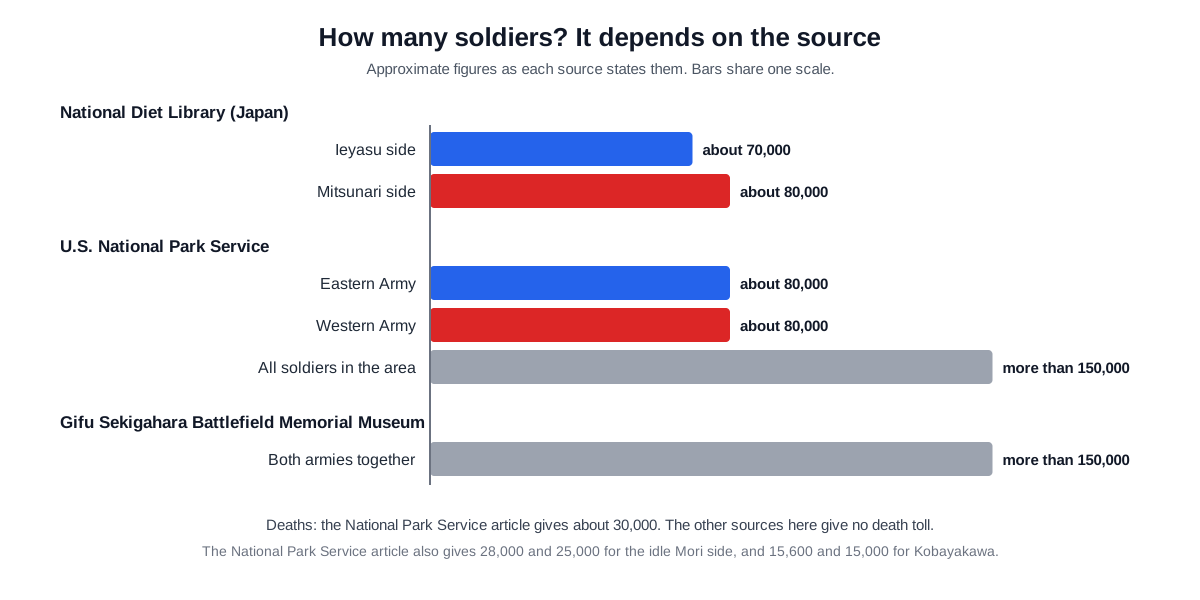
Troop numbers differ even more. The NDL gives about 70,000 on Ieyasu's side and about 80,000 on Mitsunari's. The NPS says the two armies were about equal, about 80,000 each, with over 150,000 troops on the field. Owada Tetsuo, director of the Gifu Sekigahara Battlefield Memorial Museum and professor emeritus at Shizuoka University, writes that the two armies together numbered more than 150,000.
Even within the NPS article, the Mori side appears as both 28,000 and 25,000, and Kobayakawa's force as both 15,600 and 15,000. For deaths, the NPS gives about 30,000, more than four times the deaths at the Battle of Gettysburg. The other sources used here give no death toll.
Names need care as well. The same director notes in his greeting that people at the time did not yet use the terms "Eastern Army" and "Western Army." Today's names came later.
Scenes, too, carry different weight. The lunch story, Ieyasu ordering fire on Mount Matsuo, and the helmet-cord and persimmon stories later in this article are told vividly by the NPS article. That article does not say which record each scene comes from.
By contrast, the diary of the court noble Nishinotoin Tokiyoshi (1552–1640), the Tokiyoshikyoki, introduced by the NDL, records the battle, including Kobayakawa's betrayal and the death of Otani Yoshitsugu. It is safer to read what a diary of the time confirms separately from stories passed down later.
Two and a half centuries of shogunate, and the battlefield today
After the battle, almost no one was left to oppose Ieyasu. He redistributed land and wealth, rewarding loyal generals and punishing those who had opposed him. The NPS article also tells how Mitsunari, captured and awaiting execution, declined persimmons offered to him.
Ieyasu was appointed Seii Taishogun on the 12th day of the 2nd month of Keicho 8, or 24 March 1603, and set up his shogunate in Edo. The Toyotomi family ended in the Siege of Osaka. The NPS timeline dates it from November 1614 to January 1615 and the NPS battle article to 1615; both say Hideyori was destroyed with the rest of the Toyotomi line. After his death in 1616, Ieyasu was deified as Tosho Daigongen.
The NPS article describes Sekigahara as the close of the long Sengoku era and the opening of the Edo period. It calls those 260 years a time of isolation from the outside world, of economic and cultural growth, and above all of peace and stability. The NPS article also has a story of the victorious Ieyasu tightening the cords of his helmet. His words, "Tighten the strings of your helmet after victory," became a Japanese saying.
The battlefield is still there. Japan's Agency for Cultural Affairs designated the old battlefield of Sekigahara a national historic site on 30 March 1931. It includes Ieyasu's first and last command posts, Mitsunari's camp, the Okayama beacon site, Otani's grave and the eastern and western head mounds, and the town of Sekigahara manages it. With the town, factories and station spread over a battlefield covering almost the whole plain, only the opening and decisive grounds at its western end were designated.
On the site of Ieyasu's last command post stands the Gifu Sekigahara Battlefield Memorial Museum, built by Gifu Prefecture. It was developed under a battlefield master plan drawn up in March 2015, and a large floor screen called "Ground Vision" lets visitors look down on both camps. On 11 June 2025 it was registered as a museum under Japan's Museum Act.
There is an American link too. Since 2016, Gettysburg Borough and the town of Sekigahara have been sister cities, and Gettysburg National Military Park and the museum have been sister sites. The two have exchanged a cavalry saber and Civil War uniforms for a print by the artist Tsukioka Yoshitoshi, reproduction samurai armor and a reproduction folding screen.
What to read next
- The Imjin War at a Glance: Seven Years from 1592: the war many of Sekigahara's generals had already fought.
- The Gunpowder Revolution: How Muskets and Cannon Changed Armies: how guns like the matchlock changed armies in Japan and Europe.
- Turning points in military technology: moments in the 20th century when new weapons and organization changed how wars were fought.
- A history of laser weapons: from chemical to electric lasers: how a new kind of weapon, generations after gunpowder, found its place, seen from the laser side.