After the Gulf War of 1991 ended, the F-117 Nighthawk received very favorable press. In 1993 the U.S. Department of Defense cited the effectiveness of stealth aircraft and laser-guided bombs as a basis for its future weapons purchases. Yet the U.S. General Accounting Office (GAO) later went back over the air campaign. Against what much of the public believed, it found that about 95% of the bombs aimed at strategic targets had no guidance at all.
How do those two stories fit together? Below is a short account of the road from the invasion of Kuwait to the cease-fire, then the scale of the 43-day air campaign. After that comes the question of why the F-117 and laser-guided bombs drew so much attention. Last, postwar claims sit side by side with what GAO could confirm from the data.
Invasion and a deadline
When the Iran-Iraq War (1980–1988) ended, Iraq came out with its state intact but deep in debt. In 1990 it owed about $37 billion to creditors in the Gulf. President Saddam Hussein asked the two Gulf lenders, the United Arab Emirates and Kuwait, to write off those loans. He got no answer.
In July 1990, oil moved to the center of the quarrel. Saddam Hussein charged that Kuwait and the Emirates were exceeding their production limits set by OPEC (Organization of the Petroleum Exporting Countries). He said their extra crude exports were driving prices down. He also accused Kuwait of taking oil from the Rumayla field that crosses the border, and he demanded the islands of Bubiyan and Warbah.
On August 2, 1990, about 100,000 Iraqi troops crossed into Kuwait and took the country within hours. The State Department's historians note that the United States knew of the threats but did not expect an actual invasion. On August 28, Iraq declared Kuwait its nineteenth province.
On the day of the invasion, the UN Security Council passed Resolution 660. It condemned the invasion and demanded that Iraq pull all its forces back, immediately and without conditions, to where they stood on August 1. The vote was 14 to 0, and Yemen did not take part. Resolution 661 imposed economic sanctions on August 6, and Resolution 663 said Iraq's annexation of Kuwait had no legal force.
Within days, the United States began organizing an international coalition. It also agreed with Saudi Arabia to send U.S. forces there to protect the peninsula. By the end of October, the Bush administration had made its choice: Iraq would be forced out of Kuwait if it would not leave.
Resolution 678 followed on November 29. It gave Iraq "one final opportunity." If Iraq did not carry out the earlier resolutions by January 15, 1991, states working with the government of Kuwait could use "all necessary means."
Twelve members voted for it, Cuba and Yemen voted against, and China abstained. The coalition drew forces from 34 countries, including several Arab states.
Forty-three days of air war
Once the withdrawal deadline passed, the U.S.-led coalition attacked Iraq from the air. This was Operation Desert Storm. Sources give the start date as January 16 (State Department historians) or January 17 (GAO). Fighting stopped on February 28, with Iraq defeated and its forces leaving Kuwait.
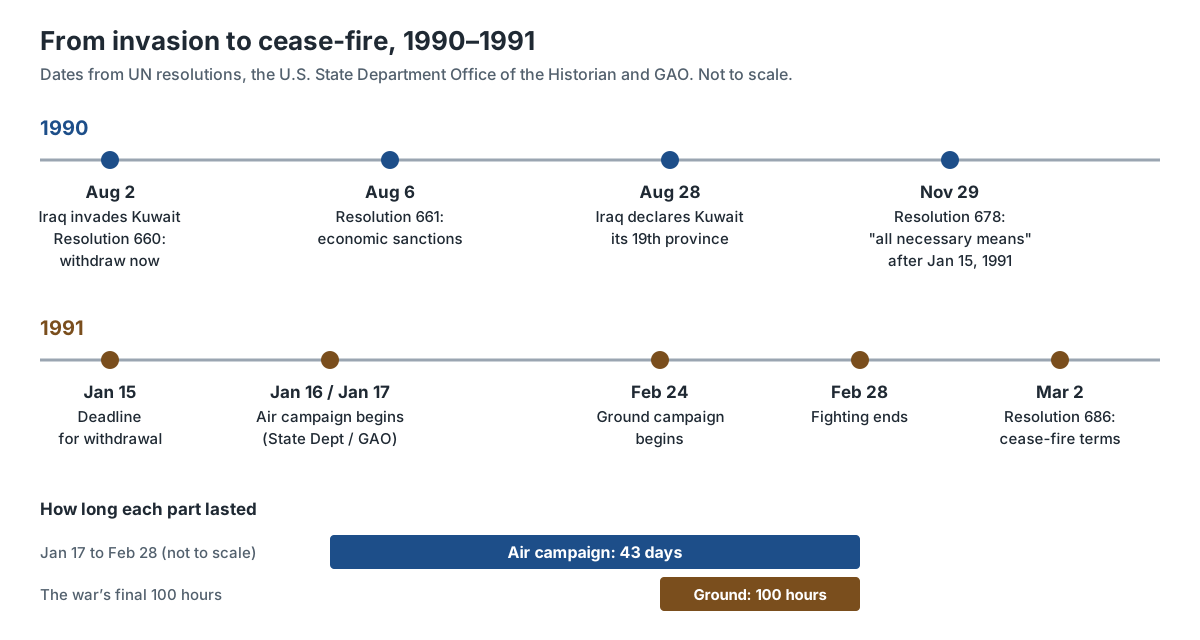
Desert Storm was mainly an air campaign that lasted 43 days. It was the first time since the Vietnam War that the United States used its air power on a large scale. The main ground campaign filled only the last 100 hours. Ground fighting started on February 24 and went on for four days, and coalition forces took back Kuwait City.
Almost all U.S. fixed-wing aircraft types joined in. Together they flew about 40,000 sorties against ground targets and 50,000 support sorties. Support work included refueling in the air, electronic jamming, and patrols to guard the sky. When the war ended, the United States had about 1,600 combat aircraft in the region.
The weight of bombs the United States dropped each day equaled 85% of its daily average against Germany and Japan in World War II. Planners sorted strategic targets into 12 sets, including command and communications, electricity, leadership, oil, nuclear, biological and chemical sites, and Scud missiles.
The coalition controlled the skies within 24 hours. It bombed strategic sites such as command and control facilities, power stations, oil refineries, military factories and missile facilities, and later turned to Iraqi troops in Kuwait. Iraq answered with missile attacks on Israel and on coalition bases in Saudi Arabia. Israel did not strike back.
A stealth aircraft that flew only at night
The aircraft that drew the most attention was the F-117A Nighthawk. The U.S. Air Force calls it the first aircraft in service anywhere that was built around low-observable stealth technology. It is a single-seat, twin-engine aircraft built to be harder to see on radar, and it carries its weapons inside the body.
The Air Force received its first F-117A in 1982, and the unit was ready for operations in October 1983. The last aircraft was delivered in the summer of 1990. What stealth reduces, and what it does not, is covered in Stealth aircraft: truly invisible?.
When the air campaign began, 36 F-117s were in the theater, and 42 served there during the war. They were used mostly against fixed, often high-value targets: command and communications, leadership, and nuclear, biological and chemical sites. Together with 64 F-111Fs, they released no less than 7.3 million pounds of guided bombs on strategic targets in 43 days.
In a white paper of September 1991, the U.S. Air Force made a claim about the first night. It said the F-117 made up 2.5% of aircraft in the theater yet hit over 31% of strategic targets. A 1995 report from the Air Force's top civilian official said it destroyed 40% of strategic targets with 2% of strategic sorties. The F-117 was also the only aircraft type with no losses and no damage in the war.
GAO added a caveat to that record. The F-117 flew fewer sorties than any other ground-attack type, and it flew only at night. Going by the overall casualty rate, any aircraft flying as many missions, stealthy or not, would most likely have had zero losses.
Guided weapons: 8%
The other headline weapon was the precision-guided munition (PGM), above all the laser-guided bomb.
Among laser-guided bombs, the Paveway family is a set of guidance kits that attach to unguided bombs. A seeker on the bomb's nose looks for the laser that marks the target, and a tail kit steers the bomb onto it. The device that shines that laser on the target is a laser designator. What gets added to an ordinary bomb is covered in Precision-guided bombs: what gets added to a plain bomb.
By the numbers, though, guided weapons were a small share. GAO found that 92% of all munitions spent in Desert Storm were unguided. Of the munitions aimed at planned targets, just 8% had guidance. Counted by bombs, about 95% of those dropped on strategic targets were unguided, and the share stayed about the same week after week.
Another public source gives a slightly different figure. The Congressional Research Service (CRS) puts precision-guided munitions at 6% of all munitions used in the campaign. GAO's 8% counts munitions used against planned targets.
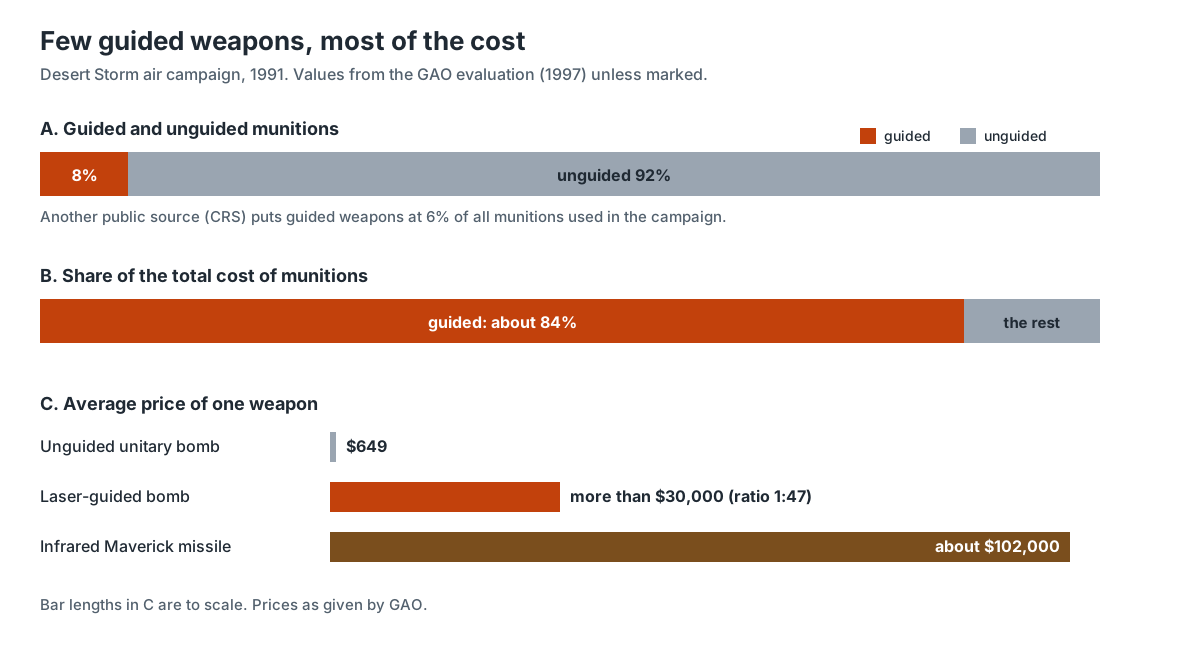
The cost was large for such a small share. Guided weapons took about 84% of all the money spent on munitions. An unguided unitary bomb cost $649 on average, while a laser-guided bomb cost more than $30,000. That is a ratio of 1 to 47.
From interviews with pilots and planners, and from Defense Department records, GAO found three reasons why unguided bombs dominated. Weather and smoke from bombing blocked or degraded the targeting sensors that guided bombs need. Guided bombs were expensive and stocks were smaller, so pilots were often told to save them. And many strategic targets were large enough for unguided bombs.
The two kinds were also used in different ways. Guided bombs went mainly to small point targets such as bunkers and aircraft shelters, while unguided bombs went to wide targets such as ammunition storage sites. Pilots told GAO that clouds, rain, fog, smoke and even humid air badly weakened every kind of sensor they had: infrared, electro-optical and laser. Some could not tell a tank from a truck.
Between claims and data
GAO first issued its evaluation as a classified report in July 1996. In June 1997 a public version followed after the Defense Department released about 85% of the material first marked classified. One aim was to test postwar performance claims by the department and by manufacturers against data from the war.
The finding was blunt. Many postwar claims about the F-117, the Tomahawk land attack missile (TLAM) and laser-guided bombs did not hold up. They went too far, gave a false picture, clashed with the best data, or could not be checked.
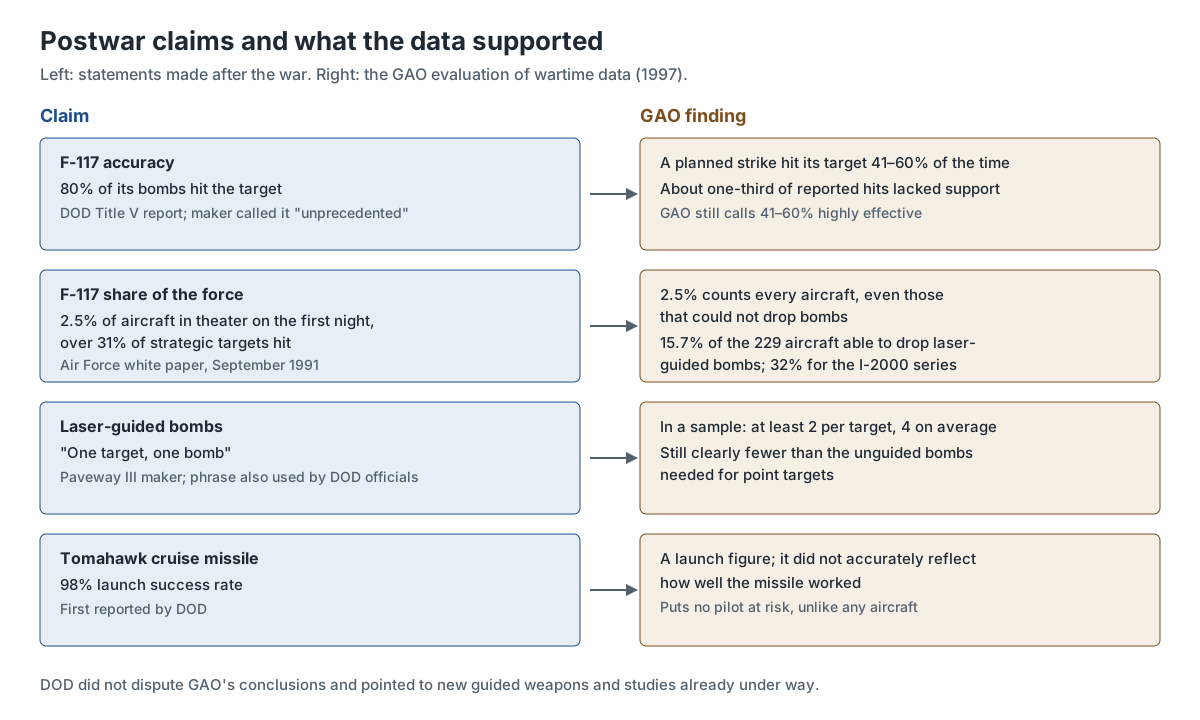
For the F-117, the Defense Department's Title V report, as cited by GAO, said 80% of its bombs hit their targets, and the maker, Lockheed, called this accuracy "unprecedented." In GAO's analysis, about one-third of the reported hits lacked supporting data or conflicted with other data. On a scheduled mission, a bomb was actually released 75% of the time, and a planned strike hit its target 41–60% of the time. Even that rate still counts as highly effective.
The "2.5%" figure changed once it was recounted. That number compared the F-117 with every aircraft deployed, including those that could not drop bombs. Among the 229 aircraft able to drop laser-guided bombs, the F-117 made up 15.7%.
Nor was the F-117 alone responsible for the collapse of Iraqi air defenses on the first night.
Laser-guided bombs came with the phrase "one target, one bomb." The maker of the most advanced guidance kit, Paveway III, used it, and so did Defense Department officials. In GAO's sample, at least two bombs fell on each target, and the average was four. Even so, the number of laser-guided bombs needed for point targets was clearly lower than the number of unguided bombs.
The Tomahawk cruise missile differs from any aircraft in one way: it puts no pilot at risk. Still, GAO judged that the 98% launch success rate first reported by the Defense Department did not accurately reflect how well the missile worked. How cruise missiles fly is covered in Cruise missiles: how they resemble aircraft.
The record also shows real successes. Some early claims were exaggerated, GAO wrote, but these weapons helped bring about what may have been the most successful U.S. war of the 20th century. Their combat performance may well have been unprecedented. CRS likewise says that precision-guided munitions, though a small share, hit several critical targets and reduced the number of sorties needed.
What the war left behind
For the aircraft GAO reviewed, 1.7 were lost or damaged for every 1,000 strikes. That was very low next to what planners expected and what past wars had shown. Over the whole war, 48 aircraft were damaged in combat and 38 were lost in combat.
GAO's summary report said the coalition side suffered minimal casualties, while the air campaign broke Iraq's ability to resist and helped free Kuwait. That judgment counts the losses of the side that carried out the strikes. The harm the bombing did to Iraqi soldiers and civilians is not given in numbers here, because the official sources opened for this article did not establish its scale.
The results were uneven. Strikes on oil and electrical targets clearly succeeded, while those on Iraqi air defenses, command and communications, and supply lines succeeded less. Results against nuclear-related sites, mobile Scud missiles and Republican Guard targets were the hardest to measure.
The lessons of this war come with limits. The land and weather mostly favored air attack, and the coalition had almost half a year to move in forces, train and get ready. Iraq did little or nothing to jam coalition electronics, and it barely challenged coalition aircraft in the air. In GAO's view, these conditions together limit how far the lessons of this war apply to future situations.
Even so, the war shaped weapons policy. The Defense Department's Bottom-Up Review of 1993 cited the effectiveness of advanced Desert Storm weapons, including laser-guided bombs and stealth aircraft, as shaping its recommendations on weapons purchases. The department partially agreed with GAO's three recommendations, did not dispute its conclusions, and pointed to new and improved precision-guided munitions and studies.
GAO also pointed to a share of the work that got less attention. Older and simpler tools did more than most people realized. They included unguided bombs, the B-52 bomber, the A-10 attack aircraft, refueling tankers and jamming aircraft. Price did not predict results: GAO saw no clear tie between what aircraft and munitions cost, high or low, and how they did.
What to read next
- Stealth aircraft: truly invisible?: what the F-117 was built to reduce, starting from the basic idea.
- Radar cross section: why a big aircraft can look small: what "harder to see on radar" means in numbers.
- Precision-guided bombs: what gets added to a plain bomb: the difference between kits that follow a laser spot and kits that use satellite navigation.
- The Gulf War (1991): From Desert Shield to Desert Storm: the whole war, including diplomacy and the ground campaign.
- The Kosovo Air War, 1999: Seventy-Eight Days of Air Power Alone: what changed in air war eight years later.