On Monday, April 12, 1204, a north wind pushed the ships closer to the shore below the walls of Constantinople. Two ships sailed lashed together, and the ladder of one of them, the Pilgrim, touched a tower. A Venetian and a French knight climbed into that tower. On that day the capital of the Byzantine Empire fell.
This army had started out as a crusade bound for Egypt. Why did people who took the cross to win back Jerusalem attack two Christian cities, one after the other? The surviving records come from the expedition's leaders, a poor knight in the ranks, a Byzantine historian inside the city, and the pope in Rome. No two tell it the same way.
This article sets those records side by side and follows how money, a fight over the throne and the pope's bans became tangled together.
A crusade meant for Egypt
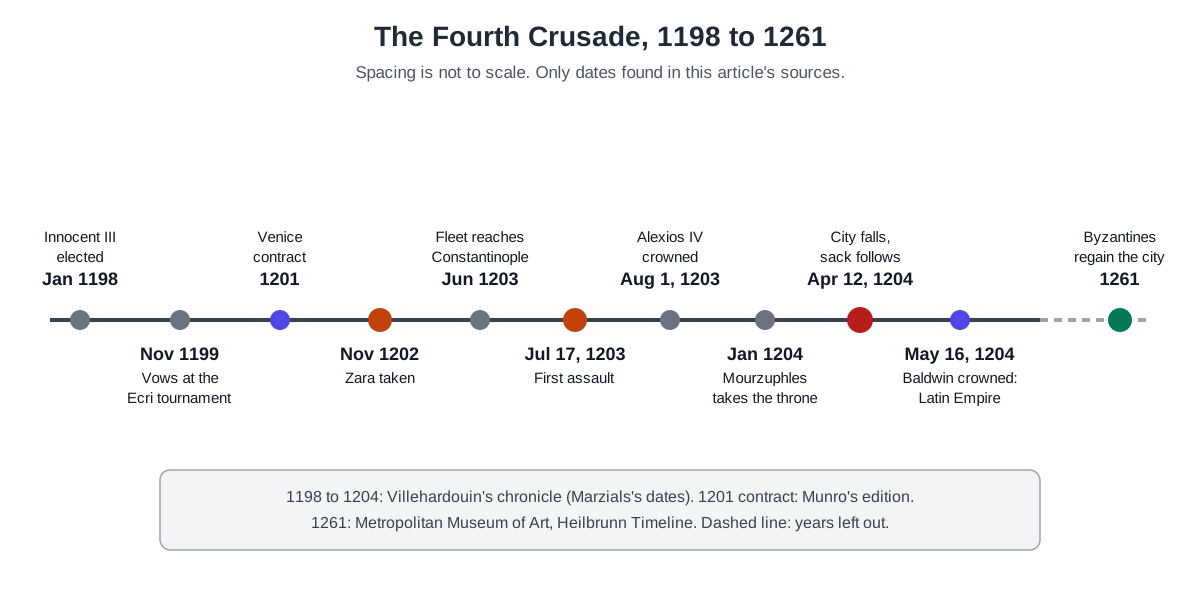
Innocent III became pope on January 8, 1198, and from the start of his reign he had the recovery of Jerusalem in mind. He told a French cleric, Fulk of Neuilly, to preach the crusade. Along with the preaching came a promise: those who took the cross and served in the army for one year would be forgiven all the sins they had confessed.
On November 28, 1199, a tournament was held at the castle of Ecri in Champagne. There Count Thibaut of Champagne and Count Louis of Blois took the cross. Thibaut was a young man of no more than twenty-two. The fullest account of the expedition comes from Geoffroi de Villehardouin, Marshal of Champagne.
Thibaut fell ill and died before the army left. The barons met at Soissons and asked Boniface, Marquis of Montferrat, to take command, and he accepted.
The destination was Egypt from the beginning. The council chose to go to Babylon, meaning Cairo. The leaders believed a strike there would hurt the Turks more than anywhere else. In public, though, they only said the army would go "across the sea."
The Venice contract and the unpaid debt
Earlier crusades had taught the barons a lesson, so they chose the sea route. Venice looked like the city best able to supply enough ships. In February 1201 six envoys, Villehardouin among them, reached Venice and met the Doge, the elected ruler of Venice, Enrico Dandolo.
The deal was large. In Villehardouin's account, Venice would provide transports for 4,500 horses and 9,000 squires, ships for 4,500 knights and 20,000 foot soldiers, and nine months of food for all of them.
The price was 4 marks per horse and 2 marks per man, 85,000 marks in all. Venice would add 50 armed galleys and, in return, take half of all land and money won while the partnership lasted. The army was to gather at Venice by the feast of St. John in 1202.
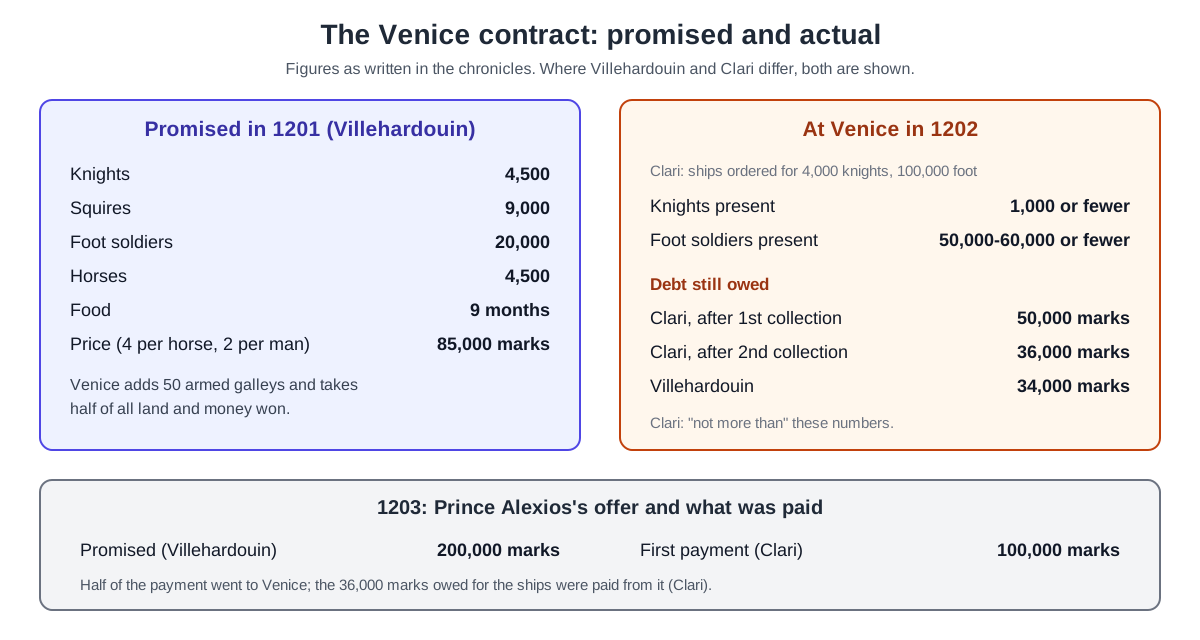
In the summer of 1202 too few men came, and in the account of Robert de Clari, a poor knight on the crusade, the Doge complains. Ships had been ordered for 4,000 knights and 100,000 foot soldiers, yet no more than 1,000 knights and no more than 50,000 to 60,000 foot soldiers had come. The rest had gone to other ports. That order size does not match the contract figures above.
Money was short too. By Clari's account, 50,000 marks were still owed after a first collection, and 36,000 marks after a second round of collecting and borrowing. In Villehardouin's version, the leaders handed over all they had or could borrow, including fine gold and silver vessels, yet 34,000 marks of silver were still missing. The Doge said Venetian merchants had earned nothing for a year and a half while they prepared the fleet.
Zara: the first attack on a Christian city
The way out came from the Doge. He said winter made a sea crossing impossible, so the army should spend the winter at Zara, a city nearby. He added that the people of Zara had done Venice a great deal of harm. Only the leaders knew of this plan.
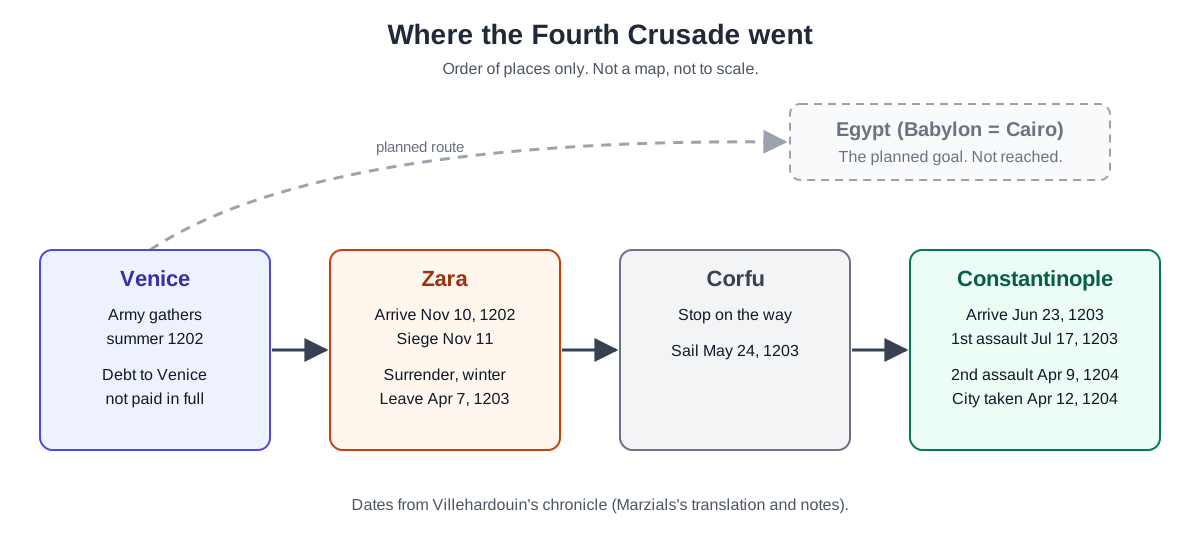
The army reached Zara on November 10, 1202, and began the siege the next day. The people of Zara offered to surrender if their lives were spared.
Then the Cistercian Abbot of Vaux stood up and forbade the attack in the pope's name. His reason was that "the inhabitants are Christians and you are pilgrims." In the end the city surrendered to the Doge on the condition that its people would live, and the Doge proposed splitting the city in half between the two sides.
The pope objected strongly to attacking a Christian city. A letter he sent to the leaders in the summer of 1203 shows that they had fallen under excommunication over Zara. They received absolution after swearing to do penance as the pope directed.
In that letter the pope also warned them not to imagine they were free to take or loot Greek lands. He also banned, under threat of excommunication, any invasion of Christian lands. He left one opening: cases where those people deliberately blocked the journey, or where some other just reason arose.
The army spent that winter at Zara. On April 7, 1203, the day after Easter, it loaded the ships, and as they left, the Venetians tore down the city's walls and towers.
The Byzantine prince's offer
While wintering at Zara, the army added up its costs. It had neither the food nor the money to reach Babylon, Alexandria or Syria.
Then Boniface told of a young man he had seen at the court of the German emperor, Philip of Swabia. This was Alexios, son of the Byzantine emperor Isaac II Angelos. Isaac's brother had seized the throne by treason and had Isaac blinded.
The offer was sweeping. Villehardouin lists the terms. If Alexios regained the throne, he would place the whole Byzantine Empire under the Church of Rome and give 200,000 marks of silver plus food for the whole army.
Alexios would either go to Egypt in person or send 10,000 men at his own cost to serve for one year. For the rest of his life he would also keep 500 knights in the Holy Land at his own expense.
The army split in two. The Abbot of Vaux and his side said this meant fighting Christians and wanted to go to Syria. The other side answered that the army could do nothing in Syria. Look, they said, at how things had gone for those who left the army and sailed from other ports.
The agreement was made, but in the account Munro translated, only twelve of the French swore to it. Some objected that the ships were hired for one year and half of it was already gone. Clari also says Boniface wanted revenge for a wrong the emperor in Constantinople had done him.
The pope knew of this plan as well. A letter he sent to the Byzantine emperor survives, dated November 16, 1202, a week before Zara fell.
In it the pope brought up how Alexios had earlier come to him and complained that his father had been wrongly imprisoned and blinded. G. A. Loud of the University of Leeds, who translated the letter into English, treats it as an important clue to how the crusade changed course.
Two assaults on Constantinople
The fleet left Corfu on May 24, 1203, and on June 23 anchored off the abbey of St. Stephen, three leagues from Constantinople. The city's harbor was closed by a chain fixed to the tower of Galata. The crusaders took the tower and brought their ships past the chain into the harbor.
Opinions split over where to attack. The Venetians wanted to set ladders on the ships and strike the sea walls. The French said they could not hold their own on the water as well as on land. In the end Venice took the sea side and the French barons the land side.
The first assault began on Thursday, July 17, 1203. On the land side the attackers set two ladders against an outwork near the sea, but English and Danish troops guarding the wall drove back those who climbed.
On the sea side the Doge Dandolo, old and blind, stood in armor at the bow of his galley and shouted to be put ashore. The Venetians took twenty-five towers. When the emperor's troops came at them, they set fire to the buildings in between and pulled back.
That night Emperor Alexios III took as much treasure as he could carry and fled the city. The citizens put Isaac, blinded and imprisoned, back on the throne. His son Alexios was crowned co-emperor on August 1, 1203. Now Alexios IV had to keep his promises.
The promises were not kept. Clari writes that the new emperor paid 100,000 marks and half of it went to the Venetians. The 36,000 marks the army still owed for the ships came out of that money. After that the money stopped.
Dana C. Munro, who edited this collection of sources, judged that the restored father and son had no way at all to meet the terms. The army's envoys openly accused the emperor at court of breaking the agreement, and the emperor replied that he had paid more than enough already.
Things inside the city got worse. A quarrel broke out between the Greeks and the Latins living in Constantinople, and someone set fire to the city. The fire burned for two days and two nights along a front more than half a league wide. No one could say how many people died.
In January 1204 Mourzuphles, a Greek high in the emperor's favor, seized Alexios IV at night, imprisoned him and made himself emperor. Isaac soon fell ill and died, and the imprisoned Alexios IV was killed as well. The promises the army had counted on now had no one left to pay them.
Before the next attack, the two sides agreed on how to divide the prize. If they took the city, all booty would be pooled and shared, and six Franks and six Venetians would choose a new emperor. The emperor would hold one quarter of the conquests. The other three quarters would be split equally between Venice and the crusaders.
On April 8, 1204, the army boarded the ships again. The next day, a Friday, it attacked at more than a hundred points and was driven back. On that day the attackers lost more than the Greeks. Three days later, on Monday, April 12, the second assault brought the city down.
Ships against walls: a siege from the water
Much of this siege took place on the water. In 1203 and again in 1204, Venetian ships carried ladders up to the sea walls. The ships' ladders got so close to the walls that, at many points, men on the towers and men on the ladders fought with swords and lances.
After the failure of April 9, the crusaders changed their approach. With only one ship against each tower, the men inside the tower outnumbered the men on the ladder. So the ships carrying ladders were tied together in pairs, two ships to one tower. The Pilgrim and the Paradise, first to reach a tower on April 12, were one such pair, and the north wind carried their ladder there.
The defenders did not sit still. After the agreement broke down, the fighting dragged on into the depth of winter. Then the Greeks set fire to seven large ships and let the wind carry them toward the crusader fleet.
The Venetians jumped into galleys and small boats, dragged the fire ships away with hooks and let the current of the strait carry them off. The only loss was a Pisan ship loaded with goods. In 1204, Clari reports, arrows and stones, pots of boiling pitch, and "Greek fire," the Byzantine incendiary weapon, rained down on the crusaders below the walls.
The sack and the Latin Empire
The fall of the city was followed by plunder. Villehardouin wrote that never since the world began had so much booty been taken in one city. He also wrote that the army, with fewer than 20,000 armed men, had beaten more than 400,000; those are the numbers in his chronicle.
As agreed, the booty was to be gathered in three churches, but not all of it came in. Quite a few people held things back despite the pope's excommunication, and several of those caught stealing were hanged. What was gathered was shared out in equal halves to the Franks and the Venetians. The crusaders paid 50,000 marks of silver to Venice out of their share and then divided at least 100,000 marks among themselves.
Church treasures went west as well. Abbot Martin set out to secure relics of the saints, and the list of relics he took includes a piece of the Cross. The Metropolitan Museum of Art explains that the city's treasures were split among the Venetians, the French and other crusaders. The largest share, it notes, is still in the Treasury of San Marco in Venice.
A new emperor was chosen too. The twelve electors picked Baldwin, Count of Flanders and Hainault, and he was crowned on May 16, 1204. So a Latin Empire was set up in Constantinople. It did not last, and in 1261 the Byzantines took the city back.
One event, different records
Reading about the Fourth Crusade starts with asking who saw what, and from where. Munro named Villehardouin and Clari as the two most important records. Villehardouin, a commander, wrote what amounts to the official version. Clari, a knight of modest means, set down what ordinary soldiers knew and believed, so his account can be used to test Villehardouin's.
The two writers often disagree. The contract figures differ, and so does the size of the remaining debt. On Zara, Clari says the Doge made two proposals, one welcomed by everyone and one known only to the leaders, while Villehardouin writes as if there had been only one.
There is also a record from inside the walls, where the Byzantine historian Niketas Choniates wrote that holy images were trampled. The altar of Hagia Sophia, the city's great cathedral, was smashed and its pieces handed out to soldiers. He described weeping in the alleys, the streets and the churches, and said no one escaped the grief. Munro, pointing to the letters of Innocent III, judged that Niketas did not exaggerate.
The pope's letters give yet another angle. The introduction in Fordham University's sourcebook says Innocent III was furious about the conquest of Constantinople.
In a letter dated July 12 he rebuked his legate. How, he asked, could the Greek church return to church union when it saw only an example of destruction in the Latins? He wrote that the crusaders spared neither age nor sex and tore silver plates from the altars to share out. Yet once his anger cooled, the pope first acknowledged and later welcomed the new regime in Constantinople.
Who turned the crusade aside is an old dispute. The editor of the Fordham sourcebook explains that a run of money problems let Venice, which provided the transport, steer the expedition toward its own aims.
A claim that Venice had made a secret deal with Egypt's sultan was also hotly argued in the nineteenth century. The English scholar Pears thought such a treaty existed, while the French scholar Wailly said the dates did not fit and the record behind the claim could not be trusted. A note added to the sourcebook in 1997 says that almost all modern scholars reject the idea of such a pact.
The stories about Dandolo are similar. One tale says he had once gone to Constantinople as an envoy, lost his sight at Greek hands and held a grudge. Marzials, who translated Villehardouin into English, doubted it, reasoning that Villehardouin would hardly have left such a thing out. That Dandolo was very old is certain, but his exact age and the cause of his blindness remain unclear.
Judgments of the outcome point in much the same direction. The Metropolitan Museum of Art explains that with each crusade, the Byzantines and the West grew further apart. The Fordham sourcebook's introduction says the expedition led to Latin-ruled states in Greece and around the Aegean and to a lasting break in communion between the Catholic and Orthodox Churches.
What to read next
- The First Crusade: Why European Armies Marched to Jerusalem: the expedition that first passed through Constantinople about a century earlier.
- Saladin and the Third Crusade: From Hattin to Arsuf: how the Jerusalem that the Fourth Crusade set out to recover was lost.
- Byzantium and Greek Fire: A Weapon That Stayed a Secret: the incendiary weapon Constantinople used at sea.
- Military logistics: performance must be sustainable: a modern look at how ships, food and money shape an army's path.