In the summer of 1916, people in Bury St Edmunds, Suffolk, heard something odd from the soldiers training nearby. The men said they were building water tanks for the Russian Army. What they were really learning, in great secrecy, was a new armored machine that moved on tracks. The cover word they used, "tank," is still the name of that machine today.
The machine grew out of one question. Could something mechanical, rather than men on foot, cross a trench line held by barbed wire and machine guns? This article follows how the first tanks came about and what happened when they first went in on the Somme in 1916. It then uses official and museum records to look at what worked, and what did not, at Cambrai in November 1917.
The numbers vary from source to source. For British tanks at Cambrai alone, one source says 476 and another says "more than 400," and casualty counts differ by several thousand. Where that happens, the figures are set side by side instead of picking one.
A war stuck at the wire and the machine guns
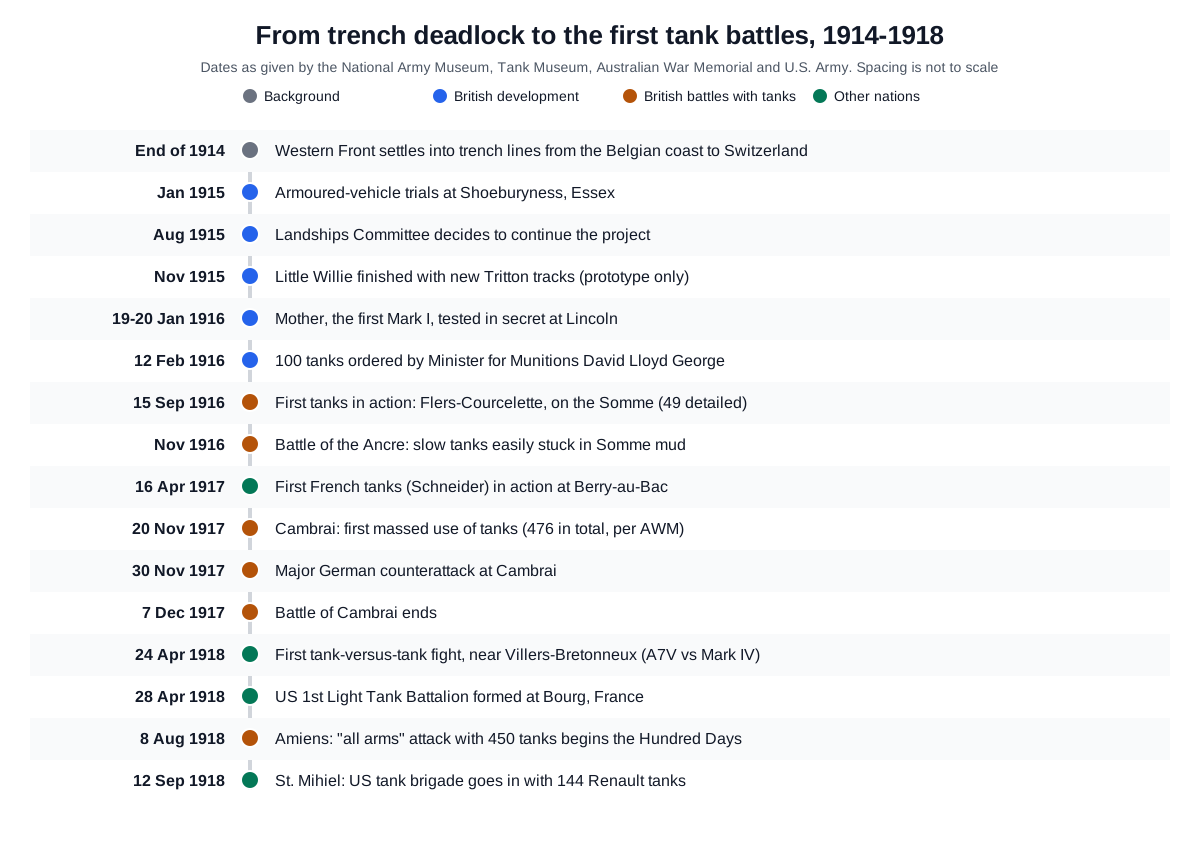
By late 1914, after a short period of movement, the Western Front had hardened into a complex system of trench defenses. Allied and German troops faced each other along a line stretching from the coast of Belgium to Switzerland. The result was stalemate.
A way through was needed. Germany tried poison gas in April 1915, but countermeasures soon followed and the Allies began using gas as well. On the British side, people started calling for a "machine gun destroyer." It would break through the wire, knock out the machine guns and open a way for the infantry.
Another article in this series explains how the trenches were built and why the front stood still: "Trench Warfare: Why the Western Front Barely Moved for Four Years."
From landships to Mother
Lieutenant Colonel Ernest Swinton, a Royal Engineers officer, proposed an armored vehicle, but the War Office showed little interest at first. The first to take up the idea was, perhaps surprisingly, the Admiralty, which ran the navy. Its name for the idea was "Land Ships."
Trials took place at Shoeburyness in Essex in January 1915. Despite some early failures, the Landships Committee chose to keep the project going by August 1915. Engineers from Fosters of Lincoln and the Royal Naval Air Service (RNAS) built a prototype by putting American tracks on a wheeled tractor. It was called "Little Willie," after Germany's Crown Prince Wilhelm.
Little Willie first ran on American tracks designed for farm machines, and they did not suit a fighting vehicle. Its designer, William Tritton, came up with a new track. That track became the model for almost every British tank of the war. Fitted with it, Little Willie was not finished until November 1915.
The real problem was its shape. The tall, boxy body could not cross a 3 m gap, about as wide as a typical German trench. Tritton quickly redesigned it with Lieutenant Walter Gordon Wilson of the navy. The result was "Mother," the prototype of the first Mark I heavy tank.
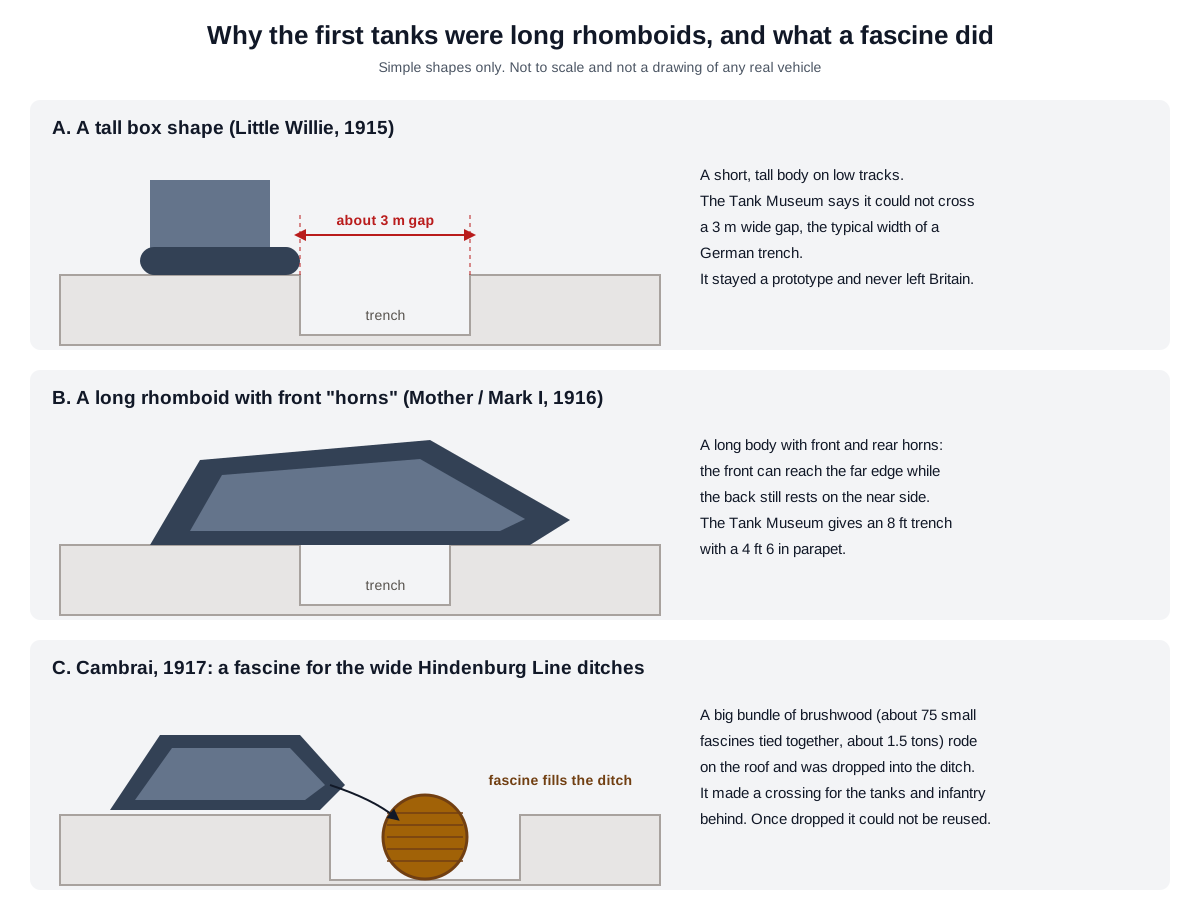
Mother had a long rhomboid body with "horns" sticking out at the front and back. With a long body, the front can catch the far edge of a trench while the back still rests on the near side. Britain's Tank Museum gives the figures as an 8 ft trench and a 4 ft 6 in parapet.
Mother was tested in secret at Lincoln during the night of 19–20 January 1916. The trials went well, and on 12 February 1916 the Minister for Munitions, David Lloyd George, ordered 100. Little Willie stayed a one-off prototype and never left Britain. Today it is the world's oldest surviving tank and sits in the Tank Museum at Bovington.
15 September 1916: into action for the first time
The Mark I came in two kinds. A "male" carried two 6-pounder guns plus machine guns, and a "female" carried machine guns only.
There were eight crew, and four of them were needed just to drive and steer. The engine was so loud that orders were passed by hand signals, and heat and leaking carbon dioxide made the inside hard to bear. Top speed was about 4 mph on a road and roughly half that across country.
The crews came from all over the army. So many mechanically minded men were needed that the unit even advertised in a motorcycling paper. It began under the Machine Gun Corps, took the name "Heavy Section, Machine Gun Corps" on 1 May 1916, and received its first Mark I tanks in June. The water tank story dates from this training period.
The first action came in the middle of the Battle of the Somme, in the attack on Flers-Courcelette on 15 September 1916. Forty-nine tanks were assigned to it. At 5:30 that morning, "Daredevil 1," commanded by Captain Harold Mortimore, rounded a corner of Delville Wood and became the first tank to go into action.
How many of the 49 actually moved depends on the source. Britain's National Army Museum counts only 15 entering no man's land when the attack began. The Tank Museum has 18 reaching their start points and 9 of those reaching their objectives.
Many broke down or got stuck in ditches on the way. The village of Flers was taken, but the hoped-for breakthrough did not come.
The decision drew criticism. Some tank officers felt the attack had used too few tanks and crews trained in a hurry, and had wasted the advantage of surprise. The Tank Museum also notes that Douglas Haig has been criticized for not waiting for more tanks and better-trained crews. Infantry and tanks had never yet practiced fighting together.
Tanks went in again at the Battle of the Ancre in November 1916. They were still slow and broke down often, and they bogged down easily in the sticky November mud of the Somme. In spring and summer 1917 they also fought at Arras and Passchendaele. The story of the Somme itself continues in "The Battle of the Somme: Questions Left by the First Day."
Cambrai, 20 November 1917
While the fighting at Passchendaele was still going on, British commanders approved a plan to attack Cambrai, a German-held railway hub. In front of it lay a strong defensive line that Germany called the "Siegfried Position" and Britain called the Hindenburg Line. The plan was an "all arms" battle combining tanks, cavalry, aircraft, artillery and infantry.
According to the Australian War Memorial (AWM), six infantry divisions, two cavalry divisions, more than 1,000 guns and 476 tanks took part. The German Historical Museum (DHM) describes the same attack as 378 combat tanks plus 98 supply tanks. The two add up to 476, so they appear to be the same total split in a different way. The National Army Museum says only "more than 400."
At dawn on 20 November, the attack opened not with a long bombardment but with a short, intense one along a 10-mile front. Tanks then moved forward with the infantry, and 14 Royal Flying Corps squadrons struck trenches, supply convoys and gun positions.
The Hindenburg Line trenches had been dug extra wide on purpose, and its ditches were deep. So many tanks carried a "fascine" on the roof, a huge bundle of brushwood. Each was made from about 75 ordinary fascines tied together and weighed about 1.5 tons once finished.
Dropped into a ditch, it formed a kind of bridge for the tanks and infantry behind, and once dropped it could not be picked up and used again. The Tank Museum says there is no evidence that fascines this large were used before or after Cambrai.
The first-day breakthrough and the push back in December
The first day was unlike anything before it. In the National Army Museum's account, some units pushed more than 5 miles, thousands of prisoners were taken, and all three Hindenburg lines were broken. The AWM describes a hole almost 10 km wide and 6 km deep in the German line.
The DHM has tanks driving up to 10 km in a few hours and about 10,000 German soldiers taken prisoner. By the village of Graincourt, tanks and infantry had gone roughly 7,000 yards, a bigger advance than any made in France up to then.
Not everything went well. Around 10 o'clock on the first morning, there was a serious if temporary delay at Flesquières Ridge. The ridge is only 105 m high, but for tanks climbing at walking pace it was still a slope, and several German field gun batteries stood along its crest.
The 51st Highland Division, attacking alongside, had its infantry follow about 200 m behind the tanks. The Tank Museum adds that it is doubtful whether this made any difference.
A story clings to this ridge: the "lone gunner." In it, a German gunner left on his own knocked out at least five tanks with a single gun. In the retelling, the number grew from five to sixteen, yet the German side had never heard of the event. The researcher Gorczynski, cited by the Tank Museum, thinks about 40 tanks were knocked out in all, but credits several batteries rather than one gun.
The success did not last. Many tanks broke down, German artillery destroyed others, and there were not enough reserves to carry a breakthrough further. Large numbers of troops were still tied up at Passchendaele. The arrival of German reserves and the barrier of the St. Quentin Canal also drained the attack of momentum after the first day.
On 30 November, Germany struck back with a major counterattack. The Germans used intensive artillery fire, mortars, gas and infiltrating "storm troops." By late 1917, German doctrine stressed counterattacking whenever ground was lost. The German assault also wore itself out in the end, and the battle was over on 7 December.
The sources describe the end in different words. The National Army Museum's account has Britain holding on to only some of its early gains. The Tank Museum's has Britain keeping some ground in the north but falling back further in the south. The AWM says Germany retook all the ground lost since 20 November, and the DHM says almost all.
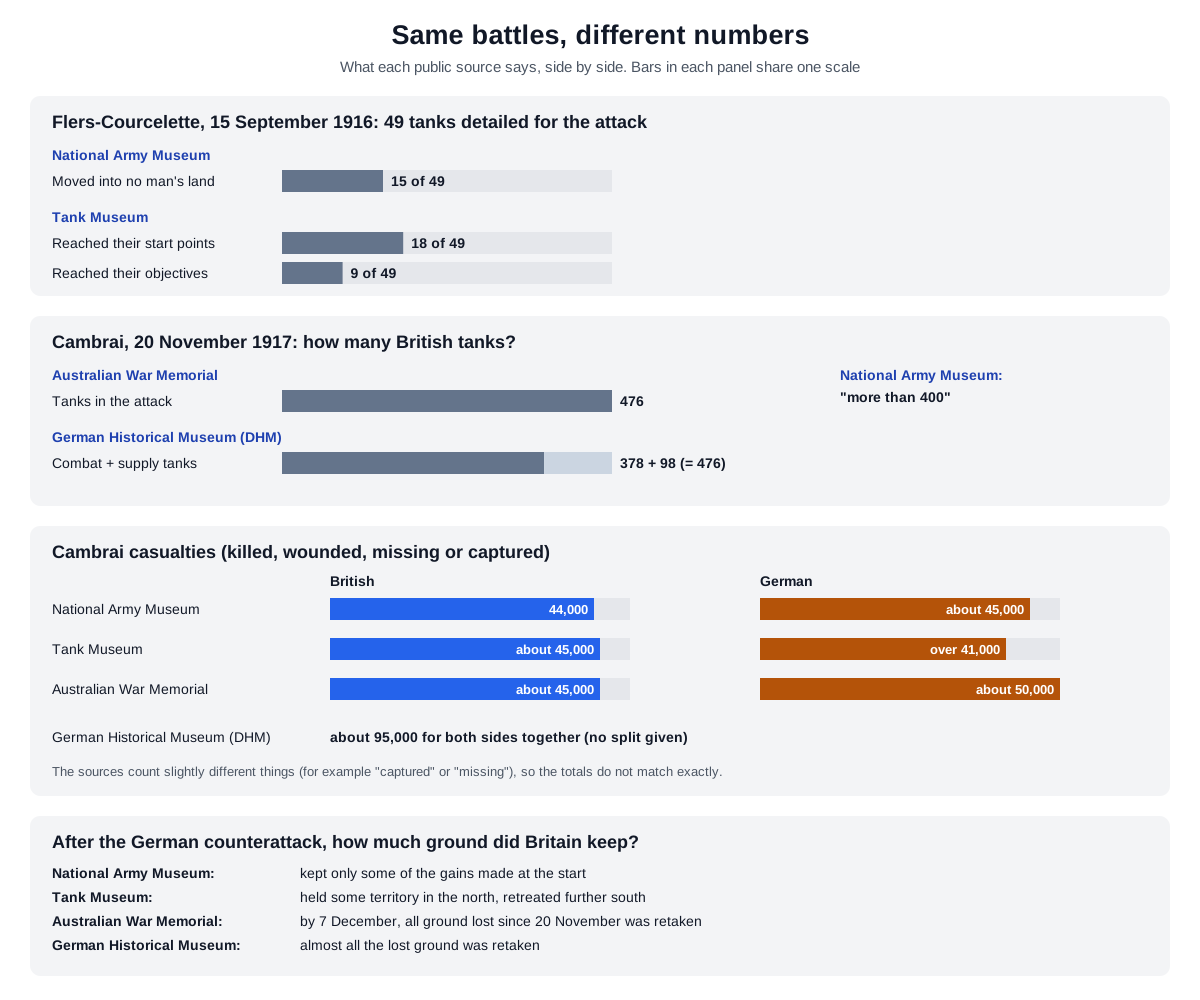
Casualty figures also differ. British losses are close across sources, from 44,000 to about 45,000, but German losses are given as over 41,000, about 45,000 or about 50,000. The DHM gives only a combined total of about 95,000 for both sides.
The sources do not all count prisoners and missing the same way, so the totals do not line up exactly. Every one of those numbers was a person killed, wounded or taken prisoner.
The first French, German and American tanks
Britain was not alone. France built the Schneider C.A.1 and the Saint-Chamond on American Holt tractor tracks and made 400 of each. The Schneider first went into action at Berry-au-Bac on 16 April 1917, and 121 of them supported the infantry. The Saint-Chamond first saw use on 5 May at the Moulin de Laffaux.
Both suffered badly from German artillery and armor-piercing bullets, and by the Armistice, combat had destroyed 308 of the 800 built. France pinned its hopes on the smaller, lighter Renault FT.
The FT was the first tank to carry its weapon inside a turret that could turn all the way round. It also seated the driver in front with the engine in the rear, a layout still seen on tanks today. Thousands were ordered, but most were finished only after the war.
Germany built the A7V. Early on 24 April 1918, a force of 13 A7Vs attacked British lines toward Villers-Bretonneux and Cachy. No single operation in the war used more A7Vs.
That day saw the first fight between tanks. An AWM record says the A7V "Nixe" disabled two British female Mark IVs before a male Mark IV badly damaged it. Ten of the 13 made it back to their start line, and by the following morning Australian troops held Villers-Bretonneux.
Many of the tanks Germany used were British. In the Cambrai counterattack Germany captured dozens of Mark IVs left behind, and about 40 were repaired and used in 1918. Germany ended up fielding more Mark IVs than its own A7Vs. Germany also developed the first generation of anti-tank weapons once tanks appeared.
The United States made George S. Patton the first soldier assigned to its new Tank Corps in November 1917. On 28 April 1918, the 1st Light Tank Battalion was formed at Bourg, France, under Lieutenant Colonel Patton. With no American-built tanks yet in France, it trained on 25 French Renault tanks on loan.
The brigade went into the St. Mihiel offensive on 12 September with 144 Renault tanks and fought again in the Meuse-Argonne from 26 September to 2 November.
What Cambrai left behind, and how judgments differ
Cambrai did not change the course of the war right away. The Tank Museum writes that it did not alter the Allies' wider strategic position, and the DHM says it brought no major change to the front. In a National Army Museum talk listing, a Tank Museum curator says the outcome could be considered a draw.
In Britain, the counterattack came as a shock. A belief that the army had not told political leaders the full scale of the German attack prompted a Court of Inquiry. It blamed the force and surprise of the German blow, the absence of a British doctrine for defense, and weak intelligence about the attack. General Julian Byng, who commanded the battle, named poor training of front-line soldiers, and Haig accepted final responsibility for the outcome.
Still, something lasting came out of it. In the National Army Museum's summary, Cambrai showed the British could break deep into German defenses quickly with relatively few casualties. It also made clear that reinforcements needed better communication to exploit success.
The first massed use of tanks and aircraft, together with the speed and force of the German counterstroke, showed what a new kind of offensive could do. Both sides tried to apply that in 1918.
Amiens, on 8 August 1918, was where it came together. Henry Rawlinson's Fourth Army attacked with 13 divisions, backed by more than 2,000 guns, 450 tanks and 1,900 aircraft, and the attack opened the "Hundred Days." At Cambrai, artillery, infantry, tanks, aircraft, logistics, staff and signals had worked as one system. The Tank Museum sees that system reaching its full strength at Amiens.
Cambrai was also the first time tanks were used in mass as one concentrated force. That success, along with a warm public response, secured the Tank Corps' future in the British Army, and the Royal Tank Regiment still commemorates Cambrai today.
The judgment does not run only one way. Even in 1918, tanks were still vulnerable to enemy fire and mechanically unreliable. In the National Army Museum's view, their full value as a weapon was recognized only after the war.
In the United States, the National Defense Act of 1920 ended the Tank Corps as a separate branch and put tank units under the infantry. The Armored Force was not created until 10 July 1940.
What to read next
- What a main battle tank (MBT) means today continues in Main battle tanks: is it all about the gun?.
- What does the fascine's job today is covered in Armored bridging: tanks need bridges too.
- To set the tank beside other technologies that changed warfare, read Turning points in military technology.
- The long road from first trials to real use was repeated with laser weapons. A history of laser weapons: from chemical to electric lasers
- Articles in this series still being written: "Trench Warfare: Why the Western Front Barely Moved for Four Years" and "The Battle of the Somme: Questions Left by the First Day"