On July 15, 1099, a knight named Lethold climbed onto the walls of Jerusalem. The defenders pulled back, and an army from Western Europe poured into the city. The people who reached it that day had left home three years earlier.
Today this expedition is called the First Crusade. Why did peasants and knights, clergy and princes walk so far? Most of what survives comes from chronicles written by Latin clergy who went along. Set the memoir of the Byzantine princess Anna Komnene and a Hebrew record from the Rhineland Jewish communities beside them, and the same events look quite different.
Byzantium's trouble and the speech at Clermont
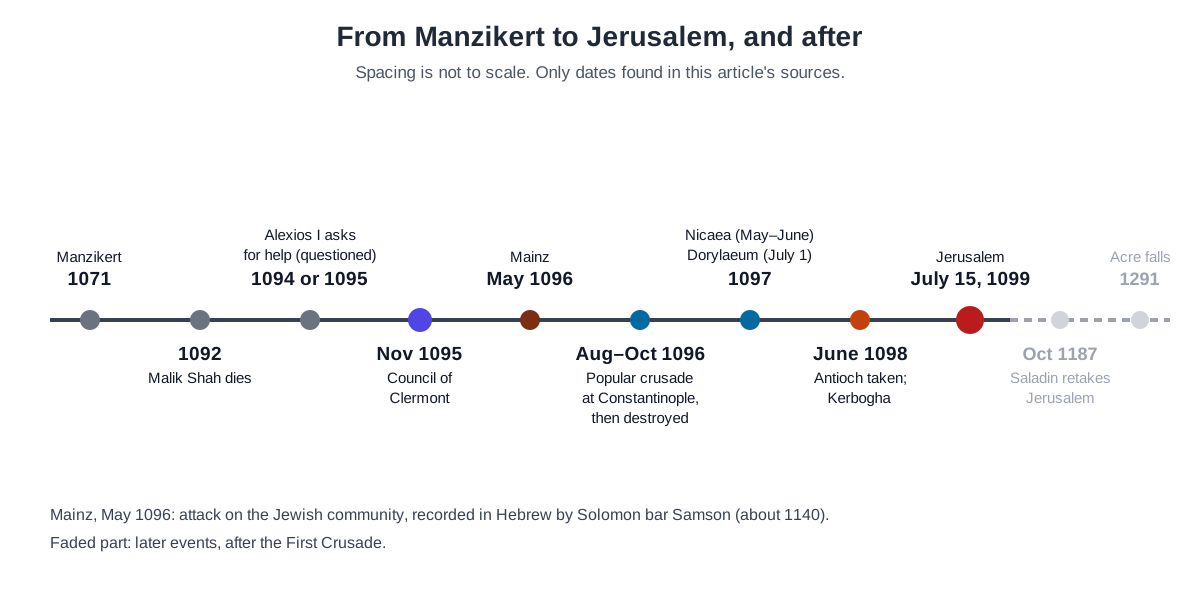
The story starts in Asia Minor, where in 1071 the Seljuk sultan Alp Arslan beat the Byzantine army at Manzikert and opened the region to the Turks. When Sultan Malik Shah died in 1092, his sons fought among themselves for more than a generation. The medieval historian August Krey reads this as the key. In his view the Turkish lords were so hostile to one another that they never joined against the invaders, so the crusaders could beat their principalities one at a time.
In 1094 or 1095 the Byzantine emperor Alexios I Komnenos sent word to Pope Urban II, asking for help against the Seljuks. Scholars have doubted this appeal, though. Krey cites the French scholar Chalandon, who argued that Alexios made no such call. In his view, the empire of 1096 needed outside help less than it had at any point after 1071.
In November 1095 the pope held a church council at Clermont. It ran for ten days, from the 18th to the 28th, and the famous speech came on the day before it closed. The problem is that no text of the speech survives. The council's own records are lost, and four or five clergymen who said they were there wrote their own versions some years later.
Each version stresses something different. In the one by Fulcher of Chartres, the pope says that the Christians of the East badly need help. The Turks and Arabs, he says, have taken Greek lands as far as the Mediterranean shore and the Hellespont. He then promises that anyone who dies on the way or in battle will have their sins forgiven at once.
In the version by Robert the Monk, when the crowd shouted "It is the will of God!", the pope told them to make it their battle cry. Those who vowed to go were to mark themselves with a cross on the forehead or chest. He did not urge the old or weak to go, and he said women should not set out without a husband, brother or legal guardian.
A departure day was set as well. A letter the pope sent that December says the papal legate, Bishop Adhemar, would leave on the feast of the Assumption.
At the heart of the crusade was the wish to reach the holy places of Jesus's life, above all the Church of the Holy Sepulcher in Jerusalem. The crusaders were promised forgiveness of sins and eternal glory. They also hoped to win land and wealth in the East. Faith and hope of gain lived side by side in the same people.
The ones who left first: Peter the Hermit and the Rhineland
Enthusiasm ran ahead of the pope's plan. Several bands did not wait for the agreed date and set out early from the Rhine country. They are often called the Peasants' Crusade, or the popular crusade.
The best known of their leaders was Peter the Hermit. In the account of the abbot Guibert de Nogent, common people with little property, but in great numbers, followed him. The story that he preached at Clermont came later. A study by Hagenmeyer in the mid-1800s found that Peter never gave a speech at Clermont and that his preaching lasted only a few months.
The violence of the marching bands broke out long before anyone reached Jerusalem. Some of the bands that set out in the spring of 1096 passed through Germany and killed thousands of Jews in large cities such as Speyer, Worms, Mainz and Cologne. That May, a band led by the German noble Emico forced its way into the archbishop's palace in Mainz, where the city's Jews had taken refuge.
These events come down to us in a Hebrew account written around 1140 by Solomon bar Samson. A Latin chronicler, Ekkehard of Aura, also wrote that Emico led almost 12,000 men. As they moved along the Rhine, the Main and the Danube, they killed Jews in the cities there or forced them to convert. Two records from opposite sides bear witness to the same events.
Peter's band reached Constantinople on the first day of August 1096. Anna Komnene wrote that he led 80,000 men on foot and 100,000 knights; that is the figure in her record.
The emperor told them not to cross the strait until the main army arrived. The Latin chronicle Gesta Francorum (Deeds of the Franks), or Gesta, says the band tore down and burned buildings, and the angry emperor sent them over to Asia Minor. In October that year they were destroyed by a Turkish army near Nicaea. Peter could not control the crowd and had gone back to Constantinople a little earlier.
From Constantinople to Antioch
Next came the main armies under the princes, who gathered at Constantinople. Among them were Raymond, Count of St. Gilles, Duke Godfrey, Hugh the Great, Bishop Adhemar of Le Puy, and Bohemond of the Norman family of southern Italy. The emperor asked them for an oath. Any city or land they took that had once been the emperor's was to be handed over to an officer he sent.
At first the leaders refused, calling such an oath unworthy of them. In the end Godfrey swore it formally. Anna Komnene believed that men like Bohemond had long wanted the empire for themselves and only pretended to march for the Holy Sepulcher. Krey adds that the emperor clearly distrusted the Latins, but that the Latin accounts show little sign of any plot against him.
In May and June 1097 the combined army besieged and took Nicaea, the Seljuk capital. On July 1 a major battle was fought at Dorylaeum. The Turks surrounded the army on every side, shooting arrows, and that day the women carried drinking water to the fighters. During the march Baldwin left the main army for Edessa and never returned to it.
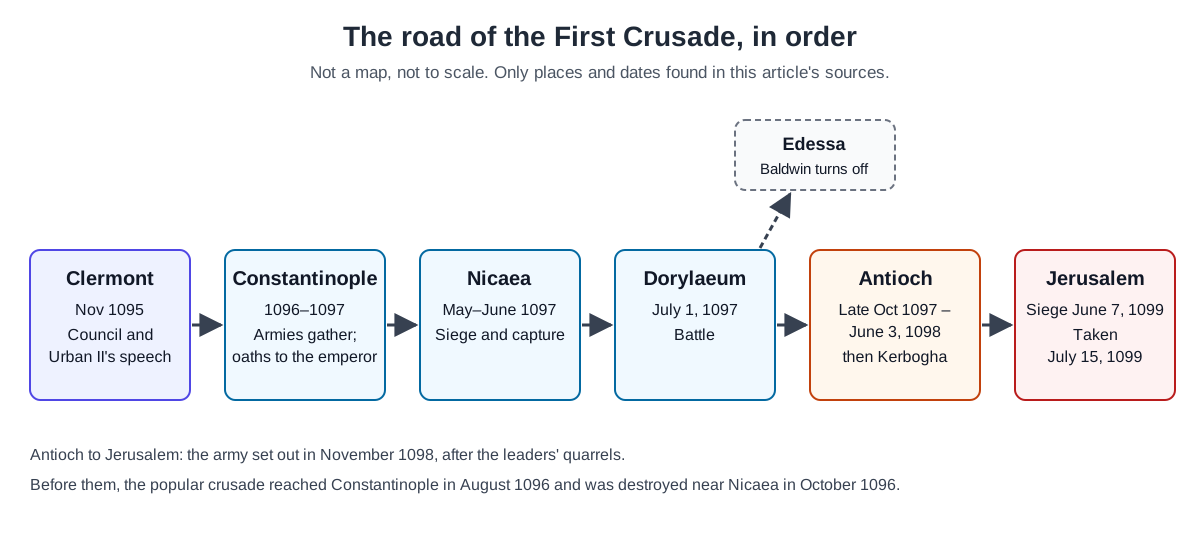
The longest stop was the Syrian city of Antioch. The siege lasted from the end of October 1097 to June 3, 1098. Even before Christmas, the price of grain and all food shot up.
The way in came from inside. A Turkish emir named Pirus grew close to Bohemond and promised to give him the three towers he guarded.
Once they held the city, the crusaders soon faced a counterattack by Kerbogha, the atabeg of Mosul. In June 1098 the "finding" of the Holy Lance, said to have pierced Christ's side, lifted the spirits of the worn-out army.
Even after Kerbogha was beaten, the march was delayed: Bishop Adhemar died and the leaders quarreled. In the end the ordinary knights and foot soldiers pushed hard for keeping their original vow. The army set out for Jerusalem in November 1098.
Jerusalem, 1099
Meanwhile Jerusalem had changed hands. During the crusaders' stay at Antioch, the city's Seljuk rulers handed it over to the Egyptian side. The crusaders surrounded it on June 7, 1099. The siege lasted five weeks.
Thirst was the worst enemy. Just before the crusaders arrived, the people of the city had filled in the springs, broken the cisterns and dammed the brooks. One denarius would not buy enough water to quench a man's thirst.
The first attack used ladders. But there were too few ladders to get over the walls, so the leaders had craftsmen build siege machines. The timber had to be brought from far away. Around then, word came that crusader ships had reached the port of Joppa.
Before the last attack, bishops and priests led the army in a procession around the city, preparing for battle with prayer and fasting. On July 15, Lethold, from Godfrey's group fighting in a wooden tower, got onto the wall. On the south side, the emir holding the Tower of David surrendered to Raymond.
What followed is recorded as horrifying even in the crusaders' own accounts. The Gesta tells of a killing chase as far as the "Temple of Solomon," and Fulcher wrote that almost 10,000 died there and that no woman or child was spared. That number is what the chronicle says, and the Gesta states that only God knows how many there were.
Not everyone met the same fate. According to the Gesta, a crowd of men and women who had gathered on the Temple roof were taken under guard by Tancred and Gaston. Raymond of Aguilers, however, wrote that the next morning some soldiers climbed onto the roof and killed them, and that Tancred was furious when he heard. The emir of the Tower of David and the men with him were sent to Ascalon unharmed.
Eight days after the city fell, the leaders picked Godfrey to lead it. Some argued for an "advocate" instead of a king, someone to guard the city and share out its revenues.
Knights, bows, and wooden towers
The two sides fought in different ways. Anna Komnene wrote that her father Alexios feared the arrival of the Frankish armies because he knew their attacks were all but impossible to withstand.
The Turkish armies were different. The Turks knew the land well and had faster horses, which made up for the crusaders' larger numbers. In the account of Dorylaeum, too, they surrounded the enemy on every side and shot arrows.
Anna Komnene's book also mentions the crossbow. She introduced it as a "bow of the barbarians" completely unknown to the Greeks; by barbarians she meant the Latins of the West. Its arrows were very short and thick with a heavy iron tip, and she called the weapon "a devilish invention." The passage shows how a strange weapon looked through Byzantine eyes.
Taking a city meant getting past its walls. At Jerusalem the crusaders used ladders, wooden towers covered with hides, and rams that pounded the wall, while the defenders threw burning brands with slings. Even so, the records talk about finding food, water and timber as often as about weapons. The hunger at Antioch and the thirst at Jerusalem are examples.
Three sets of records
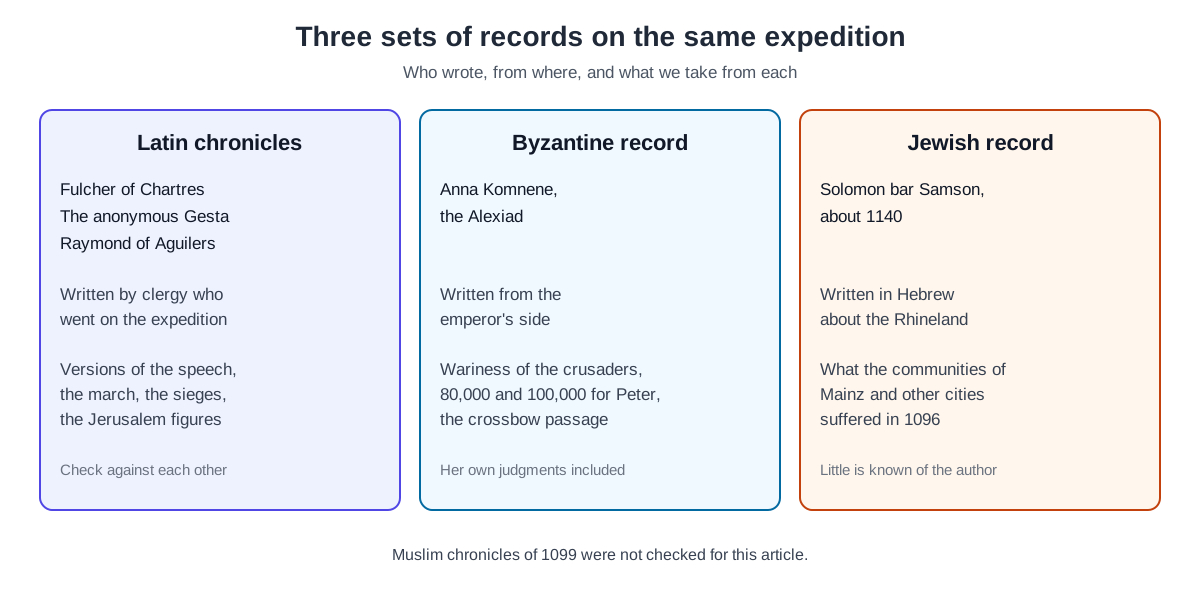
Most of the people who wrote about this expedition were Latin clergy who walked the road themselves. Fulcher, the anonymous author of the Gesta and Raymond of Aguilers are examples. They saw the crusade as God's work, and they wrote about victory, suffering and slaughter through that lens.
Being there did not make every account reliable. Krey warns that events moved so fast that late writers got confused, and that Raymond's story must be checked against the letters and the Gesta. Peter the Hermit is another case. Later accounts inflated his story, beginning with William of Tyre, who wrote almost a century later, and the Fordham sourcebook judges Guibert's account more likely to be accurate.
On the Byzantine side, Anna Komnene recorded her father's reign. In her book the emperor is wary of the crusaders rather than glad to see them, and Peter's band appears with the large figures of 80,000 and 100,000. On the Jewish side, Solomon bar Samson recorded what the Rhineland communities went through in 1096.
What it left behind
The expedition left new states in the East. The crusaders took many cities on the Mediterranean coast and built many castles to protect their new lands. The Latin Kingdom of Jerusalem they founded had 15 cathedral churches.
The city itself changed too. The crusaders took the Dome of the Rock to be the Temple of Solomon, and the Aqsa mosque was turned into a palace and stables.
Those states did not last. Muslim forces led by Saladin retook Jerusalem in October 1187, and the fall of the crusader city of Acre in 1291 ended the era of the Latin crusader kingdoms. Along the way, each new crusade drove Byzantium and the West further apart. The First Crusade was only the first chapter of that long story.
What to read next
- Saladin and the Third Crusade: From Hattin to Arsuf: the side that retook Jerusalem in 1187, and the expedition that came back.
- The Fourth Crusade: The Expedition That Took Constantinople Instead: how far Byzantium and the West drifted apart.
- Crusader Castles and Military Orders: Krak des Chevaliers and the Templars: the castles and orders that defended the crusader states.
- Turning points in military technology: modern examples of how new weapons changed the way wars are fought.