On the evening of 22 June 1940, a wooden railway carriage stood in the Forest of Compiègne. It was the carriage in which the armistice of 11 November 1918 had been signed. Hitler had it taken out of a museum and brought back to the same spot. Twenty-two years earlier, Germany had been handed the terms there; this time French delegates signed Germany's terms.
It was the 43rd day since Germany had opened its attack in the west. How did Germany do so quickly what its army had failed to do in four years of trench war in World War I? This article follows the story from the declarations of war in September 1939 to Compiègne. It passes through the Ardennes forest, the Meuse at Sedan and Dunkirk, using records from German, British and French official bodies and museums.
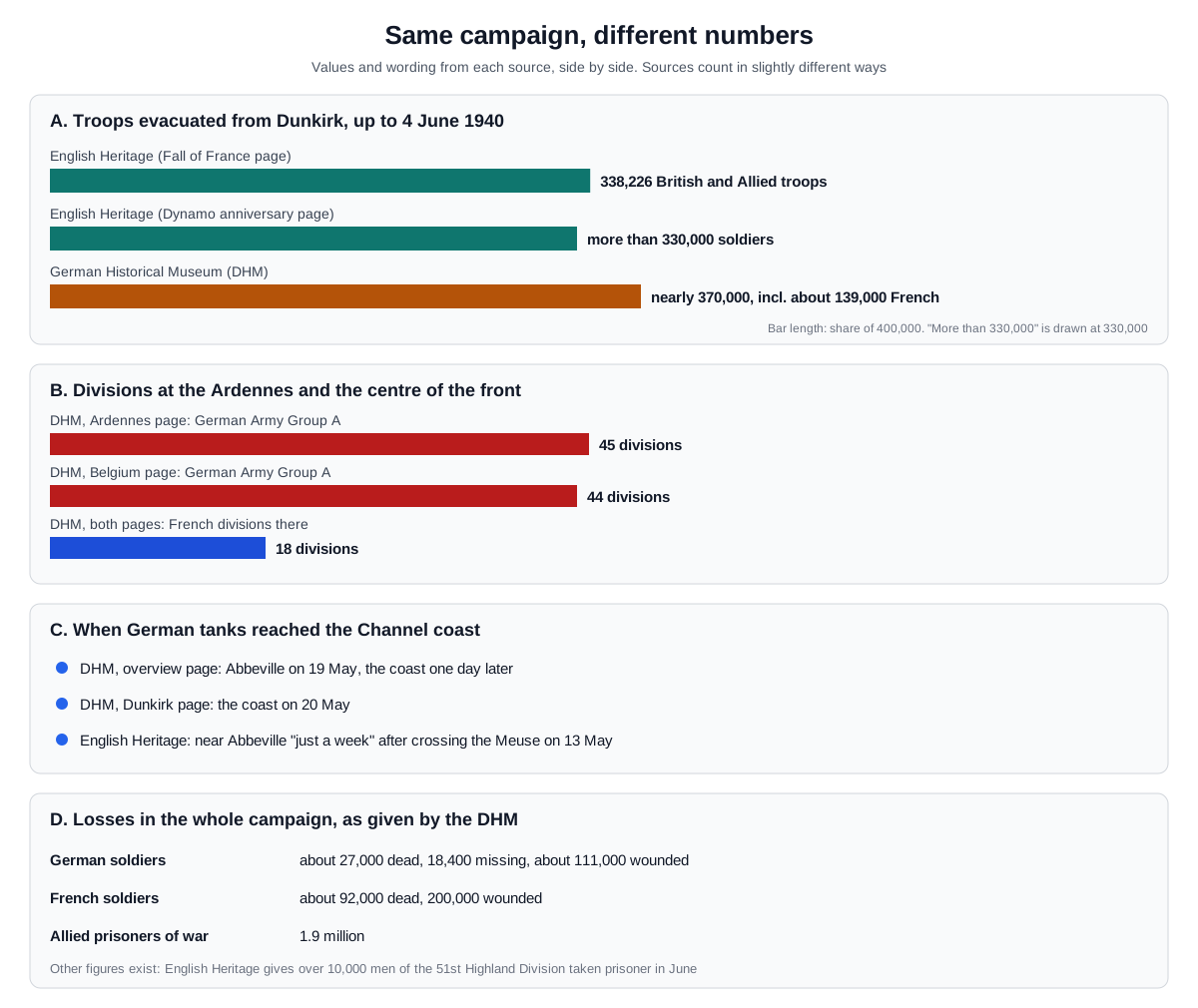
The numbers vary from source to source. For the troops rescued at Dunkirk alone, one record says 338,226 and another says "nearly 370,000," and the date German tanks reached the sea differs by a day. Such figures appear side by side here, each with its source.
A long wait after the declarations of war
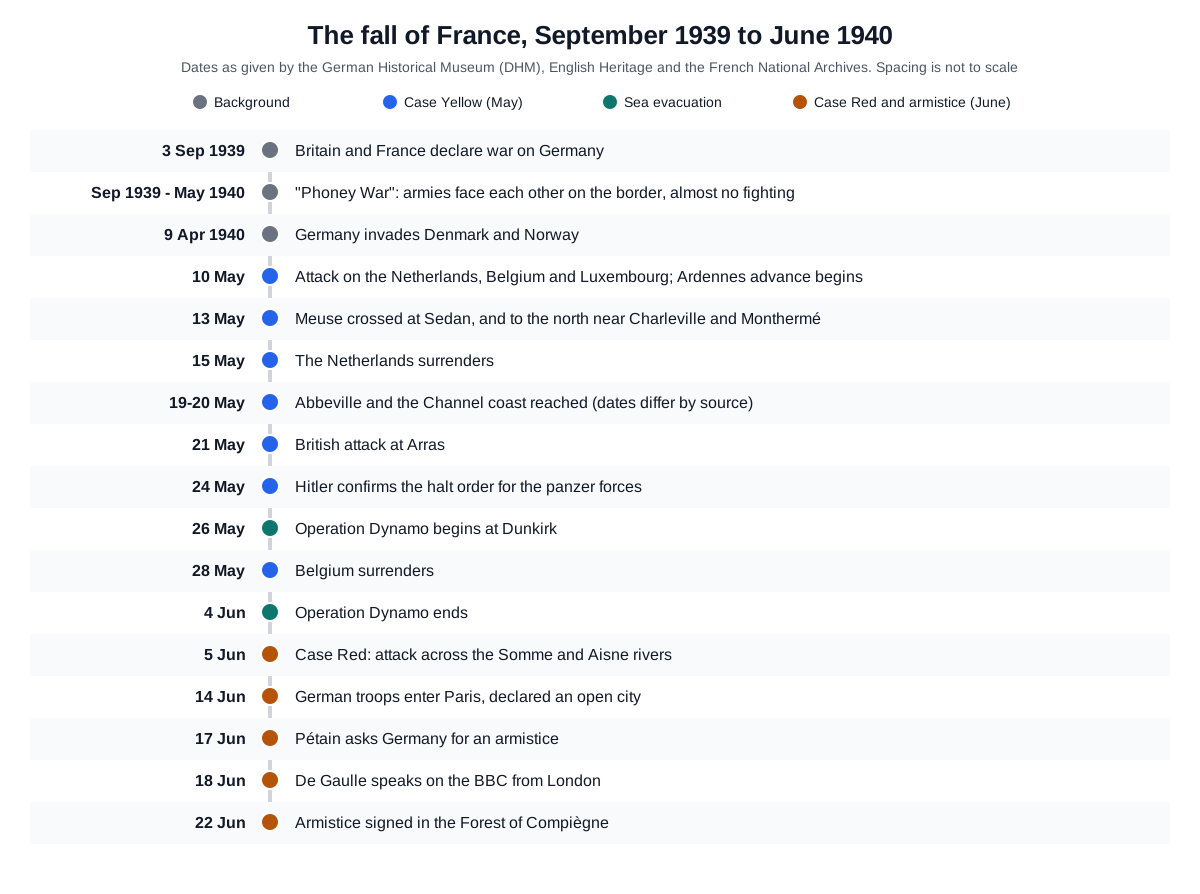
After Germany invaded Poland in September 1939, Britain and France declared war on Germany on 3 September. Yet no major fighting broke out on the French-German border. In September, French troops pushed briefly into the Saar region of Germany and then pulled back. After that, both sides spent the winter digging in and watching each other.
There were only occasional skirmishes and a war of propaganda. The period became known as the "Phoney War," and German sources call it the "Sitzkrieg," or sitting war. Over the winter the British Expeditionary Force (BEF) grew to 390,000 men and took up positions in France and Belgium alongside its allies.
France relied on the Maginot Line. Right after World War I, the French government had its general staff plan a defensive system along the German border in Alsace and Lorraine to stop another German invasion. From 1936, building was cut back again and again because modernizing the armed forces had to come first, and some bunkers were finished only just before the 1940 offensive.
When war came, more than 20 divisions waited behind the Maginot Line, ready for battle, from September 1939 to May 1940. But the line of fortresses did not reach the border with Belgium. The German route around it lay to the north.
Two plans
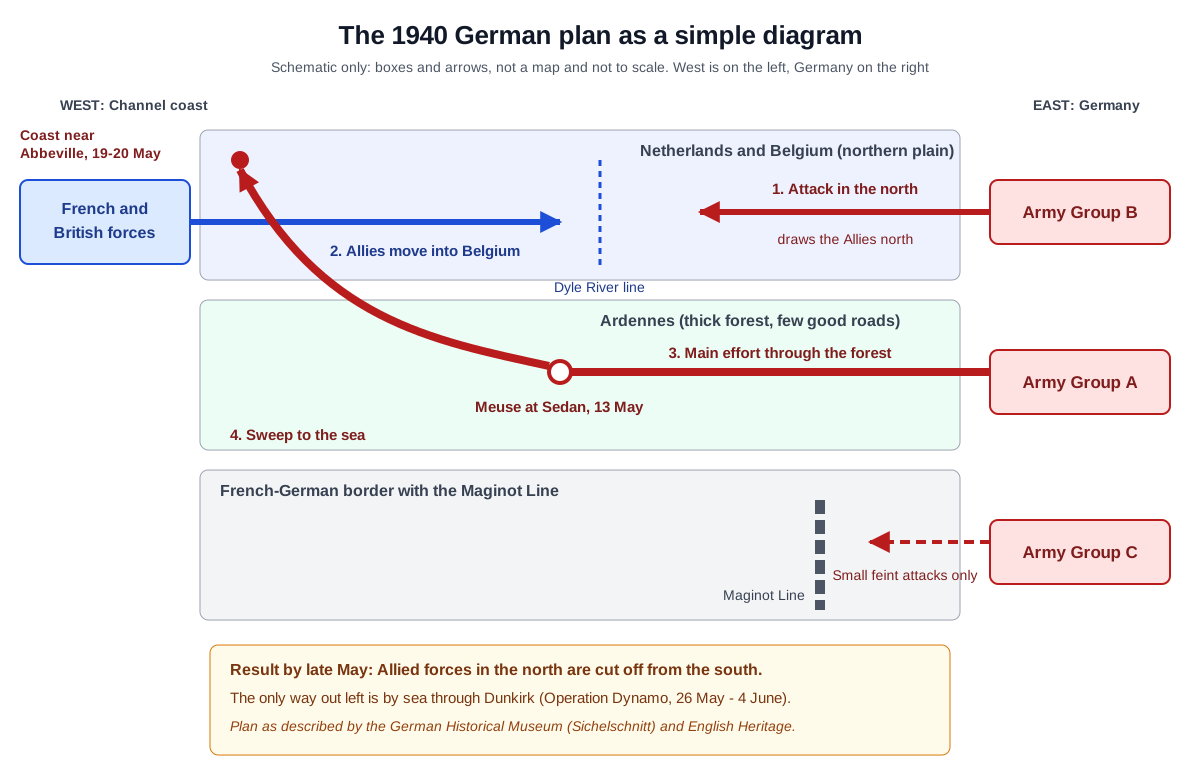
The German attack plan, named "Sichelschnitt" (sickle cut), was worked out from autumn 1939 by Lieutenant General Erich von Manstein and gave each of three army groups a task. Army Group B would strike the neutral Netherlands and Belgium. Once French and British troops moved into Belgium, Army Group A would push through the densely wooded Ardennes to the French Channel coast. Army Group C would make only small feint attacks along the Maginot Line.
It was a risky plan. The Ardennes, with few roads and thick forest, was thought too hard for motorized units to enter. The Army High Command (OKH) under Walther von Brauchitsch at first rejected the plan. Senior officers argued hotly, but Hitler held on to the plan and finally approved it.
The operation had two stages. First, Case Yellow (Fall Gelb) would draw the bulk of the Allied armies into Belgium and northern France and trap them in a giant pincer. Then Case Red (Fall Rot) would push south deep into France, with Paris as the goal. English Heritage notes that both went largely to plan, which surprised most of the German commanders.
The Allies moved as the Germans expected. French and British troops went into Belgium to support the Belgian army, and the French 1st Army Group and the BEF took up a defensive position on the Dyle River. The northern attack was strong, but it was really a diversion that drew the largest and strongest part of the Allied armies north.
10 May: the attack in the north
On 10 May 1940, Germany entered the Netherlands, Belgium and Luxembourg at once. The Netherlands had hoped to stay out of the war, as it had in World War I, and had not planned a joint defense with Belgium or the Allies. With 9 divisions and 125 aircraft, most of them old, it could not hold out alone.
After the bombing of Rotterdam, the Netherlands surrendered on 15 May to keep other cities from suffering the same disaster. By mid-May, the Netherlands had 2,890 killed and 6,900 wounded.
Most of Belgium's 22 divisions stood in the border zone. Behind them, a second fortified line ran along the Albert Canal between the fortresses of Antwerp and Eben-Emael. The German 6th Army broke through both lines on the first day of the attack. By 18 May, Liège, Brussels and Antwerp were occupied.
To the south, Luxembourg offered almost no resistance. About 60 roadblocks had been set up, but the country's 1,300 lightly armed police had orders not to oppose the attackers. The main German force crossed the country into the Belgian Ardennes.
The Ardennes and Sedan
The Ardennes is a forested upland that was thought too difficult for a big army to get through fast. The French trusted this natural obstacle. Gerd von Rundstedt's Army Group A moved fast once the attack began.
The roads were split in a telling way. The good routes through the hills were kept for the fast armored units, and the infantry followed on side roads.
Even within one museum, the number of divisions that went into the forest is given differently. The German Historical Museum (DHM) gives 45 divisions for Army Group A on its Ardennes page and 44 on its Belgium page. Both pages give 18 French divisions facing them along the Ardennes and the center of the front.
On 13 May the tip of the attack reached the edge of the hills. That day, Heinz Guderian's armored units crossed the Meuse at Sedan, and other troops crossed farther north near Charleville and Monthermé. On the same day, troops of the German 4th and 12th Armies stood on the west bank of the Meuse between Dinant and Sedan.
Once out of the Ardennes, the Germans had open French country before them all the way to the Channel coast. The Allies realized too late that the weight of the German attack was coming through Luxembourg and the Ardennes.
To the sea, and Arras
After breaking through at Sedan, the Germans raced west across northern France. The Allies had no strategic reserve and no strong counterattack that could stop them. Hundreds of thousands of Allied troops in Flanders and Belgium were about to lose all their links to the rear.
The day the Germans reached the sea differs by about a day between sources. The DHM overview page says armored units reached Abbeville at the river mouth on 19 May and the Channel coast one day later. The same museum's Dunkirk page puts Guderian's tanks on the coast on 20 May, and English Heritage says it happened "just a week" after the Meuse crossing at Sedan.
On 21 May the British counterattacked at Arras. In the original plan, two British divisions, the 5th and 50th, and the 1st Army Tank Brigade would attack south from Arras. A larger French force under Maxime Weygand would attack north, cutting the Germans in two. Two days before the attack, however, Weygand canceled his part, and Major General Harold Franklyn scaled the goal down to driving the Germans away from Arras.
After weeks of moving almost without rest, one in four British tanks had broken down. Even so, the attack went in on the afternoon of the 21st in two columns and at first took the Germans by surprise. The slow but heavily armored Matilda tanks shrugged off smaller antitank weapons.
The German armored divisions in the sector soon regrouped. They turned the 88 mm antiaircraft gun against tanks and began knocking out the Matildas. The British armor got 10 miles in and took several hundred prisoners, but lost dozens of tanks that could not be replaced, and in the end Franklyn halted the attack.
The attack came nowhere near breaking Erwin Rommel's spearhead. In English Heritage's view, the counterattack succeeded briefly but failed because there were not enough forces behind it.
The halt order and Dunkirk
On 24 May, Hitler confirmed a halt order (Haltebefehl) issued by Rundstedt, commander of Army Group A. German tanks stopped with trapped Allied forces in front of them. There is more than one explanation for why.
The DHM points to the German command itself. Hitler and his generals were surprised by how fast the advance had gone and disagreed on the next step. Brauchitsch and Franz Halder wanted a decisive blow at the trapped Allies. Rundstedt, however, wanted to spare and regroup his armor, and Hitler also trusted Hermann Göring's boast that the air force alone could destroy the enemy.
An article from the National WWII Museum in the United States looks to Arras. In its account, Hitler and many generals overrated the British attack and feared it signaled more to come. So they demanded that the British near Arras be contained, even at the cost of support for the push along the coast. The author cautiously suggests the failed attack "may have helped to save the British army."
Both accounts agree that the halt order gave the BEF and French units time to fall back to Dunkirk. Boulogne fell to the Germans on 25 May and Calais a day later. That left Dunkirk as the one port still open for escape.
Royal Navy Vice Admiral Bertram Ramsay had been planning a rescue by sea since 19 May, and on the evening of 26 May Operation Dynamo began. Working from Dover Castle, Ramsay sent warships, merchant ships and all kinds of small civilian boats back and forth to Dunkirk.
Conditions were poor. German attacks had made Dunkirk's main docks unusable. That left two choices: a narrow breakwater, called the mole, on the harbor's east side, and the beaches north of the port.
The beaches sloped so gently that a destroyer could not get closer than a mile to shore even at high tide. Small boats had to carry the troops out. On the first day, just 8,000 men got away.
It is often remembered that little ships carried most of the men, but English Heritage calls this a misconception. More than two-thirds, 239,465 men, got away via the mole, and 98,761 were taken from the beaches. The little ships did matter a great deal, but the biggest role belonged to the Royal Navy, above all its destroyers.
The operation ended early in the morning of 4 June. English Heritage says 338,226 British and Allied troops had come ashore in England when that day was over. The DHM says that nearly 370,000 were evacuated by 4 June, about 139,000 of them French.
The troops left behind or destroyed almost all their heavy equipment. The rescue was presented as a "miracle" to lift morale, but Churchill said on 4 June: "Wars are not won by evacuations." Meanwhile, Belgium surrendered on 28 May, after losing 7,500 soldiers in the fighting.
June: Paris and Compiègne
On 5 June Germany began the second stage, Case Red, by attacking over the Somme and Aisne rivers. By then the French army had lost more than 250,000 men, 10% of its total strength, through fighting, capture and the Dunkirk evacuation. Allied commander Maxime Weygand hastily formed a defensive front along the two rivers, known as the "Weygand Line."
Once the Weygand Line was broken, the French could not build a new front. German air attacks and roads choked with refugees kept the French army from retreating in good order. On 14 June the German 18th Army entered Paris, which had been declared an open city, without a fight, and the French government withdrew to Bordeaux.
The Maginot Line did not escape either. A separate German force attacked the forts from the French side, and the forts were taken one after another, though a few lasted into July. On 17 June, Guderian's armor, having pushed through Verdun, reached the Swiss border and encircled the Maginot Line and most of the French army.
From 10 to 25 June, Operations Cycle and Aerial rescued another 192,000 people from Breton and western French ports. They were British, Canadian, French, Polish and Czech troops, and civilians. On 17 June German aircraft sank the Lancastria off Saint-Nazaire; an estimated 3,000 to 6,000 people lost their lives. In the 51st Highland Division alone, more than 10,000 men could not get away and were taken prisoner.
Philippe Pétain, who replaced Paul Reynaud as prime minister on 16 June, asked Germany for an armistice the next day. On that same 17 June, Charles de Gaulle, who had become under-secretary for national defense and war on 5 June, asked to speak on the BBC in London. His appeal went out at 10 p.m. British Summer Time on the evening of 18 June.
The French National Archives presents the text of the appeal. In it, de Gaulle said that far more than numbers, German tanks, aircraft and tactics had pushed the French army back. He added that whatever happened, "the flame of the French resistance must not be extinguished and will not be extinguished." No recording was kept, and relatively few people heard the broadcast at the time.
At 6:50 p.m. German summer time on 22 June, Germany's Wilhelm Keitel and France's General Charles Huntziger signed the armistice in the Forest of Compiègne. It was the very spot where Hitler had placed the 1918 carriage. The agreement said it would take effect only once France had also agreed a ceasefire with Italy.
Under the text of the agreement, German troops would occupy French territory north and west of a line drawn on a map. The French armed forces would be disarmed, except for units needed to keep order at home. The fleet would gather in named ports and stand down under German or Italian control, and Germany declared it had no intention of using that fleet in the war. France would pay to keep the German occupation troops, and French soldiers in German camps would stay prisoners of war until a peace treaty.
The DHM judges these terms milder than the French had feared. France kept its colonies and could maintain an army of 100,000 men for internal order. From July 1940, Pétain's new government sat at Vichy in the unoccupied south. Alsace and Lorraine were in practice annexed by Germany, though not formally under law.
Tanks, radios, aircraft
The campaign is often called "Blitzkrieg," or lightning war. English Heritage describes it as hitting one decisive point (the Schwerpunkt) with overwhelming force, then following up with fast attacks by tanks, artillery, infantry and aircraft. The key was confusion that kept the enemy from reorganizing and striking back, and the risk was that the Allies might cut the stretched German supply and communication lines.
Radios mattered a great deal. Even the smallest German field units had radios, which let them move and respond more quickly than the Allies. Close coordination between the German air force and ground troops also counted, and the "Stuka" dive bomber became one of its symbols.
Individual German tanks were not always better, though. At Arras, the British Matilda shrugged off smaller antitank weapons, and the Germans stopped it only by turning the 88 mm antiaircraft gun against it.
Why did it collapse so fast?
What the Imperial German Army failed to achieve in years of trench warfare in 1914–1918, the German forces of 1940 achieved quickly and with light losses. The DHM writes that 141 German divisions, helped by surprise, defeated an opponent of equal military strength within a few weeks. This explanation puts surprise ahead of sheer size.
Other sources stress other things. English Heritage points to German communications and air-ground coordination, and to Allied forces so outmaneuvered and confused that they could not act together. The tanks, aircraft and tactics that de Gaulle named in his broadcast belong on this list too.
French decisions come up as well. The French command thought the Ardennes hard to cross. The DHM sees it as fatal that its strategic planning left out a breakthrough there by motorized German forces. It also says the Maginot Line in the end contributed little to the defense of France.
The German side had not foreseen everything either. Manstein's plan was first rejected by the Army High Command, and most German commanders were surprised that the operations went to plan. After this "Blitzsieg," or lightning victory, which many had thought nearly impossible, Hitler stood at the peak of his popularity in Germany.
What the armistice left behind
The DHM gives German losses in the western campaign as about 27,000 dead, 18,400 missing and about 111,000 wounded. France lost about 92,000 dead and 200,000 wounded. The Germans took 1.9 million Allied soldiers prisoner.
France was split in two. The north and the Atlantic coast came under a German military administration based in Paris, while the Vichy government held about 40% of French territory and the colonies. France had to pay 20 million Reichsmarks a day for the occupation.
Occupation led to persecution. In March 1942 the deportation of Jews from France began, and French authorities cooperated through registration and internment. About 76,100 Jews deported from France were murdered in the Nazi genocide.
Britain was left alone. After Dunkirk and the French surrender about three weeks later, Britain stood isolated and faced the threat of invasion. Hitler hoped the mild armistice terms would bring Britain to accept a peace offer, but that did not happen. On 16 July 1940 he ordered preparations for an invasion of England.
The troops brought home from Dunkirk became the basis for rebuilding the BEF and for a French army in exile under de Gaulle. On 28 June the British government recognized de Gaulle as leader of the Free French. The Vichy government lost real power in late 1942, when German and Italian troops occupied the south. France was not liberated until after the Normandy landings of June 1944.
What to read next
- How the tanks of 1940 differ from today's main battle tank (MBT) continues in Main battle tanks: is it all about the gun?.
- To compare radios that reached even small units with military communications today, read Resilient military communications: systems built to survive a lost link.
- To line up tanks and aircraft with other technologies that changed warfare, see Turning points in military technology.
- To follow another thread in weapons technology, see A history of laser weapons: from chemical to electric lasers.
- Articles in this series still being written: "The Road to World War II: Aggression and Appeasement in the 1930s," "The Dunkirk Evacuation: Nine Days, Over 330,000 People" and "The First Tanks and Cambrai: Machines Built to Cross Trenches"