At 03:40 on 4 June 1940, the British destroyer SHIKARI left Dunkirk, a port in northern France. Together with EXPRESS, which had left 22 minutes earlier, she carried about 1,000 troops and the Royal Navy parties who had worked on the pier. She was the last ship of the evacuation.
When the operation began, the goal was 45,000 men in two days. By the end, well over 300,000 people had been landed in British ports. Why did the Dunkirk evacuation, known as Operation Dynamo, become necessary, and what happened at sea and on the beaches over those nine days? This article follows how big ships and small boats shared the work, what stood in the way, who was left behind and why the numbers differ.
May 1940: how the armies ended up on the coast
At dawn on 10 May 1940, Germany opened its western offensive by invading the Netherlands, Belgium and Luxembourg, all three of them neutral. The Belgian king had asked for help, and British and French armies had moved into Belgium. Then the French front broke at Sedan to the south, and German armor raced toward the Channel, reaching the coast on 20 May.
The Germans then turned north along the coast. Boulogne fell on 25 May and Calais on 26 May. In the middle of this, on 19 May, General Weygand replaced General Gamelin as commander in chief of the French army.
On 4 June, Prime Minister Winston Churchill described the situation to the House of Commons. Once the northern armies could not reopen their link to the main French armies toward Amiens, only one choice remained. Belgian, British and French troops were nearly encircled, with one harbor and its nearby beaches as their only way out.
The Belgian army soon surrendered as well. The RAF Museum timeline lists this under 27 May, while the French Ministry of the Armed Forces gives 28 May.
Operation Dynamo: a plan that hoped for 45,000 in two days
Planning at sea started about ten days after the offensive opened. Vice-Admiral Bertram Ramsay, who commanded at Dover, sent a report to the Admiralty on 18 June 1940.
A War Office meeting on 19 May had already discussed "the hazardous evacuation of very large Forces." At the time, this was thought unlikely. Even so, the meeting placed control of sea movements with the Vice-Admiral at Dover and gave him the available shipping.
The beaches were seen as a problem early on. The beaches east of Dunkirk shelve very gradually. That meant a large number of small boats would be needed to carry troops from the beach to ships lying offshore. Planners doubted that the beaches alone could handle everyone, so they wanted to use the ports as well if at all possible.
Few ports were left. At Boulogne, evacuation started on 23 May and was completed on 24 May, and at Calais only non-fighting personnel were taken off. For any evacuation of the British Expeditionary Force (B.E.F.), Dunkirk was the one port left.
On the afternoon of Sunday, 26 May, the Admiralty said the situation had worsened so quickly that Dynamo had to be carried out with the greatest vigor. The aim was to bring off as many as 45,000 B.E.F. soldiers in two days, since enemy action would probably stop the evacuation after that. The formal order to start came at 18:57. Personnel ships had already been heading for Dunkirk since 15:00.
The goal kept changing over the next few days. Ramsay called the first 24 hours "a forlorn hope." Then the military situation became steadier, and it looked possible to lift about 175,000 men of the B.E.F. in three to four days.
French troops were added to the plan. The first figure mentioned was 25,000, which grew to 40,000–50,000 and later to 150,000 or more. Churchill told the Commons that a week earlier he had expected to bring back perhaps only 20,000 to 30,000 men.
Nine days on one timeline
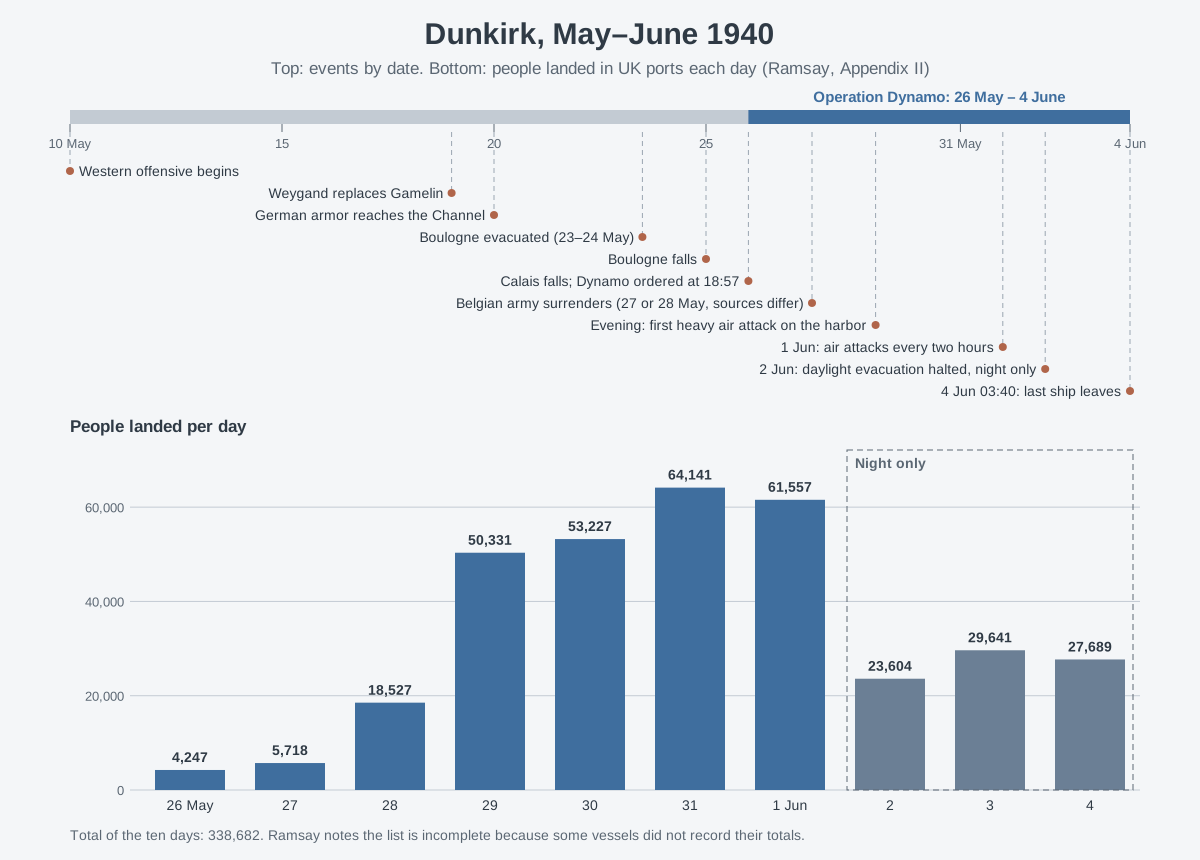
The bars under the timeline show how many people were landed in British ports each day. The first two days brought around 5,000 a day (4,247 on 26 May and 5,718 on 27 May). On 28 May the figure rose to 18,527.
For four days, from 29 May to 1 June, between 50,000 and 64,000 people were landed each day. The busiest day was 31 May, with 64,141. The ten days in the appendix add up to 338,682.
1 June was the turning point. That day, ships in the harbor, off the beaches and in the channels leading in were bombed every two hours. The Germans could also now cover the exits of the newly swept central route with gunfire from the shore. These two things brought daylight evacuation to a halt on 2 June.
From then on, ships went in only at night. On 2 June, 23,604 people were landed, then 29,641 on 3 June and 27,689 on 4 June. On the last night, 27,000 troops got away, and the French naval commander in the north agreed that the operation could be treated as complete.
From the order on the evening of 26 May to the last ship, the operation took a little under 8 days and 9 hours. Counted by calendar date, 26 May to 4 June is ten days.
The pier and the beaches: how big ships and small boats shared the work
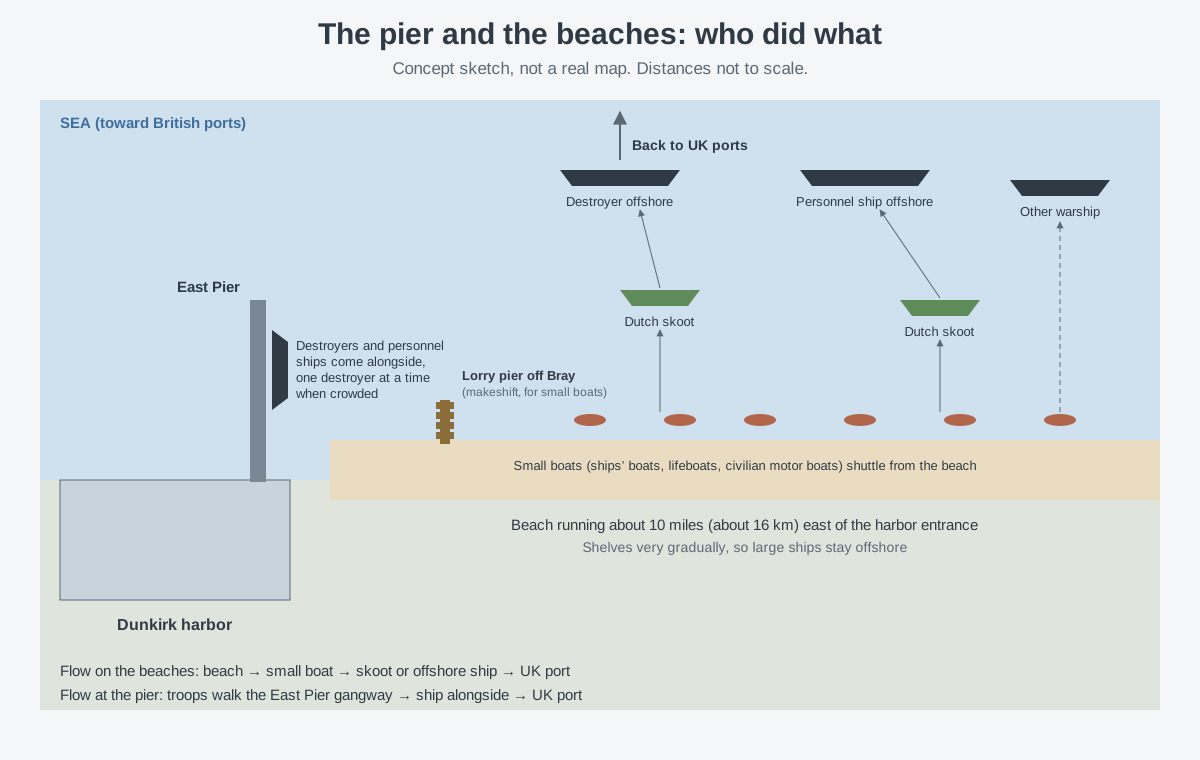
Troops were taken off from two places. One was the East Pier of Dunkirk harbor. The other was a beach stretching 10 miles (about 16 km) east of the harbor entrance. Destroyers and personnel ships came alongside the pier to load troops.
When the crowd of ships made a large target, the senior naval officer at Dunkirk let only one destroyer berth at the pier at once. The narrow gangway on the pier was also a bottleneck. To speed up loading, the men were told to hurry. Thousands of exhausted soldiers who had gone days without food or water then ran along the pier for over two hours.
The beaches worked differently. Large ships stayed offshore, and small boats shuttled in between. At first too few sailors minded the boats, so empty boats drifted away and crowded boats were swamped and sank. Both problems were fixed later.
The army helped too. Soldiers built a long makeshift pier into the sea off Bray from a line of lorries with deck planking on top. It was not steady enough for craft such as paddle steamers, but it proved very useful for loading troops into small boats.
Forty Dutch motor coasters, called skoots, formed a flotilla that linked the big ships and the small boats. Too big to run up on the sand, they mostly worked as a middle step. They took troops from small boats and passed them on to warships farther out. A few of them moved over 1,000 men each.
Civilian craft joined in as well. MASSEY SHAW, a fire float of the London Fire Brigade, made the crossing, and lifeboat crews from Ramsgate and Margate sailed their own boats across. The civilian motor boats, however, had old engines of many different types, and most had sat unused since the summer before. Just getting the engines to run was hard work.
The number of vessels depends on the source. Ramsay put the figure at almost 900 ships and boats, while Churchill spoke of "nearly 1,000 ships of all kinds." About one quarter of the troops came home in ships crewed by the Merchant Navy.
What stood in the way
The enemy tried five ways to stop the operation: mines laid by aircraft, intensive air attack, motor torpedo boats, coast artillery and submarines. Magnetic mines were scattered across the sea lanes. At times more than 100 aircraft came in one formation to bomb the single remaining pier and the sand dunes.
Many mines were laid, yet Ramsay could confirm only two British ships hit by them. Ramsay judged that degaussed ships, treated to reduce their magnetism, could move through these waters, and that this alone made the operation possible. He added that the outcome could have been very different had German aircraft been able to drop moored contact mines rather than magnetic ones.
The biggest threat came from the air. On the evening of 29 May, the first time a mass of ships crowded Dunkirk harbor, a heavy air attack followed. Motor torpedo boats caused casualties to two destroyers and two trawlers, while submarines seem to have caused no losses.
The weather helped. Any wind from the north raised a surf that badly slowed loading on the beaches. A strong north wind would have stopped beach loading entirely, but none came while the operation lasted.
The RAF covered the operation with No. 11 Group from southeast England, but fuel limited how long patrols could stay over Dunkirk. Many ship captains reported disappointment and surprise at how weak the air protection seemed while the operation was at its height. An Air Ministry footnote in the report gives another side. Much of the air fighting happened out of sight of the coast, and many German raids were actually met and broken up.
There were also reasons why air cover could not be complete. The enemy held the initiative and chose when to attack, and the area lay outside the range of controlled interception from radar stations in Britain. All the RAF could do was put up patrols and hope they would meet the enemy.
The air battle over Dunkirk also saw a first: fighters were directed by very high frequency (VHF) radio telephone. A shortage of the new sets meant Fighter Command had to go back to less efficient high frequency (HF) radios so that every squadron could use the same frequencies.
Aircraft losses differ widely between sources. The RAF Museum timeline puts RAF losses at 177 aircraft, 106 of them fighters, against 132 German aircraft. The No. 11 Group table in Ramsay's report counts 262 enemy aircraft "assessed as destroyed." Churchill told the Commons the RAF had inflicted losses of four to one or better.
Who and what was left behind, and what was lost at sea
Not everyone got away. About 40,000 French soldiers could not embark and were taken prisoner. Most belonged to the 68th and 12th Infantry Divisions and the Flanders fortified sector, units given the task of slowing the German advance. The ministry counts their fight among the reasons the operation succeeded.
Equipment stayed behind too. The Allies left about 2,000 guns, 60,000 vehicles and large stocks of ammunition, fuel and supplies. Churchill said the British army had lost nearly 1,000 guns, all its transport and all the armored vehicles of the Army in the North. The soldiers came home, but the guns, vehicles and logistics stores they needed stayed in France.
The human cost was heavy. More than 30,000 British soldiers had been killed, wounded or gone missing in the fighting. Ships went down during the evacuation as well, and the loss of life at sea reached 4,000–5,000 people.
British ship losses were heavy too. The destroyer list has 41 ships, with 6 lost and 23 damaged; 6 of 29 personnel ships and 10 of 33 trawlers were sunk. The heavy traffic meant most men from sinking ships were picked up, but ships that went down quickly after bombs or torpedoes were the exception. Ramsay estimated that about 2,000 troops were lost on the return voyages alone.
The French navy suffered losses of its own. On the afternoon of 29 May, the French destroyer Bourrasque was carrying French troops off the Belgian coast when she came under German fire. She sank quickly after an explosion, and nearly two thirds of the 700 to 800 men aboard died. The French ministry says the explosion was probably a mine, while the appendix to Ramsay's report lists her as sunk by a bomb.
330,000 or 340,000: why the numbers differ
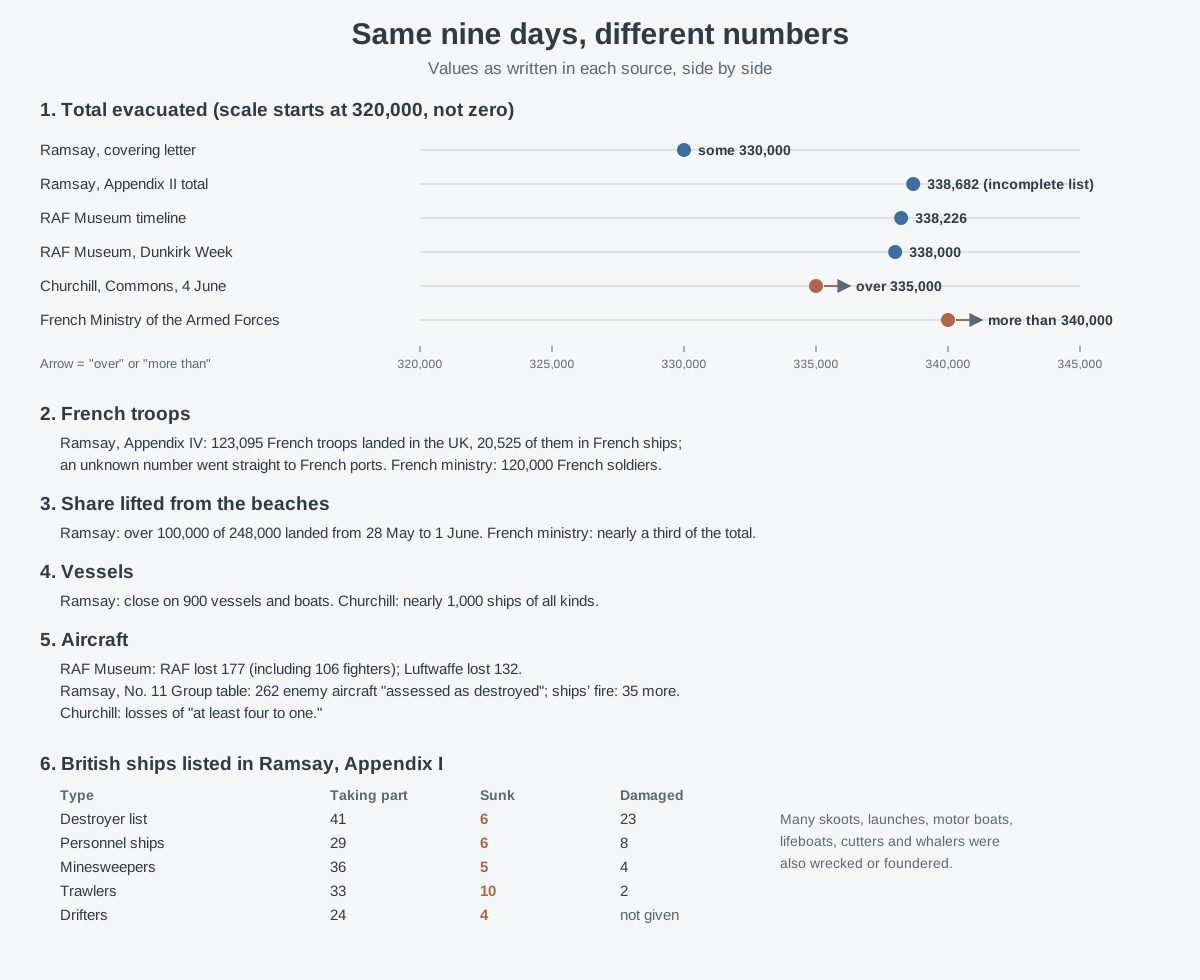
Even the most quoted figure, the total evacuated, comes in several versions. Ramsay's covering letter says "some 330,000," and the daily totals in his appendix add up to 338,682. The RAF Museum timeline gives 338,226, and another museum page gives 338,000. Churchill spoke on 4 June of "over 335,000," and the French ministry says "more than 340,000."
The records themselves offer clues for reading these numbers. Ramsay's appendix admits it is incomplete, since some ships never wrote down how many they carried. The 335,000 figure was given in the Commons on the very day the operation ended. The French ministry dates the operation from 28 May to 4 June, while British records count from 26 May.
The French share also varies. Appendix IV of Ramsay's report gives 123,095 French troops landed in Britain, 20,525 of them carried in French ships. It adds that an unknown number went straight to French ports in French ships. The French ministry gives 120,000 French soldiers and a few thousand Belgians.
The French side also brought many vessels. Nine French destroyers took part, along with 167 trawlers, drifters and other small vessels brought in from the coast between Boulogne and Cherbourg, working mostly off the beaches.
The beach share differs as well: from 28 May to 1 June, when both the harbor and the beaches were usable, 248,000 troops reached Britain. Ramsay counted over 100,000 of them as lifted from the sand. The French ministry says nearly a third of the total left from the beaches. The "330,000" in this article's title sits near the low end of these figures.
Between deliverance and disaster
On 4 June, Churchill called the evacuation "a miracle of deliverance" in the House of Commons. Yet he also said that this rescue must not be mistaken for a victory, and that "wars are not won by evacuations." He called what had happened in France and Belgium "a colossal military disaster." Near the end of the speech comes the line "We shall fight on the beaches."
The war did not stop there. Two British divisions, the 1st Armoured Division and the 51st Highland Division, stayed in France and kept fighting alongside the French army. Most of the French soldiers taken to Britain were sent back to Brest and Cherbourg within days, sometimes hours, to rejoin the fight.
On 17 June, however, the French government asked for an armistice, which was signed at Rethondes on 22 June. In between, another evacuation took place at Cherbourg. By the time the last ship sailed at 16:00 on 18 June, some 160,000 British and Allied soldiers and over 300 guns had been taken off.
The town of Dunkirk carried its own scars. When the war ended, 90% of it had been destroyed: of 3,362 buildings before the war, 1,524 were completely destroyed and 805 badly damaged. It is hard to tell how much of this came from the 1940 bombing and how much from the bombing at the end of the war. Rebuilding began on 4 September 1949 and was finished in 1963.
These nine days soon turned into stories. In 1949, Robert Merle won the Prix Goncourt for Week-end à Zuydcoote, a novel drawn from the battle of Dunkirk. In 1964, Henri Verneuil made a film of the same name from it.
What to read next
- The Fall of France, 1940: Armor Through the Ardennes: what happened on land from 10 May until German armor reached the Channel.
- Destroyers and frigates: why warships have different names: what kind of ship the destroyer, the core of this evacuation, is.
- Radar: measuring distance and motion with radio waves: the principle behind the "range of radar control" the Air Ministry footnote mentions.
- The Battle of Britain: An Air Defense Built on Radar and Control: the fight that followed in the skies over Britain right after Dunkirk.
- Military logistics: performance must be sustainable: why leaving equipment and supplies behind was such a heavy loss.
- A history of laser weapons: from chemical to electric lasers: the story of weapons against threats from the air, seen from the laser side.