Head northeast from Athens and you reach a plain that runs down to the sea. Its name is Marathon. In 490 BC a Persian expedition that had crossed the Aegean landed there, and an Athenian army came out to face it.
It was the first big clash between the two powers on Greek soil. Most of the story comes from one book, the Histories of the Greek historian Herodotus. His account is the backbone here, with a Greek government archaeology exhibition and a Yale lecture set beside it where they add to it or read it differently.
Why Persia came for Athens
It started across the sea in Asia Minor. In 499 BC the Ionian Greeks there rose against the Persian king Darius I. Athens and Eretria helped the rebels, and that help became the pretext for a Persian attack.
Athens voted to send 20 ships. During the revolt the Persian stronghold of Sardis burned, and with it a temple of the local goddess Cybele. Herodotus said those 20 ships were the beginning of trouble for Greeks and barbarians alike.
The king did not let it go. At each of his dinners, a servant had to say three times: "Master, remember the Athenians." Darius was also glad of an excuse to subdue the people who had refused him earth and water, the token of submission. He gave the expedition to Datis and to his own nephew Artaphernes, with orders to bring the people of Athens and Eretria back as captives.
Professor Donald Kagan of Yale sums up the aim in three parts. The first was to punish the two cities that had insulted and harmed the Great King. The second was to put Hippias, the former tyrant of Athens, back in power. The third was to win a base in Greece for a later conquest of the whole country.
Across the sea to Marathon
An earlier attempt had failed two years before. In 492 BC a storm off the peninsula of Mount Athos nearly wrecked the Persian fleet, and that invasion had to be called off.
The 490 BC expedition took a different route. The whole fleet came to 600 triremes, and instead of hugging the coast it crossed the Aegean straight through the islands. Herodotus gives fear of another disaster at Athos as the main reason.
The islands on the way met different fates. On Naxos the temples and the town were burned and people were taken away. Datis spared Delos, calling it "the country which gave birth to the two gods." Carystus refused to give hostages, and it gave in only after a siege and the wasting of its land.
Eretria came next. The 4,000 men Athens had sent to help took advice from an Eretrian, crossed to Oropus, and escaped. The city held out for six days, but on the seventh two citizens betrayed it. The Persians burned its temples in revenge for the temples of Sardis and carried off all the people.
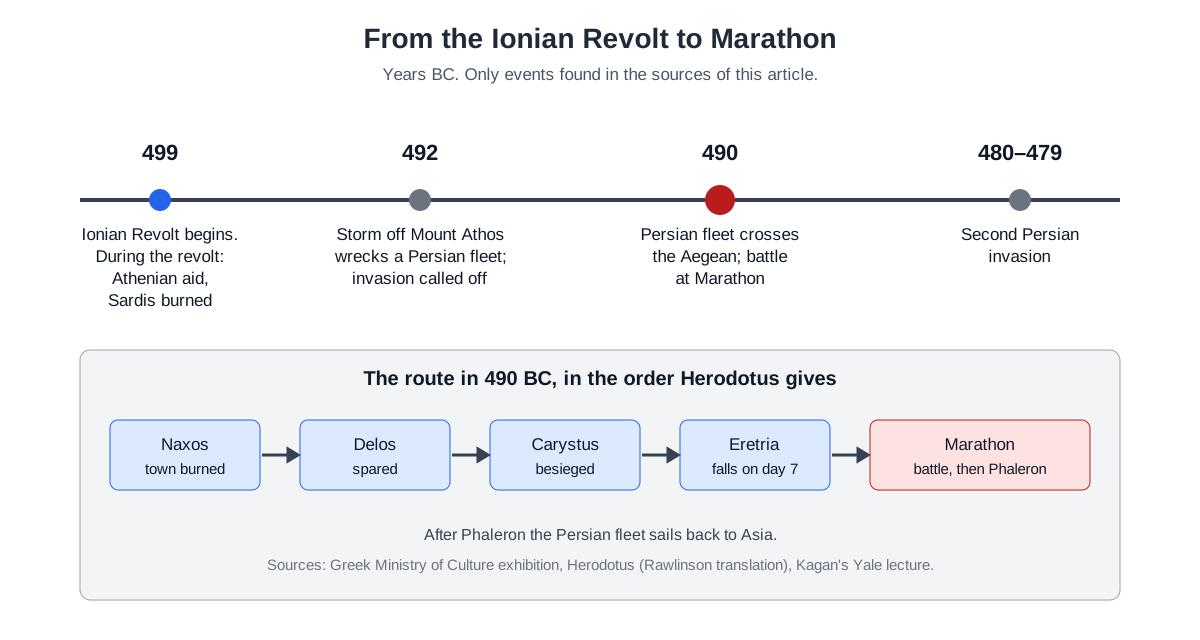
The next stop was Marathon. No place in Attica suited cavalry better, and it lay very close to Eretria. The man who guided the Persians there was Hippias.
Fight or wait
Athens also sent its army to Marathon, where it stood on the defensive. Ten generals shared the command, and one of them was Miltiades. The neighboring city of Plataea joined with its whole force.
Before leaving the city, the generals sent a trained runner, Pheidippides, to Sparta. He reached Sparta the day after he left Athens.
Sparta wanted to help but would not break its law. It could not send out an army before the full moon, so it waited. Kagan leans toward the view that this was sincere rather than an excuse, and he thinks the runner's real name was probably Philippides, changed by a copying error.
At Marathon the generals split down the middle. One side said they were too few to fight the great Persian army, the other wanted to fight at once, and Miltiades was in the second group. At the time an official called the polemarch also had a vote alongside the ten generals. Miltiades won over the polemarch, Callimachus, and that single vote decided for battle.
Where this debate took place is a matter of interpretation. Herodotus places it at Marathon, after the army arrived, but Kagan does not agree. The Athenian assembly had to decide whether to send an army, how large, and under whose command, so in his view the debate happened there. Then, he adds, the two armies spent about a week just watching each other.
One day on the plain: deep wings, thin center
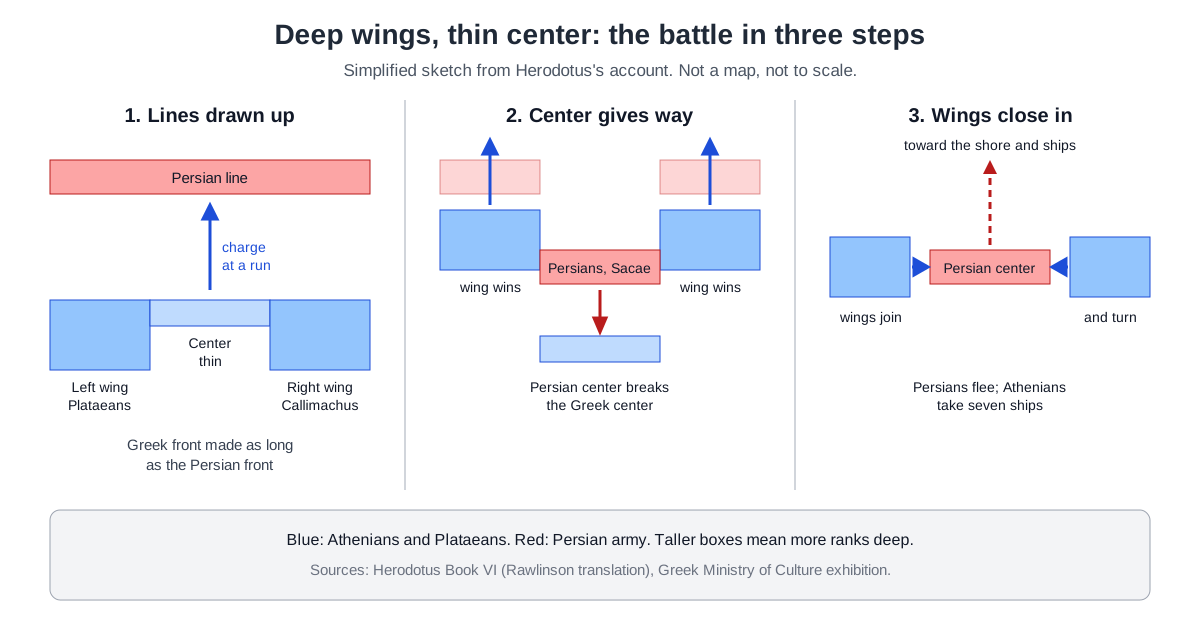
The other generals handed their turns of command to Miltiades, yet he waited until his own day came round before he fought. Callimachus, as polemarch, took the right wing, as the rule then required. The Athenian tribes stood in the center in their numbered order, and the Plataeans held the far left.
The layout was deliberate. To make the Athenian front as long as the Persian front, the center was thinned out and left as the line's weakest spot. The two wings, in return, were many ranks deep.
When the signal came, the Athenians charged at a run. In the English translation, the gap between the armies was a little under eight furlongs. The Persians saw a small force running at them with no cavalry and no archers, and thought the Athenians had lost their minds.
Herodotus adds that, as far as he knew, these were the first Greeks to charge at a run. Until then, Greeks had feared even hearing the word "Medes," his name for the Persian side.
The fight went differently in the middle and on the sides. In the center, held by Persian troops and the Sacae, the Persian side won, broke the Greek line and chased it inland. On both wings the Athenians and Plataeans won. The wings let their beaten enemies run, joined together, and turned on the troops who had broken their center.
The Greek Ministry of Culture exhibition tells the same story and adds one scene. Some of the Persians who scattered toward the sea or the plain drowned in the Great Marsh. In its account, the area of the Great Marsh was chosen as the battlefield to cancel out the Persian army's advantages.
The pursuit ran all the way to the beach. The Athenians grabbed the ships and shouted for fire, and in that struggle Callimachus and the general Stesilaus were killed. The Athenians captured seven ships.
The rest of the fleet picked up the Eretrian prisoners it had left on an island and sailed around Cape Sunium. The plan was to reach Athens before the Athenian army got back.
According to the Ministry exhibition, the Athenians had Aristeides and his men stay behind for the burials while everyone else rushed back to the city without a rest. They got there first. The Persian fleet reached Phaleron, then the harbor of Athens, waited a while offshore, and sailed back to Asia.
Around this time the Alcmaeonidae family was accused of plotting with Persia and of raising a shield as a signal to the Persians on their ships. Herodotus reports the rumor, but he also writes that he cannot believe it at all.
Shield and spear: hoplites and the phalanx
The core of the Athenian army was the hoplite, a heavily armed foot soldier. He wore a Corinthian-type helmet that covered the head and neck and left the eyes, nose and mouth open, along with a metal breastplate. His round shield was wood inside with a bronze facing, and it was strapped firmly to the arm at two points with leather handles.
The shield was on the left, so the spear belonged to the other hand, the right. Its shaft was wood, its point was bronze, and its length was about 1.80 m. The spear was for thrusting, not throwing, and the sword came out if the spear was lost or in close fighting.
The shield's position is the key. Held on the left arm, it covered its owner and stuck out to the left, over the bare right side of the comrade standing there. A tight line of overlapping shields like this is called a phalanx. Kagan presents this as the traditional view and explains that the overlapping shields turn the soldiers into one solid block.
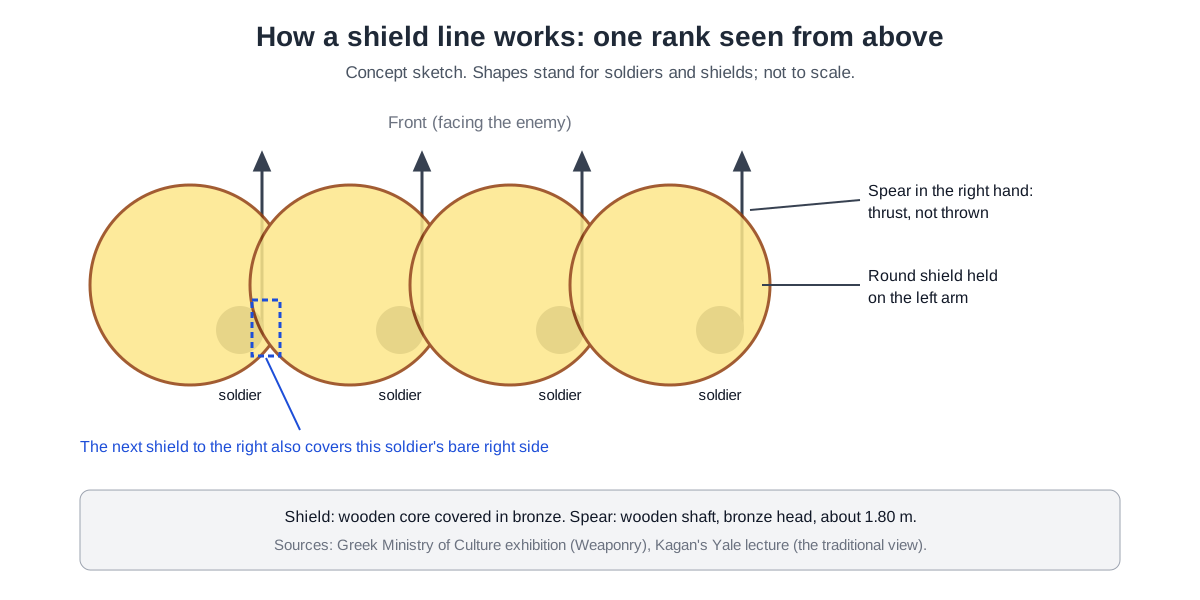
Picture people standing in a row on a rainy day, each tilting an umbrella a little to the left to cover a neighbor's shoulder. The real thing was different. What had to be stopped was an enemy spear, not rain, and the shield was bronze over wood.
The Persian equipment across the field was different. Apart from the elite Immortals, the Persians carried light and inadequate weapons. In Kagan's description, Persian infantry had no heavy armor and carried wicker shields, in an army drawn from many subject peoples. There was cavalry on the ships too, but it played no part in this battle.
Numbers and dates differ by source
The figures for Marathon depend on which source you read. Here are three side by side.
| Item | Herodotus | Greek Ministry of Culture exhibition | Kagan lecture |
|---|---|---|---|
| Persian army | No troop count; fleet of 600 triremes | 20,000–25,000 men, 600 ships | 20,000–30,000 infantry (the estimate most people accept) |
| Greek army | No troop count | 9,000 Athenians, 1,000 Plataeans | About 10,000 |
| Dead | About 6,400 Persians, 192 Athenians | 192 Athenians, 11 Plataeans, 6,400 Persians | 192 Greeks |
| Landing date | None | Landing in early September 490 BC | Landing on August 4, 490 BC |
There are no troop numbers for either side in Herodotus's account of Marathon. The Ministry exhibition gives its figures with the words "according to the sources," and Kagan says first that nobody knows before giving his estimate. The time of the Persian landing also splits between August and early September.
One more thing is worth keeping in mind. Kagan points out that Herodotus is friendly to Athens throughout his work, and that many of his informants were Athenians telling events from their own angle. It is a record in which one side's voice is loud.
The Spartans never made it in time. After the full moon, 2,000 of them reached Attica in three days, but the battle was over. They went on to Marathon to look at the Persian dead, praised the Athenians, and went home.
What remains: a tomb and a story
A tomb remains on the plain. Excavations uncovered the Soros, the grave of the Athenian dead, and the layer of the funeral pyre with bones and broken pottery. Another tomb, in the area of Vranas, has been identified by archaeologists as the grave of the Plataeans and of the slaves who also took part. Kagan explains that burial on the battlefield itself was a special honor for the 192 Greek dead.
Names remain too. A stone slab carved with the names of the dead from the Erechtheis tribe first stood on the tomb. Herod Atticus later moved it to his villa in Kynouria, and in 2000 it was found built into an early Christian building in that area. The exhibition sees finds like these as confirming and filling out what Herodotus and other writers recorded.
So what did the battle leave behind? The Ministry exhibition says the young Athenian democracy, set up in 508 BC, grew firmer by holding off a powerful enemy with free citizen hoplites. Kagan says that for the rest of Greek history, Marathon was remembered as a triumph of the hoplites, and that it was the first time the Greeks beat the Persians.
Kagan notes the criticism that people like him overstate the battle, but he does not accept it. He ends the lecture by saying that if Athens had lost at Marathon, there would have been no democracy and no Western civilization. That is one scholar's reading, not the record.
And the story did not end at Marathon. Ten years later, in 480–479 BC, Persia invaded again.
What to read next
- The Peloponnesian War: Twenty-Seven Years of Athens Against Sparta: the war in which Athens and Sparta faced each other in the Greece that came after Marathon.
- Turning points in military technology: how new technology changed the way wars are fought, with modern examples.
- Composite and reactive armor: the blocks on a tank: how today's tanks protect the crew with armor.
- A history of laser weapons: from chemical to electric lasers: how long it took a new weapon to find its place, seen from the laser side.