In March 2015, Lawrence Livermore National Laboratory (LLNL) in the United States announced that it had installed and commissioned a new pump source for a laser. It was a set of laser diode (LD) arrays with 3.2 MW of combined peak power. The laboratory ranked them first in the world for peak power among laser diode arrays. Inside them are more than 500,000 tiny points that emit light.
Output like that does not come from one emitting point. It comes from a great many of them gathered together. First the points are lined up in one row to make a diode bar, and then bars are piled on top of each other to make a stack.
This article looks at what bars and stacks look like and what grouping gains and costs. It then follows the path from the first semiconductor lasers of 1962 to megawatt arrays.
When one chip is not enough
A laser diode is another name for a semiconductor laser. It gets the name because current flows forward through a semiconductor junction, just as in a diode. Semiconductor and air differ strongly in refractive index, so a face of the crystal can reflect enough light to act as its own mirror.
When a laser diode is used to put energy, as light, into another laser, it is called a pump diode. Virtually all fiber lasers are pumped by laser diodes or by other fiber lasers. How a diode makes light is covered in "Pump diodes: the part that turns electricity into light".
The spot on a chip where light comes out is called an emitter. A chip with one emitter is a single emitter. When a crystal-based solid-state laser is pumped by diodes, the usual source is not one single emitter but a high-power diode array or bar. More light means gathering more emitters, and bars and stacks are the shapes that gathering takes.
Bars: emitters in a row
A bar is a set of emitters lined up side by side in one horizontal row. It is a group of separate semiconductor lasers placed next to each other in one array. From one bar, the light of many emitters comes out in parallel.
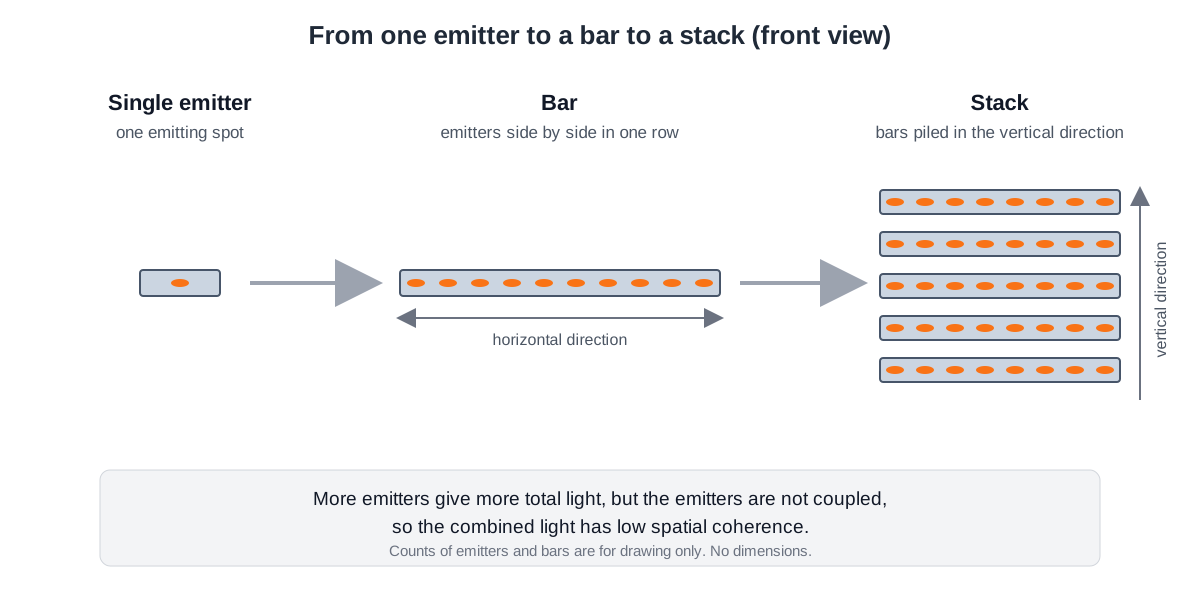
Picture one floor of an apartment building at night, with a row of lit windows. The real difference is important, though. The emitters on a bar sit on one chip, but their light is not linked. Each one works as its own laser.
So the light of a bar is not the light of one emitter made bigger. It is closer to a bundle of many lasers shining side by side. This difference comes back below, in the part about coherence.
Stacks: bars piled up
One more step is possible. To raise the output further, bars can also be stacked in the vertical direction. Several layers of bars make a stack. Seen from the front, it looks like a panel of emitters in rows and columns.
The LLNL arrays have this shape. According to a news item from ELI Beamlines, a European research facility, each array holds several 888 nm laser diode bars, which sit on stacks cooled by water. One array reaches 800 kW of peak power, and four of them together give 3.2 MW. The emitters number more than 500,000.
Bars and stacks also appear by name in product lists. The BWT product list includes a microchannel-cooled diode laser module in vertical and horizontal stack forms.
The price of grouping: coherence and heat
Grouping has costs. The first is coherence. The diode lasers that make up an array or bar are not coupled to each other. As a result, the spatial coherence of the combined light drops sharply.
The light from diode arrays and bars also has low beam quality. It is still very useful. Even with reduced coherence, such a diode array is much brighter than a normal flashlamp. Here brightness means power per unit area, as the textbook's figure caption defines it.
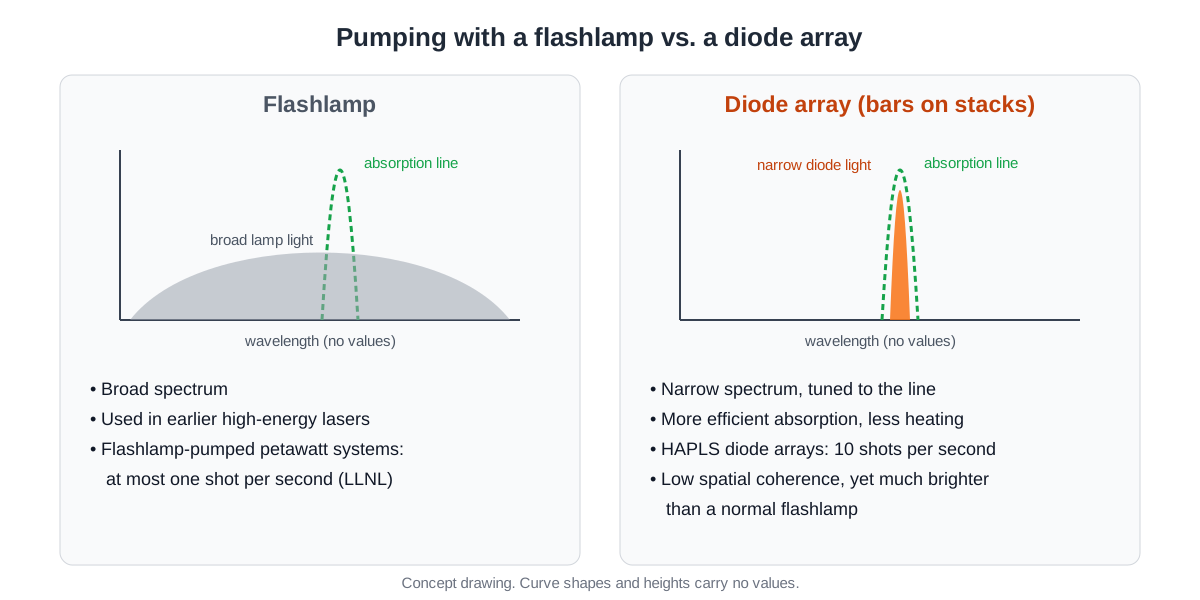
The spectrum differs too. A diode array has a much narrower spectrum than a flashlamp, so it can be tuned right onto an absorption line, a wavelength the solid-state laser absorbs well. The pump light is absorbed more efficiently, and heating effects go down.
Turning low-quality light into a good beam is the job of the gain medium. A diode-pumped solid-state laser can take fairly low-cost, low-beam-quality light from diode arrays and bars and turn it, with good efficiency, into a beam close to the diffraction limit. A diode-pumped semiconductor laser called a VECSEL does the same with the light of high-power diode bars.
The second cost is heat. A diode cannot turn all of the electricity it receives into light. TWI, the UK welding research institute, gives 30–50% as the typical wall-plug efficiency of direct-diode lasers, which use diode light directly. That is not a figure for one bar or stack, but whatever does not become light stays behind as heat.
Public examples show cooling going hand in hand with stacks. The bars in the LLNL arrays sat on water-cooled stacks, and the BWT stack module names microchannel cooling. That is why thermal management comes up whenever bars and stacks are discussed.
From a 1962 chip to megawatt arrays
The first semiconductor lasers appeared in 1962, as an IEEE Photonics Society article recounts. Researchers at GE, IBM's Watson Research Center and MIT Lincoln Laboratory separately reported the first demonstrations within days of each other. In those days, a tiny crystal hung in a glass vessel of liquid nitrogen, which kept it cold. The invention was honored as an IEEE Milestone at all three sites.
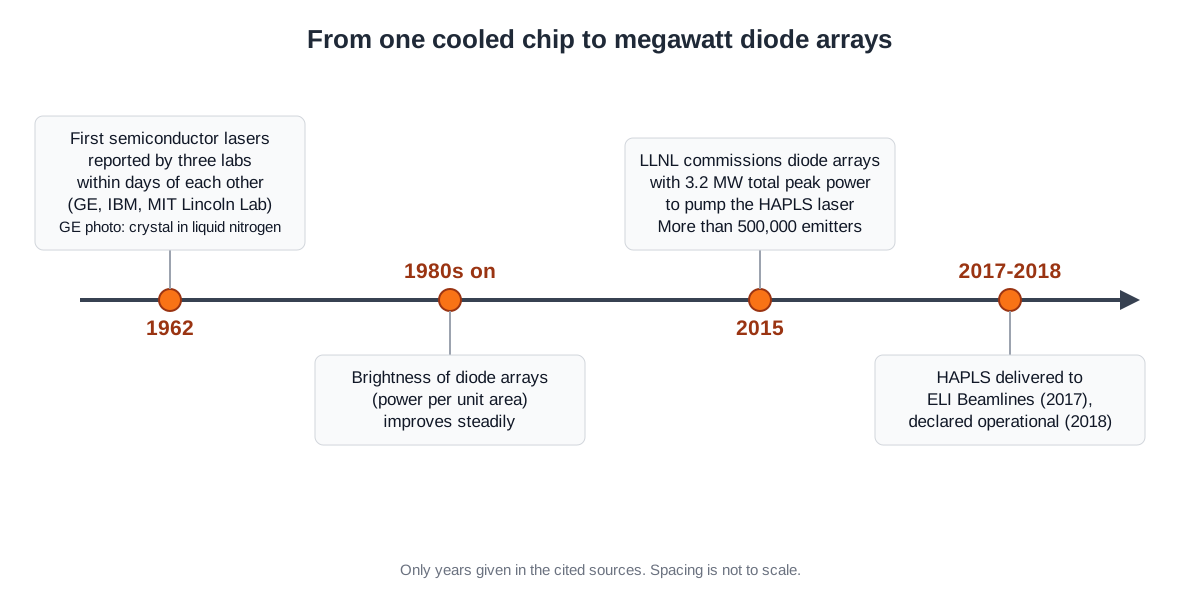
After that, the brightness of diode arrays improved steadily from the 1980s. A technology that began with a single crystal in a cold container grew into arrays of many stacked bars.
The 2015 LLNL arrays stand out in this story. They were built to pump the High-Repetition-Rate Advanced Petawatt Laser System (HAPLS). Earlier high-energy science lasers, such as the National Ignition Facility (NIF), used flashlamps. Petawatt systems pumped by flashlamps could fire no more than one shot each second.
The HAPLS diode arrays, by contrast, fire 10 shots each second and feed kilojoule pulses into the final amplifier. A higher repetition rate needed technology that passes on less heat than flashlamps did and clears it away more quickly, which shortens the wait between shots. A HAPLS systems architect described the change as closing the book on flashlamps and opening a new one with laser diode arrays. LLNL developed the arrays with Lasertel, and HAPLS was planned to be installed at ELI Beamlines in the Czech Republic starting in 2017.
Bars or single emitters
Stacking bars is not the only path. Another is to gather the light of many single emitters through optical fiber. IPG describes its diode laser modules as single emitter diodes combined with delivery fibers. nLIGHT also says its semiconductor lasers build on single-emitter diodes and high-brightness fiber coupling.
Companies that make single emitters point to advantages over bar stacks. IPG claims that, next to bar-stack pumps, its single emitters reach pumping brightness an order of magnitude higher and as much as double the power efficiency. Another difference IPG points to is cooling. Single-emitter pumps can use simple water cooling or even forced air, while in its view bar stacks need microchannel coolers that run on high-pressure deionized water.
Keep in mind that this comparison comes from one company. The megawatt HAPLS arrays described above were built from stacks of bars. Public sources show both paths in use.
Where this meets laser weapons
High-power fiber lasers also begin with pump light. The abstract of a 2010 review paper explains that the shape of the fiber lets it turn fairly low-brightness diode pump light into high-brightness laser output with good efficiency. Pump light gathered from many emitters has low coherence, but inside a fiber laser it becomes the energy of a bright beam.
Defense suppliers place pump diodes in the same chain. nLIGHT says it has long supplied high-power laser technology to aerospace and defense customers. The uses it lists include countermeasures, lidar, navigation and high-energy lasers (HEL). Its range includes a wavelength-stabilized 976 nm product offered for directed energy.
The path from a semiconductor chip, through modules and fiber, to the effector can be followed in one go in "Following One Laser Weapon: From Chip to Effector".
What to read next
- "Pump Modules: Putting Chip Light into One Fiber": the part that gathers the light of many emitters into one fiber.
- "Cooling and thermal management: where the heat that did not become light goes": the equipment that carries away the heat bars and stacks leave behind.
- "Volume Bragg Gratings: Holding a Pump Diode's Wavelength in Place": a part that holds a diode's wavelength on the absorption line.