"A new weapon is in development." News stories use that line all the time. Yet a calculation on a desk and a prototype that has already flown over a test range are both "in development." The gap between them can be a few years or a few decades.
Technology readiness levels (TRL) split that gap into nine steps. This article looks at what the scale measures, how it moved from the space program into weapons programs, and what one number on it cannot tell you.
A ruler with nine marks
TRL is a measurement system for how mature a given technology is. Each technology is checked against the criteria for each level and then given a single rating. The scale has nine levels, running from TRL 1 at the bottom to TRL 9 at the top.
The bottom three steps happen in people's heads, on paper and in first experiments. At TRL 1, basic principles have been observed and reported. At TRL 2, someone has thought of a use for them.
TRL 2 is close to guesswork, because there is little or no experimental proof yet. By TRL 3, analysis and experiments prove the concept, and people often build a model to show that the idea works.
In the middle steps, the place of testing changes. At TRL 4, the basic parts are put together in the lab to see whether they work as a set. TRL 5 and TRL 6 move out to a relevant environment, one set up to resemble real conditions. The U.S. Department of Defense (DoD) table treats TRL 6, a prototype shown in a relevant environment, as a major step up in readiness.
The top three steps are the real world. TRL 7 calls for a prototype of the actual system to be shown in an operational environment, such as an aircraft, a vehicle or space. At TRL 8, the finished system earns its qualification through test and demonstration, and in almost all cases this is where real system development ends. At TRL 9, the actual system has proven itself in successful mission operations.
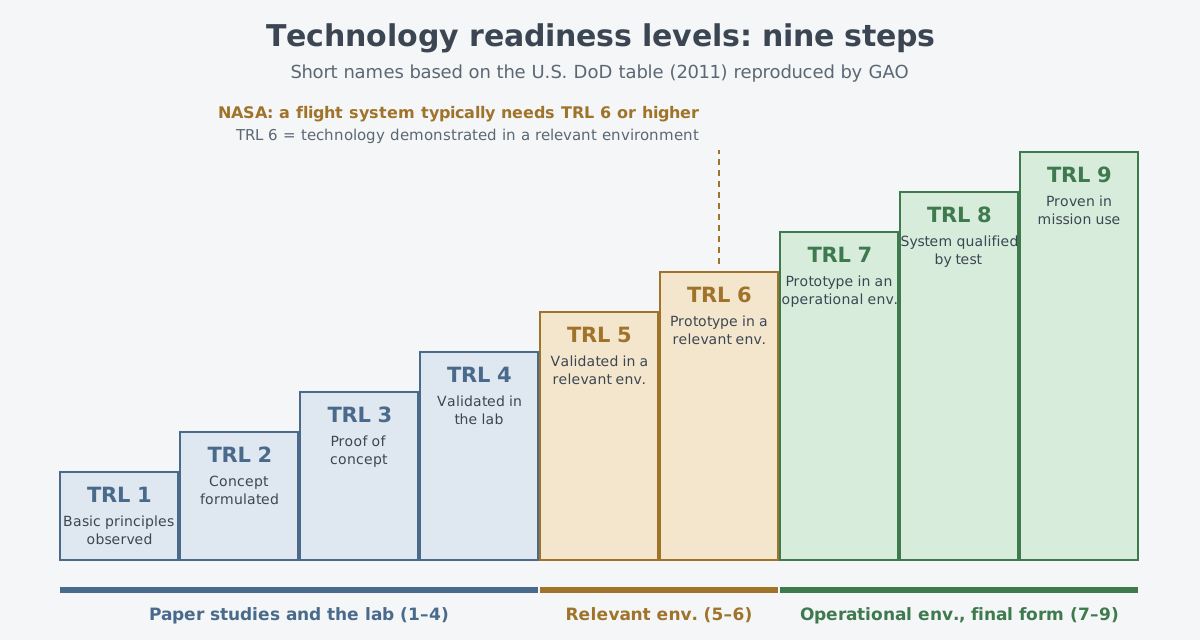
The nine steps are more like school grades than marks on a height chart. To move up one step, you have to pass that step's test. Real life differs, though. School grades go up once a year, but each TRL step takes its own amount of time, and some technologies have stayed on one step for more than ten years.
Every step rests on demonstration, meaning ability shown in tests. A technology's performance is compared with numbered maturity levels, and the demonstrations grow in fidelity and complexity as the levels rise. That is why a launch-event picture alone cannot move a technology up a step. For how simulation and testing differ at each step, see Simulation versus testing: why CG is not proof.
A ruler that began in the space program
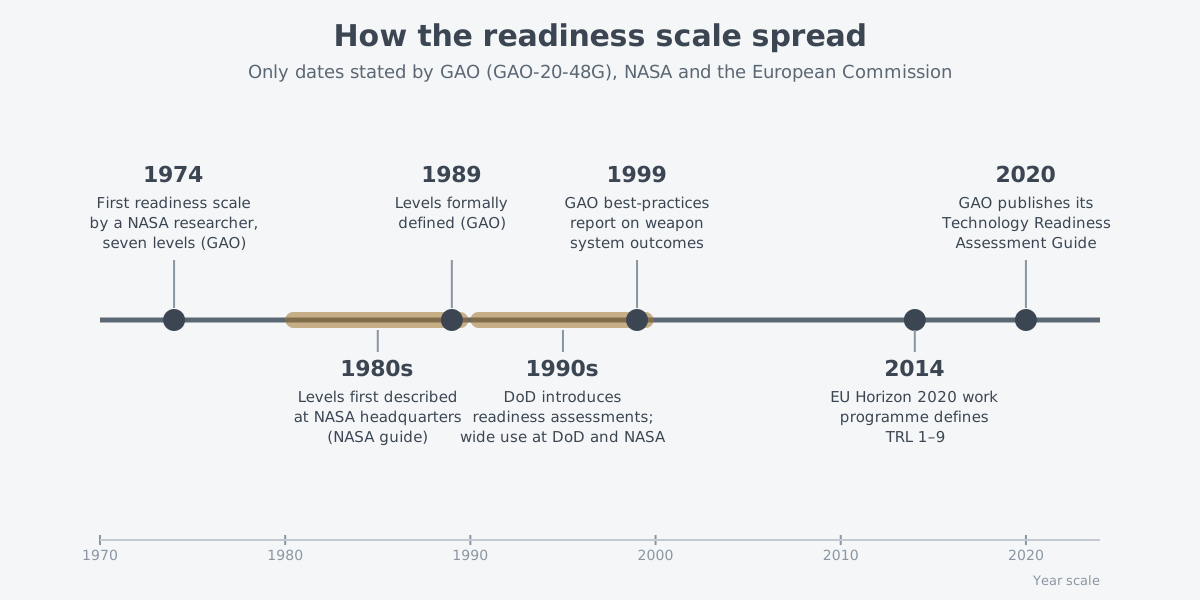
The scale came from NASA. The technology readiness assessment guide of the U.S. Government Accountability Office (GAO), GAO-20-48G, says that in 1974 a NASA researcher drew up the first readiness scale. It had seven levels, which got a formal definition only in 1989.
Sources place the starting point a little differently. NASA's own readiness assessment guide says the levels were first described at NASA headquarters in the 1980s. Today NASA defines TRL in documents such as NPR 7123.1.
The number of steps changed too. Today's TRL is a nine-level scale. It begins with a basic concept studied on paper. It ends with a technology that has shown its worth in actual use, where the product really operates.
The space agency's wording is still visible. In NASA's level descriptions, TRL 7 means showing a working model or prototype in a "space environment." A technology earns TRL 9 once a successful mission has "flight proven" it.
How the ruler reached weapons programs
DoD brought in technology readiness assessments (TRA) in the 1990s. If TRL is the ruler, a TRA is the act of holding the ruler up and measuring. It is an orderly process that gathers evidence to judge how mature the key technologies of a larger system are.
What gets measured is a critical technology. It is a technology element that is new or used in a new way. The system needs it to reach its required performance in use without breaking set cost and schedule limits. Even a technology with a long track record can need a fresh look when it is used in a new way or in a new environment.
GAO looks back on 1999 as the year it had already shown that careful technology assessment was a foundation for program success. That year's report was titled "Best Practices: Better Management of Technology Can Improve Weapon System Outcomes." It said that bringing a new technology to maturity before it goes into a product may matter more than anything else for the final product's success. GAO also found that putting immature technologies into products raises the chance of cost overruns and delays during development.
Here are that report's cases as a table. It sets the TRL of each program's critical technologies at the start next to how much cost and schedule grew afterward.
| Program | TRL of critical technologies at start | Cost growth | Schedule delay |
|---|---|---|---|
| Comanche helicopter | 3–5 | 101% | 120% |
| Brilliant anti-armor submunition | 2–3 | 88% | 62% |
| Hughes HS-702 satellite (solar cell array) | 6 | None | None |
| Ford Jaguar automobile | 8 | None | None |
On its face, the table suggests that lower TRL went with larger cost and schedule growth. GAO, however, added a note on the Comanche helicopter.
Its cost and schedule grew a great deal for many reasons, and technology immaturity was only one of them. Changes to the program's scope, funding and pace also played a part. So the table should not be read as saying one TRL number decides cost.
TRAs have been used widely at DoD and NASA since the 1990s. Other government agencies have adopted the approach as well, and so have the electronics, heavy equipment, oil and gas, maritime and aerospace industries.
How long one technology took to climb all nine
How long does one step take? NASA's assessment guide includes an example table listing the year one technology reached each of the nine levels. The technology is terrain relative navigation (TRN), used for precise landing on Mars. It finds the lander's position by matching features in pictures taken during descent with images taken earlier from Mars orbit.
It started in 1989. Exploring pinpoint landing concepts in a Mars sample return mission study counted as TRL 1. TRL 2 and TRL 3 came in 2004 and 2005. In 2007 it reached TRL 4, when the algorithms were tested by processing, after the flight, data collected on a sounding rocket.
In 2013 a real-time lander vision system ran on prototype computer hardware and met its required processing speed in laboratory tests. That was TRL 5. In 2015 the prototype flew on a crewed helicopter and was tested in real time over many kinds of terrain (TRL 6). The same year it was fitted to a vertical takeoff and landing rocket and carried out two pinpoint landing demonstrations (TRL 7).
The flight unit was finished in 2018 and went through environmental testing before moving on to spacecraft integration. In April 2020 all verification, including flight system tests, was complete, and the technology reached TRL 8. Then in 2021 the Mars 2020 rover mission used it during the final descent, which brought it to TRL 9.
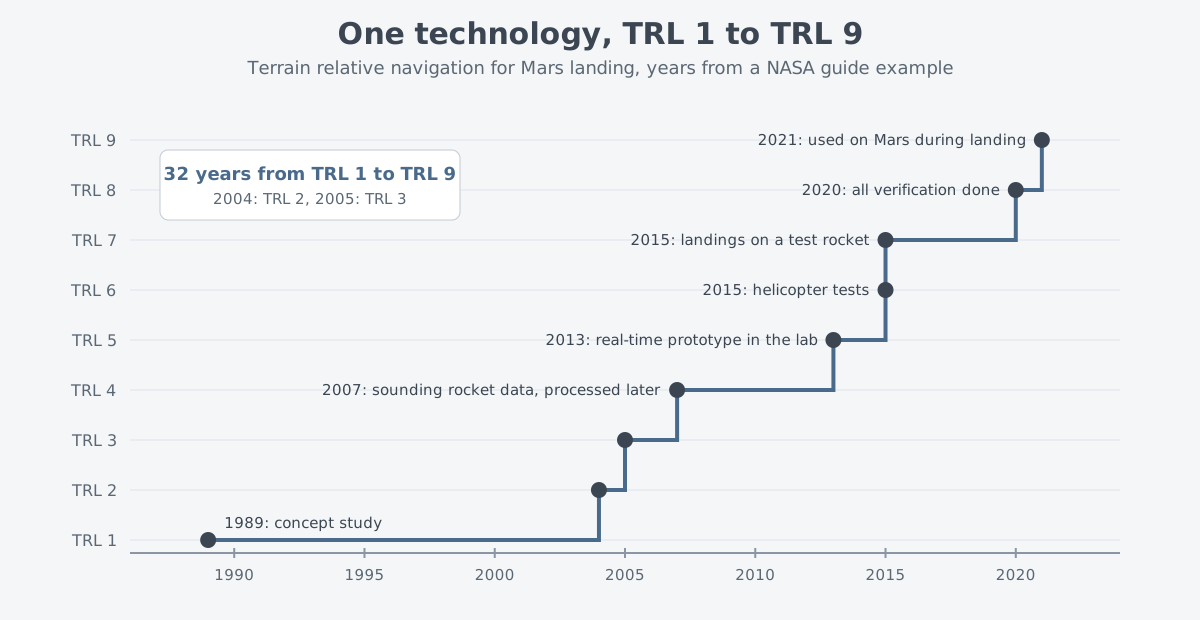
Going from TRL 1 to TRL 9 took 32 years. Of that, the step from TRL 1 to TRL 2 alone took 15 years. TRL 6 and TRL 7, by contrast, came in the same year. The gaps between steps are that uneven.
TRL in the rules
TRL did not stay a word that engineers use among themselves. It moved into the rules. NASA's assessment guide sets a usual bar for flight systems. A technology typically needs TRL 6 or higher, meaning it has been shown to work in a relevant environment, before it goes into one.
U.S. weapons acquisition has a gate called Milestone B. It marks entry into the engineering and manufacturing development phase. It is seen as the official start of a program, the point where large sums and resources get committed.
The 2024 edition of the U.S. Code, at 10 U.S.C. 4252, has the decision authority confirm that certain factors were considered before a major defense acquisition program gets this approval. One of them is that "the technology in the program or subprogram has been demonstrated in a relevant environment." In the DoD TRL table, the phrase "relevant environment" appears in the names of TRL 5 and TRL 6.
European research programs use the same ruler. The European Commission's Horizon 2020 work programme for 2014–2015 listed definitions for TRL 1 to 9 in its general annexes. Whenever a call topic mentions a TRL, these definitions hold unless the topic says otherwise. There, TRL 4 is "technology validated in lab," and TRL 9 is "actual system proven in operational environment."
The names match, but the wording varies a little. Some organizations adjust the TRL definitions to fit their own product development. When comparing a "TRL 6" from two different agencies, it is safer to check first whose table each one used.
What a single number does not tell you
First, a TRL is a snapshot. GAO calls a TRA a point-in-time evaluation. There is no standard rule for how long a rating stays valid. Experts estimate 1 to 6 months, with the type of technology and its pace of change deciding where a rating falls in that range.
Reading a level from an old announcement as today's level can lead you astray.
Second, TRL does not measure whether a program will succeed. A TRA does not put a risk rating on a program or judge whether it can meet its cost, schedule or performance goals. Nor does it remove technology risk. When done well, though, it brings concerns to light and gives a basis for realistic talks on how to handle the risks.
Third, a technology that works and a technology that can be built in quantity are different matters. That is why other rulers exist.
Manufacturing readiness levels (MRL) are a ten-level scale that judges maturity from a manufacturing point of view. Manufacturing readiness often moves at the pace of technology readiness or design stability. The GAO guide also includes tables for integration readiness levels (IRL) and system readiness levels (SRL).
Fourth, the people doing the measuring matter. GAO warns that optimism, which is widespread in acquisition programs, can affect assessment findings or how they are read. A contractor's program managers in particular may be overly optimistic about how mature critical technologies are, especially before a contract is awarded.
Where this meets lasers: how mature the oscillator was
The term also shows up in Korean laser weapon announcements. In a press release, Korea's Defense Acquisition Program Administration (DAPA) said it had built the laser oscillator with domestic technology. The oscillator is the core component of the Cheongwang laser anti-air weapon.
According to the release, the technology was not mature enough when development began and drone threats were growing fast, so an imported oscillator was used during system development. Domestically built oscillators are planned for Cheongwang starting with production units.
The press release gives no TRL number. So it does not tell us which level Cheongwang or its oscillator was at. The program's story continues in Laser weapon programs that have been made public.
Technology maturity also comes up when a program stops. The U.S. Navy decided to pause railgun research and development at the end of 2021. Its reasons were budget limits, the difficulty of fitting the weapon into combat systems, and the prospect that technology for other weapon ideas would mature. That story is in Electromagnetic railguns: launching with electricity.
What to read next
- Simulation versus testing: why CG is not proof: how tests in the lab, a relevant environment and an operational environment differ.
- Laser weapon programs that have been made public: how far public laser weapon programs say they have come.
- Electromagnetic railguns: launching with electricity: how technology maturity came up as a reason in a program that was paused.