Suppose someone quietly gets into a military network and alters the data inside. On another day, the radios on that same network are buried under heavy noise and nothing gets through. Both sound like "communications under attack." The first story belongs closer to cyberspace operations, and the second closer to electronic warfare.
So where is the line between them? This article looks at how the U.S. Department of Defense (DOD) defines each term. It then follows public documents to see where the two part, where they overlap, and why the U.S. military keeps putting them into the same organizations and strategies.
What cyberspace is, and what operations there mean
Under DOD's definition, cyberspace is a worldwide domain that sits inside the information environment. It is made of information technology networks that depend on one another, plus the data stored in them. The internet, phone and data networks, computers, and the processors and controllers built into machines all count.
Cyberspace operations use cyberspace capabilities mainly to reach goals in cyberspace or through it. A primer from the Congressional Research Service (CRS) sorts them into three groups.
- Offensive cyberspace operations: operations that apply force in or through cyberspace. They go through the same approval as physical-domain operations.
- Defensive cyberspace operations: they protect DOD or other friendly cyberspace.
- DODIN operations: they design, build, secure, run and maintain all the networks and communication systems of the DOD Information Network (DODIN).
All three groups point at the same target: networks and the data on them. The stage is computers, the programs inside them, and the links that tie them together.
What electronic warfare competes over
Electronic warfare (EW) works on a different stage. Under the DOD definition, EW means military activity that uses electromagnetic energy to take control of the electromagnetic spectrum and to attack an enemy. Here, the spectrum is simply the range of frequencies electromagnetic energy can take.
EW also has three divisions. Electronic attack turns electromagnetic energy against an enemy, weakening or blocking its access to the spectrum. Electronic protection keeps friendly equipment able to reach the spectrum. Electronic warfare support finds the emissions that friendly and enemy forces give off and catalogues them.
Jamming, which buries a radio under noise, is one form of electronic attack. For more on the three divisions, see Electronic warfare: the invisible contest.
Where they part: a domain and a spectrum
Put the two definitions side by side and the first difference shows. In the official definition, cyberspace is a "domain." It counts as one of the arenas where militaries operate, like land, sea, air and space.
The electromagnetic spectrum is not counted that way. The 2020 DOD Electromagnetic Spectrum Superiority Strategy says the spectrum is not a separate domain of military operations. The reason given is that it cannot be pulled apart from the domains set out in joint doctrine. Instead, the spectrum serves as the critical connective tissue that ties operations in all domains together.
That does not make the spectrum less important. Forces maneuver and operate within the spectrum, just as they do in cyberspace and the physical domains, and gain tactical, operational and strategic advantage there. The statement that EW affects every military domain, from land, sea, air and space to cyberspace, fits the same idea.
Think of a letter. Cyberspace operations deal with what the letter says and with the post office computers that handle it. EW fights over the route the letter travels, the open air that radio waves cross. In reality the split is not this clean: radio waves can carry cyber effects, and official documents give that overlap names of its own.
Where they overlap: cyber effects that travel by radio
The 2020 DOD strategy uses the phrase "RF-enabled cyber." RF stands for radio frequency, so the phrase points to cyber effects delivered by radio. Future spectrum systems need to hold up against the effects of this kind of cyberspace attack.
Among the advanced capabilities wanted for the future, three sit side by side: directed energy, cyber delivered by radio, and spectrum systems that do several jobs at once. Cyber and EW end up in the same list.
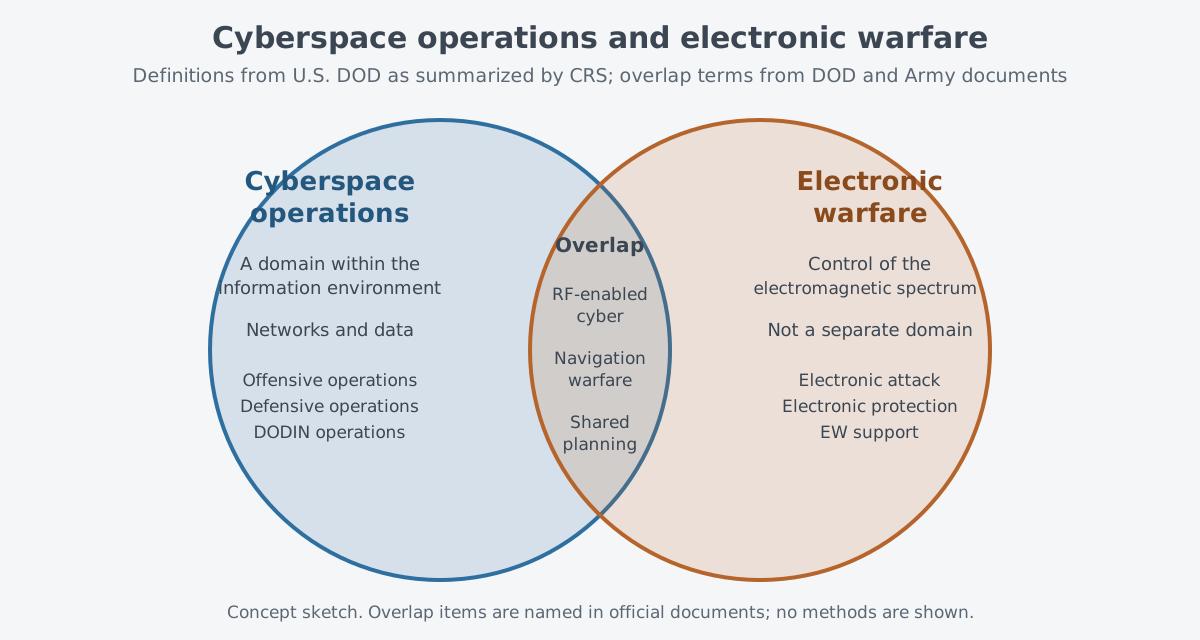
Navigation warfare (NAVWAR) is another example of the overlap. DOD defines it as offensive and defensive action that makes sure friendly forces can use position, navigation and timing information while adversaries cannot. The definition itself names the tools: space, cyberspace and EW capabilities used together. For more on satellite navigation signals, see Jamming and spoofing: interference versus deception.
Official documents also give an example of the two parting. The CRS primer on operations in the information environment lists forms of activity that have nothing to do with cyberspace. Next to dropping leaflets, cultural exchanges and foreign aid, it names jamming. Read that way, jamming on its own is not a cyberspace operation.
Names that grew from one root
The two fields once sat in one bundle. In the earlier joint publication JP 3-13, information operations (IO) rested on five pillars. They were computer network operations (CNO), psychological operations, electronic warfare, operations security and military deception.
Computer network operations covered attack, defense and exploitation. When U.S. Cyber Command arrived, CNO became cyberspace operations and got its own doctrine, JP 3-12. JP 3-13 itself, the publication on information operations, has since been superseded by JP 3-04.
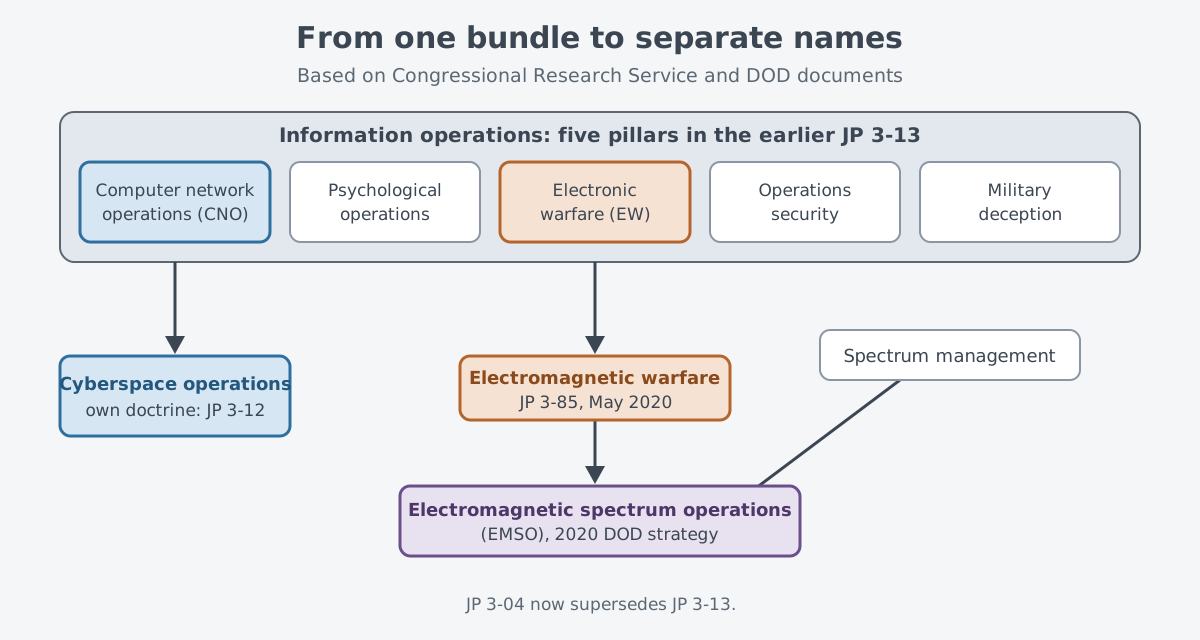
The EW side changed its name too. In May 2020, when DOD released JP 3-85, it changed its doctrinal term: "electronic warfare" became "electromagnetic warfare." Congress still uses "electronic warfare" in legislation, so both names stay in use.
Organizations and strategies that bring them together
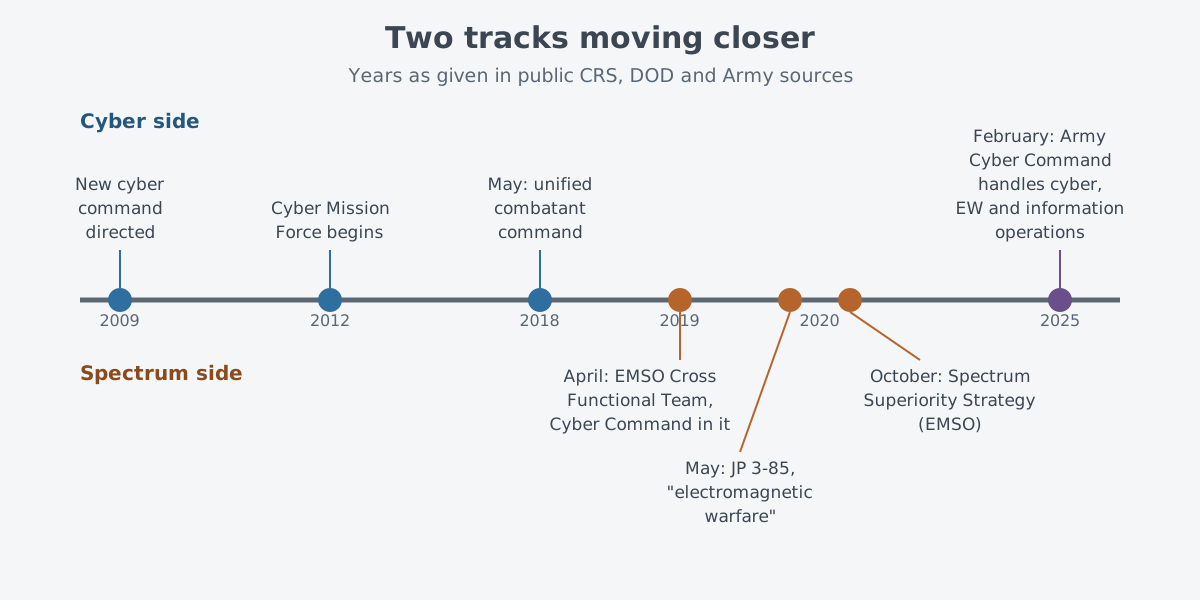
On the cyber side, the story starts in 2009. That year the Secretary of Defense ordered a new military command for cyber activities. DOD began building the Cyber Mission Force in 2012, and that force is made up of 133 teams. In May 2018, U.S. Cyber Command was raised to the status of a unified combatant command.
On the spectrum side, the Electromagnetic Spectrum Operations (EMSO) Cross Functional Team formed in April 2019. Senior members came from each service and the Joint Staff, along with Strategic Command and Cyber Command. The 2020 strategy that followed brought traditional spectrum management and electromagnetic warfare together under the single name EMSO. It also replaced the 2013 spectrum strategy and the 2017 EW strategy.
An EW planning and management tool follows the same line. It helps planners line up EW, spectrum management and cyber operations so they work together. The aim is to put all three on one screen from the planning stage.
In the Army, a single command handles all three. U.S. Army Cyber Command describes itself as a command that brings together and carries out cyberspace operations, information operations and electromagnetic warfare. In a February 2025 Army article, the command said a pilot program was testing ideas such as quickly generating effects delivered by radio.
The legal frame is worth a note as well. DOD policy says the law of war's basic principles apply to cyberspace operations too. Section 954 of the fiscal 2012 National Defense Authorization Act affirms that offensive cyberspace operations follow the same policy principles and legal regimes used for kinetic weapons. Those regimes include the War Powers Resolution and the law of armed conflict.
Where this meets lasers
Lasers sit on the electromagnetic spectrum too. The CRS primer on EW lists the ways militaries use the spectrum. Among them, lasers across the spectrum can carry messages and data, and may even be able to destroy a target. Light is an electromagnetic wave, so laser communication and laser weapons are both part of the spectrum story.
The 2020 DOD strategy, which puts directed energy and cyber delivered by radio in one list, fits the same picture. Cyber, EW and directed energy are different fields, yet each rests on the same question: how to use and protect the spectrum. For what "directed energy" means, see What is a laser weapon? Film versus reality.
What to read next
- Electronic warfare: the invisible contest: the three divisions of EW and the international rules for sharing the spectrum.
- Jamming and spoofing: interference versus deception: the difference between blocking a signal and faking one.
- Lasers and high-power microwaves: two kinds of directed energy: two ways of sending energy from different parts of the spectrum.