On a high ridge in Syria stands a castle called Krak des Chevaliers. UNESCO counts it among the best-preserved castles of the crusader period. The people who spent close to 130 years building it were neither kings nor lords. They were the Hospitallers: knights with horses and swords who had also taken monks' vows of poverty, chastity and obedience.
Why would monks build castles and carry swords? The answer starts with a question the crusaders faced after they took Jerusalem in 1099. The sections below draw on translated sources and UNESCO records. They follow how the Templars, the Hospitallers and the Teutonic Order began, what rules they lived by, and why the three orders went very different ways after 1291.
After the conquest: who would guard it?
In June 1099 the crusaders surrounded Jerusalem. Five weeks later, on 15 July, the city fell. Afterward the crusaders built a large number of fortified castles across the Holy Land to hold their new territories.
Castles did not make the roads safe. Robbers and bandits lay in wait along the routes that pilgrims traveled. Guarding those roads became the first task of the Templars.
This is where a new kind of group appears: the military order. Its brothers took vows like monks and followed a written rule. At the same time, they fought on horseback and moved on the orders of a single leader, the Master.
The Templars: monks who were also knights
The start was tiny. In 1118, a few nobles of knightly rank swore before the Patriarch of Jerusalem to serve Christ. The story comes from the 12th-century chronicler William of Tyre, and the year was added by the editor of the translation. The leaders were Hugh of Payens and Geoffrey of St. Omer.
The Patriarch and the bishops gave them a first task: keep the roads safe from robbers, above all for pilgrims. The king gave them a place to live in the south wing of his palace, near the "Lord's Temple." Because their base sat beside the Temple, they became known as the Brothers of the Militia of the Temple.
The founding story changes from record to record. De Re Militari, a society for medieval military history, gives another version in its introduction. In 1118, under Baldwin II, Hugh, a knight from Champagne, and eight others took a lifelong vow to defend the Christian kingdom. In the chronicle of Ernoul, written after 1187, knights devoted to the Holy Sepulcher tell the king they have decided to choose "a master who may lead us in battle."
Pilgrim roads, defense of the kingdom, a leader in battle: three versions survive side by side.
The first years were quiet. By William's account, the knights wore ordinary secular clothes for nine years, and in that ninth year the group still numbered just nine. That year a council met at Troyes in France and gave them a rule and a white habit.
The year of the council differs by one between sources. The rule itself dates the meeting to the feast of Saint Hilary in 1128, the order's ninth year. The editor of Fordham University's medieval sourcebook and a footnote at De Re Militari both give 1129. This early rule leans heavily on customs the order had already built up over several years.
The person who introduced this unfamiliar group to the wider world was Bernard of Clairvaux, a Cistercian abbot. In the early 12th century he wrote In Praise of the New Knighthood. On the surface it answered a letter from his friend Hugh of Payens. The editor suggests it can be read as a mix of encouragement for the knights and an advertisement aimed at the general public.
Bernard called it "a new kind of knighthood and one unknown to the ages gone by." Men who fight an enemy with bodily strength are common, and monks who fight vice with spiritual strength are everywhere. His point was that these knights fought both wars at once: one against flesh and blood, and one against evil spiritual forces in the heavens.
Two orders that began as hospitals
The second order started with sickbeds, not swords. According to the official history of the Order of Malta, the community of the Hospitallers of St. John goes back to the second half of the 11th century. Merchants from Amalfi, an Italian sea republic, got permission from the Caliph of Egypt to build a church, a convent and a hospital in Jerusalem. The hospital, named after St. John the Baptist, was there to help pilgrims.
On 15 February 1113, a bull from Pope Paschal II recognized the Order of St. John. Between 1145 and 1153, Raymond du Puy wrote its first rule. Members took three vows, of poverty, chastity and obedience, and cared for the poor and the sick.
The sword came later. The constitution of the Kingdom of Jerusalem required the order to defend the sick and pilgrims with arms and to guard its medical centers and main roads. Defense of the faith was then added to the work of the hospital.
The third order had an even more dramatic start. The Teutonic Order's rule opens by going back to 1190, when the Christians were besieging Acre. People from Bremen and Lübeck took pity on the sick and started a hospital under the sail of a ship called a "cog."
They asked Pope Celestine for two borrowed rules. For the care of the sick, they received the Hospital of St. John's rule; for the knights, the Templars' rule. The oldest surviving copy of their rule is a Middle German manuscript from 1264.
Krak des Chevaliers: a fortress on a ridge
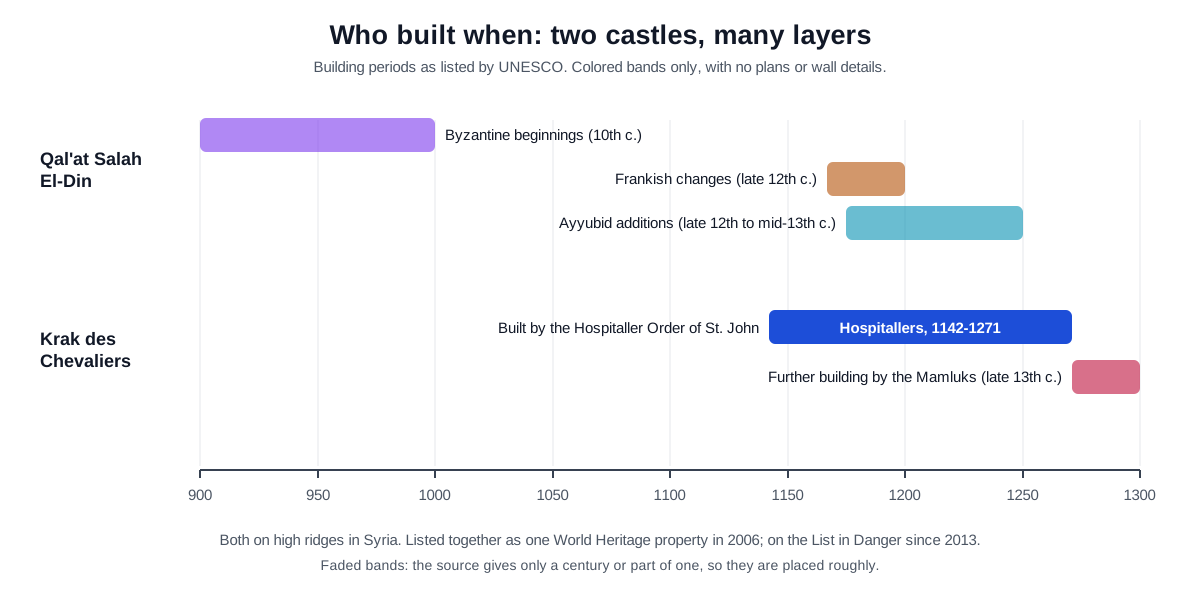
Krak des Chevaliers was built by the Hospitallers from 1142 to 1271. In the late 13th century the Mamluks added more. Two owners' work overlaps in one castle.
In 2006 UNESCO listed it as World Heritage together with another Syrian castle, Qal'at Salah El-Din, the Fortress of Saladin. That castle is partly in ruins but holds even more layers. It began in the Byzantine period in the 10th century, and Frankish builders changed it in the late 12th century. The Ayyubid dynasty then added defenses between the late 12th and mid-13th centuries.
Both castles sit on high ridges that were key defensive positions. UNESCO sees them as a record of how fortified building in the Near East changed through the Byzantine, crusader and Islamic periods. The traces left by each new owner show defensive technology passing back and forth.
So the label "crusader castle" is only half right. These were not buildings that one power put up in one go. They are the result of owners from several eras working on them in turn. The diagram below shows only who worked on each castle and when, as colored bands.
An army run by a written rule
What set a military order apart from an ordinary band of knights was its written rule. The early rule of the Templars grants each knight brother a white cloak for both winter and summer, where possible. Even their clothing was made uniform.
The rule also set out horses and men. Each knight brother was given a squire and three horses. Without the Master's permission, he could keep no more than three. Above all, no brother was to fight or rest as he pleased, but only on the Master's orders.
One more item was added to the clothing later. Under Pope Eugenius, the knights and the lower-ranking brothers began to sew red cloth crosses onto their mantles. As noted above, the Teutonic Order borrowed its knights' rule from the Templars, and the Hospitallers placed a military duty on top of their three vows.
The group grew fast. Writing around 1170–1174, William counted about 300 knights in white mantles, plus other brothers almost too many to count. There was no province of the Christian world that had not given them property, and people said their wealth equaled the treasures of kings.
Growth brought criticism. William wrote that the Templars later lost their humility, broke away from the Patriarch and took church tithes, making themselves very troublesome. Compared with the nine men at the start, they had become a very different body in a little over half a century.
After 1291: three different paths
In the later 13th century, the crusader states fell one by one. In 1271 Sultan Baibars took Montfort Castle. In 1291 the crusader city of Acre fell, ending the era of the Latin crusader kingdoms.
With no land left to defend there, the three orders went separate ways.
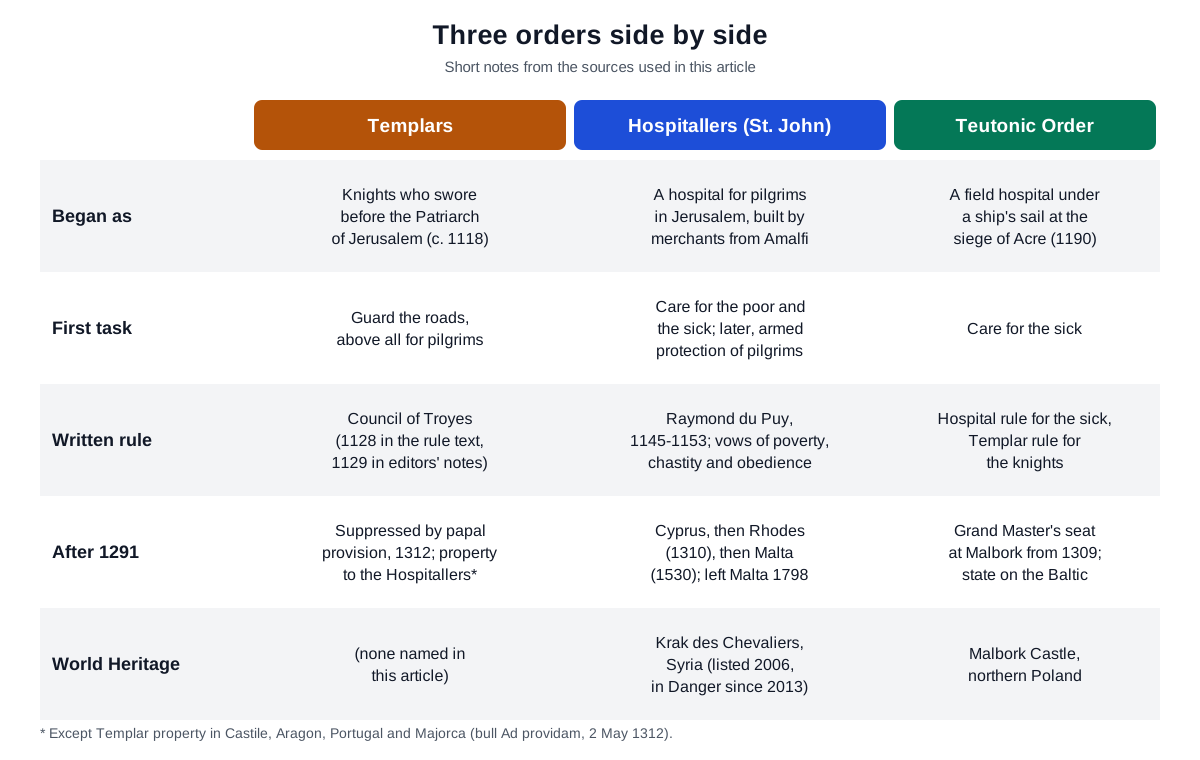
The Templars' end came through the courts. The introduction to the documents of the Council of Vienne, held in 1311–1312, says the complaint against the Templars was the council's first and greatest concern. In the run-up to the council, cases were heard across Europe against the order as a whole and against individual Templars.
In the introduction's reading, King Philip IV of France had great power over Pope Clement V. The pope and the king's envoys made secret deals in February 1312 without consulting the council fathers. Those deals won Philip the order's condemnation.
The king came to Vienne on 20 March, and two days later the pope put the bull Vox in excelso, which suppressed the order, before a commission of cardinals. The bull is dated 22 March 1312.
The wording of the bull is careful. It first admits that the legal process so far does not allow the order to be condemned as heretical by a definitive sentence. It then says the charges of heresy laid against the order had largely ruined its good name. More than four-fifths of the cardinals and council delegates, it adds, preferred suppression by provision of the Apostolic See.
So the pope abolished the order, its rule, its habit and its name "not by definitive sentence, but by apostolic provision."
Where did the property go? The bull Ad providam of 2 May 1312 gave it to the Hospital of St. John instead of creating a new order. It made one exception: Templar holdings in Castile, Aragon, Portugal and Majorca, kingdoms outside France, were left out of this decision.
The Hospitallers took to the sea. After losing Acre, they moved their seat and hospital to Limassol on the island of Cyprus, and the island's position led them to build a fleet to protect pilgrims. In 1307 they landed on Rhodes, and after taking the whole island in 1310 they moved their seat there.
The Rhodes years ended in 1523. After six months of fighting the fleet and army of Sultan Suleiman the Magnificent, the knights left the island. In 1530 they took possession of Malta, granted by Emperor Charles V, and stayed until Napoleon occupied the island in 1798 during his Egyptian campaign.
The Teutonic Order turned north. In 1309 the Grand Master's seat moved from Venice to Malbork, on the River Nogat in northern Poland. According to UNESCO, the Teutonic Order's state was founded in the 13th century and reached its greatest influence in the 14th. It waged crusades against the pagan Prussians and Lithuanians on the south Baltic coast, and against the Christian Kingdom of Poland.
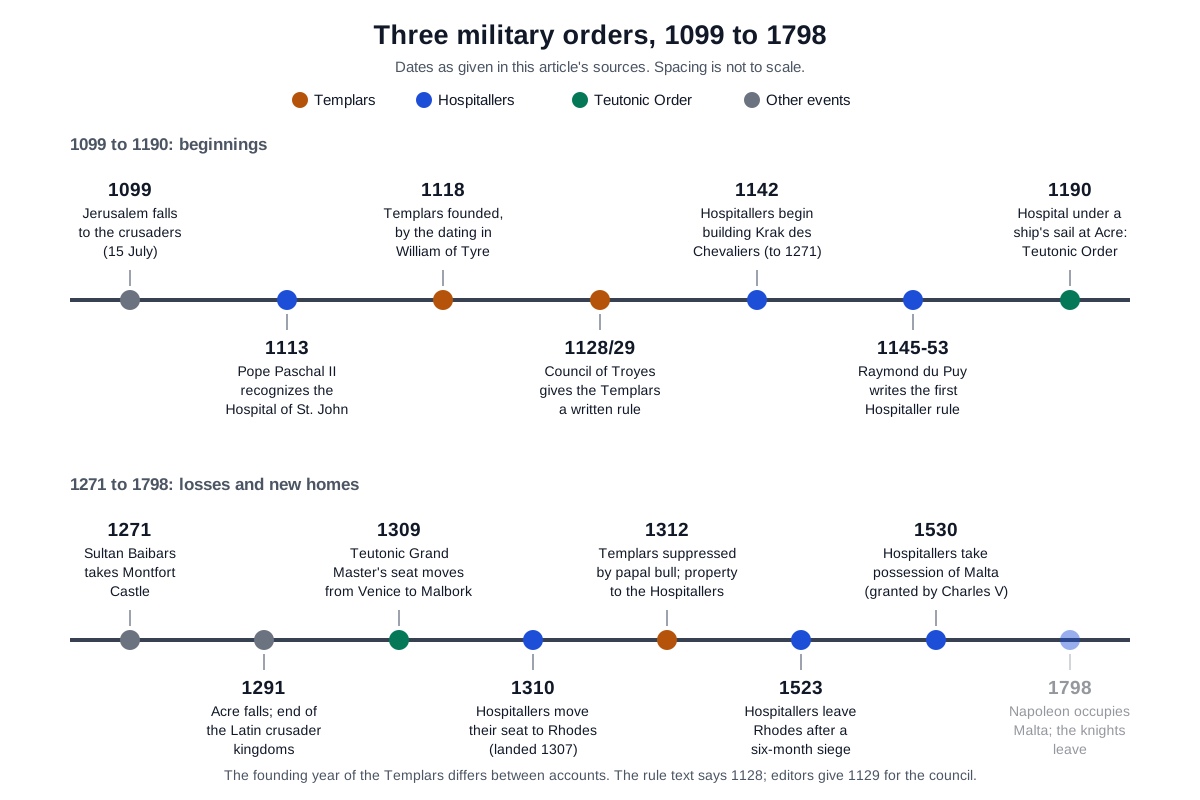
What they left behind
The most visible legacy is stone and brick. UNESCO says Krak des Chevaliers is seen as an archetype of the medieval castle, especially in the context of the military orders. It also judged that the two Syrian castles show a significant development in fortification, quite different from Europe's rather more passive defense systems.
Those castles are now at risk. Both have been on the List of World Heritage in Danger since 2013.
In the north, Malbork Castle was the Teutonic Order's 13th-century fortified monastery, greatly enlarged and decorated after the Grand Master moved there in 1309. It is on the World Heritage List as the most complete example of a Gothic brick castle complex.
The organizations left a trace too. The Templars lost even their name in 1312, but the Hospitallers carried on through Cyprus, Rhodes and Malta. The official site of the Order of Malta tells its own history under the title "11th century to the present day."
An idea also remained. A body bound by vows, a written rule and a single Master was, in Bernard's words, something the ages before had not seen. From a hospital to castles and a fleet, the military orders changed shape a great deal in the space of nearly 200 years.
What to read next
- The First Crusade: Why European Armies Marched to Jerusalem: the road to the fall of Jerusalem in 1099, where this article begins.
- Saladin and the Third Crusade: From Hattin to Arsuf: the late 12th-century war in which the orders also fought.
- Turning points in military technology: how weapons and the organizations around them changed in each era, carried forward into the 20th century and beyond.