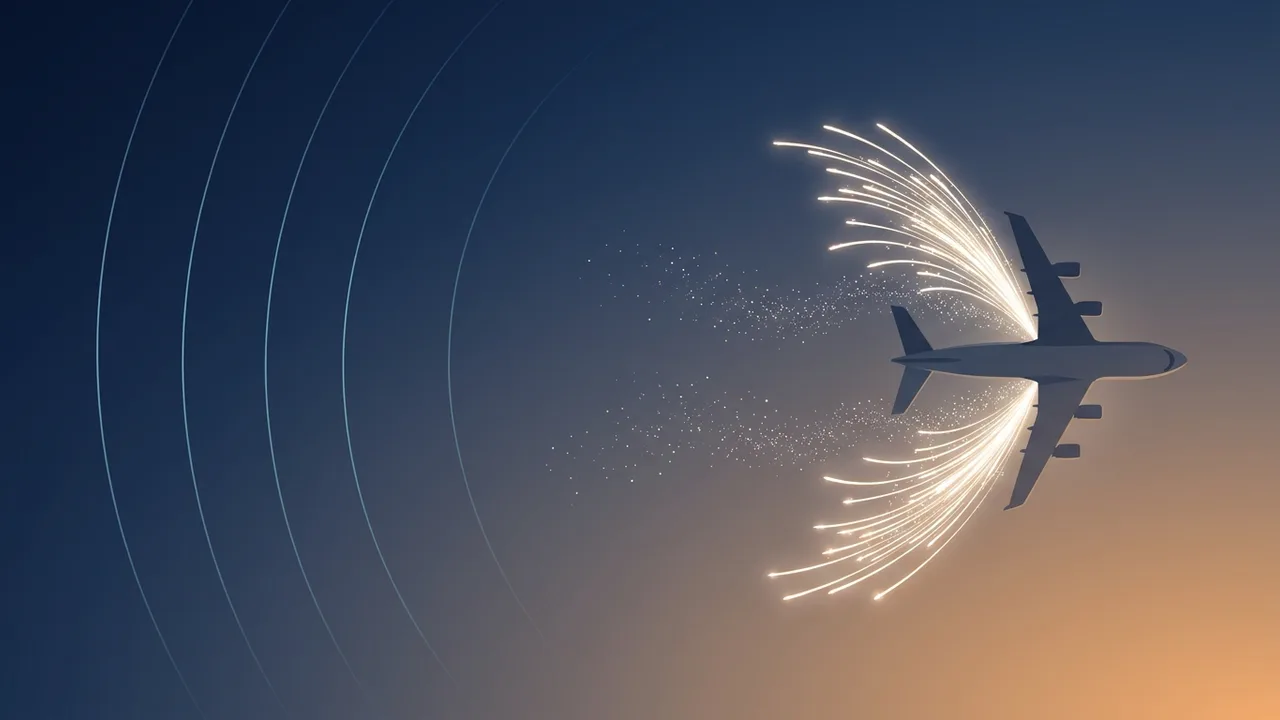
You may have seen it in an air show photo or on the news: sparks fanning out like wings behind a transport plane. Those sparks are flares. A U.S. Air Force article calls them hot, bright and a visual spectacle, yet it is careful to add that they are not ordinary fireworks set off to celebrate.
Flares have a partner that is much harder to see. It is chaff, a spray of thin strands coated with metal and scattered in the air. The two do the same job. They show a fake in place of the real aircraft.
What differs is who they fool. Chaff works against radar, which sees with radio waves, and flares work against infrared seekers, which see heat. How does each one become a decoy, when did they first appear, and what do they leave behind?
Showing a decoy instead of the real thing
Where some people make codes, others try to break them. Aircraft and missiles are no different. One side builds missiles to bring aircraft down, and the other side tries to stop those attacks.
One of the tools on the defending side is expendable countermeasures. These are pyrotechnic and electronic warfare devices that shield aircraft against guided missiles fired from the ground or from other aircraft. Each one is used once. It is released from the aircraft to give the missile a decoy target and steer the missile away from the aircraft, and chaff and flares belong to this group.
The key word is decoy. The goal is not to destroy or block the missile. It is to confuse the signal the missile follows, so that it follows the wrong thing. The wider contest over the electromagnetic spectrum is covered first in Electronic warfare: the invisible contest.
Chaff: thin strands that send radio waves back
To understand chaff, start with how radar sees. A radar sends out radio waves from an antenna and "listens" for where they bounce back. Rain and snow send them back, and so do birds, insects and mountainsides. How the round-trip time gives distance is explained in Radar: measuring distance and motion with radio waves.
Chaff is made of very thin glass fibers with an aluminum coating. Dropped from an airplane, it drifts down and the wind spreads it over a wide area. A 1998 report by the U.S. General Accounting Office (GAO) notes that aircraft are not the only users: warships and ground vehicles also spread chaff to slip past enemy radar.
Why metal? Electrical conductivity is the key. Chaff takes in electromagnetic energy and reflects it, and that is what makes a radar echo. When a great many strands spread out at once, the radar gets many echoes, and it becomes hard to tell which one is the real aircraft.
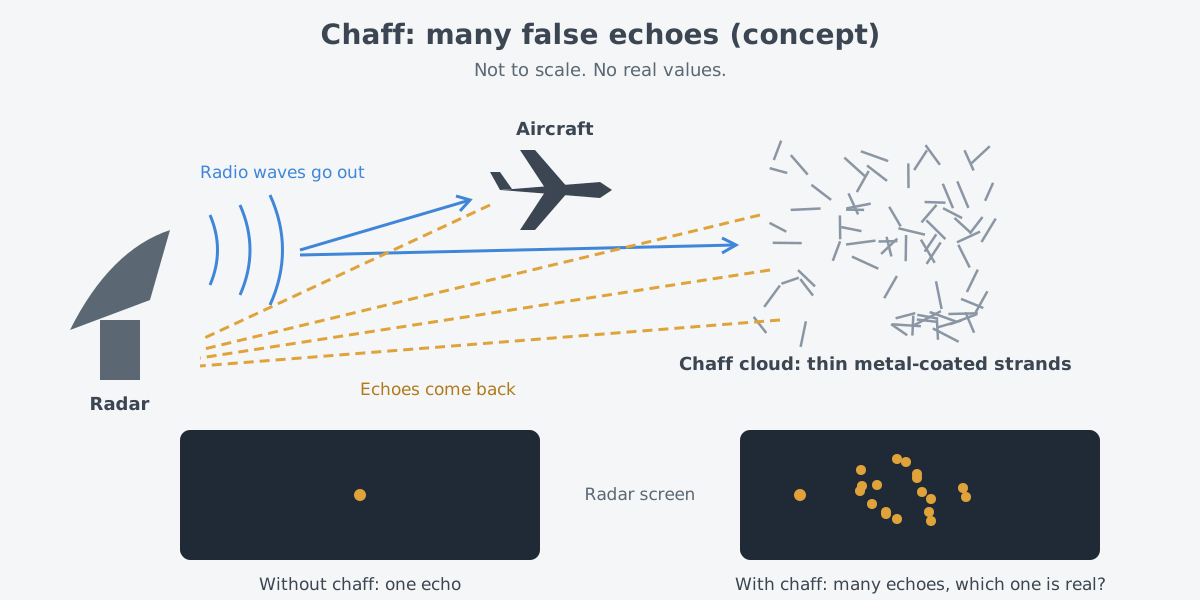
Picture a dark stage lit by a flashlight. Toss a handful of silver glitter into the air, and countless bright points appear, making it hard to find where the actor is standing. Real chaff differs in two ways: it returns radio waves rather than light, and what watches it is a radar receiver rather than a human eye.
The "Window" of World War II
Chaff was born in World War II. Britain and Germany each developed it on their own. The aim was to confuse enemy radar so that aircraft were harder to detect in wartime. The British called it "Window".
A magazine from the Smithsonian National Air and Space Museum tells the story of that time. British scientists tested dropping aluminum strips backed with paper, to bounce and scatter radar signals. The goal was to hide a big formation of bombers from radar. The strips could also fool radar operators into thinking more bombers were coming than there really were.
Yet at first the Allies held back from using this secret countermeasure in combat. They worried the Axis powers would see it and copy it. According to the RAF Museum timeline, RAF Bomber Command first used Window on 24–25 July 1943, when the Battle of Hamburg opened. The timeline calls that first use very successful: of the 700 bombers sent out, only 12 were lost.
In the United States, the Radio Research Laboratory at Harvard University was given the job of building electronic countermeasures to throw off enemy radar and direction-finding gear. One lesson learned there was that the more strips were dropped, the more confused the radar operators became. A single packet could make a radar return as big as a B-17 bomber, which earned the packets the nickname "dehydrated bombers". After Britain began using Window in July 1943, the United States soon followed under the name "chaff", and in all it made close to 13 million pounds of it.
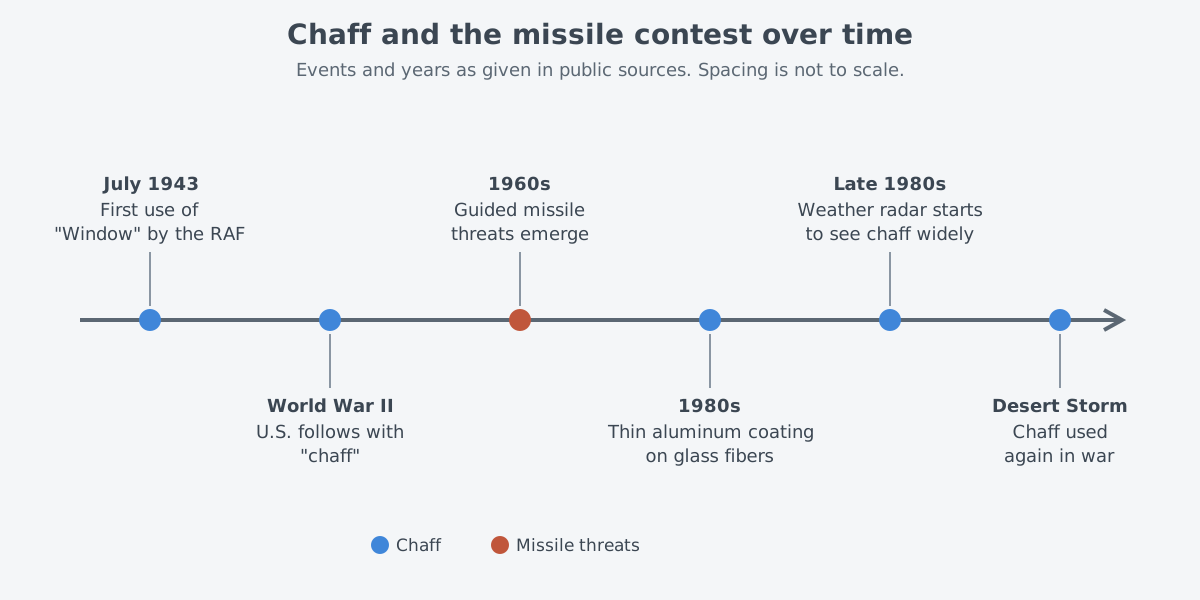
Chaff stayed in use. By 1998 the military had used it for more than 50 years, including in Operation Desert Storm, the Gulf War. It is also used in peacetime weapons training and testing.
The material changed as well. In the 1980s, solid aluminum gave way to hair-thin glass fibers wearing only a light skin of aluminum, which made chaff even cheaper.
Chaff on the weather radar
On April 22, 2016, the U.S. National Weather Service (NWS) office in Wilmington, North Carolina, got a phone call. A man watching the radar on his phone asked how much rain was due in the next hour.
The office's answer surprised him: "No rain at all!" What looked like rain on the screen was chaff.
On a reflectivity image, chaff can look much like rain. On some of the images from dual-polarization radar, though, it looks very different. One of these is the correlation coefficient. It shows how alike in shape the objects in the radar beam are.
Raindrops in the air are nearly round and much the same in shape, so their correlation coefficient is high, 0.97–0.99. Hail is lumpy, so it reads lower, 0.8–0.9. Chaff strands spin and flip on the way down, showing the radar many different cross sections, so they drop below 0.60. Using this difference, the MRMS system, which combines data from many radars, removed the chaff automatically because it does not come from the weather.
Because of military training offshore, forecasters at the Wilmington office spot chaff off Cape Fear dozens of times each year. The National Weather Service began to notice chaff often and over wide areas toward the end of the 1980s, when its newer and more sensitive weather radars came into service. Radar shows that a chaff cloud can stretch across several hundred miles and stay aloft for as long as a day.
Korean weather radar sees the same thing. The raw reflectivity data from the radars of the Korea Meteorological Administration's weather radar center holds not only weather echoes but also ground clutter, sea clutter and chaff echoes.
Flares: a light hotter than the engine
What flares deal with is infrared light. Infrared is part of the electromagnetic spectrum: the eye cannot see it, but the body feels it as heat. Its wavelength is longer than that of visible light. How light changes with wavelength is covered first in Why wavelength matters: visible and invisible light.
Warm objects give off infrared light. Things that are not very hot, such as people, give off only infrared, while very hot things, such as a fire, also give off visible light. That is why night-vision goggles and infrared cameras can "see" the infrared coming from people and animals.
An infrared seeker uses this. It finds and follows the heat signature a target gives off by itself. On an aircraft, the hot engine gives off that kind of signal.
Flares protect the aircraft by making heat-seeking missiles, whether fired from the ground or from the air, lock onto the flare's heat instead of the engine's. Besides the engine, there is now one more object giving off a heat signal.
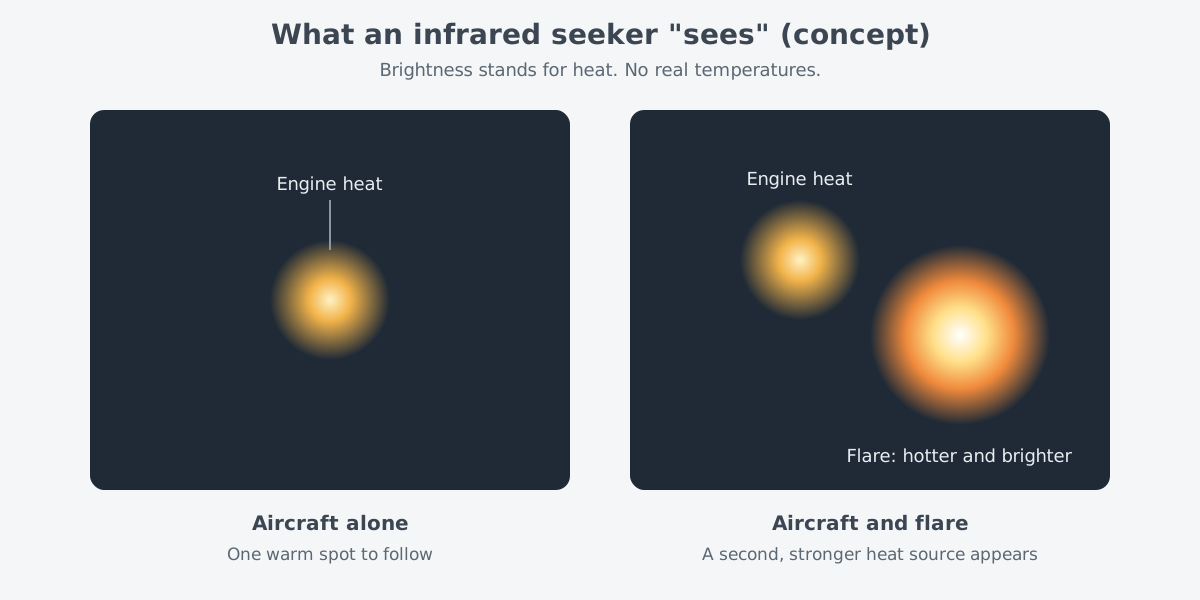
Imagine walking at night toward a campfire far away. If a brighter torch suddenly flares up right beside it, for a moment you are not sure which light you were watching. A real seeker differs: it is an infrared sensor, not a human eye, and each missile is built to look for different things.
A tug-of-war that never ends
Missile makers do not stand still either. A U.S. Army article traces guided missile threats back to the 1960s and calls what followed a technical tug-of-war among aircraft makers, missile makers and survivability experts. When a missile is built to seek heat, hotter flares answer it. When a missile is built to seek some other feature of an aircraft in flight, a countermeasure that imitates that feature follows.
The way countermeasures are tested has changed too. Before powerful computers were common, the main method was to fly a real aircraft, let real missile hardware track it, release the countermeasures and watch how the missile reacted. That was costly, took a lot of work and used up time. Today, missiles can be modeled in software, or real hardware can be used, and set against digital models of the countermeasures.
What is left behind: safety and the environment
The decoys do not stay on the battlefield. Chaff can become a safety issue when it gets in the way of the radar that air traffic controllers use. The 1998 GAO report cites an Air Force report: chaff had disturbed radar of the Federal Aviation Administration (FAA) at least twice, though such cases could be avoided or managed. Weather radar observations and friendly radar can also be affected, especially when passing vehicles throw settled chaff back into the air.
Most public worries center on health and the environment. They include the chance that people breathe in or swallow chaff particles, and what it does to soil, water, plants and wildlife. Around the time of that report, the U.S. Navy had started work on chaff that breaks down. It was estimated to cost about 40% more than the chaff then in use.
What to read next
- Electronic warfare: the invisible contest: the bigger picture that chaff and flares sit in, the contest over the electromagnetic spectrum.
- Radar: measuring distance and motion with radio waves: what the radar that chaff fools actually measures with radio waves.
- Why wavelength matters: visible and invisible light: what kind of light the infrared from a flare is.
- Missile seekers: the eye at the front: the missile seekers that flares and chaff are up against.