On 7 April 1945, Yamato, the largest battleship ever built, went down while still over 300 nautical miles short of Okinawa. 390 aircraft from American carriers had attacked her. The American cost was 10 planes and 12 airmen.
Thirty-five years earlier, an airplane at sea meant a wooden platform bolted onto a cruiser's bow. In between, the center of naval power moved from the big-gun battleship to the ship that launches aircraft. What drove that change, and did the battleship really lose its use? Treaty texts, ship histories and the public record of naval exercises and battles trace the path.
When the battleship ruled
Between the two world wars, the big navies still treated the battleship as the fist of the fleet. Lines of heavily armored, big-gun ships would meet and decide the war.
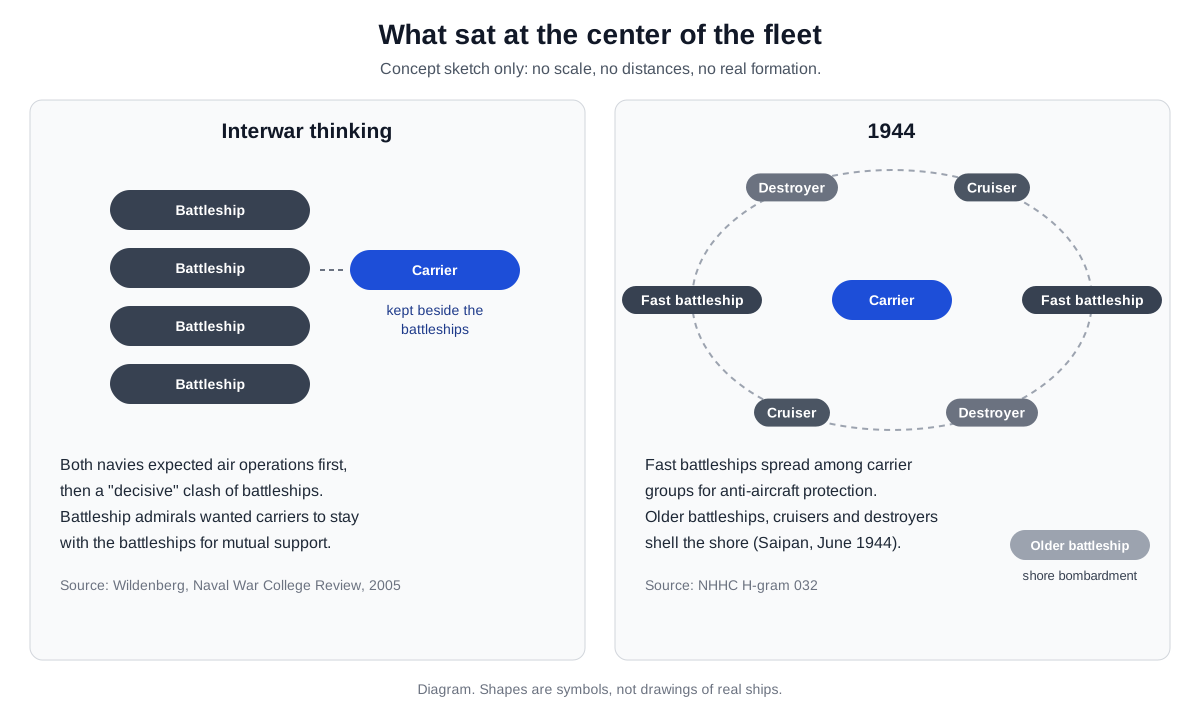
Thomas Wildenberg made this point in a 2005 article in the Naval War College Review. Like the Americans, he writes, the Japanese expected air operations to come first. A "decisive" clash of battleships would follow and settle the next war.
Carrier task forces were by then a routine feature of US exercises. Even so, the Navy's battleship admirals wanted carriers kept beside the battleships so each could protect the other. Naval aviators saw it the other way. Being tied to slow battleships was deadly for a carrier, they argued, and high-speed evasion was its best defense.
Some minds did change. Admiral William Sims was at first slow to welcome naval aviation, especially ships that carried aircraft. Such ships, he said, could not attack a foreign country without the support of a battleship force stronger than the enemy's.
His thinking shifted deeply after he took over the Naval War College at Newport. He saw bombing tests at sea off Virginia in 1921, and by March 1922 he had written that "the battleship is dead."
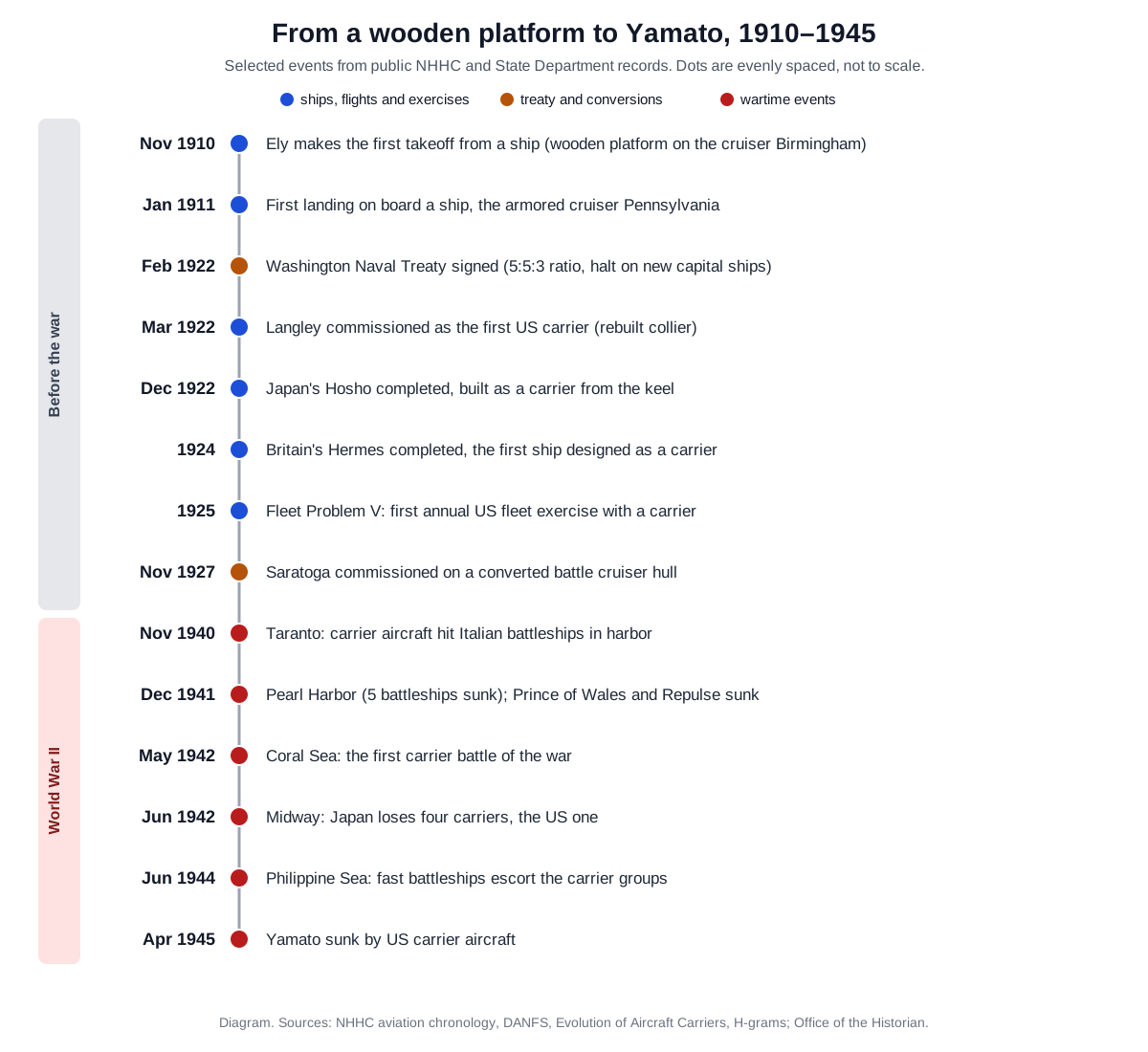
The first planes on ships, and the first carriers
On 14 November 1910, civilian exhibition pilot Eugene Ely took off from a sloping wooden ramp, 83 feet long, fixed to the bow of the US cruiser Birmingham. It is the first recorded takeoff from a ship. Two months later, on 18 January 1911, he landed on a specially built 130-by-32-foot platform on the stern of the armored cruiser Pennsylvania, then took off again. The Naval History and Heritage Command (NHHC) aviation chronology records this as the earliest demonstration that aircraft could work from ships.
So which ship was the first aircraft carrier? It depends on what counts as "first." Britain's Argus, designed as an Italian liner and given a flat deck, is seen by most historians as the first true carrier.
Britain's Hermes was the world's first ship planned as a carrier from the start, and she was finished in 1924. Japan's Hosho, also built as a carrier from her keel, was finished earlier, in December 1922.
The first US carrier, Langley, was a rebuilt collier named Jupiter. Her conversion was approved on 11 July 1919, and she was recommissioned as a carrier on 20 March 1922. A 534-foot flight deck went on top of her old bridge, and a catapult was fitted at the bow. Tests with wires to catch landing aircraft were also run on her, and they led to Langley's arresting gear.
Langley was a test ship for the carrier as a type. She launched her first plane while at anchor on 17 October 1922 and took her first landing while underway on 26 October. Ely's platform supported a single test, while Langley was a ship for testing launches and landings again and again.
Carriers made by a treaty
In 1921–1922 the leading naval powers of the day met in Washington to discuss naval disarmament. The United States, Britain, Japan, France and Italy signed the Five-Power Treaty. It set a tonnage ratio for each country.
The State Department historian's summary gives 500,000 tons each for the United States and Britain, 300,000 tons for Japan, and 175,000 tons each for France and Italy. This is the familiar 5:5:3 ratio. The treaty also told all five to halt work on new capital ships and to cut their fleets by scrapping older ones.
Not every class of ship was limited, though. A new race to build cruisers began after 1922, and the five nations went back to the table in 1927 and 1930.
The treaty was signed on 6 February 1922. In the United States, the keels of two of the battle cruisers bound for scrapping under the treaty had already been laid. A clause let them be converted into carriers, each limited to 33,000 tons, with 3,000 tons more allowed for protective armor.
Brand-new carriers were held to 27,000 tons, but Japan and the United States could each go past that by converting two unfinished battle cruisers. This clause is why both navies planned two 33,000-ton carriers apiece.
Saratoga is one example. She was laid down as a battle cruiser on 25 September 1920. On 1 July 1922 she was ordered converted to a carrier under the Washington Treaty, and she was commissioned on 16 November 1927.
Her sister Lexington was also a converted battle cruiser hull. In Japan, Akagi was a converted battle cruiser and Kaga a converted battleship.
The treaty also capped total carrier tonnage. Lexington and Saratoga used 66,000 tons of the US share.
Ranger, Yorktown and Enterprise then took their part of what was left. Wasp had to squeeze into the remainder of the 135,000-ton cap, and she entered service at 14,700 tons. After that, only a few hundred tons of treaty carrier tonnage remained.
Ideas that grew in the war games
How to use carriers was worked out in exercises at sea. Fleet Problem V in 1925 was the first of the US Navy's annual exercises to include an aircraft carrier. Langley was small and her crew was still learning, so she could put no more than ten planes in the air at once. Even so, after the exercise the fleet commander recommended finishing Lexington and Saratoga quickly.
On 17 May 1928, a joint Army-Navy exercise tested the defenses of Hawaii. Starting at 4:30 am, Langley launched 35 aircraft and caught the defenders of Wheeler Field and other sites on Oahu fully by surprise. The Army commander in Hawaii watched the attack and acknowledged that aviation mattered for the defense of the islands.
Ways to handle more planes on a small deck came out of this period too. At first Langley followed British procedure: the deck had to be clear for each landing, and each plane was struck below as soon as it landed.
Under Joseph Reeves, Langley's crew came up with the deck park, where planes were kept on the flight deck. They also devised the crash barrier and flight-deck teams marked by colored jerseys. A June 1925 report says her emergency barricade kept landing planes from running into aircraft parked on deck.
1940–1941: battleships struck from the air
On the evening of 11 November 1940, 21 old Swordfish biplanes rose from the British carrier Illustrious. Their target was Italian warships anchored in the harbor of Taranto, Italy, and reconnaissance two days earlier had confirmed that all of Italy's battleships were there. In the National WWII Museum's account, two small attacks cost two planes, badly damaged the battleships Littorio, Caio Duilio and Conte di Cavour, and caused almost 700 casualties.
NHHC's series "Evolution of Aircraft Carriers" calls it the first carrier strike in wartime history to succeed. It quotes Churchill's view that this single blow decisively shifted the naval balance in the Mediterranean. The US Navy studied the attack closely, and there were proposals to put torpedo nets at Pearl Harbor. Japanese planners studied Taranto as well.
On 7 December 1941, 353 aircraft from six Japanese carriers struck the US Pacific Fleet at Pearl Harbor and nearby airfields and bases in two waves. Five battleships were sunk and three damaged. By the NHHC overview's count, more than 2,400 people were killed or went missing that day. They were sailors, Marines and soldiers (2,008 Navy, 109 Marine Corps, 218 Army) and 68 civilians, and more than 1,100 others were wounded.
No American carrier was in Pearl Harbor that day. The NHHC overview notes that the carriers happened to be away and escaped damage, and that in the months that followed they proved crucial alongside cruisers, destroyers and fleet oilers. Three days later, on 10 December, the British battleship Prince of Wales and the battle cruiser Repulse were sunk by Japanese aircraft. After the US battleships at Pearl Harbor, two British capital ships had also fallen to air attack.
1942: carrier against carrier
On 7–8 May 1942, carriers fought carriers for the first time in this war, in the Coral Sea. A month later at Midway, the United States lost one carrier and Japan lost four, all four of them veterans of the Pearl Harbor attack. The NHHC overview marks this as the moment the Pacific naval balance started to tip.
In that battle the Japanese and American ships were 50–150 miles apart. At that range, what struck the enemy was not naval gunfire but aircraft launched from flight decks. It looked nothing like a line of battleships trading salvos.
Wildenberg sees Midway as the final phase of a revolution in military affairs in which the carrier replaced the battleship as the deciding factor in naval supremacy. He reads it as the high point of a technical shift: carrier aircraft, not guns, became the main way to bring bombs and torpedoes to bear at sea. The same article concludes that better doctrine is what finally won the battle for the Americans, and that the victory changed the course of the Pacific war.
The shipyard gap and the end of Yamato
When World War II began, the United States had seven carriers (Langley, by then a seaplane tender, is not counted). Japan started with 10, but only six were big "fleet" carriers on a par with the American ships. During the war the United States put into service 17 Essex-class carriers, 9 Independence-class light carriers whose hulls began as light cruisers, and more than 100 small, slow escort carriers.
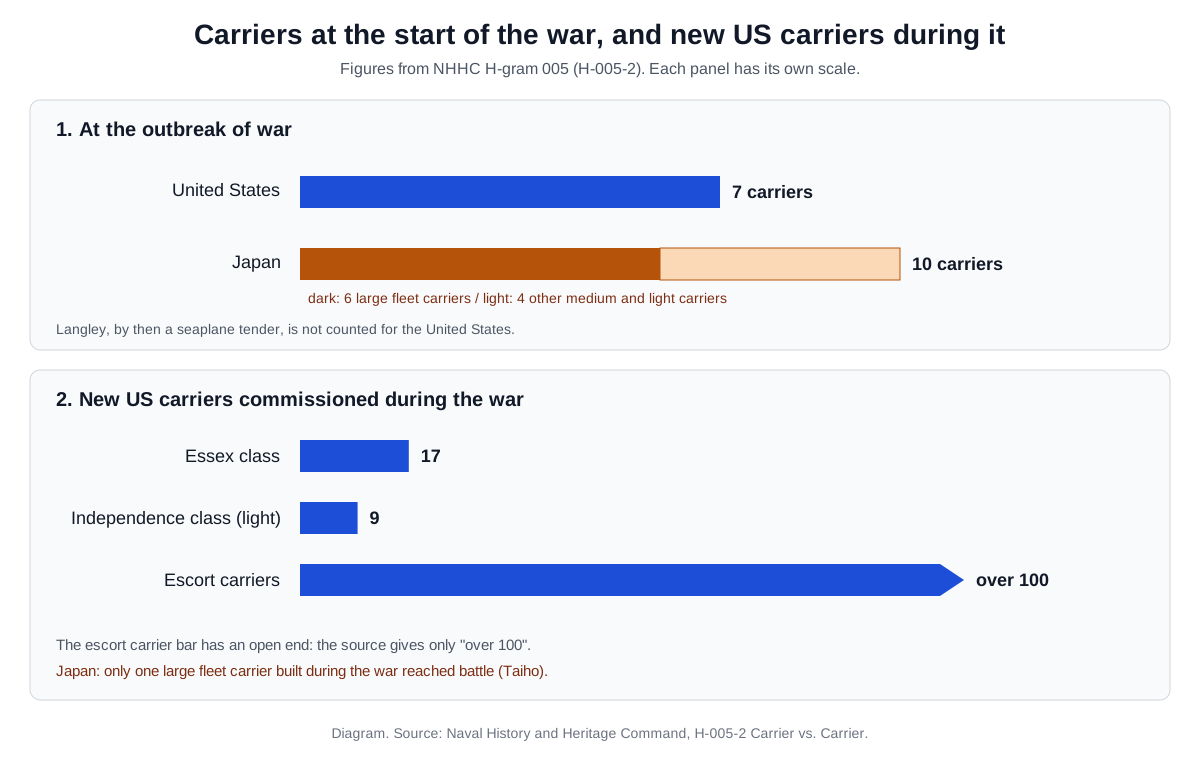
An NHHC H-gram explains this gap as American shipbuilding capacity that Japan could not match, partly because US submarines sank the Japanese cargo ships that carried vital raw materials. During the war Japan produced only one large fleet carrier that reached battle, Taiho. Shinano, rebuilt from the third hull of the Yamato class, was sunk by a US submarine in November 1944, before her sea trials had even started.
The battleship's place inside the fleet changed too. Around the Battle of the Philippine Sea in June 1944, the US fast battleships were at first spread across the carrier task groups to help defend them against air attack. When a fleet action looked near, all seven were gathered into a task group of their own. The shore bombardment of Saipan that began on 13 June that month was opened by the fast battleships, and older battleships then took it over with cruisers and destroyers.
Yamato in April 1945 stands at the end of this road. She and her sister Musashi displaced 65,000 tons, or 72,000 tons at full load, which made them the biggest battleships anyone has built. Accounts of her crew differ, but the H-gram says the most definitive figure appears to be 3,055 lost out of 3,332. Counting the ships that sailed with her, about 4,242 Japanese sailors died that day.
Did the battleship disappear?
Sims's line that "the battleship is dead" dates from 1922. Yet battleships did not vanish from the sea right away. In the 1944 US fleet, fast battleships were spread across the carrier task groups to guard the sky or shelled the shore, as at Saipan. The ship that had been the fist of the fleet took on the work of guarding carriers and shelling coasts.
What changed was more than the ranking of one ship type. Think of the wooden platform of 1910, the treaty clause of 1922, the exercises of 1925 and 1928, and small deck inventions like the deck park. One by one, they built up into the carrier battles of 1942. Wildenberg's explanation of the Midway victory as "better doctrine" points the same way.
Today's carriers still stand on that base. Langley's crew came up with the deck park and the flight-deck teams in colored jerseys, and the catapult and arresting gear were tested on her too. Other articles on this site explain how those devices work.
What to read next
- Aircraft carriers: turning a ship into an airport: the flight deck, hangar and colored-jersey teams that grew from Langley's deck, seen on today's carriers.
- Carrier catapults and EMALS: taking off from a short deck: how the catapult, one of which was also fitted to Langley's bow, works.
- Arresting gear: stopping a jet on deck: the principle behind catching an aircraft with a wire.
- Turning points in military technology: moments that changed military technology, laid out on a timeline, ending with where laser weapons fit.
- The Battle of Midway: Codebreaking and Four Carriers: how one day of carrier against carrier unfolded.
- The Battle of Jutland: The One Clash of the Dreadnought Fleets: the World War I battle between battleship fleets, before the carrier.