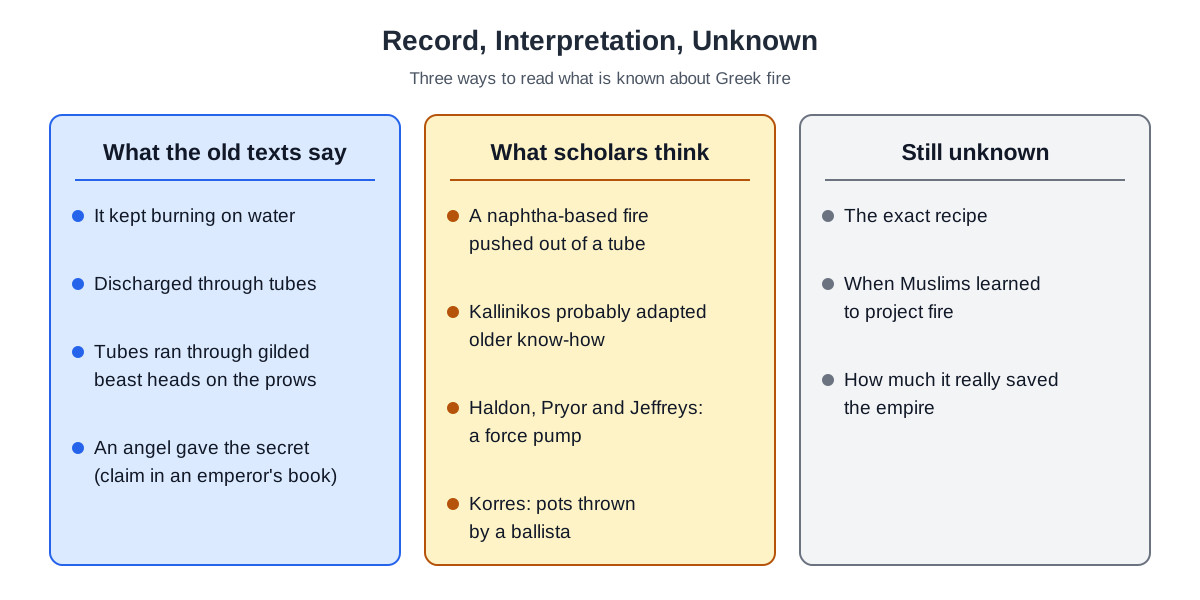
Around the time of the First Crusade, the Byzantine emperor Alexios readied ships to meet a fleet from Pisa. On the prow of each he fixed the open-mouthed head of a lion or another beast, made of brass or iron and gilded over. The fire meant for the enemy was sent through tubes and out of the beasts' mouths. In the Alexiad, Anna Comnena wrote that it looked as if the lions and other monsters were vomiting fire.
This fire is usually called "Greek fire." In Byzantine terms, a more exact name is "liquid fire." What was this weapon, and why has it never been fully explained? This article follows it through the old texts, keeping them apart from what museums and scholars say.
A fire that burned on water
Greek fire was a weapon the Byzantine Empire used in naval warfare. In the words of Royal Museums Greenwich, it worked because it went on burning on water.
The old texts quoted here call the Byzantines and their forces "Romans." The Prosopography of the Byzantine Empire (PBE), a database at King's College London, draws on Theophanes and other writers to give the weapon the name "sea fire" (πῦρ θαλάσσιον).
When scholars say "Greek fire," they mean something narrow. It is a naphtha-based incendiary, a substance that starts fires, pushed out of a tube. They keep it apart from the many other incendiary weapons used in war. Not every "fire" in an old text is Greek fire.
The man from Heliopolis: Kallinikos
The name tied to its making is Kallinikos (Callinicus in Latin form). Royal Museums Greenwich names Callinicus of Heliopolis, an architect, as its maker, in the reign of the emperor Constantine known as Pogonatus.
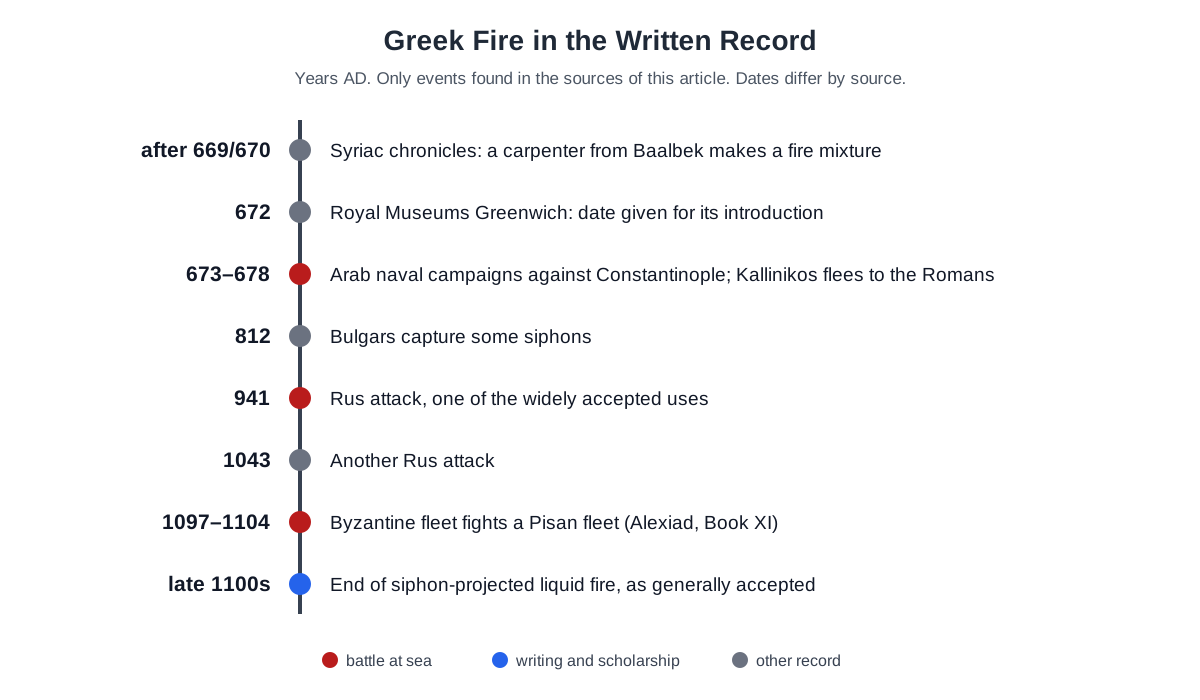
The date differs by source: Royal Museums Greenwich gives 672 as the year it was introduced. The PBE lists Kallinikos as an architect from Heliopolis in Syria. It says he fled to the Romans during the Arab naval campaigns against Constantinople (673/678). There he prepared a fiery substance that burned the Arab ships and the men on them.
The Syriac chronicles cited in the same entry tell it a little differently. They speak of a carpenter from Baalbek who made a fire mixture, after 669/670.
Even in the PBE, he is only "perhaps" the inventor. Some scholars think his part has been overstated. Fire weapons had a long history before him, and he probably adapted existing know-how rather than creating something new.
Battles in the record
Scholars widely accept a few uses: the sieges of Constantinople by the Arabs, and the attacks by the Rus in 941 and 1043. The first chapter of a book by Karatolios lists these cases, and a review in the web magazine of a society for medieval military history sums them up. How much detail survives differs from one fight to the next.
The Pisan scene at the top of this article is in Book XI of the Alexiad. The English translation that Fordham University puts online titles this book "The First Crusade (1097–1104)."
In Anna Comnena's account, the Franks, moving from Jerusalem against the Syrian cities, offered the bishop of Pisa a large reward for his help. He got two other men living on the coast to join in, and set out with many kinds of fast ships. Anna Comnena puts the number at 900. It is a number from an old text, so it is better read as what the record says than as a firm fact.
On hearing this, the emperor had every land under his rule furnish ships, and had more built in the capital. The Byzantine ships avoided a regular sea battle and made swift, irregular attacks. The Pisans fled, shaken by a fire they were not used to and by a sudden squall.
What about land? Karatolios, in his book, holds that Greek fire played no part in open-field battles; on land, it appears in siege warfare.
Views also differ on when the weapon disappeared. Scholars generally hold that siphon-projected liquid fire went out of use in the late twelfth century. Royal Museums Greenwich, on the other hand, says it was used in campaigns up to the thirteenth century.
Tubes and prows: what the record shows
The Alexiad says the fire meant for the enemy came out through "tubes." Royal Museums Greenwich also explains that siphons filled with the mixture were mounted at the front of galleys.
The Alexiad also gives the reason for the beast heads. The emperor knew the Pisans were skilled at sea and feared a battle with them. So he wanted the ships to look frightening by their looks alone.
What startled the Pisans was the direction of the fire. Fire naturally burns upward, but this fire went wherever the sender wished, often down or to the side. A strange device and a strange fire frightened them together.
That does not mean the weapon always worked. In the fight with the Pisans, the fleet commander Landulph closed in on the enemy and threw fire, but missed and only wasted it.
An angel's charge and a state secret
The Byzantine Studies Program at Dumbarton Oaks notes that this fire is generally considered the "secret weapon" of the Byzantine Empire. The Byzantine side left a story about where that secret came from.
De Administrando Imperio, by the emperor Constantine Porphyrogennetos, claims that an angel gave Constantine I, the first Christian emperor, the secret of how the fire was mixed. Karatolios's book includes this work in its list of sources on Greek fire.
This passage cannot be read as plain history. For Karatolios, its worth lies in what it shows about how the Byzantine ruling class saw its own weapon, and the reviewer finds the case convincing. A story that credits an angel tells us less about the weapon than about how people saw it.
Was the secret perfect? Muslims, too, came at some point to have a way to project fire, though just when is not clear. The Persians knew naphtha, but there is no sign that they had the Byzantine way of shooting it out. And, as with the few siphons the Bulgars captured in 812, the record shows the equipment falling into enemy hands.
What is still unknown
The biggest gap is the recipe. Its exact makeup is still a mystery. The main ingredient is only believed to be naphtha or petroleum.
Scholars also disagree on how it was projected. John Haldon, John Pryor, and Elizabeth Jeffreys argue for a force pump that pushed it out under pressure. Korres proposed a very different idea, in which the siphon was part of a ballista that threw pots of fire, but those scholars do not accept it.
There have been tests, too. Haldon published the results of experiments that built a liquid fire projector in a 2006 article. That same year, the Byzantine Studies Program at Dumbarton Oaks held a public lecture on the subject with Georgetown University's Department of Medieval Studies. Its notice said competing theories keep appearing but recent hands-on tests have settled many questions.
One question in that notice is still open. Did this fire really save the empire from the Arab conquests of the seventh and eighth centuries?
What the fire did is on record; what it was made of, and how, is not. For a study of how a guarded technology was lost, there is Alex Roland's 1992 article "Secrecy, Technology, and War: Greek Fire and the Defence of Byzantium, 678-1204."
What to read next
- Turning Points in Military Technology: how new weapon technologies changed the shape of war, with modern examples.
- A History of Laser Weapons: how weapons that drew their power from chemical reactions moved on in our own time.
- The Fourth Crusade: The Expedition That Took Constantinople Instead: the Byzantine Empire in the 12th and 13th centuries, near the end of this story.