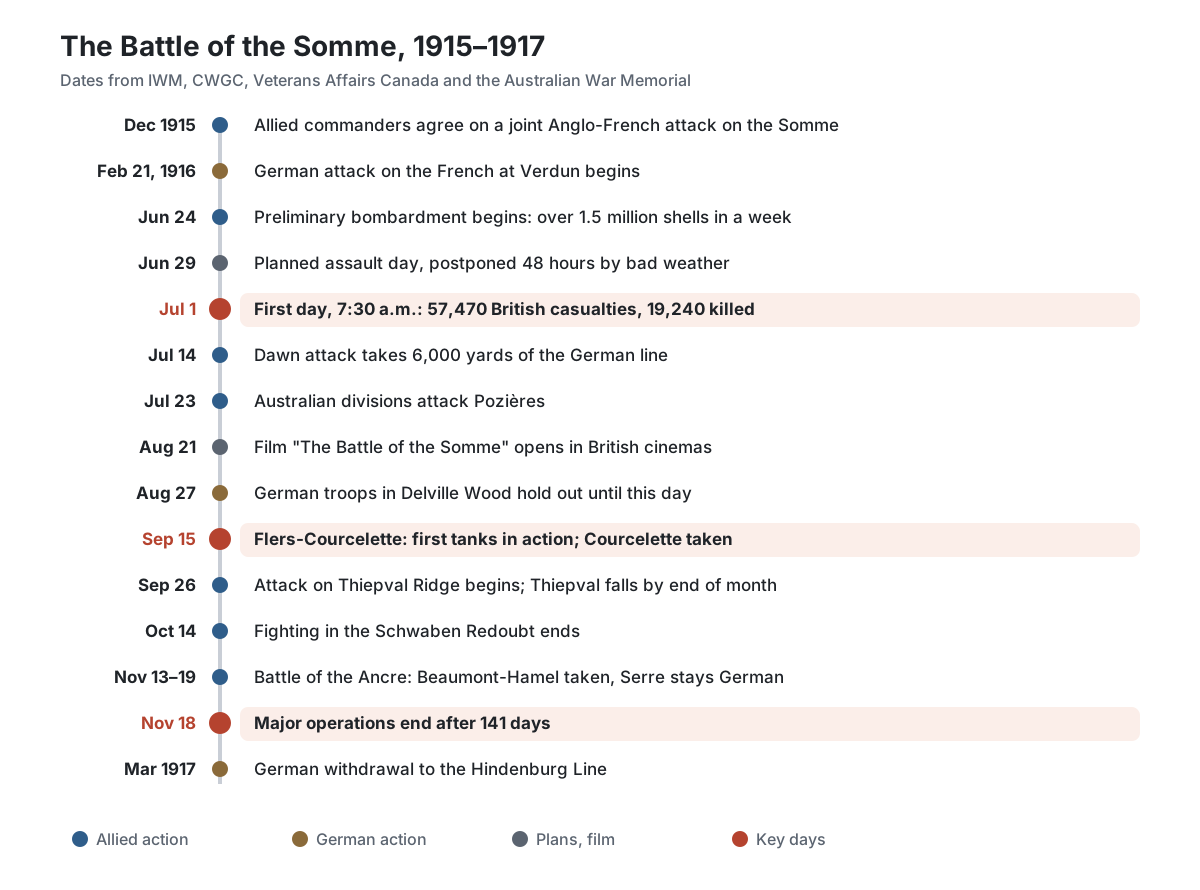
At 7:30 a.m. on July 1, 1916, British infantry climbed out of their trenches on gentle farmland north of the River Somme in northern France. They went forward after a week in which more than 1.5 million shells had been fired. By the end of that day, the British had 57,470 casualties, and 19,240 of them were dead.
No other day in British military history was so deadly. In Britain today, the Somme has become a name that stands for the futility of the First World War. Yet the battle went on for 141 days, and the British were not the only ones who fought it.
Why the Somme, of all places? Why did so many shells fail to cut the wire? What happened in the four and a half months after the first day, and how should readers handle numbers that differ from record to record and memories that still clash?
Why the Somme
Soon after the war began in August 1914, the fighting in Western Europe stalled along a trench line almost 1,000 km long across Belgium and France. Positions guarded by machine guns, snipers and artillery made a decisive breakthrough very hard. Eighteen months passed that way.
In December 1915, Allied commanders settled on a combined British and French offensive near the River Somme for the following summer. It was one piece of a larger plan drawn up in late 1915 by Joseph Joffre, the French commander-in-chief, to press Germany on every front during 1916. The site was chosen mainly because it was where the French and British armies met on the Western Front.
At first, the French were to lead the attack. Then, on February 21, 1916, the Germans struck the fortress town of Verdun. By late spring, France had poured so much into its defense that it had to cut its share of the Somme attack. Britain now had to take the lead, and Joffre pressed the British commander-in-chief, Douglas Haig, to open the offensive as soon as possible to pull German forces away from Verdun.
Most of the British troops who now led were new to war. In 1914, Lord Kitchener, then Britain's war minister, had started recruiting volunteer "New Armies." Among them were Pals battalions, where men from one town joined up together with their friends, relatives and co-workers. No British offensive up to then had been bigger, and none had been fought mainly by civilians who had volunteered instead of career soldiers.
Two men drew up the plan. Haig set the overall direction, and Henry Rawlinson led the Fourth Army, which would attack on the first day. Rawlinson favored a more limited attack, while Haig wanted to reach targets farther back. Neither man, and indeed no one in the British Army, had run an offensive on this scale before.
A week of bombardment
The bombardment began on June 24, 1916. It was meant to tear through the German wire and wreck the trenches and guns behind it. In the week before the battle, the British fired more than 1.5 million shells.
The British believed the shelling would shatter the Germans so badly that the infantry could cross no man's land and simply occupy the German trenches. In fact, the guns were spread too thinly. Roughly two in three shells were shrapnel rounds, and these did little to concrete dugouts. One estimate puts the share of shells that failed to explode as high as 30%.
The shortage was in guns, not shells. There were plenty of shells but too few heavy guns, and because Haig wanted a large advance, this limited firepower was split across both the first and second German lines. That went against Rawlinson's judgment. The German guns also survived, and on the first day that mattered a great deal.
The infantry assault was set for June 29 but was put off for 48 hours because of bad weather. The shelling ran two extra days, yet no extra shells were available.
Sources give the length of the bombardment a little differently. Imperial War Museums (IWM) and the Commonwealth War Graves Commission (CWGC) say seven days. The German Historical Museum (Deutsches Historisches Museum, DHM) uses both "a week" and "five days" on the same page. The timeline of the National WWI Museum in the United States says five days.
7:30 a.m., July 1, 1916
The offensive began at 7:30 a.m. on July 1. The British sector stretched south from Serre to the area around Montauban, and a separate attack at Gommecourt, farther north, was meant to distract the enemy. In all, 13 Commonwealth divisions went forward between a point above Gommecourt and Maricourt, with the French attacking on their southern flank.
In most places, the shelling had neither cut the wire nor wrecked the dugouts. Some senior commanders doubted that the untested New Army soldiers could handle complex tactics, so they had the infantry move forward in long, tightly packed lines. German machine gunners came up from intact shelters and fired into the British infantry crossing no man's land, and German artillery that had not been silenced also did heavy damage.
Along most of the attack front, British infantry could not take their objectives. Some units got into German trenches and were forced back, and others could not get through wire that in places was still intact. In the center at Thiepval, men of the 36th (Ulster) Division captured the Schwaben Redoubt, then had to give it up because the units on either side were stuck.
The south was different. Near Montauban, the 30th and 18th Divisions reached every objective, and the 7th Division took the village of Mametz. Troops there used more imaginative tactics and had help from the French artillery just to their right. French forces south of the River Somme also had some success.
In the north, in front of Beaumont-Hamel, the Newfoundland Regiment attacked at about 9:15 a.m. Newfoundland joined Canada only in 1949, and the regiment fought as part of the British 29th Division. Starting from a support trench behind the front, its men had to cover more than 200 m just to reach their own front line. The enemy trenches lay more than 500 m beyond that.
About 800 Newfoundlanders went into the fight that morning. Only 68 answered the roll call the next day, and more than 700 had been killed, wounded or gone missing. In Newfoundland and Labrador today, July 1 is both Canada Day and Memorial Day, which marks Beaumont-Hamel.
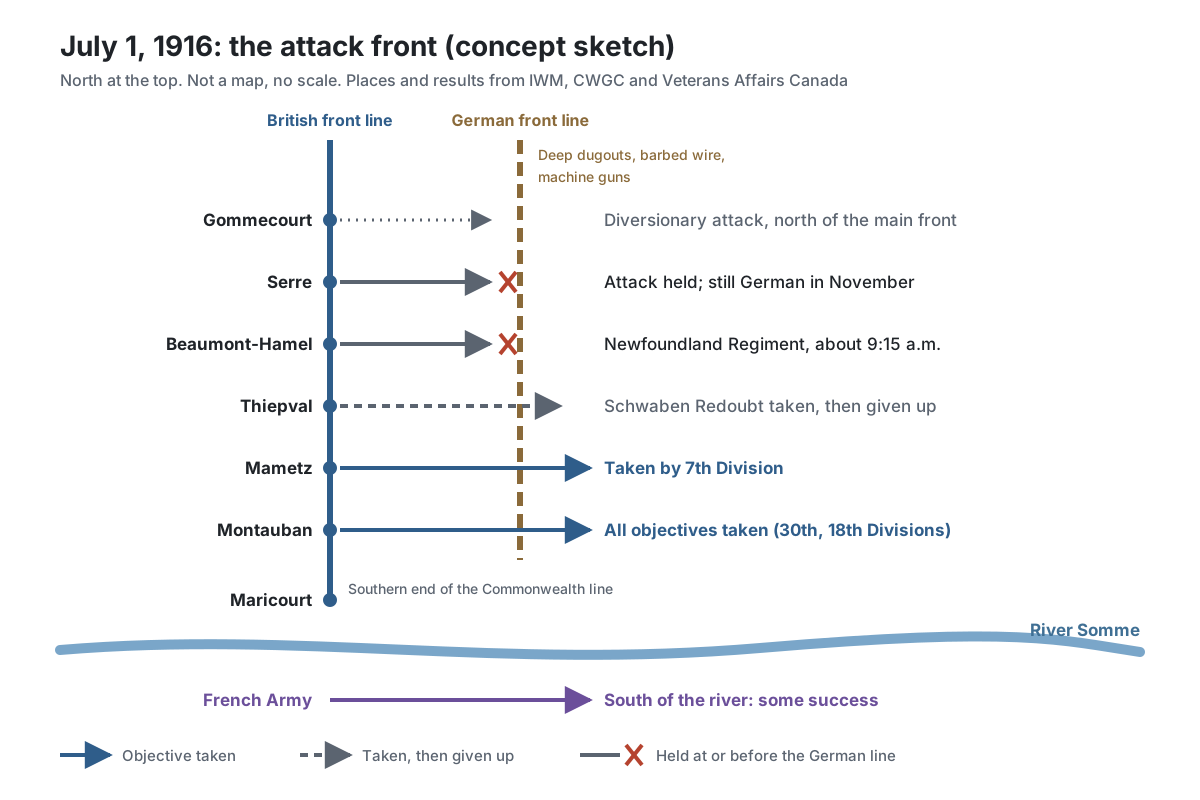
When the day ended, the British had 57,470 casualties, including 19,240 killed. Casualties include not only the dead but also the wounded, the captured and the missing. Even so, with the French still fighting hard at Verdun, there was no question of stopping the offensive.
141 days of attrition
There was no decisive breakthrough on the first day, and the next two months turned into attrition, a fight to wear the other side down. British attacks and German counterattacks followed one after another.
At dawn on July 14, the British seized 6,000 yards (5,486 m) of German trenches running from Longueval to Bazentin-le-Petit. Longueval was fully in British hands before July was out, yet German troops in neighboring Delville Wood kept fighting there until August 27.
Early on July 23, the Australian Imperial Force attacked the village of Pozières and took most of it on the first day. It was Australia's first major action of the Somme. After weeks of holding on under German shelling and counterattacks, the 1st, 2nd and 4th Australian Divisions had about 23,000 casualties by the time they were relieved in early September.
On September 15, at Flers-Courcelette, a new weapon went into battle for the first time: the tank. That day the Canadian Corps took Courcelette in an attack on a front 2,000 m wide, and Flers fell too. According to IWM, though, the day's gain was only about 2,500 yards (2,286 m) deep along a 3-mile (4.8 km) stretch.
On September 26, the attack on Thiepval Ridge began. Thiepval, an original objective for July 1, fell only at the end of September, and the fight for the Schwaben Redoubt did not end until October 14. All the while, rain was turning the battlefield into a swamp.
The Canadians fought a long battle for Regina Trench. IWM says that fight went on until November 10, and Veterans Affairs Canada says the Canadians captured it on November 11. A week later, in the last attack of the battle, the Canadians also took Desire Trench.
The last operation was fought along the Ancre River from November 13 to 19. Many hoped a late win would look good when Allied leaders met at Chantilly on November 15. Highland troops of the 51st Division captured Beaumont-Hamel, a first-day objective, but Serre, another first-day objective, stayed in German hands.
As the weather got worse, major operations ended on November 18. July 1 had been only the first of 141 days. The next spring, the Germans fell back to the newly prepared Hindenburg Line, and the Somme sector saw no major fighting again until March 1918.
Shells, machine guns, deep dugouts and the first tanks
In 1916, defensive positions on the Western Front were held with barbed wire, machine guns and artillery. Over almost two years on the Somme, the Germans had built their defenses into underground fortresses. The attacking British soldiers, by contrast, were weighed down with building material to fortify the trenches they hoped to take.
Heavy guns were the key to opening such positions, and in July 1916 the British did not have enough of them. Thinly spread guns, shrapnel that could not harm dugouts and shells that failed to explode all came together. IWM traces the tragedy of July 1 to the failure of the week of shelling to silence the German artillery and machine guns.
As the battle went on, British methods changed. Artillery techniques improved quickly, and new practices appeared, such as bringing assault troops forward under cover of night and firing machine guns in barrages, much as small cannon would. The major successes of July 14 and September 15 came out of these changes.
The creeping barrage the Canadians used at Courcelette on September 15 was also new. When infantry followed a wall of shellfire that moved forward on a set schedule, the defenders had to stay under cover. The catch was that soldiers had to stay very close to the shells, and many were wounded by their own side's artillery.
And then there was the tank. At 5:30 a.m. on September 15, the Mark I heavy tank Daredevil 1 rounded the corner of Delville Wood, and this is recorded as the first tank in action. The crews who drove these machines were young and inexperienced.
How many tanks fought that day depends on the source. IWM says 49 tanks were on hand for the infantry and 36 made it to their starting points. The Tank Museum at Bovington says 49 were assigned, 32 reached the start line and 18 actually went into action. The rest broke down or got stuck in shell holes or trenches.
Judgments of the result are careful too. Veterans Affairs Canada calls the tanks primitive, few and mechanically unreliable, yet says their shock value alone threw the enemy into confusion. IWM's summary is that the tanks did some good but left a breakthrough no nearer than before.
Numbers that differ by source
Total casualties at the Somme are often given as "more than a million on both sides." Break that down, though, and the numbers vary a good deal between institutions. Rather than pick one as correct, it helps to set them side by side and note who gave which.
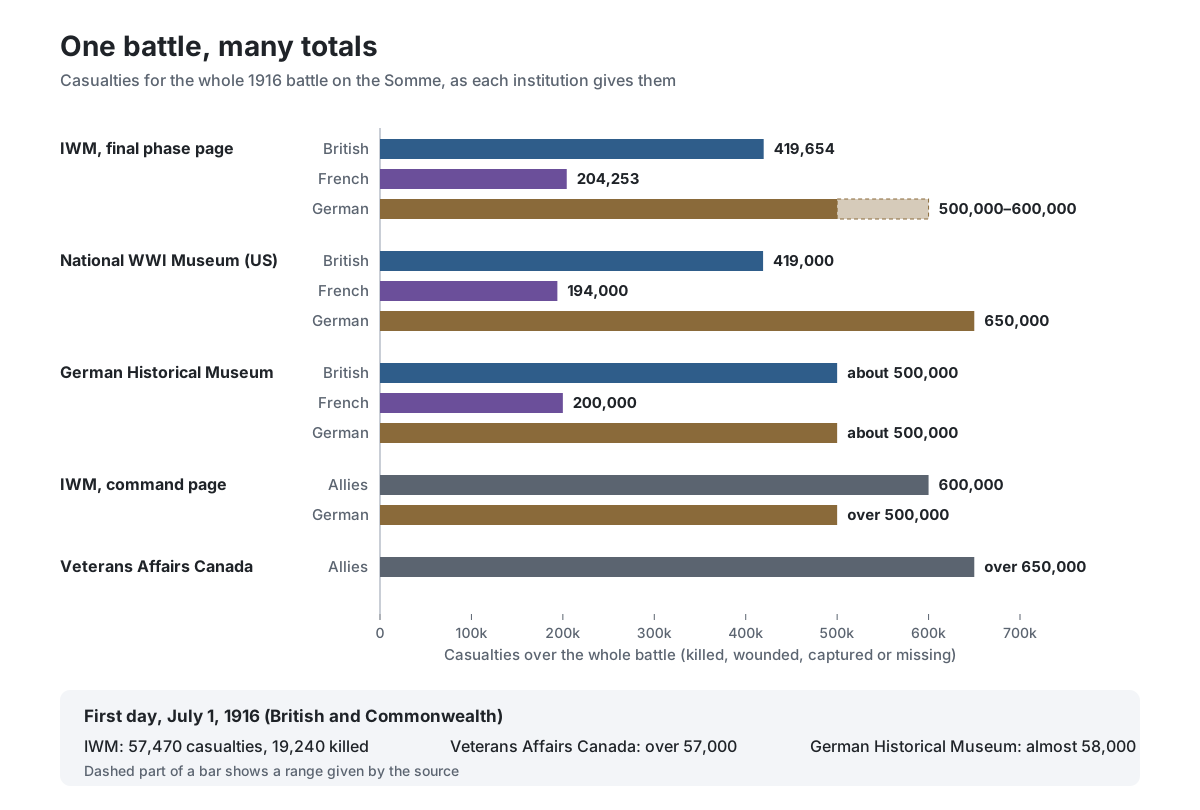
Even two IWM pages disagree. The page on the final phase gives 419,654 British, 204,253 French and 500,000–600,000 German casualties. The page on command gives 600,000 for the Allies and over 500,000 for the Germans. The timeline of the National WWI Museum in the US lists 419,000 British, 194,000 French and 650,000 German.
The German Historical Museum says the Germans and the British each lost about 500,000 men and the French 200,000. Veterans Affairs Canada puts Allied casualties at more than 650,000 and says the Allies and the Germans each lost about 200,000 lives. German soldiers called the battle "das Blutbad," the bloodbath.
There are national figures as well. More than 24,000 Canadians were killed, wounded or went missing, and the three Australian divisions at Pozières had about 23,000 casualties. First-day British and Commonwealth losses appear as 57,470 with 19,240 killed (IWM) and more than 57,000 (Veterans Affairs Canada). The German Historical Museum gives almost 58,000, with almost 20,000 dead.
The ground gained is measured in different ways too. One IWM page says the British took a strip 6 miles (10 km) deep and 20 miles (32 km) long, and its statistics page says they advanced 7 miles. Veterans Affairs Canada says about 10 km, the German Historical Museum says less than 10 km deep, and the National WWI Museum says 6 miles.
Even so, in November the British were still 3 miles (5 km) from Bapaume, and the French farther south had halted before reaching Péronne. The German Historical Museum notes that the Allies committed 104 divisions in all, about 2.5 million men.
The film and the memorials
On August 21, 1916, British cinemas began showing The Battle of the Somme, a government documentary. The official cameramen Geoffrey Malins and John McDowell shot the preparations and the opening days, and no earlier full-length film had shown soldiers in combat. Around 20 million people are thought to have seen it within a few months.
The film includes staged scenes. Weighed down by heavy equipment, the cameramen could not film the moment men went "over the top." That scene is thought to have been filmed later, between July 12 and 19, at a trench mortar school near St Pol. Most of the audience at the time had no way of knowing they were watching a reconstruction.
Still, the film's images came to stand for the whole First World War, and they opened the way for the "war film," a fictional retelling of a real war. During the war, the British government had the battle covered by selected journalists and writers and, for the first time, sent official photographers to the front. In those accounts, the Somme was shown as hard but worthwhile work.
The village of Thiepval is home to the memorial for the Somme's missing. Edwin Lutyens designed it, workers built it from 1928 to 1932, and it was unveiled on August 1, 1932. Carved on it are more than 72,000 names of British and South African soldiers who were killed in the Somme area before March 20, 1918, and whose graves are unknown. Over 90% of them fell from July to November 1916.
Because the 1916 offensive was a shared effort, the Thiepval Memorial also honors the battle as a British and French one. In a small cemetery below it, Commonwealth and French graves are equal in number, and a large ceremony takes place there each July 1.
The Beaumont-Hamel Newfoundland Memorial is one of the few places where visitors can see a First World War battlefield much as it was, with shell craters and trenches left untouched. On the highest point stands a bronze caribou, and three bronze tablets at its base list more than 800 Newfoundlanders with no known grave.
Questions left by the first day
For many in Britain today, the Somme means a war that was futile and wasteful, stuck in deadlock and grinding lives away for nothing. Blame on British generals, above all Haig, for needless casualties goes along with that memory. IWM explains that this view is rooted in the disaster of July 1, 1916.
The view during the war was different. Less positive opinions began to spread after the war, and the most influential came from Winston Churchill's 1927 book and David Lloyd George's 1933 memoirs. Both politicians had long argued for a strategy that turned away from the costly Western Front, so they also had personal reasons to criticize how the battle was run.
From 1967, official papers from the period of the battle became open to historians, but they did little to bring opposing views of its conduct closer. Only recently have historians begun to look more widely at the French Army's part and the German experience. Meanwhile, attention narrowed still further to July 1, and the historian David Reynolds suggested that Britain's idea of its Great War had been "whittled down" to "one sacred day."
There is another view as well. IWM describes the Somme as a battle the alliance needed, one Britain had to fight for its partners. In this view, the goal was not ground but a mortal blow to the German Army in France.
One French officer wrote that the British infantry was very brave but going through "a costly apprenticeship." In this view, what was learned in that apprenticeship helped bring Allied victory in 1918.
Effects on the German side are also cited. The German pullback to the Hindenburg Line in March 1917 came directly from the punishment the German Army took on the Somme. The unrestricted submarine warfare the German government then approved brought the United States into the war in April 1917.
At the same time, similar daily casualty levels were common in almost every Western Front battle. They were even higher during the mobile warfare of 1914 and 1918.
The numbers from the first day do not change. The question that has run for more than 100 years is what story to place them in. Whether the Somme is a symbol of wasted sacrifice or a costly stage in an alliance war is still debated.
What to read next
- Trench Warfare: Why the Western Front Barely Moved for Four Years: where the Somme's wire and dugouts came from.
- The Battle of Verdun: Three Hundred Days of Attrition: the French battle that pulled the Somme offensive forward.
- The First Tanks and Cambrai: Machines Built to Cross Trenches: what came after the tanks of September 15.
- Main battle tanks: is it all about the gun?: a century after Daredevil 1, how today's tanks are judged.
- Military logistics: performance must be sustainable: problems behind the fighting, like plenty of shells but too few guns, in today's terms.
- A history of laser weapons: from chemical to electric lasers: long after the first tanks, how another new kind of weapon grew.