On April 19, 1775, 77 militiamen formed up on the town green in Lexington, Massachusetts. British light infantry from Boston came toward them, and a single shot rang out from no one knows where. In less than three minutes, eight militiamen were dead and ten were wounded.
Eight years later, on September 3, 1783, Britain signed a treaty in Paris that recognized the 13 states as independent. What happened in between? One timeline and a few side-by-side numbers can show it. A quarrel over taxes turned into gunfire, town militias became the Continental Army, and a revolt in North America grew into a war that drew in France and Spain.
On the American side, it draws on public pages from the National Park Service (NPS), the State Department's Office of the Historian and the National Archives (NARA). For a British view, it sets the explanations of the UK's National Army Museum (NAM) alongside them.
The debts of the Seven Years' War and the Stamp Act
Britain won the Seven Years' War, but in 1763 it came out of it with heavy debts. Prime Minister George Grenville lowered the duties on sugar and molasses but collected them more strictly than before. The Currency Act of 1764 stopped the colonies from issuing paper money.
The Stamp Act came next. Legal documents and many other paper goods now needed a stamp bought from the government.
The act gave the 13 colonies a common cause against Parliament. In October 1765, delegates from 9 colonies met and sent petitions denying Parliament's right to tax them. The British government then decided that repealing the act was easier than enforcing it.
At the root of the quarrel was not the size of the tax but who had the right to set it. In the NAM's account, Britain wanted the colonies to pay for their own defense, while colonists said only their own assemblies could levy taxes. It also gives a comparison for 1763: 26 shillings of tax a year for a typical Briton, one shilling for a typical Massachusetts taxpayer.
New taxes under the Townshend Acts of 1767 met fresh resistance. In 1773 Parliament gave the East India Company a monopoly on carrying tea free of tax. On December 16 that year, colonists dressed up as Indians climbed aboard the company's ships in Boston Harbor and dumped the tea chests into the water. This was the Boston Tea Party.
Britain closed the port of Boston and, in 1774, passed laws that tried to bring Massachusetts under direct British control. In the colonies, these laws were called the Intolerable Acts. That September, the First Continental Congress met in Philadelphia.
April 19, 1775: from Boston to Concord
General Thomas Gage, the military governor of Massachusetts, learned that arms and supplies were stored at Concord, 18 miles northwest of Boston. He sent a force in secret to seize and destroy them. Sources put the force at around 700 (NPS) to 800 (NAM).
The clash with the 77 men on Lexington Green was short. Who fired the first shot is still unknown. The British marched on to Concord and left three companies, about 96 men, at the North Bridge. Shots were exchanged at the bridge; three British soldiers were killed or mortally wounded and nine more were wounded.
The road back was longer. The fighting ran all day along 16 miles of road between Boston and Concord, with about 1,700 British regulars against more than 4,000 colonial militia. Brigadier General Hugh Earl Percy arrived with nearly 1,000 reinforcements, and at Lexington two 6-pounder guns fired the first artillery shots of the war.
By the end of the day, 273 British soldiers and 95 militia and civilians had been killed, wounded or missing. Within two days, 15,000 New Englanders had surrounded the British in Boston, and a siege of 11 months began. The NAM calls the day not a serious military defeat for Britain, but a political disaster.
From militia to the Continental Army
The colonies had no standing army. They had militia: farmers and merchants who turned out when called. On June 14, 1775, the Continental Congress voted to raise a standing army. The next day it unanimously chose George Washington as commander in chief of the new Continental Army.
On June 17, the first major action of the war was fought on Breed's Hill across the water from Boston, the Battle of Bunker Hill. Inexperienced colonial soldiers held off British veterans for more than two hours, and of the 2,200 British soldiers who saw action, more than 1,000 were killed or wounded. The British took the hill, but at a high price. The order "Don't fire until you see the whites of their eyes!" spread through stories of this battle, but it is unclear who actually said it.
On March 4, 1776, Washington placed artillery on Dorchester Heights to threaten Boston, and in April the British left the city for Halifax in Canada. Throughout the war, Britain had to ship men and supplies across the Atlantic. A crossing took five weeks and sometimes two months, so even a short loss of control at sea could be serious.
On July 4, 1776, the Continental Congress adopted the Declaration of Independence and cut the colonies' political ties to Britain. Declaring independence opened the way to a formal alliance with France and French help.
A timeline from Lexington to Yorktown
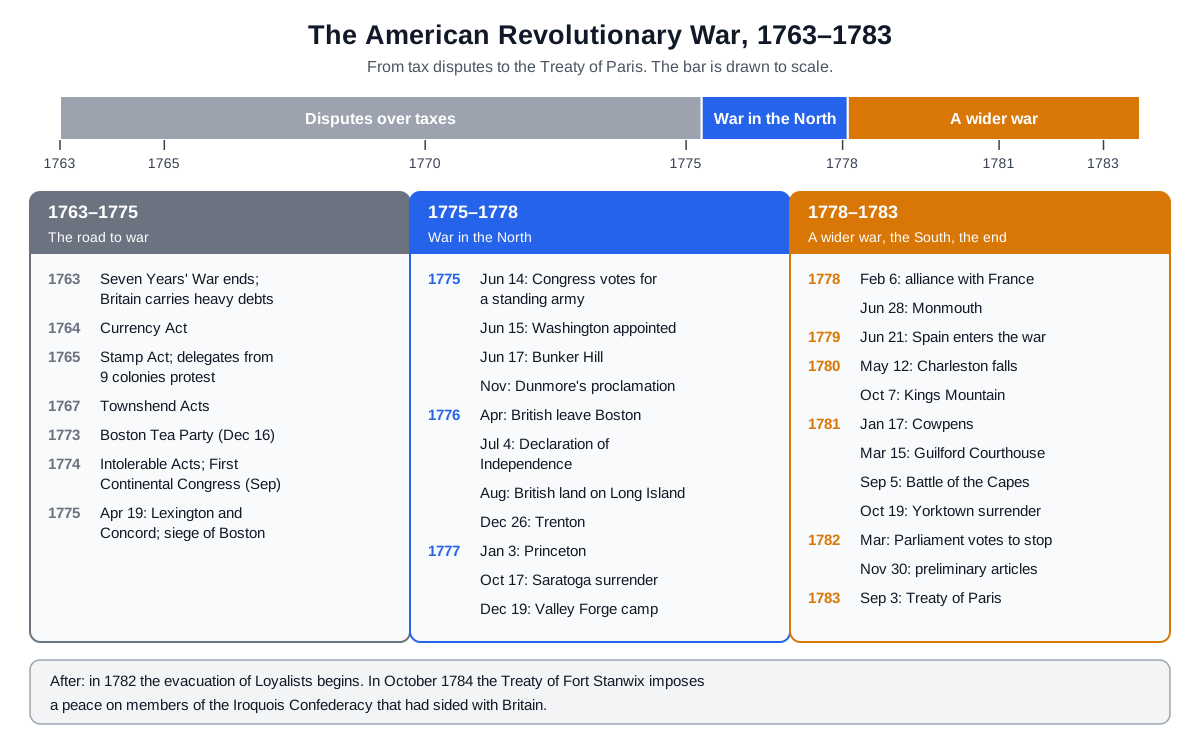
On August 22, 1776, a British army of around 22,000 came ashore on Long Island. Washington's army was driven back, and in these battles General William Howe killed or captured more than 6,000 soldiers. Many more went home.
The turn came in winter. On Christmas night, Washington crossed the ice-covered Delaware River with 3,000 men. On December 26 at Trenton, his army defeated Hessians, German troops in British pay, and took more than 1,000 prisoners. A second win at Princeton on January 3, 1777, revived hope that the war might be winnable.
The Continental Army spent the winter of 1777–1778 at Valley Forge in Pennsylvania. On December 19, over 12,000 soldiers arrived with 400 women and children and built rows of log huts. No battle was ever fought there, but disease killed. Influenza, typhus, typhoid and dysentery were the most common killers, and two-thirds of those who died did so in March, April and May, when supplies were better.
That winter, Baron von Steuben, a former Prussian officer, took charge of training. He saw that American soldiers would not accept harsh European-style discipline, so he taught by showing. He remarked that soldiers usually needed two years of training but these men learned quickly, and he later wrote a full military manual. The Battle of Monmouth on June 28, 1778, ended in a stalemate, but it showed that the Americans could now face British regulars on equal terms.
In December 1778, Britain turned south. It hoped to win back the southern colonies by recruiting Loyalists, colonists who stayed loyal to the king. When Charleston fell on May 12, 1780, the patriots lost a large army.
At Kings Mountain on October 7, 1780, the commander of the Loyalist force, Major Patrick Ferguson, was the only British soldier on the field. It was a battle among Americans over their own future.
At Cowpens on January 17, 1781, Continental soldiers and militia won. At Guilford Courthouse on March 15, the British won, but at a heavy cost. The fighting in the South was savage, and both sides committed atrocities.
Saratoga and the French alliance
In 1777, General John Burgoyne came south from Canada to cut New England off from the other colonies. When he set out, his army numbered about 9,000. It included 4,000 British regulars, 3,200 German auxiliaries and nearly 1,800 others: Loyalist soldiers, American Indian warriors, Canadian militia, civilian workers and followers.
At Freeman's Farm on September 19, the British held the field but took about 580 casualties (about 320 on the American side). On October 7 Burgoyne attacked again at Bemis Heights and was driven back, with about 600 British and about 150 American casualties. He fell back to Saratoga and surrendered on October 17, 1777. The NPS describes this as the first time in world history that a British army surrendered to another country.
The news reached Paris in December, and French Foreign Minister Vergennes decided on an alliance. On February 6, 1778, Benjamin Franklin and two other commissioners signed a Treaty of Alliance and a Treaty of Amity and Commerce. The alliance treaty barred either country from making a separate peace with Britain. The Continental Army learned of the alliance in May.
France had its own reasons. It had lost to Britain in the Seven Years' War and given up North American land in the 1763 Treaty of Paris, and it saw the revolt as a chance. It had already been helping in secret. From 1778 to 1782, France sent supplies, arms and ammunition, uniforms and, above all, troops and naval support.
Spain formally entered the war on June 21, 1779. The Netherlands and the Sultanate of Mysore in India also joined the fight against Britain. A revolt in North America had become a war across several continents.
Muskets, rifles and cannon: the weapons of the time
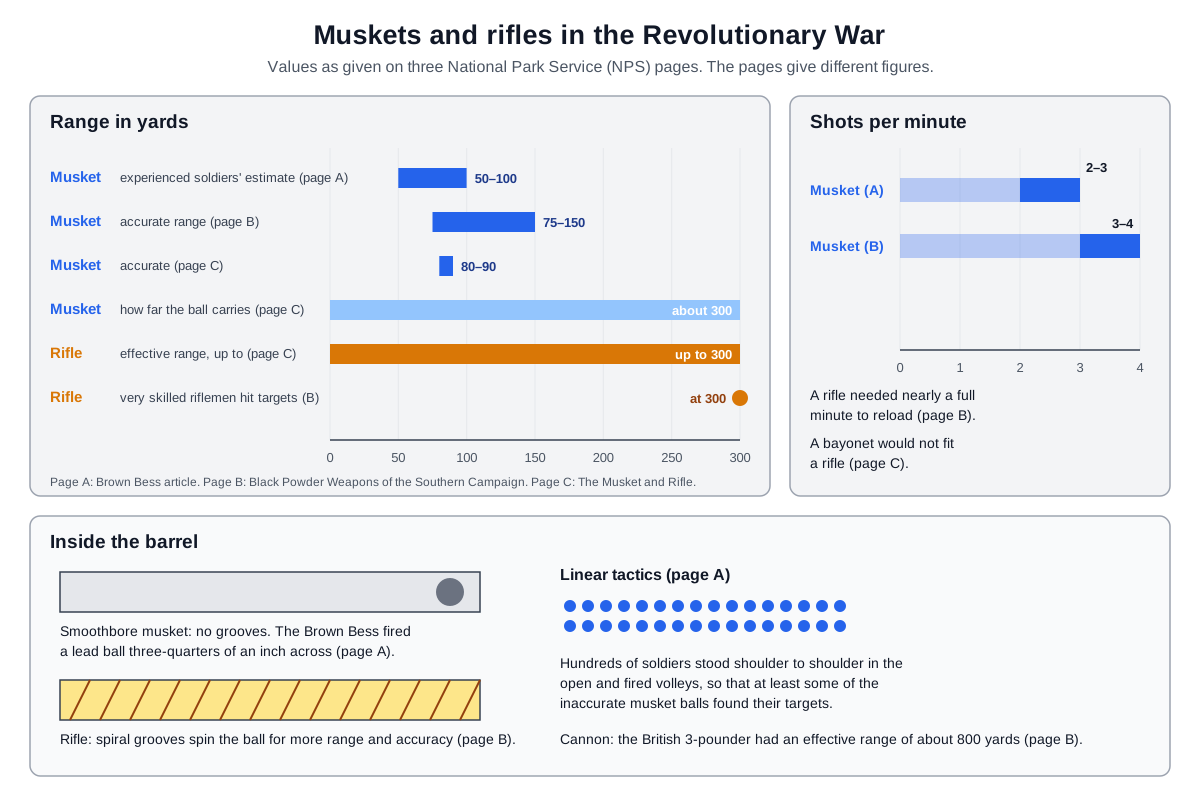
The standard infantry weapon of the war was the smoothbore flintlock musket. The most common versions were the British Brown Bess and the French Charleville, and many Continental soldiers carried the Brown Bess too. The inside of the barrel was smooth, with no grooves to spin the ball. It fired a lead ball three-quarters of an inch across, loaded through the muzzle.
That made it slow and inaccurate. Even trained soldiers fired only two or three shots a minute, and experienced soldiers put its range at 50 to 100 yards.
Different NPS pages give different figures. The page on the southern campaign says it was accurate at 75 to 150 yards and could fire three or four times a minute. A teachers' page says it was accurate at 80 to 90 yards and the ball could carry about 300 yards.
Armies made up for an inaccurate gun with linear tactics. Hundreds of soldiers stood shoulder to shoulder in the open, and officers had them fire together in volleys. If a hundred guns fired in the same direction at once, at least some of the inaccurate balls would hit.
The rifle had spiral grooves inside the barrel, called rifling, which spun the ball as it left and improved range and accuracy. The best marksmen could hit a target 300 yards away.
But rifles were expensive to make, took nearly a full minute to reload and could not take a bayonet. In this war, the rifle was mainly a civilian weapon.
There was artillery as well. In 1770 Britain began mass-producing a 3-pounder cannon, the so-called "Grasshopper," with an effective range of about 800 yards. It was light and easy to move, so it sometimes went along with infantry units to support them at close range.
The Battle of the Capes and Yorktown
In the summer of 1780, 5,500 French troops under the Comte de Rochambeau arrived at Newport, Rhode Island. In the South, General Charles Cornwallis moved to Yorktown, Virginia, in the summer of 1781. General Henry Clinton had ordered him to secure a sheltered port where the British fleet could anchor.
Admiral de Grasse brought 37 ships, including 28 ships of the line, to the Chesapeake Bay. On September 5, 1781, near the mouth of the bay, he met 19 British ships of the line. The battle lasted about two and a half hours and involved no Americans. The British had six ships damaged, 90 sailors killed and 246 wounded; the French had 209 casualties and two ships damaged.
Once Admiral de Barras's squadron joined, the French had 36 ships of the line, and the British fleet sailed back to New York. The bay stayed in French hands, and Cornwallis could no longer receive reinforcements by sea. The NPS page on the battle concludes that without de Grasse's control of the bay, the allied victory at Yorktown would have been impossible.
On land, about 17,600 American and French soldiers had gathered by the end of September, against 8,300 British soldiers in Yorktown. On September 28 the allies moved on Yorktown and began the siege. On the night of October 14, 400 French and 400 American soldiers took British Redoubts 9 and 10 in less than 30 minutes.
On October 19, the British walked out between two long rows of troops, Americans on one side and French on the other, and laid down their arms. A third of Britain's whole force in North America surrendered that day. On the same day, Clinton sailed from New York with 5,000 troops, too late to help.
Yorktown was not quite the end. Britain still held New York, Charleston and Savannah. In March 1782, Parliament passed a resolution that the war against the United States should not continue.
In the NAM's view, the British Army fought fairly well in battle but could not overcome its logistics problems. French and Spanish entry into the war cancelled British naval dominance, and that proved decisive.
Numbers that differ by source
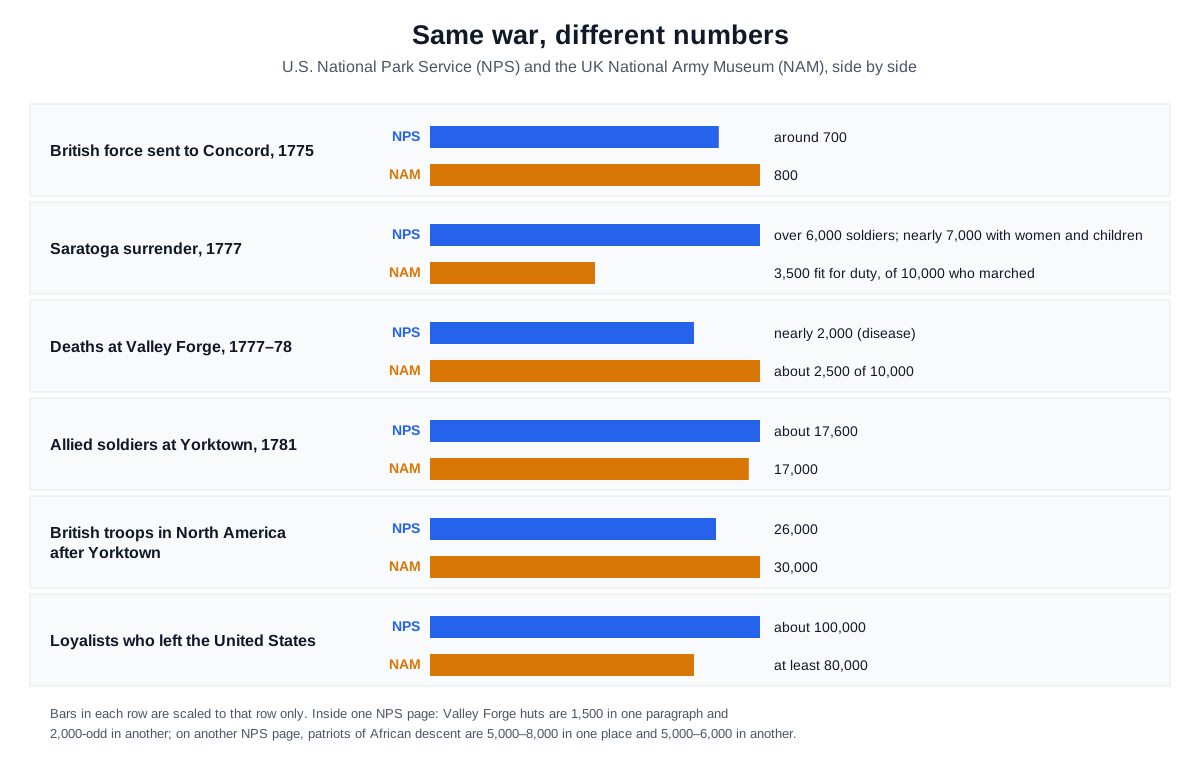
The same events come with different numbers. The NPS puts the force sent to Concord at around 700, the NAM at 800. A record written that morning by the Reverend William Emerson of Concord also says 800.
At Saratoga, the figure depends on what is counted. The NPS says a British army of over 6,000 prepared to surrender and that nearly 7,000 officers, soldiers, women and children marched out. The NAM counts only fighting strength: 10,000 British and German soldiers set out from Canada, and just 3,500 of them could still fight when the army surrendered.
For deaths at Valley Forge, the NPS gives nearly 2,000 from disease and the NAM about 2,500 out of 10,000. Even within one NPS page, the number of huts is 1,500 in one paragraph and 2,000-odd in another.
The end of the war is no different. The allied force at Yorktown is about 17,600 for the NPS and 17,000 for the NAM. British troops still in North America after Yorktown are 26,000 for the NPS and 30,000 for the NAM. Loyalists who left the United States number about 100,000 for the NPS and at least 80,000 for the NAM.
The Treaty of Paris and the questions it left
Preliminary articles were signed in Paris on November 30, 1782, and, after Britain and France had settled their own peace, the final treaty was signed on September 3, 1783. Britain recognized the 13 states as independent and accepted their boundaries. The treaty also covered fishing rights on the Newfoundland banks, prewar debts owed to British creditors, the return of property taken from Loyalists and the withdrawal of British forces. The western boundary was the Mississippi River.
NARA calls the war a world conflict, with France, Spain and the Netherlands involved alongside the two main parties. It names two key provisions: British recognition of independence and boundaries that left room for westward expansion.
Some questions did not end with the treaty. The first concerns the Loyalists. By the NAM's estimate, around 40% of the colonial population supported the patriots and 15–20% supported the Crown, about half a million people.
Half of New York's population was Loyalist, and the rest of the population tried to stay neutral. The war split families and towns, both in North America and in Britain.
African Americans faced a harder choice. In November 1775, Lord Dunmore, the British governor of Virginia, offered freedom to enslaved people of rebellious Americans who reached British lines. During the war, tens of thousands sought their freedom on the British side, and a smaller number fought for independence. Congress only allowed Black men to be recruited from January 1776, and about 700 to 720 patriots of African descent were at Valley Forge.
The Declaration's words "all Men are created equal" forced people to face the contradictions of slavery. When the Loyalists left, about 15,000 of them were African Americans, and some later helped found Sierra Leone in Africa.
Native Americans were divided too. Burgoyne's army included American Indian warriors, while 150 Oneida and Tuscarora warriors joined General Horatio Gates's American army. In October 1784, the Treaty of Fort Stanwix imposed a peace on the members of the Iroquois Confederacy that had sided with Britain. The NPS timeline says the war's aftermath proved devastating to Native Americans, as tribes with no European allies faced growing pressure from settlers moving west.
A fight that began with 77 men on Lexington Green ended as a war among several nations. Its outcome did not mean the same thing to those who won independence, those who left their homes and those who went on to lose their land.
What to read next
- The Seven Years' War: A War Fought on Several Continents at Once — the war that created Britain's debts and France's reasons.
- The Napoleonic Wars at a Glance: Corps and Conscription — how the age of muskets and volleys grew larger.
- Military logistics: performance must be sustainable — why supply across an ocean weighed so heavily, linked to logistics today.
- Self-propelled howitzers: guns that move themselves — from 18th-century cannon to guns that move on their own.
- A history of laser weapons: from chemical to electric lasers — a very different line of weapons that came long after gunpowder.