In August 1914, five German armies moved through Belgium and northern France and turned south. By early September the head of the German First Army stood 60 km from Paris, and the French government moved to Bordeaux. A little more than a week later, the German armies fell back about 80 km to behind the Aisne River.
What stopped them? This article starts with the German plan that put "the West first," known as the Schlieffen Plan. It then follows what happened, step by step, in Belgium, France and faraway East Prussia. It ends with the Western Front settling into a line of trenches after the Battle of the Marne.
For a long time the failure was told as the story of a successor who ruined the plan. Yet historians disagree about whether such a plan really existed. That debate comes at the end, with each side set out in turn.
The fear of a two-front war
Germany lay between France to the west and Russia to the east. The two were allies, so a war could mean fighting on both sides at once. This two-front war was exactly what the German General Staff feared.
Count Alfred von Schlieffen was chief of the German army's General Staff from 1891 to 1905. According to LeMO, the online museum of the German Historical Museum (DHM), he wrote a memorandum on this two-front war shortly before he retired. Russia would need time to mobilize its army. In that time Germany would first defeat France and then move its troops from the Western Front to the East.
There was also a question of numbers. By massing troops on one front at a time, Germany and Austria-Hungary hoped to make up for being outnumbered by the other side. When the war began in 1914, about 3.5 million soldiers of the Central Powers faced more than 5.7 million of the Entente powers.
Moltke's changes and Belgium
Before 1914, Schlieffen's idea hardened into something like doctrine, and his successor as chief of staff, Helmuth von Moltke (the Younger), revised it. Two masses of troops would wrap around France from the north and from the south. The pincer would close west of Paris and force the enemy to surrender.
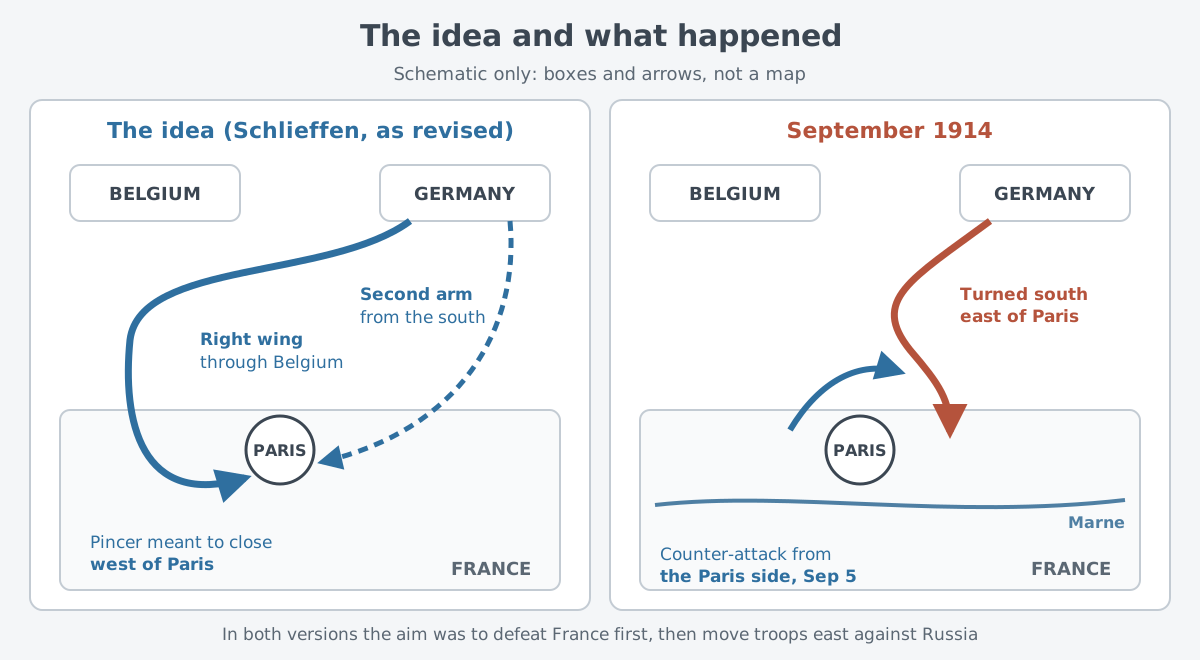
The picture came with one condition. To swing wide in the north, German troops had to pass through neutral Belgium. Britain was a guarantor of Belgian neutrality, so the German entry into Belgium on August 3–4 led to Britain's declaration of war.
The National Army Museum (NAM) in London tells the same story from the British side. Germany's war plan was to strike France quickly while Russia was slowly mobilizing. Germany declared war on Russia on August 1 and invaded Belgium three days later, and Britain declared war on Germany on August 4.
August 1914: from Liège to Mons
On August 1, Germany ordered general mobilization. The next day it demanded, by ultimatum, the right to march its troops through Belgium and occupied Luxembourg, and on August 3 it declared war on France. Records give the date German troops entered Belgium as August 3 or August 4.
The first hurdle was the Belgian fortress city of Liège. Built in the late 19th century, its fortress was ringed by 12 outer forts. The further advance of the German right wing depended on taking it quickly, and so did the success of the whole plan.
Fierce Belgian resistance dashed hopes of a quick capture. The siege tied down more German units and lasted longer than the German Supreme Army Command had planned. The city fell on August 7, but the last outer forts did not fall until August 16 or 17, after heavy artillery was brought in.
The war was not only between armies. The Belgian population resisted the occupying troops more strongly than expected, and the German military administration put down that resistance harshly. Civilians were shot, and on August 25 German troops destroyed large parts of the Belgian city of Leuven (Löwen).
Farther south, France attacked too. The French deployment plan was also offensive and pushed into Alsace-Lorraine, but its first offensives were stopped between August 19 and 22. Meanwhile, on August 18, the great advance of five German armies began and went largely according to plan.
The British Expeditionary Force (BEF) started with four infantry divisions (later six) and one cavalry division, some 90,000 men. It was very small beside the German and French armies. On August 22 it dug in to hold the line of the Mons-Condé canal, and the next day it stopped the Germans who ran into it with accurate rifle fire.
Even after holding at Mons, the British had to fall back when the French Fifth Army on their right withdrew. On August 25, General Joseph Joffre, the French commander, told his forces to fall back to the Marne River. Over the next ten days, the BEF made a 320 km fighting retreat in hot weather.
News from the East
Schlieffen's arithmetic relied on Russia moving slowly. In fact, Russia mobilized its troops far earlier than Germany had expected. On August 17 the Russians opened a large offensive into East Prussia, where the German Eighth Army faced two Russian armies.
The Eighth Army's commander broke off the Battle of Gumbinnen (August 19–20) and pulled back. The Supreme Army Command disapproved, recalled Paul von Hindenburg to command the Eighth Army, and gave him Erich Ludendorff, who had made his name at Liège, as his partner.
In the Battle of Tannenberg, fought from August 26 to August 30 or 31, the Eighth Army surrounded the Russian Second Army and crushed it despite having fewer troops. Sources put the number of Russian soldiers taken prisoner at between more than 90,000 and more than 92,000. In the Battle of the Masurian Lakes on September 8–15, the Russian First Army was also badly beaten.
This fight was tied to the West as well. To attack the Russian First Army after Tannenberg, the Eighth Army was reinforced with five infantry divisions and one cavalry division from the Western Front. The plan said finish in the West, then turn east. Instead, divisions from the West went east before the fighting there was over.
The Battle of the Marne
German troops reached the Marne on August 30. By early September, though, the German armies were not where the plan had placed them. They had not advanced as far as the Channel coast and had already turned south east of Paris.
The National Army Museum explains why. The Germans thought the British and the French Fifth Army had already been defeated, so they chose to swing past Paris on its eastern side. Their flank lay open when the counter-attack came on September 5. Joffre quickly formed a new army in front of Paris and ordered a counter-attack along the whole line from Paris to Verdun.
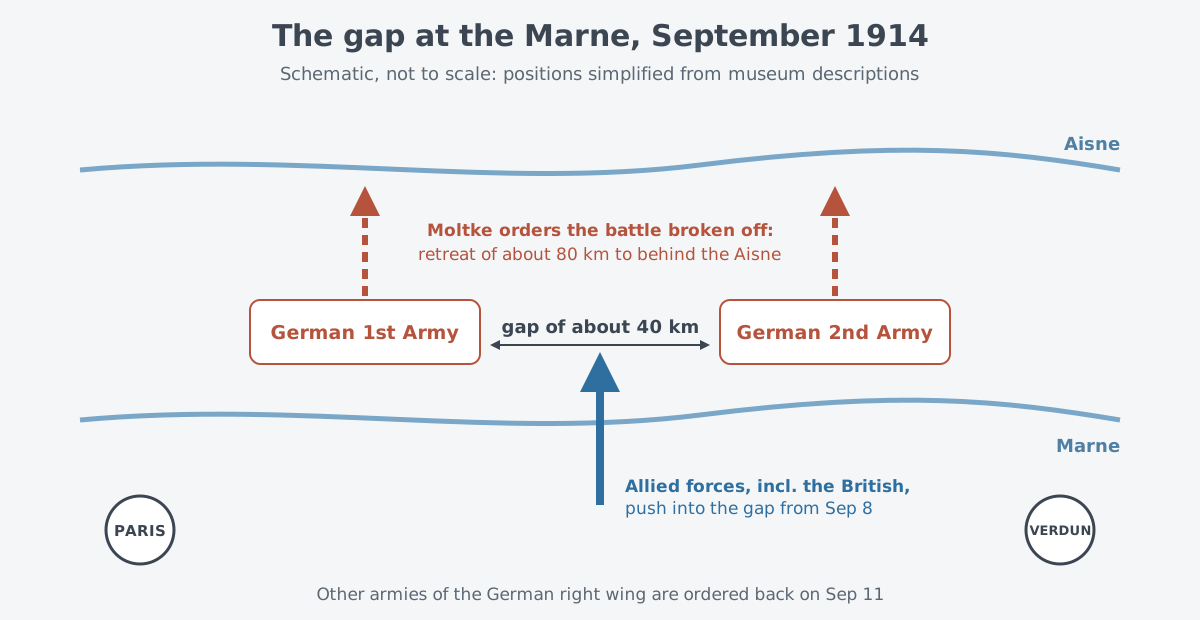
The surprise counter-attack split the German First Army from the Second, leaving a gap about 40 km wide. When Allied forces, including the British, pushed into that gap from September 8, Moltke ordered the battle broken off. The German troops fell back about 80 km to behind the Aisne, and the British and French followed hesitantly.
On September 11, the other armies of the German right wing were also ordered to retreat. Sources give the dates of the Battle of the Marne slightly differently: September 5–12, 6–12, or 5–10. LeMO notes that the battle showed how worn down the German offensive had become, and that the needed reserves were lacking.
The result was clear. The German offensive lost its momentum, and in the words of the German Historical Museum, the Schlieffen Plan had failed. Moltke was removed on September 14, and the Prussian war minister Erich von Falkenhayn took his place. The French called the battle the "Miracle of the Marne."
Weapons and armies in 1914
The armies that marched off in August 1914 still looked much like those of an earlier age. German and French soldiers wore almost the same headgear as in the Franco-Prussian War of 1870–1871. German infantry wore a spiked helmet of pressed leather, and French soldiers wore the red cloth cap called the képi.
This gear was entirely unsuited to the new kind of war. New weapons such as machine guns and rapid-firing artillery caused unexpectedly heavy losses in the first weeks. So many soldiers were killed or badly wounded by bullets and shell fragments that armies looked urgently for protection. The French army introduced a steel helmet first, in 1915, and the German army followed in 1916.
The weight of guns mattered too. The last forts at Liège fell only after heavy artillery was used. At Mons, on the other hand, what stopped the Germans was the accurate rifle fire of well-trained soldiers.
Communications also shaped the outcome. The Germans had decoded Russian radio traffic and knew the enemy's operational plans. So Hindenburg left only one cavalry division as a screen toward the Russian First Army in the north, even though it was just a day's march away. German superiority in artillery and the slowness of the Russian army added to this.
Armies also differed in size and character. Britain went to war with a small professional army built mainly to police its overseas empire. Just over 250,000 regulars, the same number of Territorials and 200,000 reservists added up to about 700,000 trained soldiers. That was tiny beside the huge conscript armies that Germany, France and Russia raised.
The Race to the Sea and the trench line
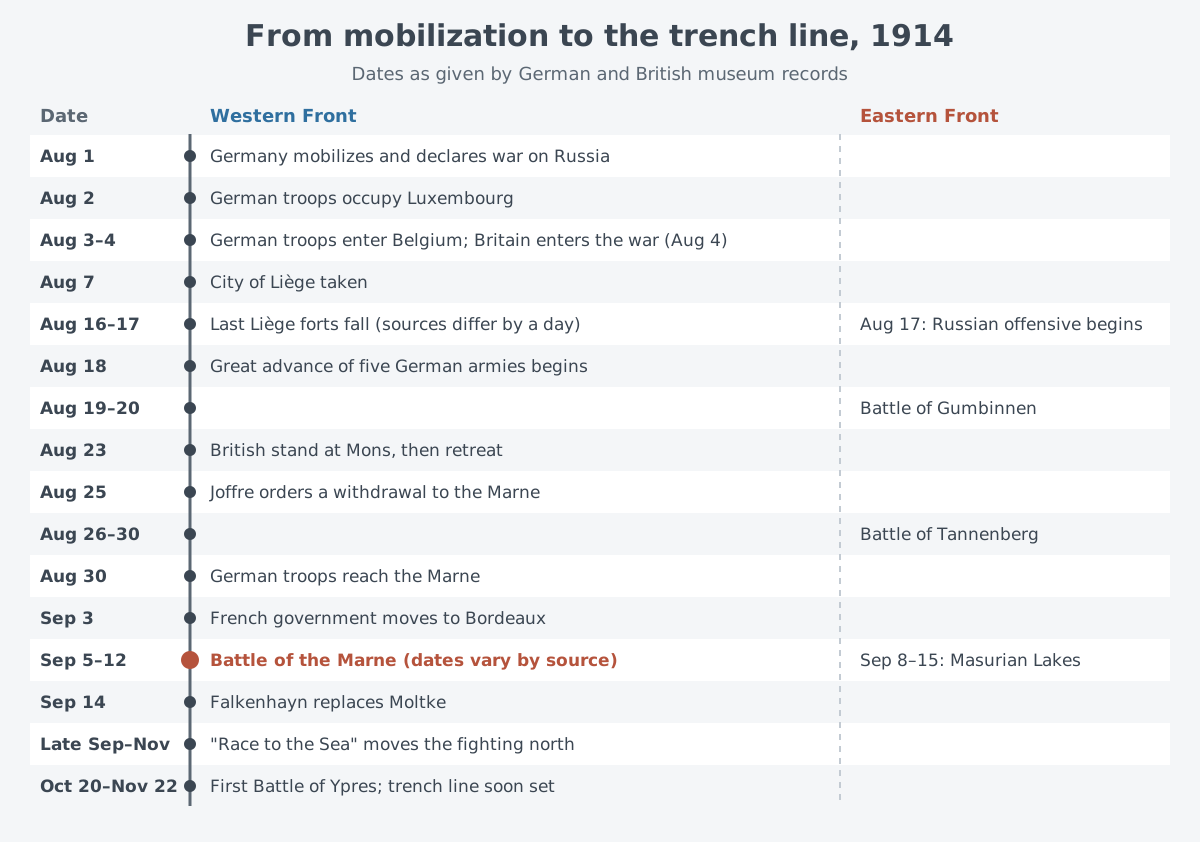
Back at the Aisne, the Germans entrenched on the high Chemin des Dames ridge north of the river and in mid-September beat off several attempts to push them off. From then on, each side tried to go around the other's flank instead of attacking head-on. Between the last days of September and late November 1914, the line crept north toward the coast. This stretch of fighting is often called the "Race to the Sea."
Falkenhayn wanted to seize the Channel ports, which were important to the BEF's supply lines, and win back the initiative. The Allies also tried to envelop their enemy along the coast. The Belgian city of Antwerp fell on October 9. Belgian units opened the sluices at Nieuport and flooded the land, and the front on the coast froze as well.
From October 20 to November 22, the BEF fought at Ypres and helped stop a large German push aimed at the Channel ports. It paid heavily. By year's end it had taken more than 90,000 casualties, and the army that first crossed the Channel was nearly gone.
After Ypres, the war of open movement was over. Both sides dug in, and soon a line of trenches ran from the English Channel to the Swiss border. Even two pages of the National Army Museum give its length differently: 750 km in one and more than 600 km in the other.
Despite the victories in the East, the war had moved away from Germany's plan for a quick win over France. As the Western Front froze, supply and support, in other words logistics, moved to the center of strategic thinking. The idea of a quick end to the war turned out to be an illusion.
Was there really a Schlieffen Plan?
So far this is the familiar story: there was a Schlieffen Plan, and it failed on the Marne. Since 1999, however, that story itself has been the subject of a long debate. A 2016 review in the British Journal for Military History sums up its main lines.
Start with the memorandum. Schlieffen completed it in February 1906 but dated it back to December 31, 1905, the day he left the post of chief of staff. It was titled "War against France." In more than 4,700 words, Russia appears only to be dismissed, and nothing is set aside to guard Germany's eastern border.
The review notes that German forces were too few even for the memo's western campaign in 1905–1906, and far too few for a war on two fronts in 1914. Yet after the defeat, some surviving senior staff officers said the 1914 plan was Schlieffen's and failed because Moltke did not see it through. Above all, they said, he weakened the right wing by supposedly shifting troops to the left. Historians retold this version, with small changes, for generations.
Terence Zuber's 1999 article "The Schlieffen Plan Reconsidered" set out to overturn nearly everything said until then about the German plans of August and September 1914. He argued that those stories were made up to cover the General Staff's failings. The claim drew critical scholarly examination and, especially in Germany, considerable outrage.
The reason is that in Germany, how the plan is read is tied to the long-running debate over responsibility for World War I. In Zuber's view, Schlieffen's planning as a whole was not aggressive in aim, and any attacks it called for were ultimately meant for defense.
Others, such as Annika Mombauer, disagree: she argued that the 1914 plan, whatever its differences from the memo, worked the same in practice and had the same aggressive aim. Gerhard P. Gross of Germany's Military History Research Institute used newly found summaries of German deployment plans from 1893 to 1914 and published "There Was a Schlieffen Plan" in 2008. Zuber replied in 2010 with "There Never Was a 'Schlieffen Plan'."
Other countries' plans were not simple either. Studies covered in the same review find that French planning was shaped and limited by the need to secure British support and by doubt about getting it. They also find that German and Austro-Hungarian planning barely meshed. How closely the 1914 plan followed Schlieffen's idea, and whether its failure can be laid on Moltke alone, remain points on which historians differ.
What to read next
- Why World War I Began: From Sarajevo to Mobilization: the month or so before August 1.
- Trench Warfare: Why the Western Front Barely Moved for Four Years: how the trench line that formed after the Marne held.
- Military logistics: performance must be sustainable: why supply moves to the center when a war drags on.
- Turning points in military technology: other moments when new technology changed how wars were fought.
- A history of laser weapons: from chemical to electric lasers: the distance between an old idea and working technology, seen through laser weapons.