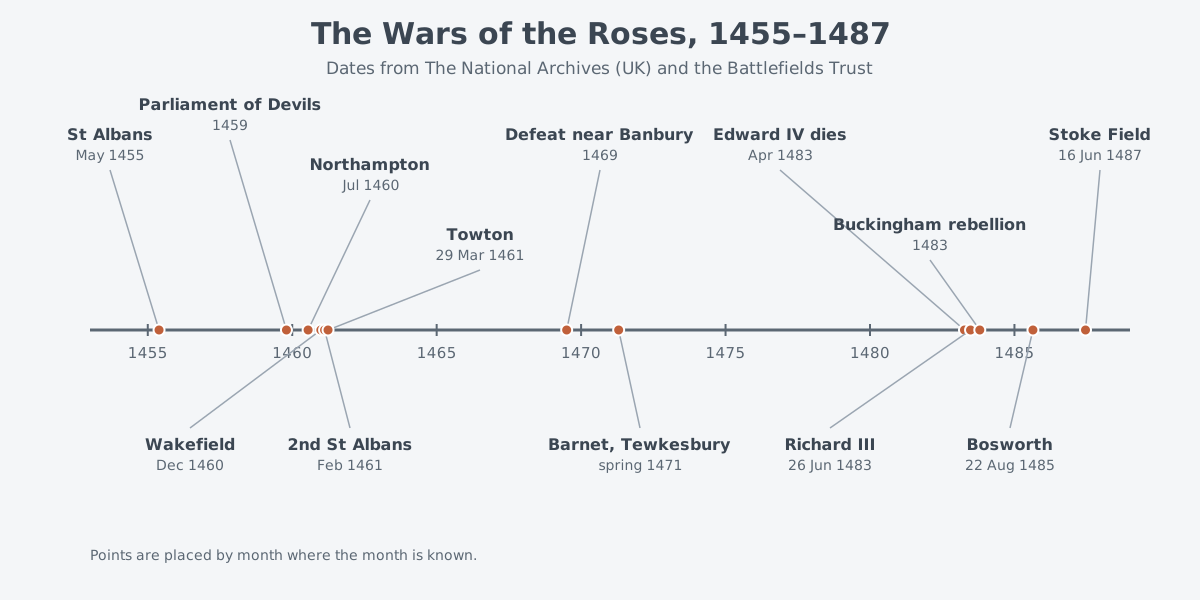
On 22 May 1455, fighting broke out at St Albans in England. It took place in the town's streets, not on an open field. One side was the party traveling with the English king, Henry VI. In the struggle, an arrow struck the king and cut his neck.
How did subjects blocking a royal procession turn into a civil war that lasted more than 30 years? This article follows the conflict now called the Wars of the Roses: why it began, the order in which the crown moved, and how it ended.
The story rests on records published by The National Archives (UK) and on university history material. It also looks at shot and badges found in the ground. Where sources give different numbers, the text says whose number it is.
A baby king and a lost France
The roots go back half a century. In 1399 the Duke of Lancaster, Henry Bolingbroke, seized power from Richard II and took the throne as Henry IV. The crown then passed to his son, Henry V.
Henry VI came into the world at Windsor Castle on 6 December 1421. Nine months later his father died, so a baby became king. Royal power was used in his name from 1 September 1422, and a long regency followed.
Meanwhile, the English position in France collapsed. Normandy was lost in 1450, and English land in France shrank to the area around Calais. Material from the University of Cambridge Faculty of History explains that by then the great lords could no longer pretend the king was really ruling.
Henry VI suffered repeated bouts of a serious mental illness. With the king unable to do his job, two groups formed. A court group around the Duke of Somerset wanted other people to govern quietly in the king's name. Richard, Duke of York, and his supporters wanted a formal council to govern instead of the king.
Then Henry's wife, Margaret of Anjou, sided with one group and brought the king along. That left the other side, whether it wanted to or not, fighting the king himself.
A street fight at St Albans
When the king got better in 1455, York and his allies were afraid they would soon be accused of treason. On 22 May they blocked the king's party as it traveled toward Leicester.
In the streets of St Albans, the Yorkists picked out and killed their personal enemies among the king's followers. This was when the arrow hurt the king. York took Henry back to London and before long was running the government again as Protector of England.
An account by someone who saw the fight survives at The National Archives. The archive describes it as among the first war reports written in English. The bigger battles and the cycle of revenge that ran into the 1480s started here.
The Duke of York claims the throne
Peace after St Albans did not last. In 1459 the "Parliament of Devils" passed attainders against York and the men who backed him. An attainder took away a person's lands and declared him a traitor.
The fighting grew, but nothing was settled. In July 1460 York's side captured Henry VI at Northampton, yet Henry stayed on the throne.
On 10 October 1460, York finally demanded the crown for himself. He argued that his descent gave him a better claim than Henry VI. The lords did not accept this, and the judges refused to rule on it.
Under the compromise, Henry VI would keep the crown until he died, and York would follow him. That cut Henry's son, Edward, Prince of Wales, out of the succession. The deal held for just three months. Fighting resumed, and York died in battle at Wakefield on 30 December 1460.
Towton in the snow
After York's death, Henry VI's army marched south. In February 1461 it beat another Yorkist force in a second fight at St Albans, but London shut its gates, and the army went back north.
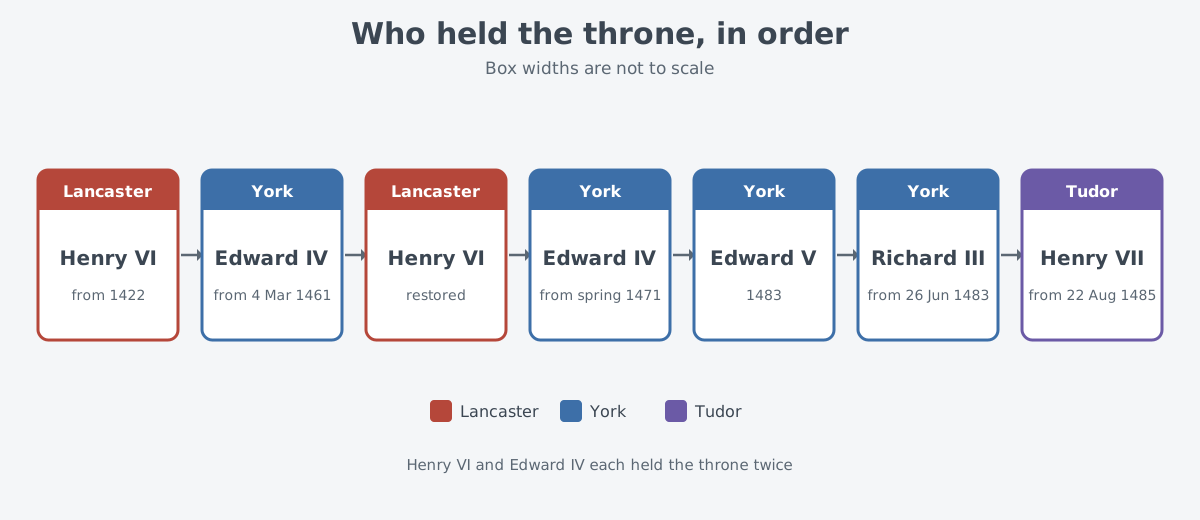
Meanwhile York's eldest son, Edward, came up from the Welsh borderlands. London let him in, and on 4 March he proclaimed himself king. He was Edward IV.
The decisive clash came on 29 March at Towton in Yorkshire. Lancastrians and Yorkists met in the snow, and Edward won. Henry VI escaped to Scotland, and no one was left to challenge Edward's rule.
How many men fought? The National Archives writes that "perhaps 60,000" soldiers took part in what it calls the biggest land battle ever fought in Britain, and that around 28,000 were killed. David Grummitt of The Open University says the often-cited figures of 75,000 participants and 28,000 casualties are unlikely. In his view, far fewer men were involved.
Towton is usually counted as the largest and bloodiest battle in English history. Even so, the exact headcount differs from source to source.
The Kingmaker and the kings who ruled twice
Edward IV's throne was not secure either. In 1464, Lancastrian raids in the north drew the king's armies into battle again.
Edward chose Elizabeth Woodville, a Lancastrian widow, as his queen. The marriage wrecked a plan to tie England to France through a royal match. As the king handed posts to the queen's relatives, Richard Neville, Earl of Warwick, his most powerful ally and known as "the Kingmaker", was pushed aside.
Some people still wanted Henry VI back. In 1468 a man named Thomas Portalen pledged £2 to any army that would restore the Lancastrian king, and he was prosecuted for treason. That did not stop a revolt in 1469, when Edward IV's troops lost a fight near Banbury.
Soon Warwick switched sides and made peace with Henry VI. Edward lost the crown and fled to the Netherlands, and Henry VI was king once more.
Edward came back in spring 1471. He defeated Henry VI's supporters at Barnet and then at Tewkesbury. Henry VI died on 21 May 1471 while held in the Tower of London, and The National Archives writes that he was killed there.
Richard III and Bosworth
Edward IV's second reign was mostly peaceful, with help from his brother Richard, Duke of Gloucester, and other allies. Then Edward died unexpectedly on 9 April 1483, and a new power struggle began.
Gloucester took the role of Protector and announced that Edward IV's children were illegitimate. Edward IV's son Edward V and the boy's younger brother vanished inside the Tower of London. According to The National Archives, Gloucester became Richard III on 26 June 1483, and he was crowned at Westminster Abbey on 6 July.
Within months a rebellion broke out. Richard's former ally, the Duke of Buckingham, turned against him. Richard was traveling without his Great Seal, which weakened his authority, and he added a personal note condemning Buckingham to a document asking for the seal. The rebellion failed, but The National Archives sees it as the pattern that Henry Tudor later followed to win.
After several years in exile in France, Henry Tudor came ashore at Milford Haven in August 1485. On 22 August at Bosworth, his small rebel army faced Richard III's much larger royal army, and Richard was killed in the fighting.
Richard was buried at the Grey Friars in Leicester. His bones were found again recently under a modern car park, and in 2015 they were laid to rest again in a new grave at Leicester Cathedral.
Weapons and badges from the ground
Where exactly was the Battle of Bosworth fought? The Bosworth Battlefield Survey spent five years combining documents, the shape of the land and fieldwork to find the site. Leicestershire's county museum service cares for what it found. After metal detecting across a large area, the survey placed the fighting roughly a mile to the south-west of Ambion Hill, on both sides of Fenn Lane.
The most striking finds are 34 pieces of round shot. No medieval battlefield has produced a bigger group of cannonballs. They are lead shot of several sizes, from bullets fired by handguns to shot from large artillery pieces. They are a trace of gunpowder weapons on this battlefield.
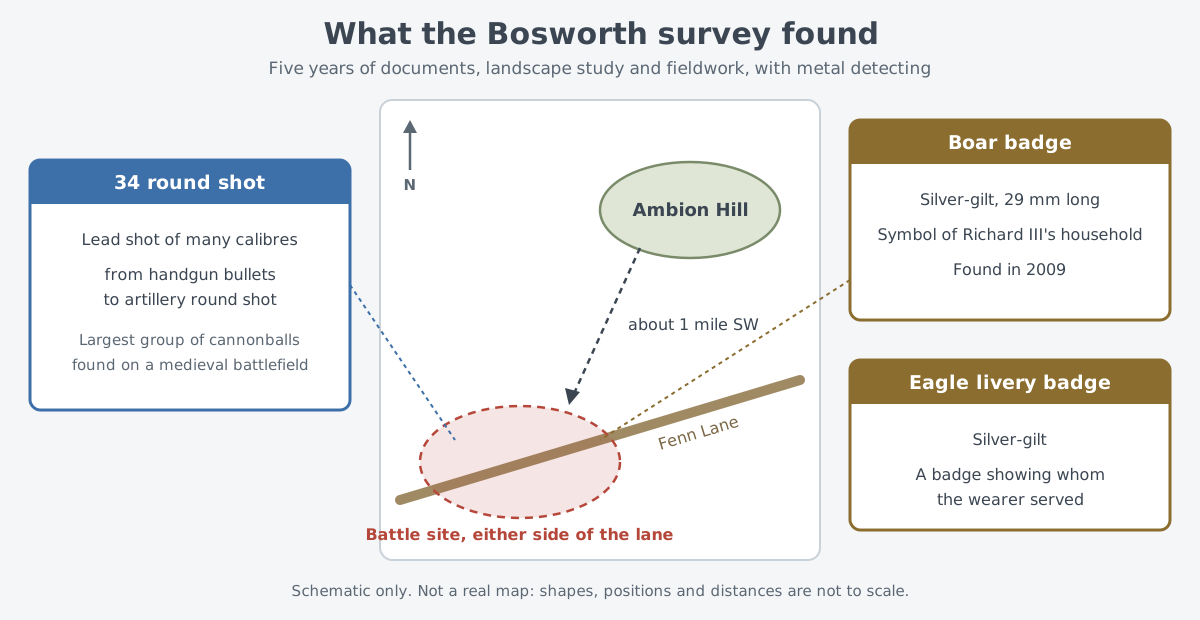
Small badges turned up too. A silver-gilt boar badge only 29 mm long was found in 2009. Richard III's household used the boar as its emblem, and because the badge is gilded silver, its owner was probably someone of high rank near the king. The badge may mark the place where Richard made his last stand.
Badges like this are called livery badges, and they showed whom the wearer served. The survey also recovered a gilded silver livery badge shaped like an eagle. Kevin Schürer of the University of Leicester thinks it is a falcon from the livery of Arthur Plantagenet, an illegitimate son of Edward IV. There is no record, however, of Arthur being at Bosworth.
Livery could be clothing as well as badges. One battlefield of the Wars of the Roses became widely known in the nineteenth century as "Losecote Field". The name comes from rebels throwing off their livery jackets as they fled, to avoid capture.
A weapon English infantry favored in the medieval period was the bill. It is a long staff weapon that grew out of a farm tool for pruning, and the Royal Armouries holds a bill from the late 15th century. At St Albans, the first fight, the king was hurt by an arrow, and at Bosworth, the last great battle, the ground kept shot from guns and artillery. Bows and gunpowder weapons stood side by side in the same war.
The Tudor rose and the end of the wars
The winner at Bosworth became Henry VII and was crowned at Westminster Abbey on 30 October 1485. Through his mother, he traced his line back to John of Gaunt, Duke of Lancaster. In January 1486 he married Elizabeth of York, a daughter of Edward IV, which brought the Lancaster and York families together.
Even so, the fighting did not stop at once. Leading Yorkists tried to unseat Henry in favor of a pretender named Lambert Simnel. Their attempt was settled at Stoke Field on 16 June 1487. The Battlefields Trust says this clash can be seen as the final battle of the whole conflict.
"The Wars of the Roses" is a name added later. It refers to two heraldic badges: the white rose of York and the red rose of Lancaster. The Cambridge material adds that these rose motifs were used relatively little in the fighting. What came out of the ground at Bosworth was a boar and a bird, not a rose.
When the wars ended, a new rose appeared. According to the National Trust, the Tudor family, which joined both sides, created the Tudor rose to stand for the new dynasty. It has white petals at the center and red ones around the outside. In the Lady Chapel at Westminster Abbey, where Henry VII is buried, the Tudor rose appears among Tudor badges, along with the portcullis and the falcon and fetterlock.
In the 30-odd years from the street fight of 1455 to Stoke in 1487, the English crown passed through five men. Two of them, Henry VI and Edward IV, became king twice. In the words of The National Archives, it was Henry VII who ended open conflict.
What to read next
- The Hundred Years' War at a Glance: What Happened Over 116 Years: the long war England fought in France before the Wars of the Roses.
- Crécy and the Longbow: The Real Story Behind Bows Beating Knights: how English bows and infantry were used.
- Turning points in military technology: other moments when new weapons changed the shape of the battlefield, like the shot at Bosworth.
- A history of laser weapons: from chemical to electric lasers: to follow the story of weapons all the way to today's lasers.