On December 22, 1864, Major General William Tecumseh Sherman, now inside Savannah, Georgia, sent a telegram to President Lincoln in Washington. He offered the city as a Christmas gift, along with 150 heavy guns, plenty of ammunition and about 25,000 bales of cotton. The message also meant that an army that had left Atlanta a little over a month earlier had crossed Georgia and reached the Atlantic.
The word "gift" hides how disputed this march still is in the United States. About 60,000 soldiers cut their supply line and fed themselves from the land. Railroad rails were heated and bent out of shape, and many people followed the army toward freedom.
Why did Sherman head for the sea, how did his army move, and what did it leave behind? This article also looks at why the numbers and the judgments differ from source to source.
The sources are battlefield pages from the National Park Service (NPS) and public writing from the National Archives and the Library of Congress. A historian's essay and the orders printed in Sherman's own memoirs fill in the rest.
The road to Atlanta
In March 1864 Ulysses Grant took command of all Union armies and ordered a coordinated offensive to crush Confederate resistance and finish the war. Grant faced Robert Lee's army in Virginia, while Sherman took charge of the push into Georgia.
Sherman led 100,000 soldiers in three armies gathered near Chattanooga, Tennessee. Facing him were 53,000 Confederates of the Army of Tennessee, led by Joseph Johnston. Grant told Sherman to break up Johnston's army and to get as deep into enemy country as he could.
The target, Atlanta, was a manufacturing city. More important, it was a rail junction where four railroads met. Those lines tied the southern Atlantic coast states to the western Confederacy.
The fighting began on May 7 and went on almost every day across north Georgia until September. On July 17 John Bell Hood replaced Johnston in command. During the final siege Sherman's troops cut the railroads into the city, and the Confederates left Atlanta on September 1. Sherman entered the next day.
Why march to the sea
Sherman held Atlanta, but Hood's army was still in the field. Hood moved north and attacked the Western & Atlantic Railroad that supplied Sherman, along with the small posts protecting it. He then moved into Alabama to prepare an advance into Tennessee.
Sherman's answer was to split his force. He would lead 62,000 picked men on a march meant to destroy, and George Thomas would hold Hood in Tennessee with the remaining troops.
Lincoln and Grant would have preferred that Sherman destroy the Confederate army first, according to historian John F. Marszalek. Sherman won over Grant, and Grant then convinced the president. Once Grant approved, Sherman returned to Atlanta to get the march ready.
Sherman was aiming at more than an army in the field. The NPS biography at Fort Sumter says he targeted the Confederacy's economy and its psychological will to keep fighting. There were several goals: to come up behind Lee's army and ease the pressure on Grant in Virginia, and to destroy infrastructure.
Politics was part of the picture too. Lincoln was reelected on November 8, 1864, and the NPS says the capture of Atlanta and the pursuit of Johnston's army helped him win. The march began a little over a week later.
A timeline, November–December 1864
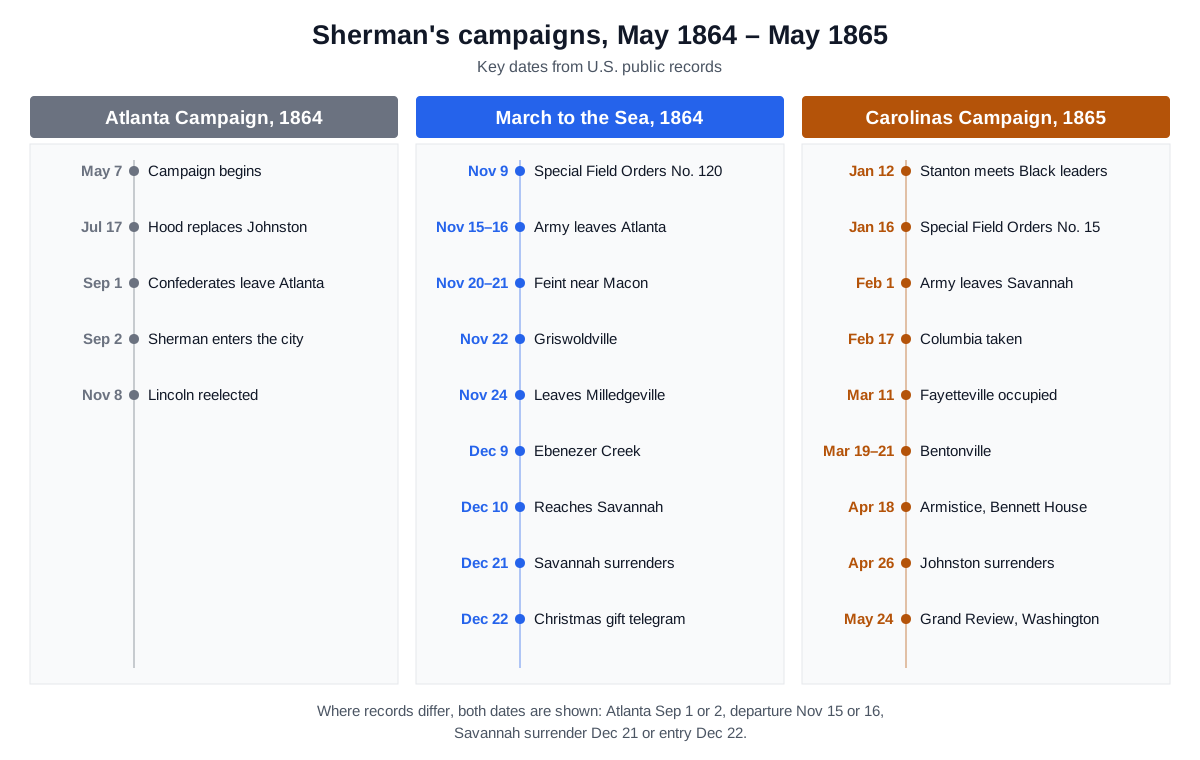
On November 9, a week before leaving, Sherman set the rules of the march in Special Field Orders No. 120. The army left Atlanta on November 16. Marszalek gives the date as November 15.
At first the direction was kept vague on purpose. The two wings moved so that the Confederates could only guess whether Savannah, Macon or Augusta was the goal. A small fight at Walnut Creek near Macon on November 20–21 was a feint to cover the main body as it passed through middle Georgia. The real goal was Milledgeville, the state capital.
On November 22 the one true battle of the march broke out at Griswoldville. Three brigades of Georgia militia, heading from Macon to Augusta, ran by accident into Brigadier General Charles Walcutt's brigade, which had built a position of logs and fence rails.
The militia charged three times, and estimated casualties were 712, with 62 Union and 650 Confederate. After the shooting stopped, Union soldiers found that the militia they had fought was made up of old men and boys.
At Milledgeville the legislature widened the state draft to men from 16 to 65. Governor Joseph Brown decided to move the capital to Macon so the state's records would be safe. Union soldiers wrecked state buildings and ruined books and papers before leaving on November 24, one week after leaving Atlanta.
On December 10 the army reached the outskirts of Savannah. Confederate defenses kept it from linking up right away with the Union Navy offshore. The right wing then took Fort McAllister at the mouth of the Ogeechee River, which let the army surround the city.
When the troops of Confederate general William Hardee slipped away, the mayor of Savannah surrendered the city. A Library of Congress blog gives the formal surrender as December 21. The Fort Pulaski park page says the city did not fall until Sherman entered on December 22, the day the Christmas telegram went out.
An army without a supply line
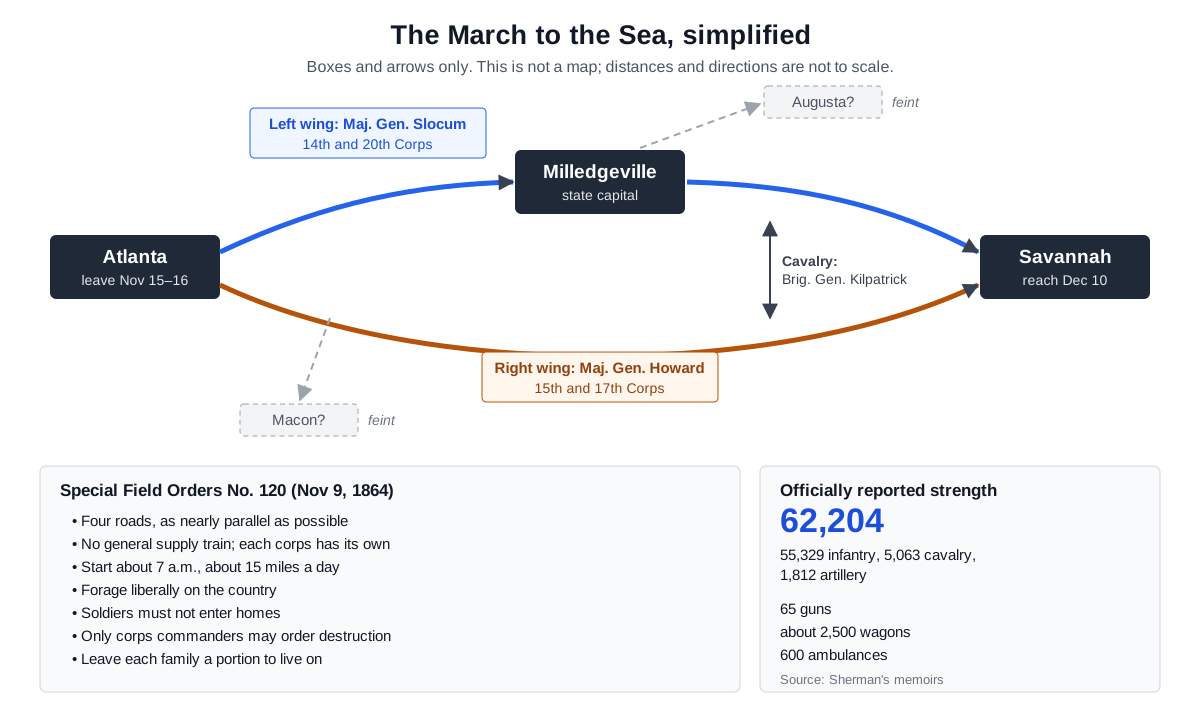
Special Field Orders No. 120 split the army into two wings. The right wing, under Major General Howard, held the 15th and 17th Corps. The left wing, under Major General Henry Slocum, held the 14th and 20th Corps.
The cavalry of Brigadier General Judson Kilpatrick took its orders straight from Sherman. The army moved on four roads, as nearly parallel as possible.
The biggest change was that there was no general supply train. Each corps kept only its own ammunition and food wagons, and the columns usually started at 7 in the morning and covered about 15 miles a day. The officially reported strength was 55,329 infantry, 5,063 cavalry and 1,812 artillery, for 62,204 in all. Sherman cut his guns to 65, and about 2,500 wagons and 600 ambulances came along.
Food came from the land. The army was to "forage liberally on the country." Each brigade was to form a foraging party under careful officers and to keep at least ten days of food and three days of animal feed in the wagons.
The same order also drew lines. Soldiers were not to enter people's homes or trespass, and only corps commanders could order mills, houses or cotton gins destroyed. Nothing was to be destroyed where the army was left alone, and foragers were to avoid abusive or threatening language and try to leave each family enough to live on. Where people burned bridges, blocked roads or showed hostility, though, the order called for destruction in proportion to it.
In practice those lines were often crossed. The foragers soon got the name "bummers." They ranged five miles or more from the main columns, caused the worst harm in the countryside while also gathering most of the army's food.
Sherman admitted that foragers likely committed many acts of pillage and violence, but he argued that their crimes were mostly against property, not people. Many houses were damaged and some were burned, while others were left almost untouched.
The railroads were wrecked on purpose. Soldiers pulled up the wooden ties, stacked and burned them, and heated the iron rails in the fire until they bent out of shape and could not be used again. The twisted rails became known as "Sherman's neckties." This damage crippled Confederate supply lines, but it often hurt local civilians, including enslaved and formerly enslaved people.
The Confederate forces in the way were few and weak. The strongest was the cavalry of Joseph Wheeler, 3,500 riders, and Kilpatrick's 5,000 Union horsemen pushed it aside. Sherman also cut the telegraph lines so that word of his moves would not reach the enemy.
People who followed the army to freedom
As the march went on, more and more people who had been enslaved followed the army. Many greeted the Union soldiers as liberators. Some became laborers doing work the march needed, and others simply walked behind the columns.
Each corps was also to have a pioneer battalion, made up of Black men if possible, to repair the roads. Writer J. D. Dickey puts the number who left plantations and farms during the march at more than 10,000.
Sherman worried that the people following him would slow the army and eat food meant for his soldiers. The march order let able-bodied Black people come along, while naming the army's first duty as caring for those who bore arms. The racism of the age ran through the ranks of this army of liberation too.
On December 9, 1864, the rear guard of Union general Jefferson C. Davis used a pontoon bridge to cross Ebenezer Creek, which was in flood. The line of refugees behind it had been told to wait for a signal. Then, once the final unit of the rear guard got across, the bridge was cut loose.
Fearing Confederate cavalry, people jumped into the water. Some were pulled out on rafts or by soldiers who went into the creek, but many drowned or were captured by Confederates.
How many people were there differs by record. Marszalek describes a line of some 650 refugees. The Georgia Historical Society marker says hundreds drowned. Sherman defended Davis.
After a public outcry, on January 12, 1865, Secretary of War Edwin Stanton sat down in Savannah with Sherman and local Black leaders. Special Field Orders No. 15 followed on January 16.
The order set aside three kinds of land for the settlement of freed people. These were the islands south of Charleston, abandoned rice fields along rivers up to 30 miles inland, and land along the St. Johns River in Florida.
Each family could hold no more than 40 acres of farmland, and the freed people were to run the affairs of the islands and settlements themselves. The inspector of settlements, General Saxton, was to give each head of family a written possessory title. Sherman also decided to lend mules to settlers.
The Georgia Historical Society marker says the coastal land covered by the order came to more than 400,000 acres.
The promise did not last. President Andrew Johnson's Amnesty Proclamation of May 29, 1865 rolled the effort back. In the second half of 1865 thousands of freed people were suddenly evicted from land they had been given. Apart from a small number with legal titles, they lost that land.
From Savannah to the Carolinas
Sherman left Savannah on February 1, 1865 and headed north into the Carolinas. On February 17 his army took Columbia, the capital of South Carolina, and the same day the Confederates left Charleston. The NPS page at Fort Sumter says Sherman "captured and sacked" Columbia. With their supply lines and communications cut, the Confederates gave up Charleston Harbor, including Fort Sumter.
Marszalek writes that destructive war returned in the Carolinas, and that South Carolina suffered more than Georgia had. In his account, North Carolina was hit less hard, since people did not blame it for the rebellion the way they blamed South Carolina.
After taking Fayetteville, North Carolina, on March 11, Sherman's army fought Johnston's Confederates at Averasborough on March 16 and at Bentonville on March 19–21. At Bentonville five Confederate attacks failed to drive the Union troops off, and Johnston withdrew at night. Estimated casualties were 4,133, 1,527 Union and 2,606 Confederate.
Johnston and Sherman signed an armistice at the Bennett House on April 18. The formal surrender followed on April 26. Every Confederate force in Georgia, Florida and the Carolinas laid down arms with him, making it the biggest Confederate surrender of the whole war. On May 24 Sherman's army marched in the Grand Review in Washington.
The campaign from Georgia through the Carolinas did heavy damage to Southern industry, farming and infrastructure. Sherman later estimated the destruction at $100 million.
Where numbers and judgments differ
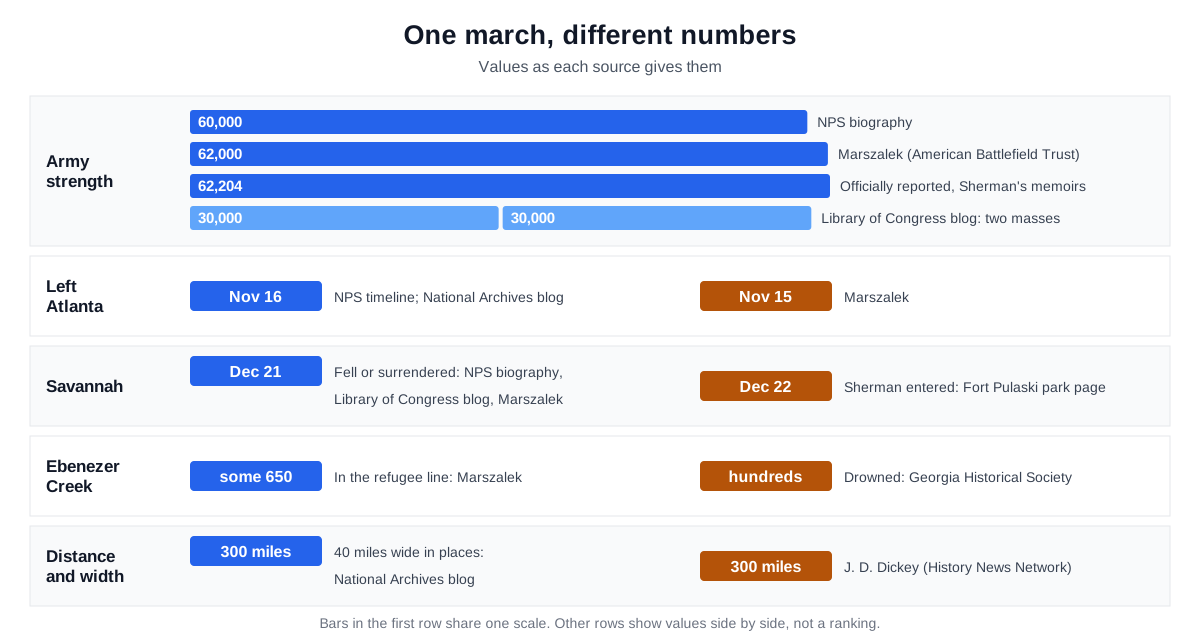
Even for the same march, the numbers differ from source to source. For strength, the NPS biography gives 60,000, Marszalek 62,000 and the official return in the memoirs 62,204. A Library of Congress blog describes two masses of 30,000 each. The departure date is given as November 16 or November 15.
Dates differ too. Some records date Savannah by its surrender on December 21, others by Sherman's entry on December 22. For Atlanta, both September 1, when the Confederates left, and September 2, when Sherman entered, are used. A National Archives blog gives the march as 300 miles and the band of destruction as 40 miles wide in places.
The judgments differ even more. The NPS calls the march's tactics brutal and says they made civilians feel the devastation of war. The National Archives blog says Sherman employed total war, and Sherman himself left the line "War is cruelty."
Marszalek sees it another way. Sherman did wage destructive war, he argues, but not out of personal cruelty; he wanted to end the war quickly with the fewest deaths on both sides. He calls Sherman "the American father of total warfare" and estimates fewer than 3,000 casualties in the six-week march. He adds that the march is still remembered as barbarism.
Dickey writes that Sherman himself called this strategy "hard war." In his view, Sherman's reputation has swung between hero and villain depending on who is writing. Southern attitudes shifted sharply from the 1880s, and from the 1960s the "Lost Cause" view lost ground among historians.
Dickey's conclusion is that Sherman can never be fully celebrated or fully condemned. To celebrate him is to approve of theft and arson against civilians. To condemn him is to ignore his part in breaking plantation slavery.
What to read next
- The American Civil War at a Glance: 1861 to 1865: the whole war, from the first shots at Fort Sumter to the surrender at Appomattox, and where this march fits in it.
- Railroads and the Telegraph: What Made the Civil War Industrial: why a rail junction like Atlanta mattered so much.
- Military logistics: performance must be sustainable: why feeding and moving an army has always mattered as much as its weapons.
- Turning points in military technology: the big shifts in technology that came after the railroad and the telegraph.
- A history of laser weapons: from chemical to electric lasers: the path of laser weapons, the central topic of this site.