In AD 9, three Roman legions were destroyed in the forests and marshes east of the Rhine. Their commander was Quintilius Varus, governor of Germania. The man who led him into the forest was Arminius, a Germanic noble who had served with the Roman army and reached equestrian rank. The Varus Battle, the Hermann Battle and the Battle of the Teutoburg Forest are three names for this one event.
The Kalkriese Museum explains that the defeat brought an abrupt halt to Rome's plan to turn Germania into a province. Roman troops crossed the river again a few years later, yet the Rhine stayed Rome's frontier for a long time. So did one lost battle in a forest really fix the border of an empire?
Answering that starts with the records. Every written account of the battle comes from the Roman side: Velleius Paterculus, Cassius Dio, Suetonius and Tacitus. Since 1989, excavations have added a new kind of evidence.
Building a province beyond the Rhine
Rome had looked east of the Rhine for years. The first military bases on the Rhine were built in the last decades BC to conquer Germanic land across the river. In his record of achievements, the Res Gestae, Emperor Augustus wrote that he had pacified Germany along the ocean coast, from Gades up to where the Elbe meets the sea. A note in the Loeb edition reads this as moving the border, for a time, eastward beyond the Rhine all the way to the Elbe.
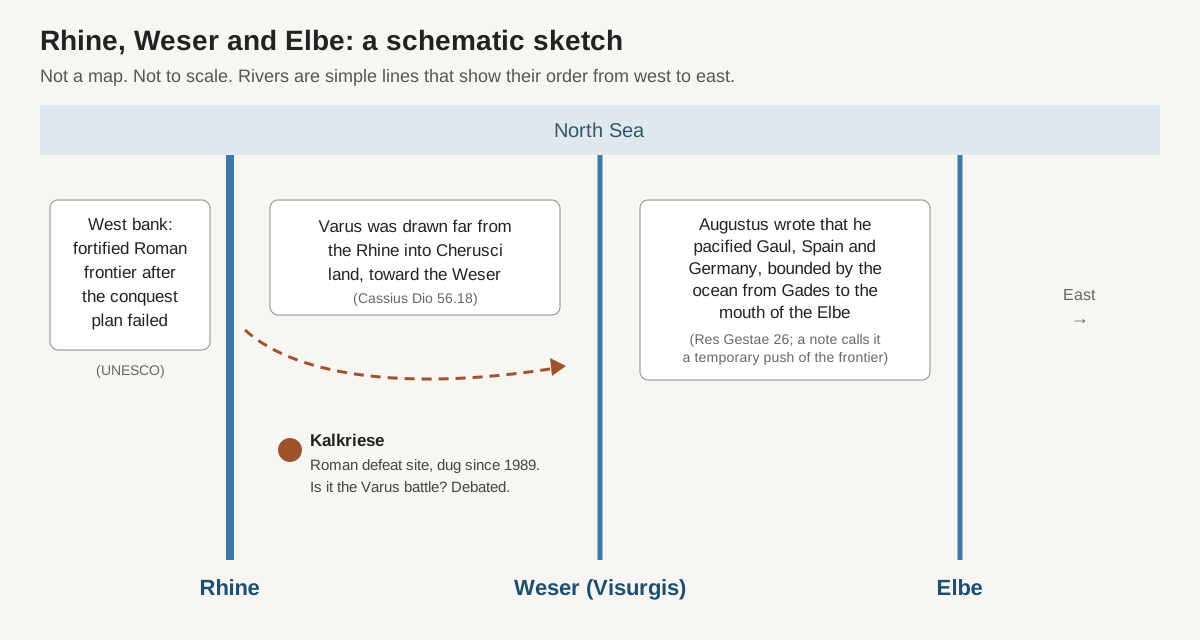
Just before the battle, Rome held only the districts it had subdued, not the whole country. Soldiers wintered there and towns were being founded. Local people were getting used to Roman ways, holding markets and meeting peacefully.
Rome had spent more than 20 years trying to subdue the tribes in the land between the Rhine and Elbe rivers. Romans believed Germania was close to becoming a province.
Varus and Arminius
In Dio's telling, things changed when Varus arrived as governor. He tried to change the people faster, gave orders as if they were slaves, and took money as if from conquered nations. Seeing large Roman forces along the Rhine and inside their own territory, the people did not revolt openly. Instead, they pretended to do everything Varus asked.
Arminius was a man of the Cherusci, the son of the Germanic leader Sigimer. He had campaigned with the Roman army again and again and had gained equestrian rank. He spent much of his time with Varus and often ate at his table, yet he stood at the center of the plot.
There were warnings. Segestes, a man of the same people, told Varus about the plot, but Varus did not believe him. He also ignored others who urged caution.
By then Varus had gone deep into Cherusci land, far from the Rhine and toward the Weser (Visurgis in Latin). In hostile country he should have kept his legions together. Instead, he sent many soldiers off to different communities.
Four days in the forest
The first move was an uprising among tribes living far from Varus. It had been planned on purpose to draw him out. When Varus marched against it, the attack began in the middle of forests that were by then almost impossible to pass.
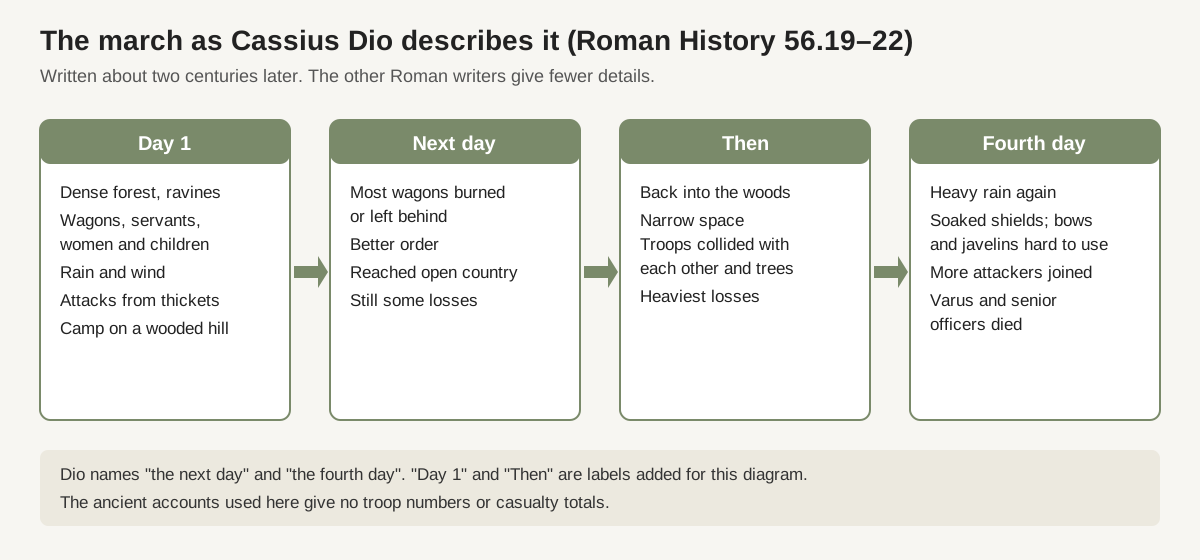
The route itself was hard. Ravines cut across the hills, and the tall trees stood packed together. Even before the enemy struck, the Romans struggled to cut trees, build roads and bridge gaps. Heavy rain and wind split the column further, and soldiers were mixed in with wagons and unarmed people, unable to form proper ranks.
The Romans made camp in the best spot they could find on a wooded hill, then burned or left behind most of their wagons and anything not strictly needed. The next day they moved in better order and reached open country, but still took losses. Back in the woods, they suffered their heaviest losses. In the narrow space, cavalry and infantry tried to form lines together and kept colliding with each other and with the trees.
On the fourth day, heavy rain and wind came again. Varus and his senior officers, already wounded and fearing capture or death at enemy hands, took their own lives. Velleius sums it up briefly: the army was trapped by forests, marshes and ambushes. Dio wrote his account of these days two centuries after the battle.
The marching column and its gear: conditions in the record
The soaked equipment is also in the record. The Romans could not use their bows and javelins well, and their shields were drenched. Their opponents were mostly lightly equipped, could close in and pull back freely, and suffered less from the storm.
There was a reason the column was so long. As in peacetime, the army brought many wagons and pack animals, with many servants and a fair number of women and children trailing behind. This was one more reason the troops advanced in scattered groups. Moving what an army needs to eat, dress and travel, in other words logistics, shaped the march even 2,000 years ago.
The excavations connect with this picture. The finds at Kalkriese show a unit on the march, carrying its baggage and personal belongings. In 2018, a Roman segmented armor (Schienenpanzer) came out of the ground, the first such body armor ever found complete.
Still, the records stress different things about the same defeat. Dio writes at length about weather and terrain. Velleius, who served under Tiberius, blamed the loss more on the commander's poor judgment than on the soldiers' courage. Reading both keeps either one from setting the whole story.
Rome's response and the Rhine frontier
Putting Velleius and Suetonius together, three legions were destroyed along with three cavalry units, six cohorts, their general, his officers and all the auxiliaries. The three legions were the 17th, 18th and 19th. None of the ancient sources gives a total death toll.
Not everyone was lost. Varus's nephew Asprenas protected the army with the two legions he commanded. People shut inside the fort of Aliso were besieged by a large Germanic force, then fought their way back to their side.
The Germans took every stronghold but one. They failed there because they did not know siege methods and the Romans used many archers.
Rome was badly shaken. Augustus feared not only for the lost soldiers but for Rome's provinces in Germany and Gaul, and even for Italy and Rome. When nobody of fighting age would enlist, he made them draw lots.
Suetonius passes on a story, as something "they say," that the emperor left his beard and hair uncut for months and cried, "Quintilius Varus, give me back my legions!" Augustus kept the day as one of mourning every year.
The Roman army soon came back. Rome first pulled back across the Rhine, then crossed again a few years later with eight legions.
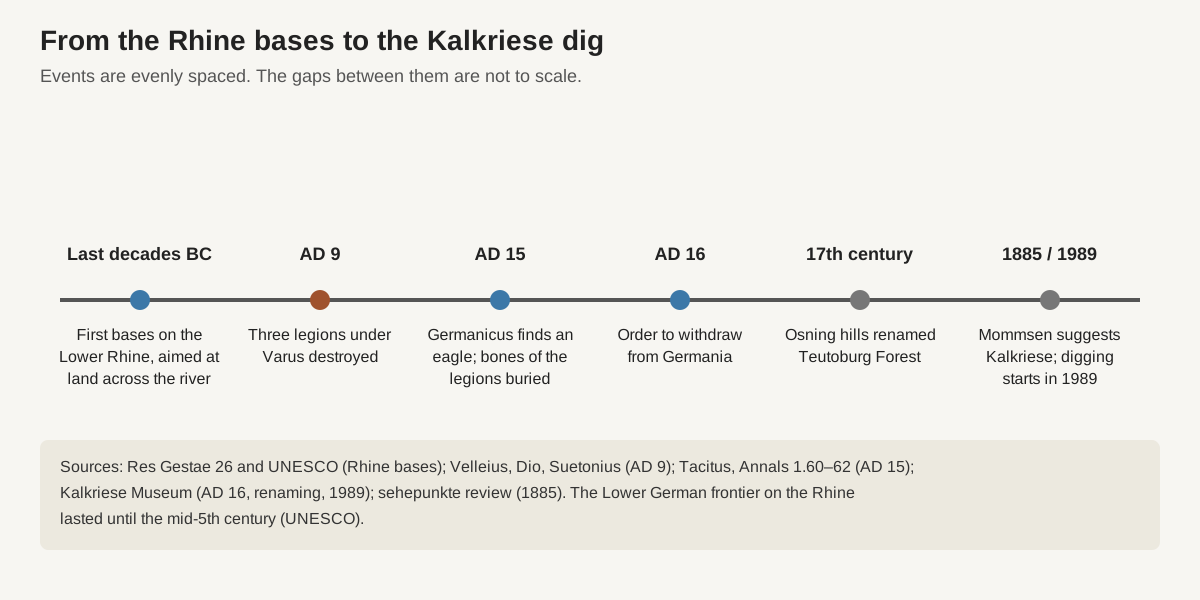
In AD 15 Germanicus's army recovered the lost eagle, or standard, of the 19th legion. Six years after the battle, at the old battlefield not far from the Teutoburg Forest, they buried what was left of the three legions. In Rome, an arch was dedicated to mark the return of the eagles Varus had lost.
The campaign did not last. Emperor Tiberius wrote to Germanicus again and again, calling him home. There had been enough successes and enough setbacks, he wrote, and with Roman vengeance done, the Cherusci and other tribes could be left to their own quarrels. The order to withdraw came in AD 16 after three costly years, and Rome dropped its aggressive Germania policy for decades.
A document Augustus left points the same way. Tiberius had the senate read a list written in Augustus's own hand, covering the empire's troops, provinces and taxes. Its last clause advised keeping the empire inside its current borders. Tacitus leaves the reason as a question: fear, or jealousy?
The result was the Rhine frontier. Once the ambition of conquest failed, the left (west) bank of the Rhine became a fortified frontier. This Lower German Limes ran for 400 km along the Lower Rhine and lasted until it fell apart with the Western Roman Empire in the mid-5th century.
UNESCO's text does not pin the failure on one battle. Taken together, the records show Varus's defeat, several costly campaigns and the choices of two emperors adding up to a border that stopped at the Rhine.
Arminius's end is recorded too. After the Romans withdrew, he reached for kingship, ran into resistance from his own people and fell through the treachery of his relatives. Tacitus, a Roman historian, still called him "undoubtedly the liberator of Germany."
Where was it fought? Kalkriese and open questions
Even the name "Teutoburg Forest" has a story. According to the Kalkriese Museum, Tacitus is the only ancient writer who mentions, in passing, that the fighting took place near the Teutoburg Forest. No map showed a range by that name before the Osning hills were renamed in the 17th century. The new name was chosen because people liked it, not because of any evidence about the battle.
After that, almost every part of northwestern Germany was put forward as the battlefield.
The historian Theodor Mommsen proposed Kalkriese in 1885. Digging around Kalkriese, a village in the Osnabrück district, began in 1989, and since 1998 the work has been done together with Osnabrück University. The Kalkriese Museum says thousands of Roman finds show that Roman troops suffered a crushing defeat there. In its view, many arguments point to Kalkriese being among the places where the Varus Battle was fought.
Scholars have not settled the matter. A 2008 review in the academic journal sehepunkte says the Kalkriese finds seemed to confirm Mommsen's idea, but that dissenting voices soon created a controversy. A study published in 2025 analyzed about 5,400 small finds from the early imperial period.
The publisher's description says it proves that Roman infantry and cavalry units fought a battle there. The date falls between the late reign of Augustus and the time of Tiberius. Yet the tangle of archaeological and historical evidence has so far prevented a final verdict on the site.
In short, Kalkriese is clearly a place where Roman troops suffered a heavy defeat. Whether it is where Varus's army made its last stand is still an open question. The battle has also carried great weight in modern times. The Kalkriese Museum says few historical events have fed German identity and German nationalism as strongly as this one.
Comparing old texts with evidence from the ground is also a useful habit when reading weapons news today. Asking who wrote something, from what position, and where a number came from is the subject of How to read laser weapon news.
What to read next
- How the Roman legion was organized and supplied is covered in "The Roman Legion: The Organization and Roads Behind an Empire."
- For a modern look at how wagons and supplies tie an army down, see Military logistics: performance must be sustainable.
- Moments when weapons and organization changed sharply are collected in Turning points in military technology.