At eight o'clock on the night of 3 July 1754, a single sheet of paper changed hands at a small fort. It had been hastily built in a meadow in the woods of what is now Pennsylvania. George Washington, leading the Virginia militia, signed the surrender terms offered by a French commander. The document was written in French, and one word in it soon became a quarrel between two empires.
Within a few years, this woodland dispute had spread to the kingdoms of Europe and to Bengal in India. It reached islands in the Caribbean and the waters off France's western coast. Britain's National Army Museum says that the Seven Years' War, fought from 1756 to 1763, "can claim to be the original 'world war'." The clashes between Britain and France in North America and India were folded into a Europe-wide war.
How did the forests of North America, the fields of Germany, a riverbank in India and the reefs of the Atlantic coast become one war? This article puts the four theaters on a single timeline, then follows the story to the two treaties at the end and the debts that came after.
A small fort in the Ohio woods
Start with a map of North America in 1753. Britain held 13 colonies running from the Atlantic coast up to the Appalachian Mountains. Past the mountains lay New France, which reached from Louisiana up the Mississippi basin and around the Great Lakes into Canada. It was a very large colony, but few people lived there.
The border between the two was not well defined. The sharpest dispute was over the upper Ohio River valley, where France built a number of forts to strengthen its claim. When fighting began, the French, their settlers and the Native nations allied with them formed one side. The other side joined Britain and its American colonists with the Iroquois Confederacy, whose lands covered much of what is now upstate New York.
In 1753 Virginia's governor had sent Washington into the Ohio country to warn the French off settling there. In May of the next year Washington camped at a clearing called the Great Meadows. With Half King, a Seneca leader, he surrounded a party of French soldiers nearby. Joseph Coulon de Jumonville, a French commander, was killed in the fight.
By late June a much larger French force returned, with Native allies beside it. According to the U.S. National Park Service, seven different tribes fought on the French side on 3 July, and the British side surrendered after heavy losses. The terms granted Washington's men the "honors of war." They could march out with drums beating and take a small cannon with them.
The trouble lay in two places: the document's second paragraph and its seventh article. Both called Jumonville's death an "assassination" (assassinat). Washington denied that the killing was an assassination and said his translator had rendered the word as "loss" or "death of."
One National Park Service article says that by signing, Washington in effect agreed to having assassinated Jumonville. It was the only time in his life that Washington surrendered to an enemy, and after the surrender the French burned the fort.
The next year Britain sent General Edward Braddock to North America as commander in chief. His target was the French Fort Duquesne, on the site of present-day Pittsburgh.
His roughly 2,400 men and their heavy guns could not move quickly on the narrow forest road, so Braddock split his force. In July 1755 he was ambushed near Fort Duquesne, and over half of the 1,200 British soldiers in his party were killed. Braddock himself died on 13 July of the wounds he received there.
In the United States this fighting is often called the French and Indian War. The State Department's Office of the Historian describes it as the North American part of a larger imperial war known as the Seven Years' War, running from 1754 to 1763. One National Park Service article instead dates the same war 1756–1763. Fighting in North America began first, in 1754, and the National Army Museum dates the Seven Years' War as a whole 1756–1763.
Hanover, Saxony and Silesia: the war in Europe
In Europe the spark was Hanover, in northern Germany. King George II of Britain also ruled Hanover, and with the war in North America going on, France got ready to strike there. In early 1756 Britain signed a treaty with Prussia, which promised to help defend Hanover. France answered by allying with Austria.
Fighting in Europe opened in June 1756, when France seized Menorca, a British-held island in the Mediterranean. Two months later Prussia attacked its neighbor Saxony, and Austria declared war on Prussia. Soon nearly every large European state was in the war.
Seen from Prussia, the story starts a little earlier. Frederick II, who came to the throne in 1740, had taken the Austrian province of Silesia in two Silesian Wars.
In 1756, the German Historical Museum explains, he learned of a coming alliance of Austria, France, Saxony and Russia against Prussia. To get ahead of the expected attack, he invaded Saxony on 29 August 1756 without declaring war. In early 1757 most of the princes of the Holy Roman Empire voted to send an imperial army against Prussia as the aggressor.
In 1757 Frederick beat the imperial army and French forces at Rossbach, and an Austrian army more than twice his size at Leuthen. These two victories spread a cult around him, far beyond the German states, as an almost unbeatable commander. Yet on 12 August 1759 at Kunersdorf he suffered a defeat that came close to destroying his army.
Why did Prussia not collapse? Part of the answer lay with its enemies. The Russian and Austrian commands could not agree, so the allies never forced a decision. Prussia held on for two more years, even with half of Silesia, parts of Saxony and all of Farther Pomerania occupied.
In 1762 Empress Elizabeth of Russia died suddenly. Her successor, Peter III, left the alliance and made a separate peace with Prussia on 5 May 1762, and Sweden also made a separate peace that year. The event is known as the "Miracle of the House of Brandenburg."
There was also a front around Hanover. In July 1757 an army under the Duke of Cumberland lost to the French at Hastenbeck, and on 1 August 1759 Ferdinand of Brunswick won at Minden. At Minden a brigade of foot soldiers from Britain and Hanover misread its orders and advanced head-on toward 60 squadrons of French cavalry, yet held its ground when counterattacked.
A timeline across four theaters
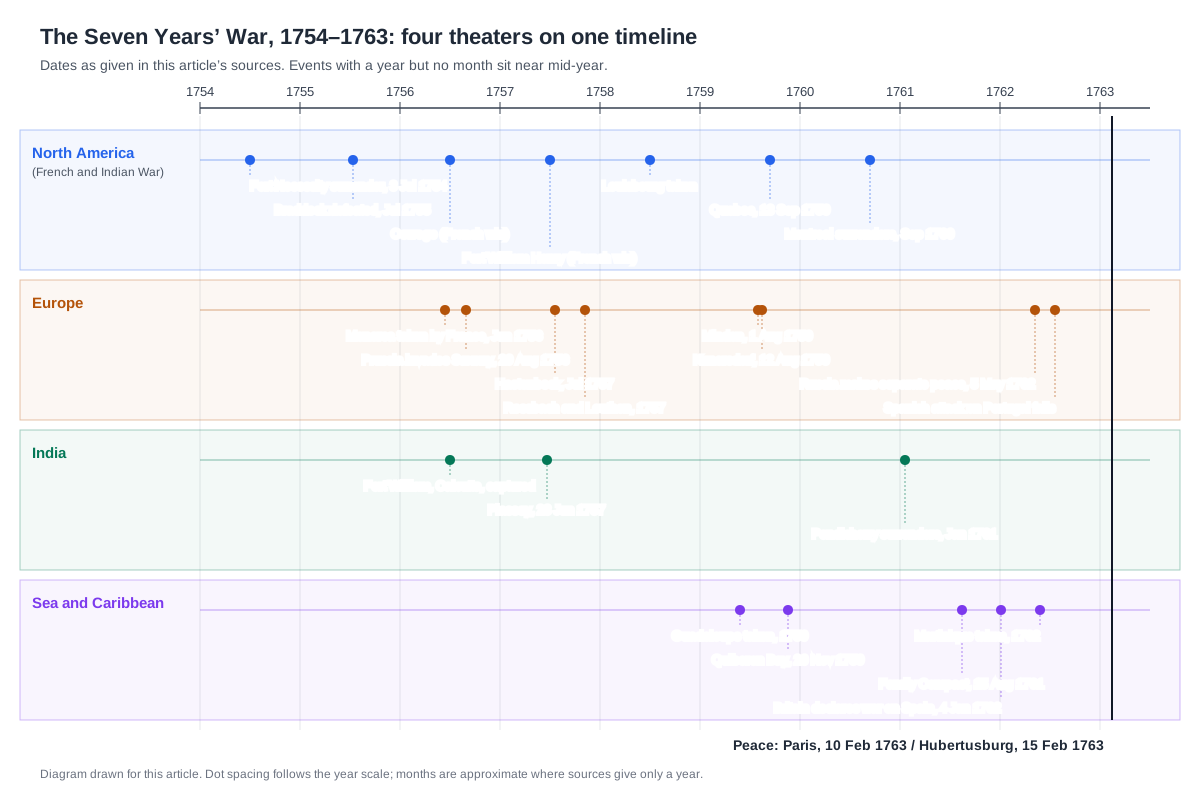
In North America the French led in the early years. France won at Oswego in 1756 and at Fort William Henry in 1757. But France, worried about British naval power, would not risk large convoys to North America and put more of its effort into the war in Europe. The Office of the Historian notes that from 1757 on, the tide started to shift toward Britain.
In 1758 Britain took the fortress of Louisbourg, in what is now Nova Scotia, Canada. That opened the way by sea up the St. Lawrence River to Quebec, the chief French town on the continent. On 13 September 1759 the British won on the Heights of Abraham outside Quebec, and in September 1760 Montreal also surrendered. Warriors of the Iroquois Confederacy helped win the final victory that led to Montreal's surrender.
In India the Mughal Empire was collapsing, and Indian and European powers were each trying to build their own base of power. Britain's East India Company was among them. After the Seven Years' War broke out, the Company refused to halt its military preparations against the French. Siraj-ud-Daulah, ruler of Bengal with the title of Nawab, then captured its Fort William at Calcutta, today's Kolkata.
Prisoners then died in a small dungeon. This event, known as the "Black Hole of Calcutta," rests on the account of one British survivor and has been argued over ever since.
On 23 June 1757, at Plassey, about 160 km north of Calcutta, Company troops under Robert Clive faced the Nawab's army. Before the battle, the Company and a Bengal banking family had secretly offered to make Mir Jafar, one of the Nawab's commanders, the new nawab. During the battle Mir Jafar, at the head of the Nawab's horsemen, held back from the fight. Clive's side lost 22 killed and 50 wounded, while the Nawab's side suffered more than 500 casualties.
French power in India ended in January 1761, when Pondicherry gave up after months of siege by land and sea forces together. In 1765 the Mughal emperor Shah Alam II granted Clive the diwani, which let the Company gather Bengal's taxes and customs duties. The National Army Museum judges that the Company was by then no longer a purely commercial body but an imperial power.
The sea and the Caribbean were theaters too. Britain took Guadeloupe, the richest French island in the Caribbean, in 1759, and Martinique in 1762.
On 15 August 1761, King Charles III of Spain and King Louis XV of France signed an alliance called the Family Compact. Britain declared war on Spain on 4 January 1762. British forces then seized Spanish Cuba and the Philippines, and a Spanish invasion of Portugal failed.
Volleys, light infantry and blockading fleets: the forces of the time
One phrase keeps coming up in accounts of the infantry fighting in this war: the musket volley. Soldiers stood in ranks and fired together.
Braddock's defeat shows how this could fail in a forest. He had worked to prepare his men for fighting among trees. Even so, once the ambush struck, the poorly prepared troops fired useless volleys into the trees before breaking and running.
The British Army learned from it. Each existing regiment gained a light company, made up of soldiers able to scout, fight in loose order and make good use of cover. In time, entire light regiments were formed to serve in America.
Open ground was another matter. At Quebec, the Marquis de Montcalm set out his troops in a traditional formation, one that worked only with soldiers drilled to move together in precise order.
The National Army Museum says many of his soldiers had little practice moving as one body and tended to shoot on their own. At close range, that sharply weakened the punch of their massed fire. James Wolfe's regulars, by contrast, were used to fighting in ranks and firing quick, disciplined volleys, and they were placed behind a ridge out of reach of the French batteries. For the opening volley, Wolfe had his men load each musket with two charges.
Getting to Quebec took skill of its own. Scouting the river, the British found a cove that flat-bottomed landing craft could reach. They landed there before dawn on 13 September and climbed a steep path up the cliffs. Meanwhile, ships of the fleet made a feint elsewhere to pull the defenders' eyes away.
Gunpowder weapons depended on the weather. When a heavy downpour hit Plassey, the British gunners threw tarpaulins over their guns and powder at once. The other side left theirs uncovered, and those guns fell silent. The Nawab had 50 field guns run by French officers lent for the purpose, against Clive's 10 field guns and 2 small howitzers.
At sea, blockade shaped the war. British warships sealing off the French coast choked the flow of supplies to France's colonies, one of the conditions that opened the way for the attack on Quebec. In 1759 France hoped to put 20,000 soldiers ashore in Ireland, but Admiral Edward Hawke's Channel Fleet had kept the port of Brest blockaded for five months.
Early in November a gale drove Hawke's ships to shelter in Torbay, England, and Admiral de Conflans slipped out with the French fleet. Conflans took refuge in Quiberon Bay, a stretch of poorly charted rocks and reefs, but Hawke followed him in. Britain lost two ships on the outer reefs, yet in a fight carried on almost in the dark, the French fleet was badly broken. The French flagship Soleil Royal ran aground and was burned the next day, and Royal Museums Greenwich notes that the action stopped French plans to invade Britain.
How much a war depends on moving and supplying armies across the sea is a theme that runs into today's military logistics article as well.
Numbers that differ by source
Troop numbers for old battles vary from source to source, and the Seven Years' War is no exception. Sometimes two pages from the same museum give different figures.
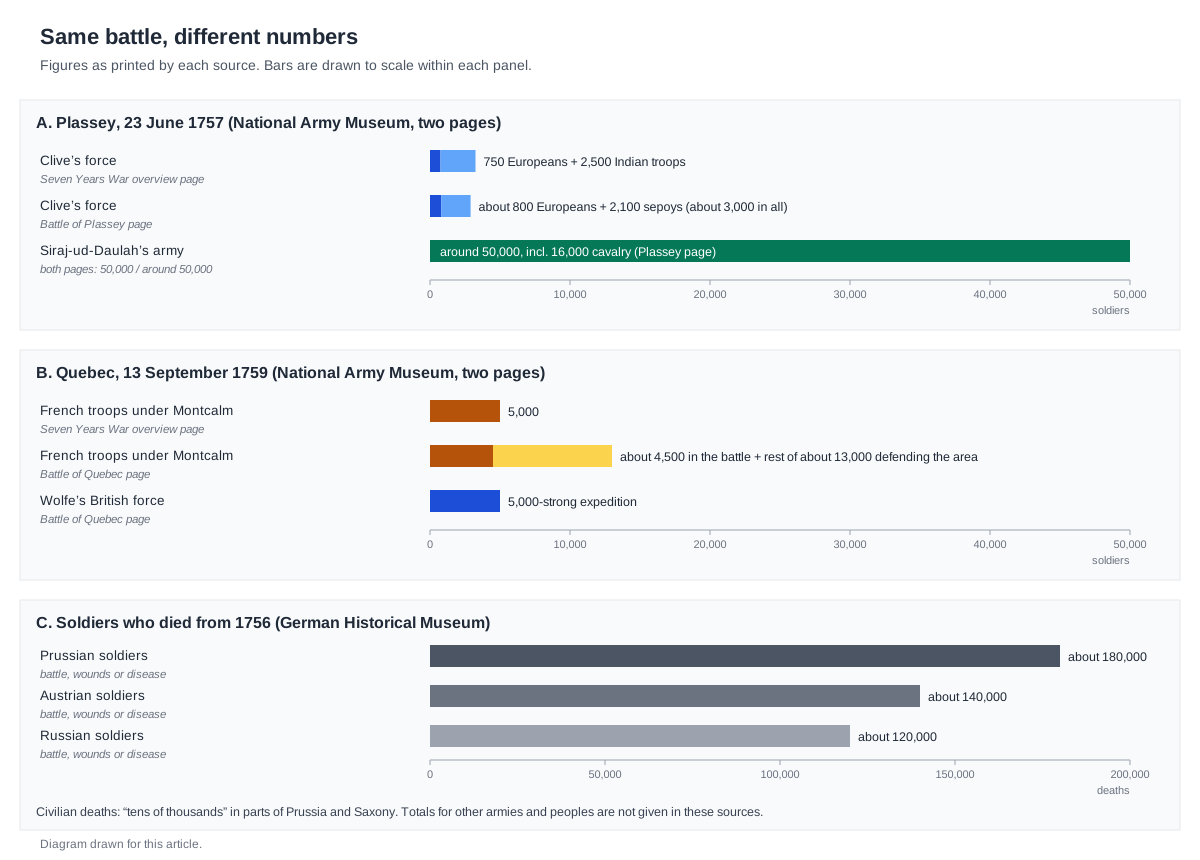
Plassey is a good example. The National Army Museum's Seven Years' War overview gives Clive 750 Europeans and 2,500 Indian soldiers, facing an army of 50,000.
The same museum's Plassey page gives Clive about 3,000 men: 2,100 sepoys, or Indian infantry, and about 800 Europeans. It gives the Nawab around 50,000, including 16,000 cavalry. Both pages show a very large gap between the two sides, but they break down Clive's force differently.
Quebec is similar. The overview says 5,000 French troops under Montcalm held a very strong position. The Quebec page splits the figure: about 13,000 soldiers defended Quebec and the area around it, and only about 4,500 of them took part in the battle. Wolfe's expedition was 5,000 strong, and the battle left roughly 640 French and 650 British dead or wounded.
The toll of the whole war was heavier still. The German Historical Museum says that from 1756 about 180,000 Prussian, 140,000 Austrian and 120,000 Russian soldiers lost their lives. They died on the battlefield, of wounds or of disease. These figures count only those three armies and leave out the losses in the theaters overseas.
People who were not soldiers paid too. Parts of Prussia and Saxony were laid waste, and tens of thousands of civilians were killed, mistreated or plundered.
The peace of Paris and Hubertusburg
By 1762 nearly all the European powers were worn out, in money as well as in men, and started sounding each other out about peace. The war ended in February 1763 with two treaties signed five days apart.
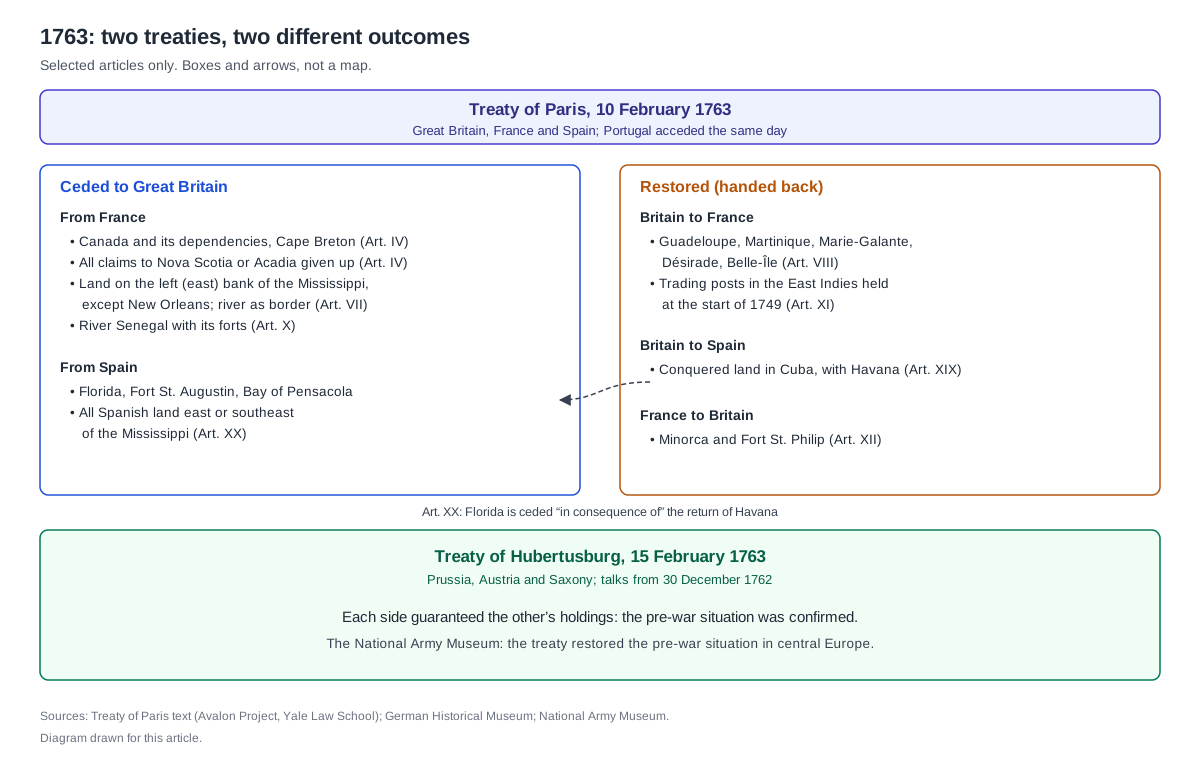
The first was the Treaty of Paris, signed in Paris on 10 February 1763 by Britain, France and Spain. The King of Portugal joined it the same day. Under Article IV, France ceded Canada and its dependencies, along with Cape Breton Island, to Britain and gave up all claims to Nova Scotia.
Article VII made the middle of the Mississippi River the border between the two powers and handed Britain the French land east of the river, except New Orleans. Article X also gave Britain the river Senegal in Africa, with its forts.
The treaty also handed conquests back. Under Article VIII, Britain returned Guadeloupe, Martinique and other Caribbean islands to France. Article XI gave back, in India, the trading posts France had held at the start of 1749, and Article XII returned Minorca to Britain. Article XIX gave Spain back Havana and the conquered parts of Cuba, and in consequence Article XX ceded Florida and Spain's land east of the Mississippi to Britain.
The second was the Peace of Hubertusburg, five days later on 15 February. Envoys of Prussia, Austria and Saxony had negotiated from 30 December 1762 in an outbuilding of the Hubertusburg hunting lodge, which Prussian soldiers had wrecked in 1761. Each side guaranteed the other's holdings, and the treaty confirmed the situation as it had been before the war. After seven years of fighting, central Europe was back where it started.
So the two treaties ended very differently. The German Historical Museum judges that the Peace of Paris ended the war overseas and confirmed Britain's leading role as a naval and colonial power. The same museum sees Frederick II's aim, in holding out against stronger enemies for almost seven years, as making Prussia the fifth great power of Europe.
The debts that victory left
The winner got a bill too. The British government came out of the war in 1763 burdened by heavy debts. Prime Minister George Grenville cut the import duties on sugar and molasses but had them collected far more strictly, and the taxes colonists actually paid went up. The Office of the Historian explains that a run of trade and tax laws from 1763 to 1775 helped bring on the American Revolution.
The new land brought problems as well. France had spent heavily on gifts to its Native allies, but the British forces that took over the French forts stopped the practice. Pontiac, a leader of the Ottawa, used wampum belts to carry coded messages to communities across today's Midwest to coordinate attacks on British forts. Britain lost all its western forts except Fort Pitt and Detroit, and war with the Native nations went on from 1764 into 1766.
London answered with a royal proclamation in 1763 that banned colonial settlement west of the Appalachians. It barely slowed the westward flow and mostly angered settlers and the wealthy colonists who had put money into western land deals.
The National Army Museum sums it up: "Britain's victory in North America sowed the seeds of a later defeat." Once the French danger had passed, colonists resented paying for British troops stationed among them. The museum lists this as one reason for the war for American independence in 1775–83.
In India, too, victory had more than one face. Up to India's independence in 1947, nearly every child in a British school would have known the name Plassey and the figure of "Clive of India." Yet in his own lifetime Clive split opinion. Critics attacked him as a corrupt, greedy "nabob" who had turned political and military power into private wealth.
Today the national battlefield at Fort Necessity presents that summer's standoff as the opening act of a struggle over who would hold North America. That war ended in 1763 with French power removed from North America and India. What began with one signature in a woodland clearing changed the masters of two continents and left behind the spark for the next war.
What to read next
- The Gunpowder Revolution: How Muskets and Cannon Changed Armies: goes back to where the muskets and field guns of the volley era came from.
- The American War of Independence, from Lexington to Yorktown: how the debts and taxes of the Seven Years' War led to another war 12 years later.
- The Battle of Trafalgar: the day Britain and France met at sea again, almost half a century after Quiberon Bay.
- Turning points in military technology: how battlefields changed when weapons changed, followed through 20th-century technology.
- A history of laser weapons: the path of weapons that use light instead of gunpowder, from public records.