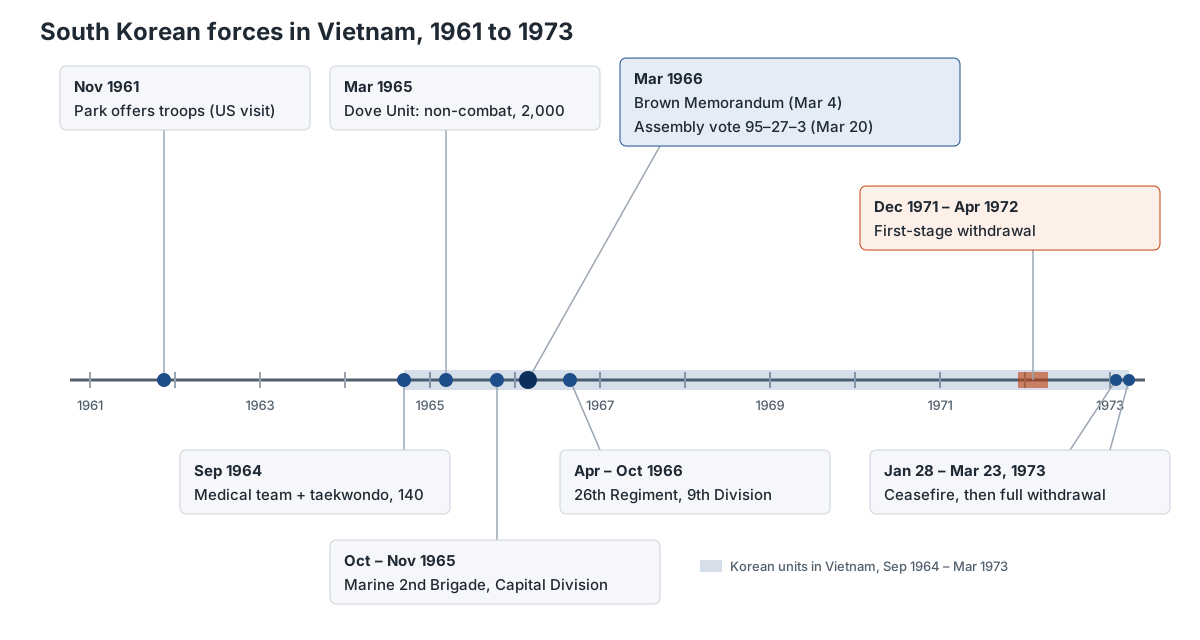
On October 9, 1965, a Marine unit that had sailed from Busan came ashore at Cam Ranh Bay in South Vietnam. It was the Blue Dragon unit, the first of South Korea's combat units to go to Vietnam. By the time the last Korean troops left in March 1973, more than 300,000 South Korean soldiers had passed through Vietnam.
The deployment still does not reduce to one story. For some, it stands for loyalty to an ally and a stepping stone for economic growth. For others, it is a war that left questions about combat pay, Agent Orange, and allegations of harm to Vietnamese civilians.
This article follows public Korean and American records through the story. How was the deployment negotiated and voted on? How many went, how did they come home, and what is still in dispute?
Why South Korea went
The government gave two reasons. One was to repay the allies that had fought for Korea in the Korean War. The other was a security judgment that the Vietnam front was directly tied to the Korean front. When South Vietnam joined the United States in asking for troops, the government used these reasons to win the National Assembly's consent.
The United States had its own reasons. After the 1964 Gulf of Tonkin incident it began bombing North Vietnam and launched a "Many Flags" policy that asked free-world countries to send troops.
An article on Uri History Net, a National Institute of Korean History site, explains why Korean troops were preferred. They cost less to maintain than US troops, they were fellow Asians, and they had experience from the Korean War. As antiwar protests grew in the United States and troops became harder to raise at home, the requests grew stronger.
The South Korean government was making its own calculations. The Uri History Net article sees the large deployment as a point where Korean and American interests met. By sending troops, Seoul hoped to keep the size of the US force on the peninsula, strengthen the alliance, and expand US aid, which was the ultimate aim. Park Chung-hee, then chairman of the Supreme Council for National Reconstruction, had offered troops as early as his US visit in November 1961.
By around 1965, the United States was moving part of its home reserves and overseas forces to Vietnam. No one could be sure when the two US divisions in Korea might be sent to South Vietnam as well.
One scholar sees two motives side by side. One was a sense of repaying a debt from the Korean War. The other was a calculation that the deployment would raise Korea's leverage over aid and US involvement.
From a medical team to two divisions
The first deployment was about medicine and training more than guns. On September 11, 1964, 140 people sailed from Busan on a navy LST: 130 staff of the 1st Mobile Army Surgical Hospital and 10 taekwondo instructors. They reached Saigon on the 22nd. The hospital set up at Vung Tau, and the instructors taught South Vietnamese troops at military academies and an infantry school.
The next year, a non-combat unit of about 2,000 for construction and rear support followed. It was named the Dove Unit, a symbol of peace. It left Incheon on March 10, 1965, reached Saigon on the 16th, and was stationed at Di An, 22 km northeast of Saigon.
The way for combat units opened at a Korea-US summit in Washington on May 17–18, 1965. Most of the requests that Foreign Minister Lee Tong-won had put to US Ambassador Winthrop G. Brown were settled there. On August 13 the National Assembly approved sending the Capital Division (the Tiger Division) and the 2nd Marine Brigade (the Blue Dragon unit).
The Blue Dragon unit left Busan on October 3 and landed at Cam Ranh Bay on October 9. The main body of the Tiger Division left Busan on October 16 and reached the port of Qui Nhon on October 22. The "Vietnam War dispatch" entry says the Capital Division had arrived in Qui Nhon "by November 1."
The Brown Memorandum and the Assembly vote
In December 1965, the United States formally asked for more combat troops. US Secretary Rusk made the request to Foreign Minister Lee, who was in the United States for the UN General Assembly.
Lee pointed out that an earlier promise to modernize Korean equipment had not been kept and argued for "promises first, troops later." Rusk countered with "troops first, promises later." Washington then sent Vice President Humphrey as a special envoy twice, on January 1 and February 22, 1966.
What the United States offered survives in the US Foreign Relations series (FRUS). A State Department telegram to the embassy in Seoul dated January 27, 1966, carries a draft letter for the Koreans. Its basic principles were that Korea's defenses must stay intact, that Korea should face no new economic burden, and that Korea should gain some net benefit.
The extra troops would receive overseas allowances at the level paid to the Tiger Division. Casualty benefits would be paid at twice the rate agreed by a joint US-Korea committee.
After Ambassador Brown delivered the letter, Lee told him on February 1 that the government had decided "in principle" to accept the US offer. President Park wanted to wait to announce it until he was back on February 17 from a trip to Southeast Asia. On February 28 the government publicly announced that it would send one more regiment and one more division.
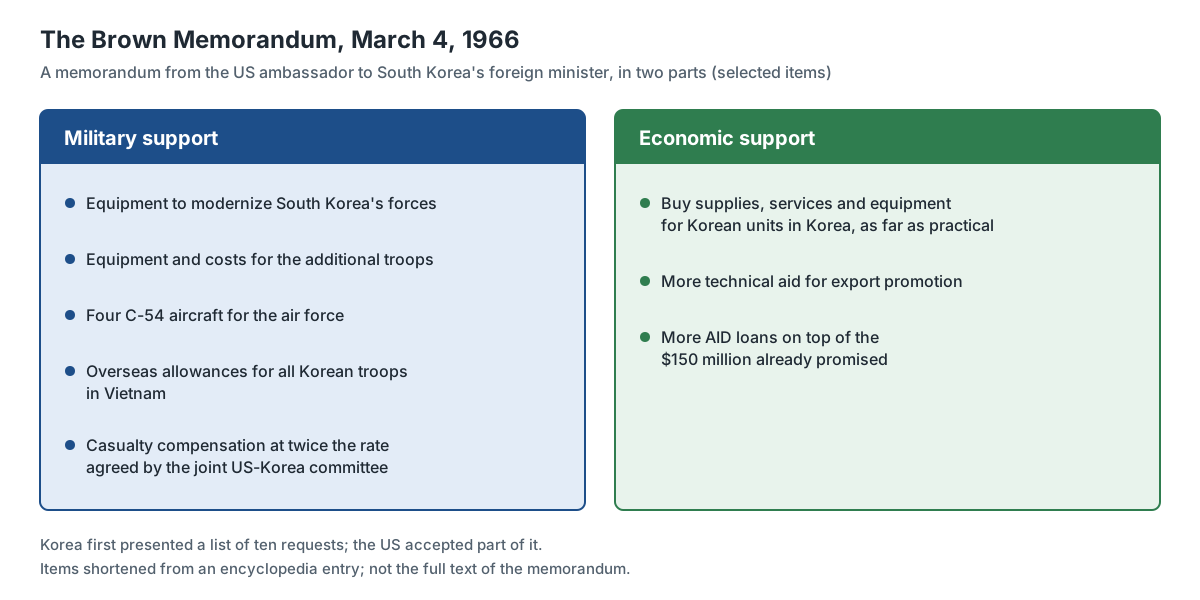
The Brown Memorandum put the US promises on paper. It is a memorandum dated March 4, 1966, from Ambassador Brown to Foreign Minister Lee, in two parts: military cooperation and economic support.
The military part covers equipment to modernize Korea's forces and equipment and costs for the additional troops. It also lists four C-54 aircraft for the air force, overseas allowances for all Korean troops in Vietnam, and double casualty compensation. The economic part covers buying supplies, services and equipment for Korean units in Korea as far as practical. It adds more technical aid for export promotion and further AID loans on top of the $150 million already promised.
Before the memorandum, the Korean government had presented ten requests that the United States found hard to accept. The United States was willing to accept part of them, though not all.
Getting through the National Assembly was not easy. Leaders of the opposition People's Party opposed the request, warning that sending more troops would leave Korea's own defenses weaker, and some members of the ruling party shared that worry. On March 20, after a debate that ran until 3 a.m., the Assembly passed the measure 95 to 27, with 3 members abstaining.
Two days earlier, on March 18, Ambassador Brown had sent a warning to Washington. He wrote that Korea was not an endless source of troops and that the public was deeply anxious about how far Korea had already gone. Korea's defense ministry had given firm assurances that the total sent to South Vietnam would not exceed 40,000.
Once the increase was approved, the Capital Division's 26th Regiment landed at Qui Nhon in April. The "White Horse Division dispatch" entry gives the date as April 19, and the "Vietnam War dispatch" entry gives April 15. The 9th Division (the White Horse unit) had deployed around Ninh Hoa by October 8. With that, the Korean forces in Vietnam grew to corps size and could run their own operations.
How many went, and how many did not come back
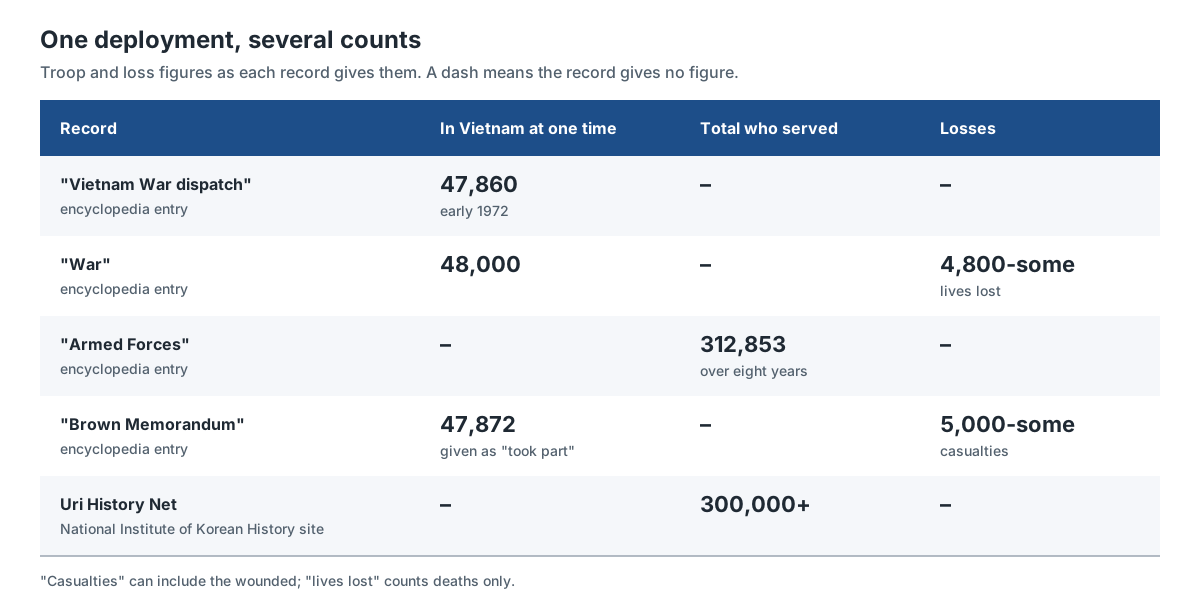
The numbers vary from record to record. For troops in Vietnam at one time, the "Vietnam War dispatch" entry gives 47,860 in early 1972, and the "War" entry gives 48,000. For everyone who served, the "Armed Forces" entry gives 312,853 over eight years, and Uri History Net says more than 300,000.
These two kinds of numbers should not be mixed. Fewer than 50,000 were there at any one time, but more than 300,000 passed through Vietnam over eight years. In early 1972, when the other allies kept only token forces of about 100, Korea still had 47,860 troops there. From the second half of 1972, Korean forces outnumbered US ground forces and became the largest contingent among the allies.
The number who did not come back also differs. The "War" entry says the 4,800-some lives lost must not be forgotten, while the entry on the Brown Memorandum gives 5,000-some casualties. Because "casualties" can include the wounded, the two figures cannot be read as the same thing.
Withdrawal
From July 1969, the United States began pulling out some troops under its Vietnamization policy, the idea that "the Vietnamese should fight the Vietnam War." Korea's first-stage withdrawal began with the 2nd Marine Brigade on December 4, 1971, and ran to April 1, 1972. The "Vietnam War dispatch" entry puts the number withdrawn at 9,476, and the "War" entry at 10,000. Combat forces of 37,000-some, built around two infantry divisions, stayed until the ceasefire.
The ceasefire agreement required all foreign troops to leave Vietnam within 60 days. The ceasefire began on January 28, 1973. When a rear party of 118 left by air on March 23, every Korean unit had withdrawn. The final withdrawal after the ceasefire brought home 36,856 troops.
The "Vietnam boom": what it left in the economy
The deployment also left a deep mark on the economy. Korea earned about $1 billion in foreign exchange through trade and non-trade channels. US public loans of $520 million gained in the troop talks went into infrastructure. Commercial loans of $240 million went into plants for heavy and chemical industries, which became the core of Korea's export industry in the 1970s.
Korean technicians and companies in Vietnam gained know-how in construction, civil engineering, ports, and logistics. The construction industry in particular built up the ability it later used in the Middle East construction boom.
The entry on the Brown Memorandum credits US support with an average growth rate of 12% a year. That was well above the target of the Second Five-Year Economic Development Plan. The military grew too: reserve divisions became combat divisions, and a new semi-combat division was created.
The verdict is not all positive. The gains in foreign reserves and funds for public works are viewed favorably. Critics also say the boom distorted Korea's foreign trade and domestic economy and gave rise to a few new large business groups. Some point out that Korean society has tended to remember the Vietnam War only as the "Vietnam boom."
Debates that have not ended
The debates over the deployment run along several lines. The encyclopedia entries and the Uri History Net article quoted here carry notices that they are the authors' views and may differ from the official positions of their institutions. The US records are cables exchanged by the US government at the time, with editorial notes.
The mercenary charge. At the Symington hearings in the US Senate in 1970, Senator Fulbright criticized Korea for joining the war for economic gain rather than to defend liberal democracy. The opposing view is just as clear.
The "Vietnam War dispatch" entry says the deployment came not from a treaty obligation but from "loyalty to free-world allies." Military aid and combat pay did exist, but the troops were not sent for them from the start. Korean forces also fought under their own independent command, so the entry calls the word "mercenaries" wrong.
Pay and compensation. The same allowances look different depending on where you stand. In the 1966 draft letter, the US side wrote that the overseas allowances were as much as 30 times the pay of troops in Korea. It put them at about 4 times the pay of South Vietnamese troops.
The Uri History Net article argues that the government and companies did not fairly compensate soldiers and workers. Enlisted men's combat pay was only a quarter of what US troops received. Death benefits were only a little more than a year's salary for an office worker of the time. The government also took high fees when the money was sent home and exchanged.
Agent Orange. Many Korean veterans suffered lasting effects, including harm from Agent Orange. In 1999, more than 16,000 victims sued the US makers Dow Chemical and Monsanto for damages, but they did not receive proper compensation. Agent Orange victims, along with the issue of children of Korean fathers left in Vietnam, are also listed among the deployment's negative effects on Korean society.
Allegations of harm to civilians. This is the heaviest debate. The Uri History Net article explains that large-scale massacres of civilians took place in operations that required finding guerrillas hidden among civilians. They were especially severe in the central region right after the Tet Offensive.
For Korean forces, the cases of Ha My village in Binh Dinh Province and Phong Nhi and Phong Nhut villages in Quang Nam Province have become known. In 2018, civic groups organized a Citizens' Peace Tribunal, a kind of mock trial, in which a victim took part directly as a plaintiff.
The dispute then reached a real courtroom. News reports say that on February 7, 2023, the Seoul Central District Court ruled for Nguyen Thi Thanh. She survived what happened in Phong Nhi on February 12, 1968, and the court ordered the state to pay her about 30 million won. It was the first time a Korean court had found the state liable over these events.
The court also rejected the government's claim that wartime agreements among South Korea, South Vietnam, and the United States freed it from liability.
The government took a different position. On February 17, Defense Minister Lee Jong-sup said at a National Assembly committee that he was certain there were "absolutely no massacres" by Korean troops. Government lawyers had suggested the culprits might have been communist fighters in Korean uniforms, according to reports.
The government appealed in March. US military documents and survivors say more than 70 people died in Phong Nhi and Phong Nhut that day.
For a long time, Korean society saw this war only through the lens of the economic boom and the alliance with the United States. Today there is more active discussion of the harm suffered and the harm done by those who took part, and of the war's effects on Korean society.
What to read next
- The Vietnam War at a Glance: 1955 to 1975: the course of the whole war that Korean troops joined
- The Gulf of Tonkin Incident: What the Declassified Records Say: the event after which the United States began bombing North Vietnam
- The Fall of Saigon, 1975: The End of the Vietnam War: how the war ended two years after the Korean withdrawal
- Military logistics: performance must be sustainable: what it takes to keep a force running far from home