In the autumn of 1938, British Prime Minister Neville Chamberlain came home from Munich and held a single sheet of paper up high. It was an Anglo-German declaration dated 30 September, bearing his name and Hitler's. Its text spoke of the wish of the two peoples never to fight each other again. Cheering crowds greeted him, and Chamberlain called the Munich deal "Peace for our time."
Less than a year later, on 3 September 1939, Britain and France were formally at war with Germany. Why did concessions meant to keep the peace fail to stop a war? This article follows the public record from Manchuria in 1931 to Poland in 1939, step by step, looking at each act of aggression and the response to it.
What Versailles and the Depression left behind
The Treaty of Versailles, which closed World War I, put tight limits on Germany's armed forces. The army was capped at 100,000 men. The navy could keep only ships under 10,000 tons, and both a submarine fleet and an air force were banned outright. Conscription was forbidden, and the Rhineland, on the French border, could hold no German troops or fortifications.
Most Germans saw the war guilt clause, the huge reparations and the military limits as especially harsh. Then came the economic crisis. The 1929 U.S. stock market crash, a downturn in Germany, and money troubles in France and Britain hit together and became a global financial crisis. The 1933 London Economic Conference produced no major agreement, so the Great Depression lasted through the rest of the decade.
A video by Imperial War Museums (IWM) notes that in early 1933 over one in three German workers was out of work. That situation played a large part in Hitler's rise to power. He won support by attacking the harsh terms of the Versailles Treaty.
Across the Atlantic, the United States turned inward. The Depression pushed it further into the isolationism that had followed World War I. The U.S. Office of the Historian lists three crises: Japan seized northeast China in 1931, Italy invaded Ethiopia in 1935, and Germany expanded in central and eastern Europe. The United States took no major action against any of them.
East Asia: from Manchuria to the Marco Polo Bridge
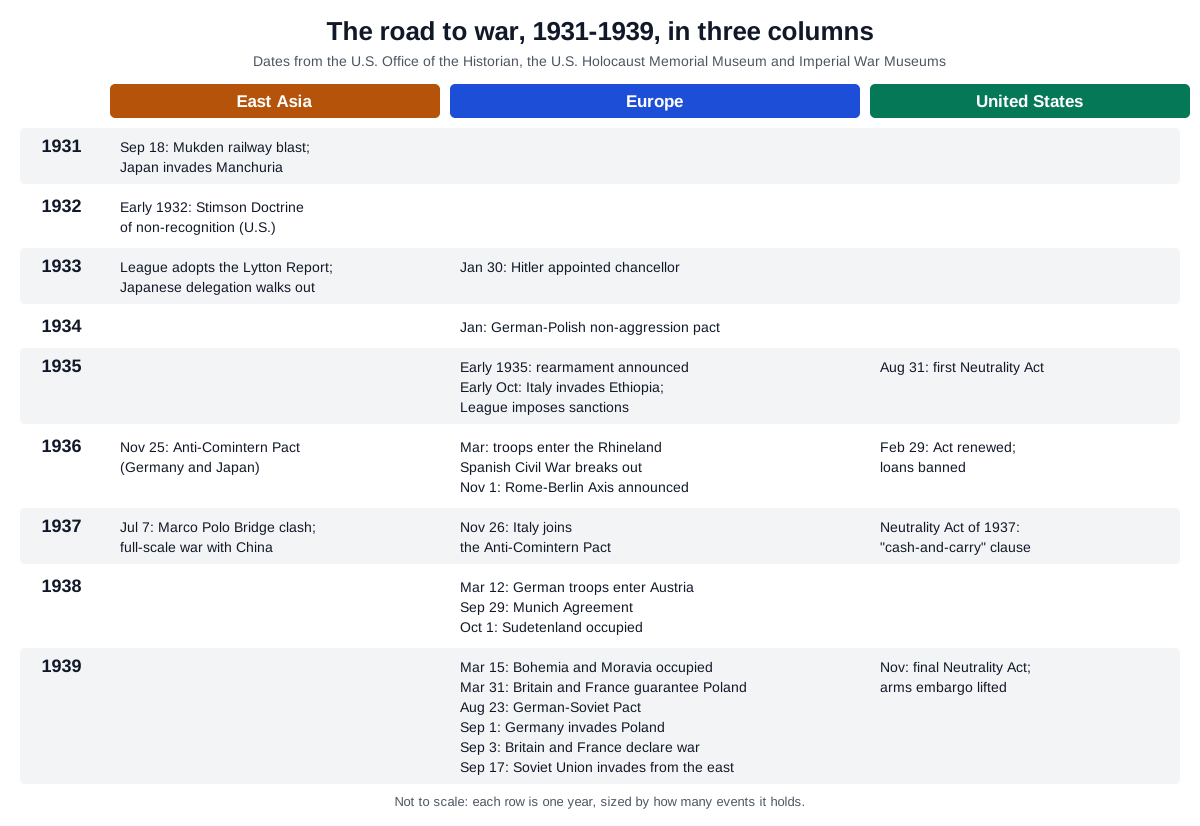
The first act of aggression came in East Asia, not Europe. On 18 September 1931, a blast wrecked a stretch of railway near Mukden, today's Shenyang. Japan, which owned the line, blamed Chinese nationalists and used the moment to invade Manchuria. Some suspected that mid-level Japanese Army officers had planted the bomb to create a pretext for military action.
In just a few months, Japanese forces took over all of Manchuria. Japan declared it a new autonomous state, Manchukuo, but the local Japanese Army was the real ruler. With the Depression under way, few people backed economic sanctions to punish Japan.
In early 1932, U.S. Secretary of State Henry Stimson said the United States would refuse to accept any Japan–China treaty or deal that hurt American rights. This became known as the Stimson Doctrine. The Office of the Historian judges that this policy of non-recognition did very little against Japan's continuing aggression and expansion.
The League of Nations sent the Lytton Commission. Its report laid equal blame on Chinese nationalism and on Japanese militarism, yet it refused to recognize Manchukuo because the new state broke China's territorial integrity. When the League adopted the report in 1933, Japan's delegates left the room and never again took their seats on the League Council. The truce that followed still left Manchuria firmly in Japanese hands.
On 7 July 1937, Chinese and Japanese troops clashed at the Marco Polo Bridge near Beijing, and the two countries entered full-scale war. Japanese forces pushed down the coast and into the capital, Nanjing. While the U.S. gunboat Panay was evacuating Americans from Nanjing, the Japanese Army bombed it, killing three people. Before 1937, few U.S. officials had urged a firm stand, and the United States gave China little help for fear of provoking Japan.
Europe: rearmament, the Rhineland and Ethiopia
On 30 January 1933, President Paul von Hindenburg appointed Hitler chancellor of Germany. It was the result of a political deal, after some conservative politicians persuaded the president. Hitler then took Germany out of the League of Nations and walked away from talks on European disarmament.
In January 1934 he signed a non-aggression pact with Poland. The aim was to remove the chance of a French-Polish military alliance before Germany could rearm. In early 1935 Hitler announced a rearmament program that broke the Versailles terms, and in March 1936 German troops moved into the demilitarized Rhineland.
To the south, Italy moved too. Benito Mussolini's Italy invaded Ethiopia, then also called Abyssinia, in early October 1935, and had conquered and annexed it by May 1936. Sources give the invasion date as either 2 or 3 October.
The League answered with sanctions against Italy. Even so, an IWM curator says the League did little beyond minor sanctions and Britain made no move to stop the invasion. Hitler, watching, was greatly encouraged.
After the League's sanctions, and once Italy's alliance with the British and French had ended, Italy and Germany grew closer from 1936. On 25 October that year the two signed a cooperation treaty, and on 1 November they announced the Rome-Berlin Axis. On 25 November, Germany and Japan signed the Anti-Comintern Pact, directed against the Soviet Union and world Communism as a movement. Italy joined it on 26 November 1937.
The Spanish Civil War also broke out in 1936.
In the United States, Congress had passed the first Neutrality Act on 31 August 1935, banning exports of arms, ammunition and implements of war to nations at war. On 29 February 1936 it extended the law and also banned loans to warring nations. The Neutrality Act of 1937 added a "cash-and-carry" clause. At the president's discretion, warring nations could buy anything except arms, as long as they paid at once and used non-American ships.
1938: Austria and Munich
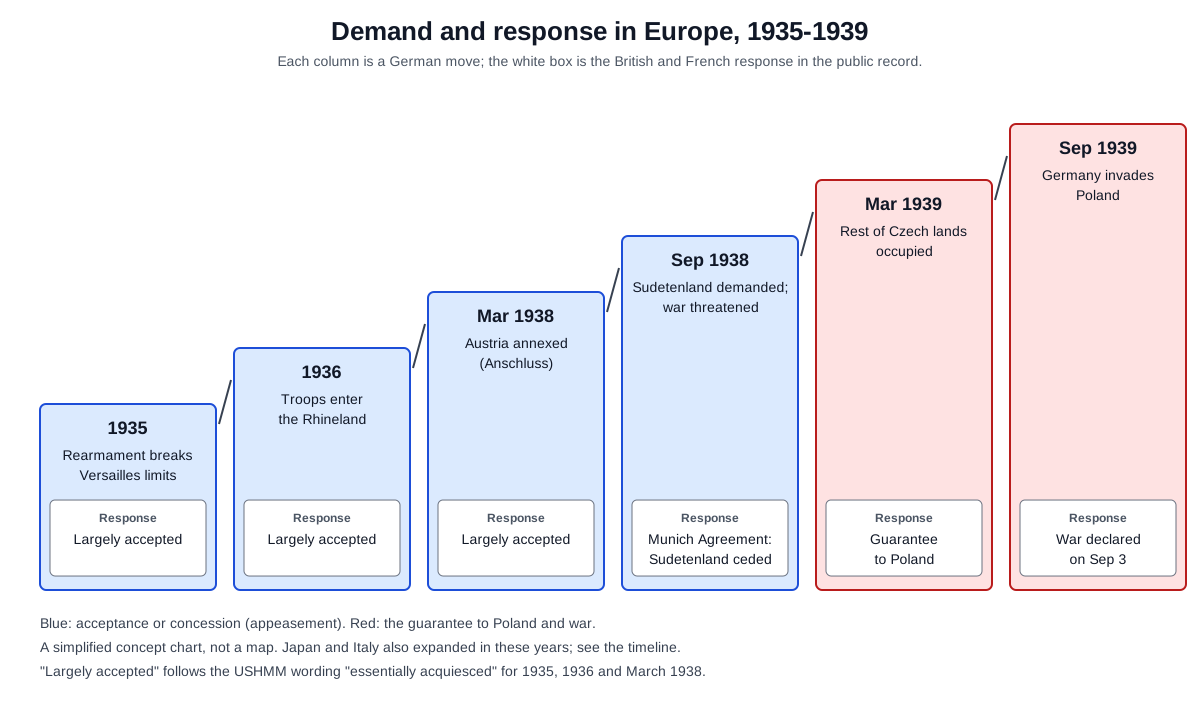
On 12 March 1938, German troops entered Austria. In April a plebiscite was rigged to show that about 99% of Austrians wanted the union, and the annexation was approved after the fact. The United States Holocaust Memorial Museum (USHMM) explains that Britain and France essentially went along with each step. That ran from rearmament in 1935 and the Rhineland in 1936 to the March 1938 annexation of Austria, known as the Anschluss.
Czechoslovakia came next. It had remained a working parliamentary democracy up to the Munich crisis, and its border region with Germany, the Sudetenland, had a mostly ethnic German population. Every defensive position the Czechoslovak Army had prepared for a war with Germany also sat in that region. In late summer 1938, Hitler warned that Europe would go to war if the Sudetenland were not given to Germany.
A teaching resource from The National Archives (TNA) of the UK records that in September Hitler claimed that 300 ethnic Germans in the Sudetenland had died. The claim was untrue. He used the claim as cover for moving troops up to the Czech border, while local Nazis were instructed to provoke unrest. Edvard Beneš, the leader of Czechoslovakia, feared that giving up the Sudetenland would hand most of the country's defenses to Germany and leave it defenseless.
Chamberlain flew to Germany three times in September. The minutes of the first meeting, at Berchtesgaden, record Hitler saying he did not care "whether there is a world war or not" and meant to settle it soon. They also record Chamberlain asking why he had been invited at all if Hitler meant to use force. Godesberg followed a week later, then Munich on 29 September.
Only four leaders sat at the Munich table, from Britain, France, Germany and Italy, and the Czech leaders were left out at Hitler's insistence. Hitler, Chamberlain, Édouard Daladier and Mussolini signed the agreement on 29 September 1938. It set the evacuation of the Sudeten areas to start on 1 October and end by 10 October. An international commission of five nations, Czechoslovakia among them, was to work out the details.
German forces marched into the Sudetenland on 1 October without a shot being fired.
In the days before the agreement, war fear had spread across Britain: children were evacuated, and people lined up for gas masks. News of the Munich Agreement set off celebrations across Britain. Winston Churchill, then outside the government, called it "an unmitigated disaster," and behind closed doors Hitler treated the Anglo-German declaration as unimportant.
1939: from Prague to Poland
The Munich promise did not last six months. On 14–15 March 1939, under German pressure, Slovakia declared independence, and on 15 March German troops seized Bohemia and Moravia, the Czech provinces. This openly broke the Munich agreement, and Germany set up the Protectorate of Bohemia and Moravia on that land.
On 31 March, Britain and France guaranteed the integrity of Poland's borders. IWM treats this guarantee as the point where appeasement ended.
In April Italy invaded and annexed Albania, and on 28 April Hitler announced that Germany was leaving its non-aggression pact with Poland. The guarantee did not stop Hitler. He was set on war and would not be talked out of it by threats or by concessions.
On 23 August, Germany and the Soviet Union signed a pact. The two foreign ministers, Joachim von Ribbentrop for Germany and Vyacheslav Molotov for the Soviet Union, worked out the terms.
The public part was a promise not to attack each other for ten years. A secret protocol carved eastern Europe into Soviet and German zones of influence and divided Poland along the Narev, Vistula and San rivers. Two bitter enemies made the deal because it suited them both.
On 1 September, Germany attacked Poland with no fear of Soviet intervention. Before the invasion, Nazi propaganda accused Poland of mistreating ethnic Germans. The SS, working with the military, faked an assault on a German radio station and pinned it on the Poles.
On 3 September, Britain and France honored the pledge made five months earlier with a declaration of war on Germany. On 17 September, Soviet forces crossed into Poland from the east. With these events, World War II had begun.
Arms and calculation: aircraft, radar and time
On 20 September 1938, in the middle of the Munich talks, General Ismay, secretary of Britain's Committee of Imperial Defence, sent a secret note to the cabinet. The note warned that absorbing Czechoslovakia would raise Germany's military prestige and war potential. It would likely also let Germany field stronger land forces against France and Britain than it could at that moment.
The picture in the air was a little different. The note judged that Germany might keep its lead over the British and French air forces in striking power. With the needed effort, though, Britain could catch up, or at least sharply cut Germany's lead, in defense against air attack.
Its conclusion was that, in military terms, "time is in our favour." If war with Germany had to come, fighting it in 6–12 months would be better than now.
Even while signing at Munich, Chamberlain was agreeing to a huge rise in arms spending to prepare for war. An IWM curator says British and French rearmament sped up in the late 1930s. Even so, the two countries were arguably less ready for the 1939 war than they could have been. The curator adds that Britain's heavy investment in developing radar turned out to be very useful.
Churchill visited Germany in 1932 and then spent the 1930s calling ever louder for British rearmament. Some saw him as a warmonger, others as a man raising his own profile, but the IWM curator says there is no evidence for either view.
How to judge appeasement
Appeasement means meeting the demands of a country that might turn hostile, in the hope that peace will hold. IWM presents the word as the name for Britain's 1930s policy of letting Hitler expand German territory unchecked. It adds that the policy is now widely discredited as weakness, but at the time it seemed popular and practical.
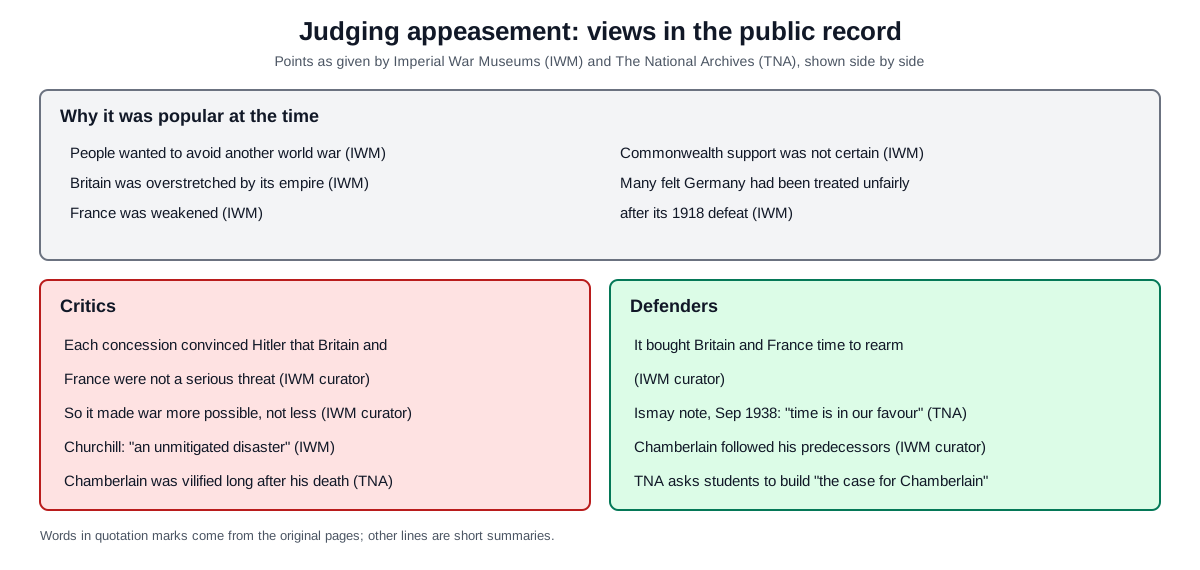
Why was it popular? Chamberlain and the British people badly wanted to avoid the mass killing of a second world war.
Policing a worldwide empire had stretched Britain thin, and it could not pay for large-scale rearmament. France, its chief ally, was badly weakened, and Commonwealth support was less certain than in World War I. Many Britons also felt that Germany had been treated unfairly after its 1918 defeat.
The government's thinking ran along the same lines. It believed that Germany's complaints were real ones, and that meeting them would satisfy Hitler and make him less demanding. British public opinion leaned toward some revision of the Versailles treaty's territorial and military terms, and both Britain and France felt unready for a military clash with Nazi Germany.
Critics look at the outcome. An IWM curator says each concession taught Hitler that Britain and France were no serious threat to his ambitions, so appeasement made war more likely rather than less. Long after his death, Chamberlain was condemned both for the policy as a whole and, above all, for what he did in September 1938.
The case for the defense sits in the same records. One can also argue, the curator says, that Munich forced Hitler to drop a planned war of conquest, since he could not yet risk fighting Britain and France. Appeasement also bought the two countries time to rearm. Chamberlain was continuing the line of the prime ministers before him, Ramsay MacDonald and Stanley Baldwin.
Chamberlain resigned as prime minister and died half a year later, in November 1940, without leaving a defense of his own. The TNA lesson invites students to build the case for Chamberlain themselves.
East Asia had offered a lesson first. The Office of the Historian concludes that the Manchurian crisis of 1931–33 exposed the weakness of the 1920s agreements on peace, non-aggression and disarmament. They could do little against a power set on pushing forward. Put the recorded dates in order, and it becomes clear that concession and acceptance did not happen once, but went on over several years.
What to read next
- The End of World War I and the Treaty of Versailles: how the treaty at the start of this story was made.
- The Fall of France, 1940: Armor Through the Ardennes: what happened in western Europe after the declarations of war.
- Radar: measuring distance and motion with radio waves: the principle behind the radar Britain invested in during the 1930s.
- Turning points in military technology: major turning points in weapons technology, from the proximity fuze to stealth.
- A history of laser weapons: from chemical to electric lasers: how a new defensive technology takes years to settle in, seen through lasers.