In the 4th month of 1592, a Confucian scholar in Uiryeong, in Gyeongsang Province, gave away his family's wealth to gather men. At first there were only a few dozen. He always wore red, fought up and down the riverbanks, and called himself the "Red-Robed General." His name was Gwak Jae-u.
By that summer, groups like his had risen in Jeolla, Chungcheong, Gyeonggi, Hamgyeong and Hwanghae as well. An old monk on Mount Myohyang sent letters to temples across the country, calling monks to arms. None of these forces had been drafted by the state.
So why did they go to war? And how far did their strength reach?
This article covers the righteous armies and the monk army of the Imjin War. It looks at how they differed from the government army, who rose where, how they fought and kept going, and why they did not last. The guides are the Revised Annals of King Seonjo, part of the Annals of the Joseon Dynasty, and the Encyclopedia of Korean Culture from the Academy of Korean Studies.
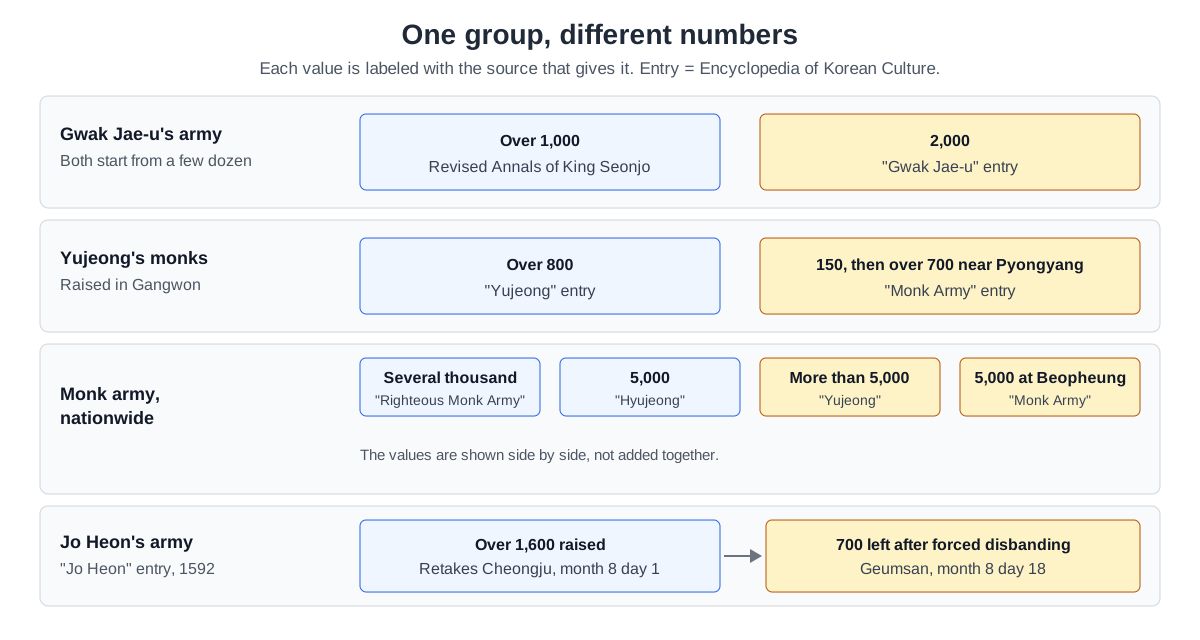
Different scholars wrote different entries, and troop numbers often disagree; where they do, the numbers are set side by side. Dates follow the month and day numbers given in the records.
What a righteous army was, and how it differed from the government army
A righteous army (uibyeong, 義兵) was a militia of people who rose on their own to fight an enemy when the country was in danger. The word covers both the leader and the fighters under him. The idea took clear shape during the Imjin War.
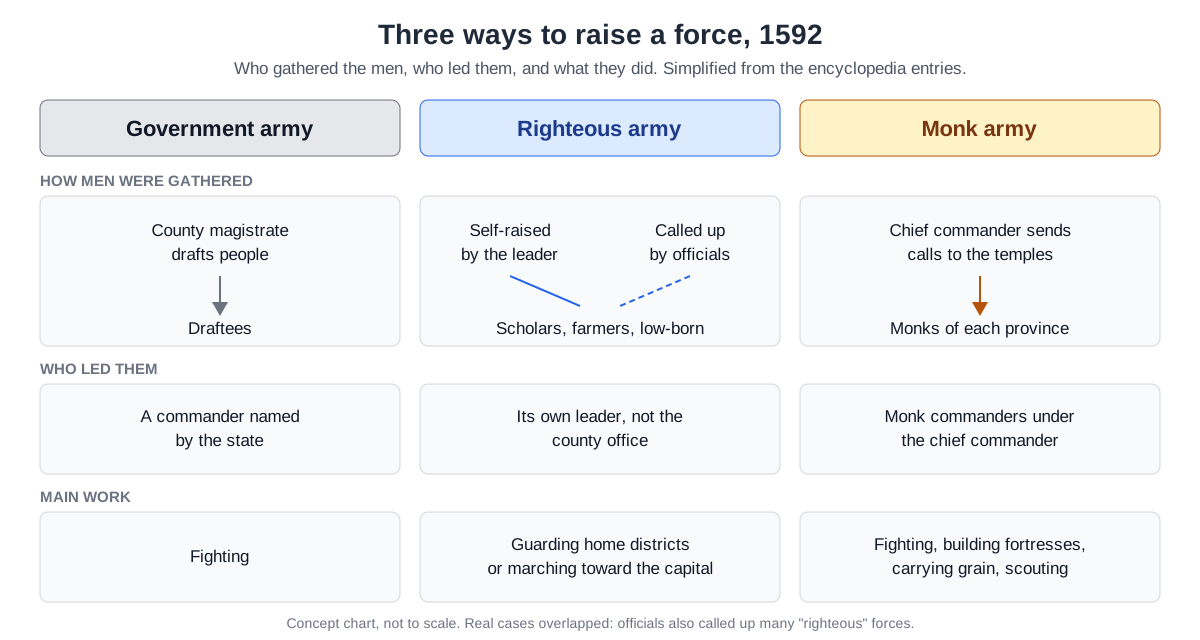
What set it apart from the government army was who raised it.
The Righteous Army entry quotes a line from the Revised Annals on this. Those who did not answer the county office's call were righteous armies. Those whom a magistrate drafted and placed under a commander were the government army. Because a righteous army was tied to its leader rather than to officials, it could move more freely than the government army.
"On their own" covers a range, though. Some were self-raised (jamo uibyeong), gathered by the leader himself. Many others were called up by officials (somo uibyeong), and many of those involved some force. The armies raised by Kim Seong-il, the pacification envoy for western Gyeongsang, and by Kim Reuk, the relief envoy for eastern Gyeongsang, are examples.
They can also be grouped by what they aimed to defend.
Kim Gang-sik, who wrote the Righteous Army entry, splits them into two types. Local defense forces (hyangbyeong) guarded their home districts, and royalist forces (geunwangbyeong) aimed to retake the capital and lost ground. He places the armies of Yeongnam and Hamgyeong closer to the first type and those of Honam closer to the second. In his view, the main reason for the difference was whether a force rose while the Japanese army was invading its own area.
Why so many rose in the summer of 1592
When the war began on the 14th day of the 4th month of 1592, the government army collapsed badly. The Revised Annals entry for the 1st day of the 6th month of 1592 describes what followed. The drafting of men and grain made people resent the commanders, and the troops broke whenever they met the enemy. The same entry goes on to say that when leading families and scholars in each province rose on the court's orders, people near and far came to join.
Most leaders were yangban, the Joseon elite, and many of them were former civil officials. Scholars who had not yet held office and sons of secondary wives (seoeol) were common too. Military men were few.
Ordinary people had their own reasons. Rather than be drafted by the state and moved from front to front, they preferred to fight under a leader they knew and trusted. A righteous army also made it easier to protect parents, wives and children near home.
The court's attitude mattered as well. Right after the war began, it sent officials to each province to raise troops for the government army, with little result. It then encouraged the righteous armies, recognized them as official forces, and gave their leaders posts. Ordinary people then joined in large numbers.
Village structure gave them a base. The community compacts (hyangyak) that spread across the country from the 16th century linked local elites with villagers, and small village associations still existed beneath them. Members of the righteous armies ranged from yangban to the lowest classes.
Leaders who rose county by county
The Revised Annals name the first to raise righteous armies: Go Gyeong-myeong and Kim Cheon-il in Honam, Gwak Jae-u and Jeong In-hong in Yeongnam, and Jo Heon in Hoseo. The Righteous Army entry adds others: Kim Myeon of Goryeong, Gwon Eung-su of Yeongcheon and Im Gye-yeong of Boseong. It also names Jeong Mun-bu in Hamgyeong, Yi Jeong-am in Hwanghae, and U Seong-jeon in Gyeonggi.
Gwak Jae-u raised his army on the 22nd day of the 4th month, eight days after the war began. He set up headquarters at the Jeongam ferry (Sotbawi Naru) and Segan-ri in Uiryeong, and fought across the neighboring counties.
Around late in the 5th month he stopped a Japanese force that was trying to cross at Jeongam ferry. This kept western Gyeongsang safe, so farmers there could work their fields as usual. In the 10th month of that year he sent his men to the first battle of Jinju.
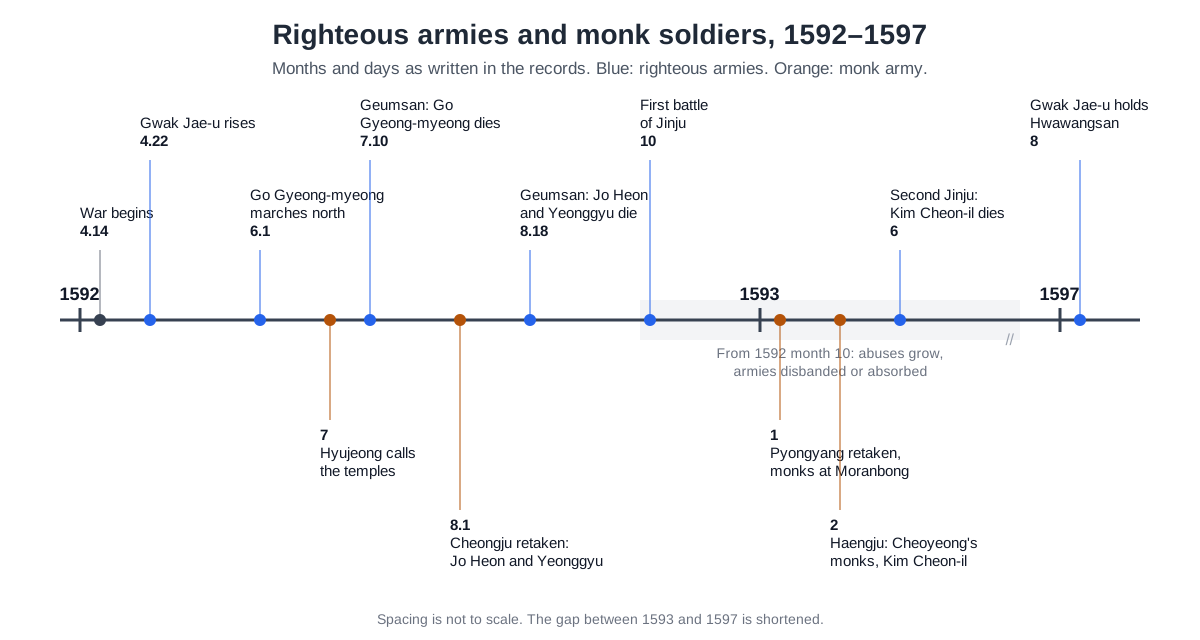
In Jeolla, Go Gyeong-myeong agreed with Kim Cheon-il and Bak Gwang-ok to send out calls to arms. He gathered more than 6,000 men at Damyang and became commander of the righteous army of left Jeolla.
On the 1st day of the 6th month he set out north toward the capital. On the 1st day of the 7th month he turned back after hearing that Japanese forces had taken Geumsan and were aiming at Honam. On the 10th day, at Geumsan, he fought alongside government troops. The government troops broke first, his own army fell apart, and he died there with his son Go In-hu.
Jo Heon of Okcheon, in Chungcheong, raised more than 1,600 men. On the 1st day of the 8th month, together with the monk Yeonggyu's force, he retook Cheongju fortress. After that, the Chungcheong governor's interference forced much of his army to disband.
He led the remaining 700 to Geumsan, and on the 18th day of the 8th month they fought beside Yeonggyu's monks until all were killed. In 1971 the place where they died at Geumsan was made a memorial site, Chilbaek Uichong, the Tomb of the Seven Hundred Righteous.
Kim Cheon-il of Naju started with 300 men. He used Doksan fortress in Suwon as a base for guerrilla raids, and in the 8th month moved his camp to Ganghwa Island. Ganghwa was a key point from which court orders could reach Honam and Hoseo.
In the 2nd month of the next year he came out from Ganghwa to join the fight at Haengju fortress. In the 6th month of 1593 he entered Jinju fortress, led its government and volunteer troops together, and died with his son when the fortress fell.
Things were different in Hamgyeong, in the far north. In Hoeryong, Guk Gyeong-in seized two royal princes, handed them to the Japanese commander Kato Kiyomasa, and surrendered.
Jeong Mun-bu, a military inspector posted to North Hamgyeong, then raised a righteous army. Local officials such as the magistrates of Jongseong and Gyeongwon joined him. Victories at Ssangpo and, the next year, at Baektapgyo won back the northeast region of Gwanbuk.
The monks' army
Joseon suppressed Buddhism, and monks could not form military units of their own. In the early part of the war, monks fought alongside local righteous armies, but there was no chain of command for monk soldiers.
The change came through Hyujeong, a monk of Mount Myohyang. Better known by one of his other names, Seosan Daesa, he went to see King Seonjo, who had fled to Uiju. He told the king that old and sick monks would keep to their practice where they were, and all the rest would join the war.
After the 7th month of 1592 the state created a post to lead the monks and called Hyujeong in. At 73 he became chief commander (dochongseop) of the monks of the eight provinces and sixteen orders. Based at Beopheung Temple in Sunan, he sent calls to temples across the country.
Monk commanders rose in many regions. Uieom in Hwanghae, Yujeong in Gangwon and Cheoyeong in Honam were all Hyujeong's disciples. Yujeong is often called Samyeong Daesa.
Among the monk commanders, the first to win distinction was Yeonggyu. He was staying at Cheongnyeon hermitage in Gongju when the war began, and he raised more than 800 monks in Chungcheong. He retook Cheongju with Jo Heon's army and died with them at Geumsan. He is said to have told his monks that they were rising "not because the court has ordered it."
When Pyongyang was retaken in the 1st month of 1593, the monks under Yujeong took the Moranbong sector. At Haengju fortress in the 2nd month, Cheoyeong led 1,000 monk soldiers under Gwon Yul. The whole force inside the fortress then numbered fewer than 10,000. Monks also served in Yi Sun-sin's navy.
How they fought, and how they kept going
The places where righteous armies rose had something in common. The Japanese army moved along its lines of advance and posted troops only at key points, so some areas lay beyond its reach. Those areas became bases for the righteous armies.
Some leaders, like Go Gyeong-myeong, fought pitched battles with large forces. Most, though, fought guerrilla actions that used the lie of the land. Gwak Jae-u struck along the rivers, and Kim Cheon-il worked from a mountain fortress.
Not answering to the county office did not mean having no discipline. When Yi Jeong-am raised a righteous army at Yeonan in Hwanghae, he wrote the volunteers' names in a sworn register (Uibyeong Yakseochaek) and set eight articles of military law. One of them ordered death for anyone who harmed civilians.
The hardest part was feeding and arming the men.
Leaders gave up their own wealth to make weapons and supply grain. The burden of supply, part of what is now called logistics, fell on each leader. In eastern Gyeongsang, Kim Reuk named a village head or official in each county and collected grain from people according to their means. One reason the units stayed small was how hard it was to obtain weapons and grain.
The monk army took on more of the work outside battle. It built and held mountain fortresses, carried grain, and scouted, drawing on the monks' knowledge of the hills. Yujeong built fortresses such as Palgongsan, Geumosan and Akgyeonsan. In 1594 at Uiryeong he had barley planted on temple fields and land cleared around a fortress, and gathered more than 4,000 seok of grain for the army.
Size in numbers, and the limits
How many fighters were there in all? The Righteous Army entry gives the nationwide total reported to the Ming in the 1st month of 1593 as more than 22,600. That was a quarter of the government army, and already much smaller than in 1592, when the righteous armies were most active.
Numbers for single groups differ by source. Gwak Jae-u's army appears as more than 1,000 in the Revised Annals and 2,000 in the Gwak Jae-u entry. The monks Yujeong raised in Gangwon number more than 800 in the Yujeong entry. The Monk Army entry says they started at 150 and passed 700 by the time they reached east of Pyongyang.
The nationwide monk army is "several thousand" in the Righteous Monk Army entry and 5,000 in the Hyujeong entry. It is more than 5,000 in the Yujeong entry, and 5,000 at Beopheung in the Monk Army entry.
The numbers fell for a reason. As the government army slowly recovered, the court held back new righteous armies and put limits on their activity. From the 10th month of 1592, righteous armies sprang up everywhere and caused trouble.
Some existed in name only, made up of men avoiding the government draft. Among the more than 100 camps, some clashed with the government army.
Friction with the government army already appears in the records of summer 1592. The Revised Annals say that the government troops and the righteous armies came into conflict, and that most provincial commanders could not work with the volunteer leaders. Kim Seong-il was the exception: he balanced the two sides well, so the Yeongnam armies were treated with respect and fewer of them were killed in defeat.
In the end the state broke up the righteous armies, and the rest scattered or were absorbed into the government army. The monk army took a different path.
It was never disbanded. After the Ming army arrived it carried grain as well as fighting, and after the capital was retaken it built fortresses, becoming close to a regular force. In the 8th month of 1593, two monk officers were placed in each province under the chief commander to unify the organization.
Around the second invasion of 1597, the state tried again to raise forces modeled on the early righteous armies. Revenge units (boksugun), made of volunteers who had lost family members to the Japanese army, were raised widely from the 12th month of 1596. The Righteous Army entry says they achieved little and faded away.
Volunteer forces that rose again were mostly small. Even so, in the 8th month of 1597 Gwak Jae-u entered Hwawangsan fortress at Changnyeong and held it with troops from four counties.
What remained after the war
The experience of the righteous armies fed into new institutions. Yu Seong-ryong called for a system of local defense forces in his military reforms, which led to the sogogun, a provincial army newly organized in the counties during the war. The sogogun formed small units in each village and became a standing means of guarding against unrest in peacetime too. During the second invasion, the state raised and controlled local forces directly.
The monk army kept guarding fortresses after the war. After the Manchu invasion of Byeongja (Byeongja Horan), monk garrisons were set up at Namhansanseong and Bukhansanseong, and this monk army system was abolished in the Gabo Reform of 1894. In the 4th month of 1605, when war merits were recorded, 34 monk soldiers were named merit subjects (Seonmu Wonjong Gongsin).
Views of monks changed too. Kim Yong-tae, who wrote the Hyujeong entry, holds that once the monk army's service was recognized, criticism of monks eased and society's view of Buddhism shifted. Starting with Pyochungsa in Miryang in 1738, shrines honoring Hyujeong, Yujeong and others received official recognition from the state.
There is no single verdict. The Revised Annals wrote that the righteous armies "did not achieve much, but won people's hearts, and the life of the state was kept going thanks to them." The Righteous Army entry argues that seeing them only as loyalist forces led by officials (chunguigun) hides the role of ordinary people, so "militia" or "local defense force" fits better. Jeong Tak, an official of the time, had said that some righteous armies fought in earnest, while others were joined for personal convenience and only guarded their home districts.
What to read next
- The Imjin War at a Glance: Seven Years from 1592: an article on the whole course of the war in which the righteous armies rose.
- Yi Sun-sin and the Battle of Hansando: an article on the fighting at sea in the summer of 1592, while the righteous armies held the counties.
- Military logistics: performance must be sustainable: grain and weapons were one reason the righteous armies did not last. This article looks at what today's armies group under the work of staying in the fight.