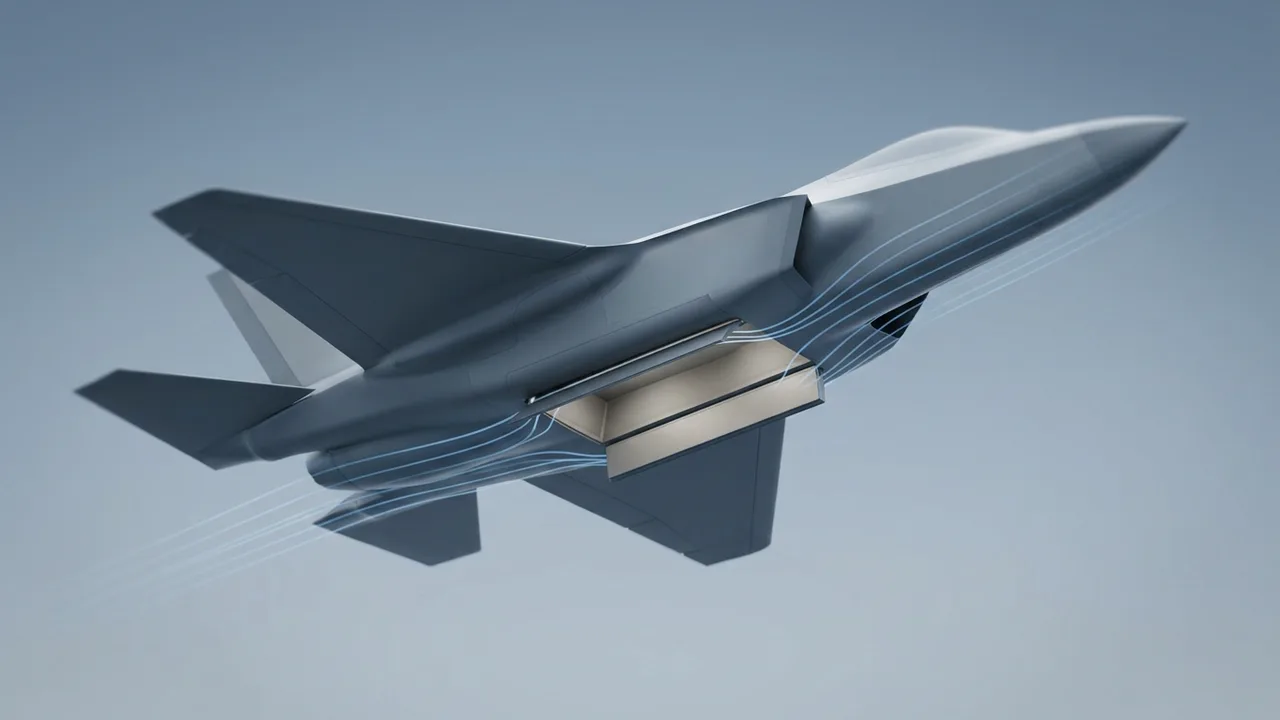
Picture a fighter jet and you probably see missiles or long tanks hanging in a row under its wings. Some fighters, though, have nothing under their wings at all. Are they flying unarmed?
No. Aircraft like these carry their weapons in a compartment built into the body, called an internal weapons bay, and keep the doors shut. Why go to the trouble of putting them inside? There are two main reasons, and there is a price to pay as well.
Weapons hung under the wing
Bombs, missiles and fuel tanks hung on the outside of an aircraft are all called external stores. In 1966, researchers at NASA Langley wrote that military airplanes were moving toward carrying many kinds of external stores, such as fuel tanks, bombs, rockets and rocket launchers.
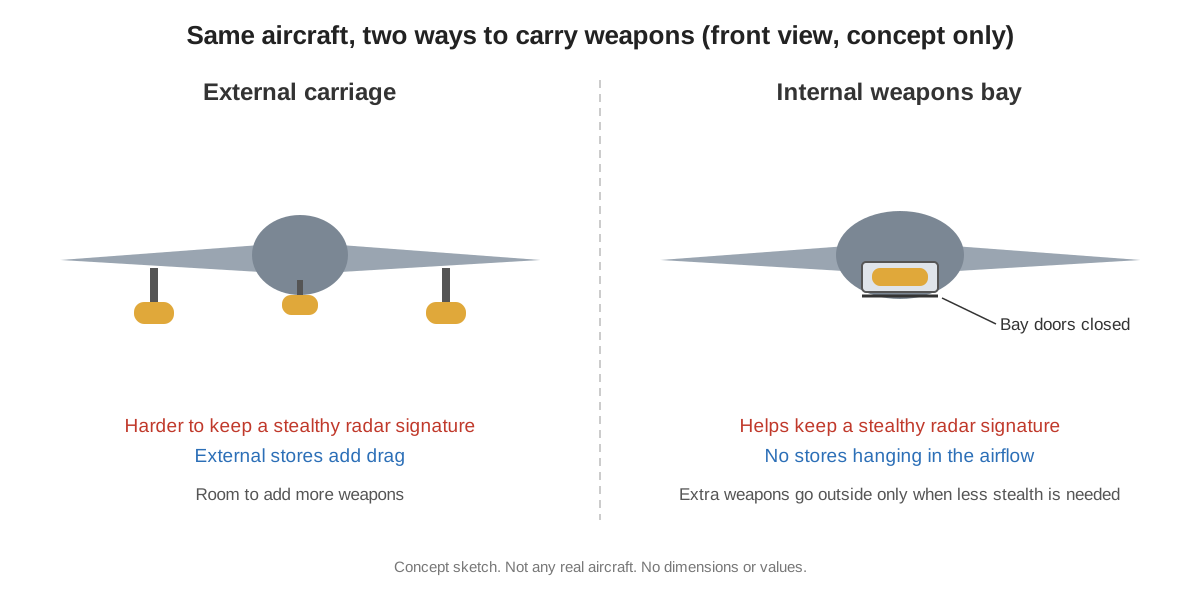
The same paper pointed to the core of the problem. Aerodynamicists design an airplane to be almost "clean," but the real airplane will probably fly in a less clean form. Adding stores in different combinations and in different ways can raise drag sharply and may even hurt the mission.
This was not a new worry. Over the 15 years before that paper, NACA, NASA and other research groups had published a large amount of data on external stores. Hanging things under a wing had long been a puzzle for aerodynamics.
Reason one: a smaller radar signature
The first reason is radar. A 2024 Congressional Research Service (CRS) report on the F-35 explains that all three F-35 versions carry their primary weapons internally to keep a stealthy radar signature. It also lists an internal weapons bay among fifth-generation fighter technologies, next to stealth coatings and shaping, composite materials and advanced radar. A 1991 NASA report (TP-3110) likewise names a lower radar cross section as one benefit of carrying stores inside at supersonic speeds.
This makes sense. An aircraft can be shaped to stand out less on radar, but hanging a row of differently shaped objects underneath changes that outer shape. How radar finds objects from radio echoes is covered in Radar: measuring distance and motion with radio waves.
The idea goes back to the first operational stealth aircraft. A U.S. Air Force fact sheet describes the F-117A as the first aircraft built around low-observable stealth technology to enter operational service. Its armament entry reads simply "internal weapons carriage." Deliveries of the F-117A began in 1982.
One point needs to be clear. Stealth does not mean "invisible." It means "harder to detect." That difference is the subject of a separate article, "Stealth aircraft: truly invisible?"
Reason two: drag
The second reason is air resistance, or drag. The 1991 NASA report says that carrying stores inside at supersonic speeds reduces interference drag and gives a more acceptable thermal environment. Drag is the force that resists an aircraft as it moves through air. Every part of the airplane creates drag, even the engines.
Drag can be split into two broad kinds. One is skin friction, from air rubbing along the surface. The other is form drag, which comes from the object's shape. A smooth surface has less skin friction than a rough one.
The 1966 NASA paper estimates the drag of an airplane with external stores at subsonic speeds. Besides skin friction and form drag, it also counts base drag and interference drag. Interference drag is, as the name says, the share that comes from the flow around neighboring stores, or around the stores and the airframe, getting in each other's way. The drag that stores add depends on how they are mounted at subsonic speeds, and also on where they sit relative to the airplane's other parts at supersonic speeds.
It is a bit like putting a cargo box on a car roof: more wind noise and more fuel. The real case is quite different, though. An aircraft flies much faster, and at supersonic speed, where a store hangs matters as well as what it is. With the weapons inside, nothing hangs outside, so much of the drag those stores would add is avoided.
The trouble starts when the doors open
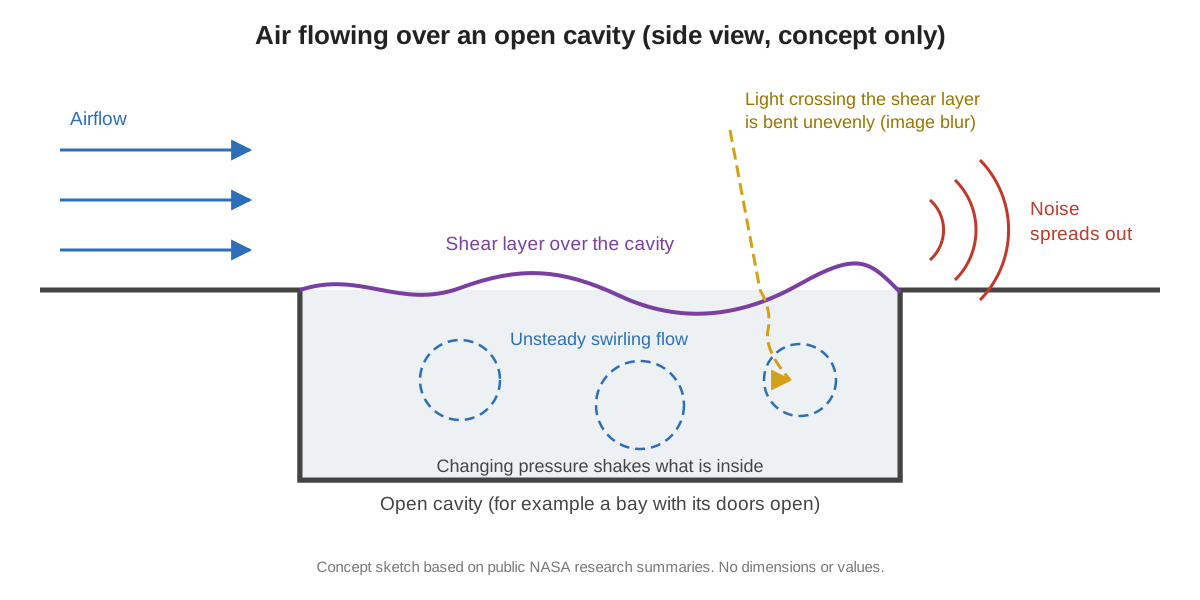
A weapons bay has a price. To use a weapon, the doors must open, and an open bay leaves an empty hole, or cavity, in the smooth underside. When fast air sweeps over that hole, the flow turns rough.
A 1979 report on the B-1 bomber describes a large effort during development to measure and suppress noise in the weapons bay cavity. The work used wind tunnel models, flight test measurements and changes to the aircraft design, and flight tests showed a large drop in cavity noise. Noise is not the only issue. NASA TP-3110 lists large dynamic loads on weapons bay parts when the bay is open as a drawback of internal carriage.
What happens over an open cavity has been published in more detail for an aircraft that carries no weapons. SOFIA, the Stratospheric Observatory for Infrared Astronomy, is a flying observatory with a 2.5 m telescope in an open cavity at the rear of a Boeing 747SP. In 2014, NASA Ames researchers simulated how the unsteady flow in and over that cavity disturbs the telescope.
The key region in those simulations is the shear layer, the layer of flow that covers the cavity. Large, unsteady flow structures inside this layer make noise that spreads outward. The pressure inside the cavity keeps changing too, and that can shake the equipment inside.
Releasing a weapon is a separate problem: TP-3110 notes that with some bay shapes, separating a store is difficult. To study exactly that, NASA measured the pressures, forces and moments acting on a generic store as it left a box-shaped cavity in supersonic flow. For some of the cavities, the tests also compared versions with and without doors on their sides. In the tests, expansion waves and shock waves from the cavity edges strongly changed the pressure on a store leaving a shallow cavity.
Choosing inside or outside
The drawbacks listed in TP-3110 also include needing more volume inside the aircraft and tighter limits on the shape and size of the weapons. So an aircraft with a weapons bay does not always carry everything inside. The CRS report explains that the F-35 carries its primary weapons inside but can carry additional weapons outside on missions that need less stealth.
In the end, the mission decides. When standing out less on radar matters most, the aircraft flies with the weapons in its bay. When carrying more matters more, it adds weapons outside too.
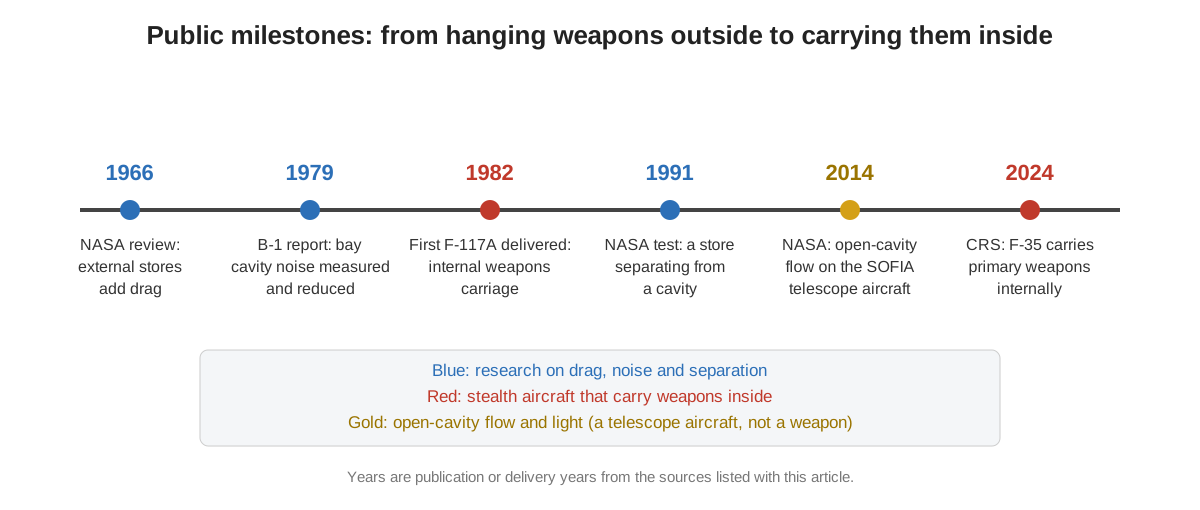
The timeline shows the pattern. Research on the drag of hanging weapons came first. Then came noise research on a bomber that carries weapons inside, for when its doors open. After stealth aircraft appeared, research on releasing a weapon from a bay continued.
Where this meets lasers: the air over an open cavity
The SOFIA study contains something familiar to anyone who works with lasers. The NASA Ames team identified two effects that can reduce the clarity of the telescope's image. One is density changes in the shear layer, which distort the image. The other is vibration of the telescope structure, which shakes the path the light travels.
The cause is the refractive index of air. Along the line of sight, the refractive index depends strongly on how density is spread through the shear layer. When light crosses air with uneven density, it bends by slightly different amounts in different places.
A laser beam crossing a long stretch of open air meets atmospheric turbulence, which comes from the same root. Pockets of air with different temperature and density mix and change the path of the light. That problem, and the technology that corrects it, continue in Light through air: absorption, scattering, turbulence, thermal blooming and Adaptive optics: restoring a blurred beam.
What to read next
- Stealth aircraft: truly invisible?: what it means that stealth is "harder to detect," not "invisible."
- Radar cross section (RCS): what it means for a big aircraft to look small: the idea used to put a number on a radar signature.
- Light through air: absorption, scattering, turbulence, thermal blooming: how air with uneven density blurs light.