On one side of a flat plain stands an army that the records count in the hundreds of thousands. Facing it, a much smaller army forms up at a slant. This is the Battle of Gaugamela, fought in the autumn of 331 BC between Alexander of Macedon and the Persian king Darius III.
The battle is often told as "the small army that beat the big one." Yet the records do not even agree on how big the big army was. This article follows why the battle happened and how it unfolded. It also looks at what set the Macedonian army apart and what to watch for in the old records, using translations of the ancient sources and their editors' notes.
Why the armies met beyond the Tigris
The campaign began in Greece. At Corinth, Alexander gathered delegates of the Greek cities and had them name him general with full powers over the Greeks. The delegates agreed to join an expedition against Persia to seek redress for the wrongs Persia had once done to Greece. By coincidence, Darius had become king of Persia at about the time Philip II died and Alexander became king of Macedon.
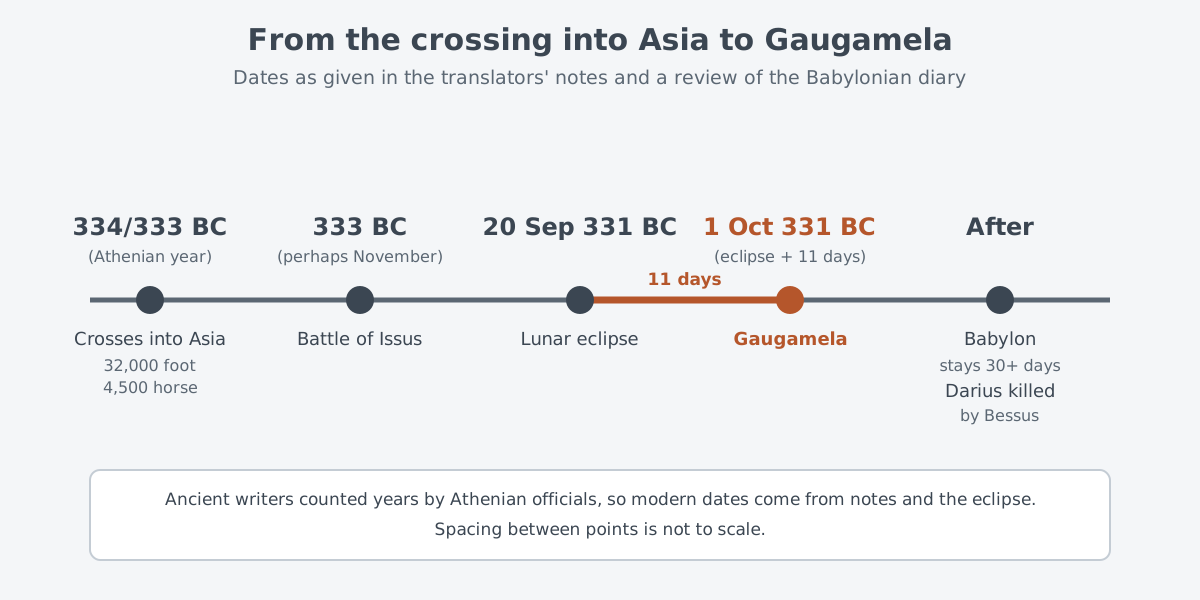
Next, Alexander marched to the Hellespont strait and took his army across from Europe into Asia. The force that crossed numbered 32,000 foot soldiers and 4,500 cavalry. Ancient writers counted years by the names of Athenian officials. Converted to the modern calendar, that year covers the months from July 334 BC to May 333 BC.
The two kings had already met once, at the Battle of Issus in 333 BC, perhaps in November. Darius judged that Alexander had held a big advantage there in the length of his weapons, so he had swords and lances made much longer than before.
He also tried to bargain. He offered all the land west of the Euphrates and 30,000 talents of silver, but Alexander chose glory over the gifts.
The days before the battle
Even the name of the battlefield is confusing. Many ancient writers called this fight the Battle of Arbela. The great battle, however, took place at Gaugamela, not Arbela. Gaugamela lay about 600 stades from Arbela, and Arbela is today's Erbil.
The ground was level all around. The Persians had already smoothed out the uneven patches so that chariots could roll and horses could gallop with ease. Those chariots were one of the weapons Darius chose: 200 chariots with scythe-like blades fixed to the yoke and the axles.
The sky gives the date. Eleven nights before the battle, on 20 September 331 BC, there was an eclipse of the moon. In the handbooks of Babylonian astrologers, such an eclipse meant the death of a king. Add 11 days to 20 September and you reach 1 October.
On the night before, Parmenion and other senior officers saw the plain lit up by the fires of the Persian camp and urged a night attack. According to the story, Alexander refused, saying he would not steal his victory. Plutarch adds that some read the reply as a calculation: Darius would give up the war only after a complete defeat in broad daylight.
How the battle unfolded
The Macedonian line was shorter than the Persian one. So Alexander held both wings back at an angle. The aim was to stop the larger enemy from swinging round the sides and wrapping up the shorter line. He took the right wing himself, and Darius faced him from the centre.
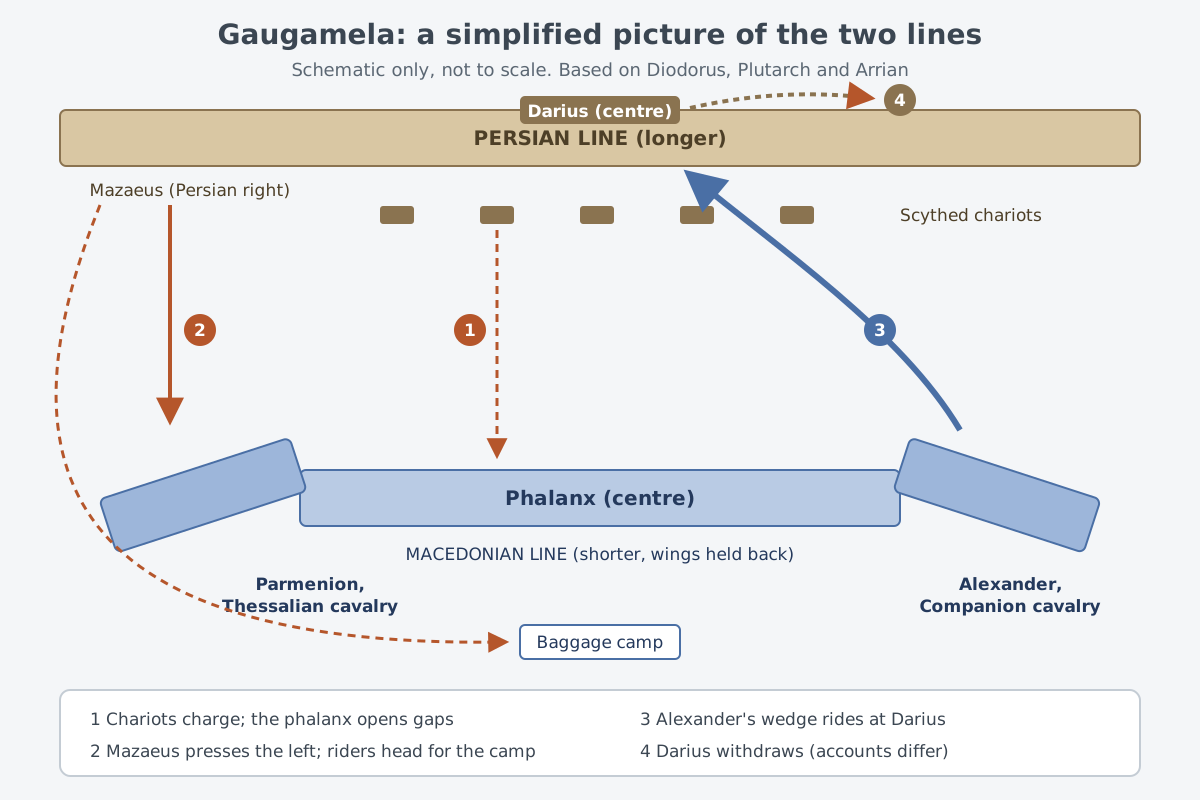
The scythed chariots came first, but Alexander had given his orders in advance. When the chariots charged, the phalanx infantry were to lock shields and beat on them with their spears to frighten the horses. If the chariots still came on, they were to open gaps and let them through. Startled horses turned many chariots back into their own ranks, and the rest ran on through the gaps the soldiers opened.
Trouble came on the left. Mazaeus, on the Persian right wing, sent 3,000 horsemen around the side of the Macedonian line, and they burst into the Macedonian baggage camp. The left wing under Parmenion was pushed back, and he sent riders to Alexander warning that the camp and baggage would be lost.
At that moment, on the right, Alexander formed a wedge of Companion cavalry and part of the phalanx and charged straight at Darius in the centre of the Persian line. The cavalry led and the phalanx rolled after it like a flood. When Darius withdrew, the Persians lost heart. On the left, Parmenion, who had held on, finally drove off the Persians facing him with the Thessalian cavalry.
What set the Macedonian army apart
At its core was a close-packed formation called the phalanx, first set up in Macedon by Philip II, the king before Alexander. He designed its formation and equipment after the warriors in the Trojan War story, who fought in close order with overlapping shields. A note by the editor of the Loeb edition names the two most important military reforms. One was building the phalanx out of foot soldiers; the other was giving them a long pike called the sarissa.
How long was the pike? Polybius gives it in cubits, an old unit of length: 16 cubits by the original design, and 14 as adapted to actual use. When the front ranks held their pikes level, five pike points stuck out in front of the man in the first rank. The ranks behind held their pikes slanting up over the shoulders of the men in front, like a roof that kept off things flying in from above.
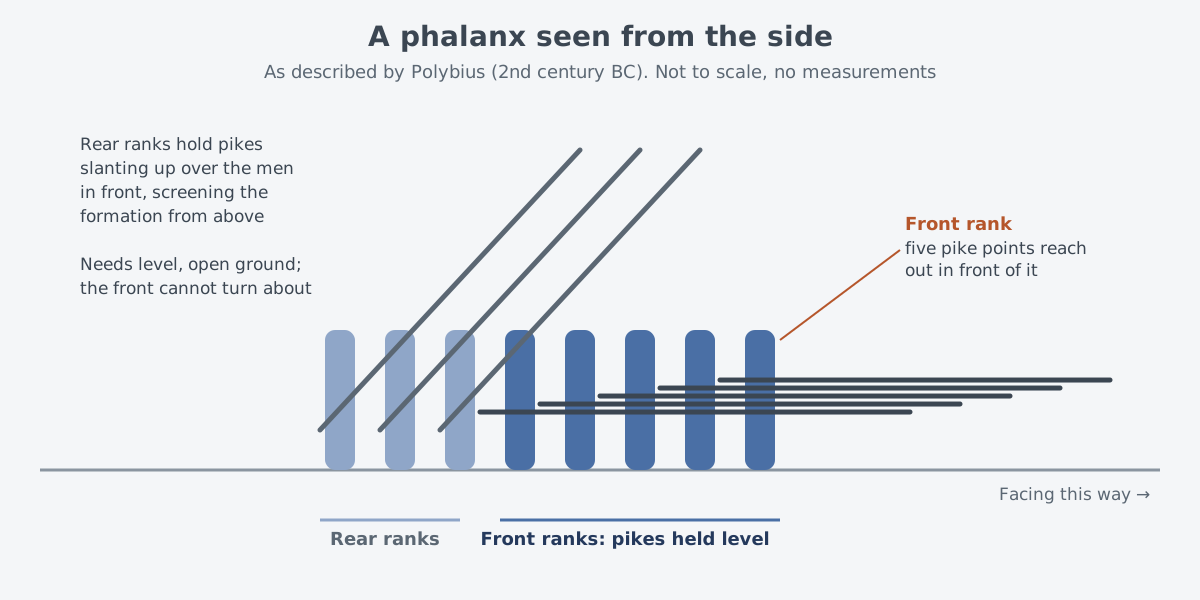
Picture a wall bristling with layer after layer of pike points. Unlike a wall, though, it did not just stand there; the rear ranks pushed with their body weight and added force to the charge.
While it kept its proper formation, a frontal charge by this phalanx was very hard to withstand. Its weaknesses were just as clear. It needed level, open ground free of ditches, trees, ridges and streams, and the front rank could not turn around.
This description was written long after Gaugamela, in the era when Rome and Macedon fought each other. The phalanx of Alexander's day need not have matched it in every detail. Still, a formation that is strong to the front but hard to turn is worth reading alongside the layout at Gaugamela. There, Alexander held both wings back to guard his sides.
The other half of the Macedonian army was cavalry. When Alexander led the army out, he sent the cavalry squadrons out in front of the foot soldiers of the phalanx. He led the Companion cavalry on the right wing himself. On the left wing, the Thessalian cavalry held the line.
At Gaugamela the phalanx let the chariots through and then pressed forward behind the cavalry, while the cavalry drove into the centre where Darius stood. Foot and horse each had a different job and moved together within one battle; that is the picture of this army the records give.
Numbers and scenes that differ between records
The books by Greek and Roman writers that describe Gaugamela in detail date from later times, not from the battle itself. The only contemporary record of that day is a Babylonian astronomical diary. The numbers in the records also differ widely. Here are the Persian forces and the dead on each side, writer by writer.
| Record | Persian forces | Persian dead | Macedonian dead |
|---|---|---|---|
| Arrian | 40,000 cavalry, 1,000,000 infantry, 200 scythed chariots ("said to") | about 300,000 ("said to") | about 100 |
| Diodorus | 800,000 infantry, at least 200,000 cavalry, 200 scythed chariots | more than 90,000 | about 500 |
| Plutarch | a million men | ||
| Curtius (Loeb note) | 45,000 cavalry, 200,000 infantry | 40,000 | |
| Justin (Loeb note) | 500,000 | ||
| Oxyrhynchus Papyrus 1798 (Loeb note) | 53,000 | 1,000 infantry, 200 cavalry |
The editor of the Loeb Diodorus called Curtius's figures "more reasonable" in a note. On the Macedonian side, Arrian counts about 40,000 infantry and 7,000 cavalry. The records agree that the Macedonians were fewer, but how large the gap was cannot be settled.
Every number in the table also stands for people who died or were wounded that day. After the battle, the field was left with a great many unburied dead.
The scenes differ too. In Arrian's account, a terrified Darius turns and runs before anyone else. In Diodorus's account, Alexander's javelin hits the driver beside Darius, and soldiers farther off think the king has fallen and flee first. It is also Diodorus who calls Darius "a clever strategist."
There is a contemporary record as well. It is the astronomical diary kept day by day by the staff of the Esagila temple in Babylonia, noting events in the sky and on the ground. The cuneiform clay tablet is kept today at the British Museum, London. The diary has a line saying "the army abandoned Darius and returned to the cities," which does not match Arrian's account.
Jona Lendering, the author of a scholarly review that discusses the diary, argued that the Babylonian record should be preferred, since it was written only a fortnight after the fighting. To reconcile the two, some have rendered the line as "Darius abandoned his army," but he wrote that setting aside the rules of grammar does not solve the problem. The same scene changes depending on who wrote it down, and when.
What the battle left behind
Alexander buried his dead, entered Arbela and then moved on to Babylon. The people of Babylon welcomed him, and he stayed more than 30 days. He promised to rebuild the Marduk temple and declared that Babylonian homes would be spared from looting.
Darius withdrew toward the distant provinces, and at Ecbatana in Media he gathered stragglers and rearmed them. Later, while retreating toward Bactra, he was seized and killed by Bessus, the governor of Bactria. In Greece, news of the battle left many cities alarmed at the growing power of Macedon.
It is hard to sum up Gaugamela in one sentence. Seen as military history, it is a case where an army whose long-pike infantry and cavalry each had their own job beat an army that the records make far larger. Seen through its sources, it is also a battle where later stories and a clay tablet from that very day tell different scenes. Both views are needed to read it.
What to read next
- The Punic Wars and Cannae: Hannibal's Encirclement and Rome's Recovery. See how the Roman army that Polybius compared with the phalanx actually fought.
- Turning points in military technology. Modern examples of weapons and organization changing together and reshaping war.
- A history of laser weapons: from chemical to electric lasers. From long pikes to light: how long it takes for a new weapon to find its place, seen in another era.