In the autumn of 1274, more than 900 ships left Happo, the harbor of today's Masan in Korea. On board were Goryeo troops, Mongol and Han Chinese troops, and the seamen who sailed the ships. They were bound for Hakata, across the sea in Kyushu. Seven years later a larger fleet set out on the same sea, and both times the fleets came back.
In Japan, the second failure came to be explained by a wind sent by the gods: the kamikaze, or "divine wind." Did a wind really save Japan? The sections below follow why the Yuan and Goryeo crossed the sea and why a stone wall went up along Hakata Bay. They also show how Korean and Japanese public bodies and American university scholars read the same events differently.
Envoys and a refusal
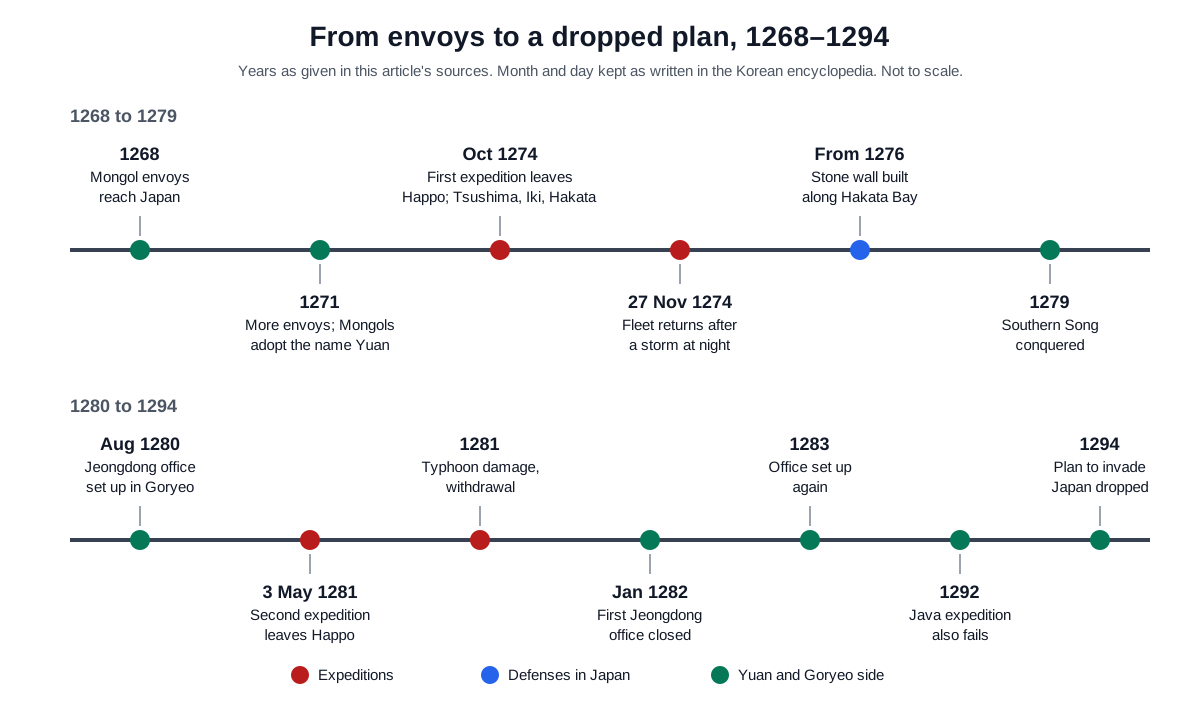
The man who ordered the expeditions was Khubilai Khan, the Yuan emperor known by the temple name Shizu. The Mongols adopted the dynastic name Yuan in the eleventh month of 1271. The Yuan did not start with ships.
The Encyclopedia of Korean Culture explains that the Yuan first tried to bring Japan under its rule by diplomacy through Goryeo. Only when that did not work did it form an allied army.
Mongol envoys reached Japan in 1268 and 1271, but Japan's shogunate refused to submit to the Mongols. That refusal set the campaigns in motion.
Goryeo's position matters too. Goryeo had made peace with the Mongols and returned its court to Gaegyeong.
After the Sambyeolcho forces were put down in 1273, Goryeo sent troops on both expeditions at the Yuan's demand. Koreans therefore call the force the Yeo-Won (Goryeo-Yuan) or Yeo-Mong (Goryeo-Mongol) allied army. The Goryeo court also hoped to strengthen royal power.
1274: the first expedition to Hakata Bay
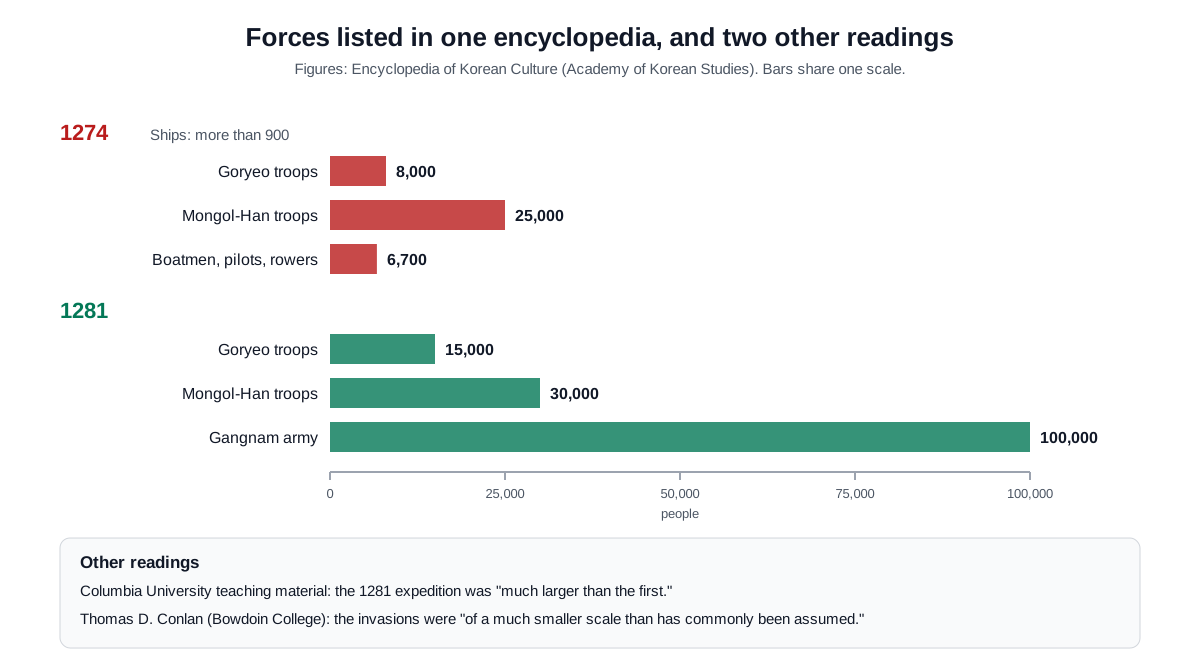
On 27 October 1274, by the date given in the Encyclopedia of Korean Culture, the allied force left Happo. It carried 8,000 Goryeo troops under Kim Bang-gyeong, 25,000 Mongol-Han troops under Hindu, and 6,700 boatmen, sea pilots and rowers, spread across more than 900 ships. In Japan this fighting is called the Bun'ei campaign (Bun'ei no eki).
The fleet took Tsushima and then Iki before pressing on to Hakata. Kim Bang-gyeong, leading the Goryeo troops, landed at Fukuoka and overcame the Japanese defenders. The allied force won at Hakata but pulled back as the day ended.
That night a storm rose. Many warships were damaged or sank, and the fleet returned home on 27 November. The soldiers who did not come back numbered more than 13,500. Each of them was someone who had boarded a ship at Happo.
Sources weigh the cause of this failure differently. Columbia University's material says the first expedition failed largely because of the weather. The encyclopedia's entry on Kim Bang-gyeong says the force suffered heavy losses in rough seas on the way back.
A stone wall along the shore
Japan built a wall by the sea while it waited for the next attack. From 1276 on, the Kamakura shogunate ordered nine provinces of Kyushu to build a stone wall around Hakata Bay, assigning each a length according to the size of its landholdings. The wall runs about 20 km from Kashii in the east to Imazu in the west.
Records of the time call it ishi-tsuiji, a "stone earthwork." Today it is known as the Genkō Bōrui. It stands on the sand dunes of the bay shore, and its build differs from place to place. In the Imazu area, the wall is stacked as a trapezoid 3 m high, 3 m wide at the base and 2 m wide at the top.
Why was Hakata Bay the target? Fukuoka City points out that coastal towns such as Hakata, Hakozaki, Imazu and Kashii were key hubs for overseas trade centered on the Southern Song. The city sees that as the reason the Mongols attacked there. The wall became a national historic site on 30 March 1931, and today the protected area is split into ten places across five districts.
1281: two fleets and a typhoon
After defeating the Southern Song in 1279, the Yuan emperor Khubilai pushed again for an invasion of Japan. To conquer the Southern Song, the Mongols had even built a navy to cross the Yangtze River. In the eighth month of 1280, a Jeongdong office was set up in Goryeo with King Chungnyeol at its head. "Jeongdong" means an expedition to the east against Japan, and the office was there to prepare the next year's campaign.
The 1281 force came in two parts. The Encyclopedia of Korean Culture lists 15,000 Goryeo troops under Kim Bang-gyeong, 30,000 Mongol-Han troops under Hindu and Hong Dagu, and a Gangnam army of 100,000 under Fan Wenhu. Gangnam refers to the former lands of the Southern Song. In Japan this fighting is called the Kōan campaign (Kōan no eki).
The plan was for the two fleets to meet at Iki and act together. The Goryeo and Mongol-Han troops left Happo on 3 May. But the Gangnam army arrived late, which threw the plan off, and once it arrived it was badly hit by a typhoon. The allied force withdrew again.
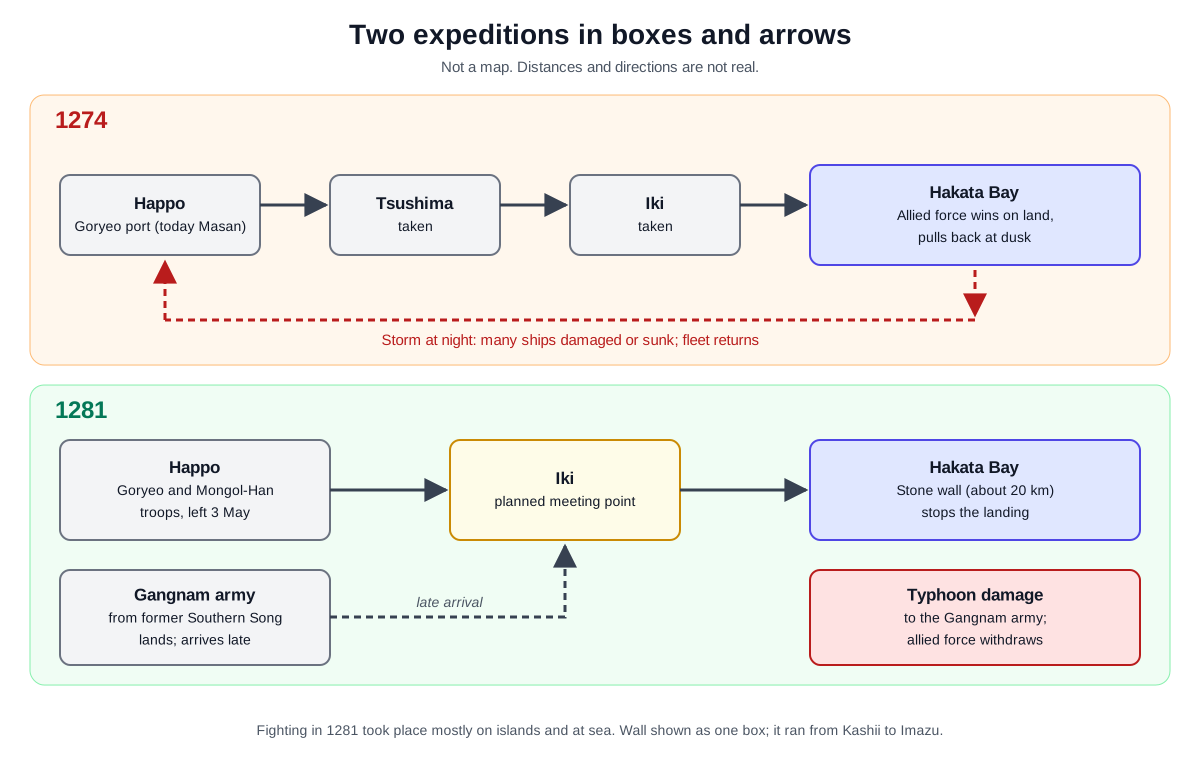
The stone wall did its job in this campaign. During the Kōan campaign, the wall kept the Mongol forces from landing. In 1274 the Mongols had landed in northern Kyushu, but the 1281 fighting was largely around the islands and out at sea.
Wind or warriors?
Columbia University's material says the 1281 expedition was much larger than the first and that a terrible typhoon damaged the fleet badly enough to end the mission. The Japanese believed the typhoon was no accident but sent by the gods, and named it kamikaze, the "divine wind." With it grew the belief that the gods protected the islands and that no outside force could ever invade them.
Some scholars read the same events another way. In his 2001 book In Little Need of Divine Intervention, historian Thomas D. Conlan argues that medieval Japanese warriors were able to hold the Mongol forces in check with no help from a "divine wind." In his reading, Japan was holding off the Mongols well before any storm arose, and the invasions were much smaller than commonly assumed.
| What | Source | Reading |
|---|---|---|
| 1274 failure | Columbia University teaching material | Largely the weather |
| 1274 failure | Encyclopedia of Korean Culture (Kim Bang-gyeong) | Heavy losses in rough seas on the way back |
| 1281 failure | Columbia University teaching material | A typhoon damaged the fleet and ended the mission |
| 1281 failure | Encyclopedia of Korean Culture (allied army) | Withdrawal after the Gangnam army's late arrival and typhoon damage |
| 1281 landing | Fukuoka City | The stone wall stopped the landing |
| Both invasions | Conlan (Bowdoin College) | Held in check before any storm, and smaller in scale |
The two readings do not cancel each other out. Korean and American sources both record that a typhoon did heavy damage to the fleet. Japanese institutions' records and the scroll show Japanese warriors fighting on the shore and at sea. How much each side of the story counts is still a matter of interpretation.
Why the idea of the kamikaze took hold after the invasions is also a question Conlan sets out to answer. The Encyclopedia of Korean Culture holds that Japan pointed to the typhoon that kept the allied army from attacking properly and stressed the myth of the divine wind. Later, it says, Japan presented this as an important historical experience in building the emperor system.
A scroll and ships under the sea
One man who fought in these campaigns left pictures behind. They are the scrolls of the Illustrated Account of the Mongol Invasions (Mōko shūrai ekotoba). Takezaki Suenaga (born 1246), a warrior from Higo Province in today's Kumamoto Prefecture, likely commissioned them to record his courage in the Mongol wars. Since they were painted just a few years after the fighting, the pictures are themselves a rare record from the time.
The scenes are concrete. Suenaga marches past Kikuchi Takefusa, who comes from Higo too and sits on a defensive wall, and asks him to vouch for his courage in the coming fight. Warriors row out in boats to meet the Mongol fleet, and Suenaga leaps aboard an enemy vessel and wrestles with a Mongol commander. Names are written above the figures, and only Suenaga's is in red.
Still, these scrolls are one man's record of his own deeds. The Bowdoin College site compares historical copies to show how the scrolls were altered. A scene of Suenaga in a boat is missing. Striking sections of handscrolls were sometimes cut out and remounted as hanging scrolls, so the gap may not be due to damage alone.
Some people doubted the pictures, including the unfamiliar weapon called tetsuhau and the Yuan ships. Yuan ships are thought to have sunk off Takashima in Nagasaki Prefecture in the Kōan campaign, and a ship found there on the seabed resembles those in the scroll. A 750th-anniversary exhibition by the Uki City Board of Education explains that this showed the scenes were what Suenaga actually saw. The scrolls are now a National Treasure of Japan.
The waters off Takashima became a site for underwater archaeology in Japan. A project funded by the Japan Society for the Promotion of Science surveyed the whole floor of Imari Bay with sonar. It found parts of a Mongol ship's hull and many tiles.
A later project built its methods for studying underwater sites around the Takashima No. 1 and No. 2 wrecks, which are being preserved where they lie. Until then, the study of underwater sites such as shipwrecks had been almost untouched in Japan.
Where did the ships come from?
Randall J. Sasaki's study, published by Texas A&M University Press, sorted the timbers into categories and analyzed how they were joined. No firm answer on their origins is possible, but many of the timbers appear to belong to small boats made along the Yangtze in China. The big V-hulled cargo ships and the Korean-built vessels probably account for only a minor part of what was raised.
What it left for Goryeo and the Yuan
Khubilai did not give up after two failures. The Jeongdong office closed in January 1282, right after the campaign, and opened again in 1283, when war preparations took place mainly in Gangnam. A new expedition was being planned, but after Khubilai died, the plan to invade Japan was dropped in 1294.
For the Yuan, the campaigns were a heavy burden. Columbia University's material says such expeditions were extremely costly and that failed campaigns were one of the main reasons Mongol rule in China grew weak and finally fell. A 1292 expedition to Java also ended in failure.
Goryeo was left with different marks. The Encyclopedia of Korean Culture holds that King Chungnyeol's role in the second expedition helped strengthen royal power in Goryeo. It also helped the Yuan tighten its grip on Goryeo. After Khubilai's death, the Jeongdong office lost most of its military role and remained as a liaison office between the Mongol empire and Goryeo.
Japan was left with a stone wall on the shore, a set of scrolls, and the story of the "divine wind." These two invasions were the first and only attempts to conquer Japan before modern times. Today Fukuoka City is developing the Genkō Bōrui as a heritage site for understanding the historical facts and background and for reflecting on peace.
What to read next
- The Mongol Conquests: An Empire Built on Horses and Relay Stations: how the empire that began on the steppe grew before it ever crossed the sea.
- Goryeo Against the Mongols: The Move to Ganghwa and Thirty Years of War: the long war before Goryeo sent troops to the allied army.
- Turning points in military technology: moments in the 20th century when new weapons and organization changed how wars were fought.
- A history of laser weapons: from chemical to electric lasers: how long it takes a new weapon to find its place, seen from the laser side.