In 1241, Mongol armies stood in Hungary. Before the year was out, they turned back. The Great Khan Ögödei had died far away in Mongolia, and the leaders went home to choose a new one.
One man's death could pull an army out of the middle of Europe, which says a lot about an empire held together by personal loyalty. Yet the same empire also had roads that carried troops and messages from the steppe to Hungary and from Goryeo to Baghdad. This article uses public records to trace why the conquests began and what horses, organization and relay stations did. It then follows the wars, including the war with Goryeo, and what they left behind.
Why did they leave the steppe?
Why did the Mongols leave their grasslands in the early 13th century and set out to conquer? Columbia University's teaching materials say first that scholars have not agreed on the specific reasons. Three reasons come up often: climate, trade and Chinggis Khan himself.
The first is grass. Between 1180 and 1220, Mongolia's mean annual temperature dropped, and the season in which grass could grow became shorter. For herders, animals were the base of everything, and less grass put the herds at risk. That threat may have pushed people out of Mongolia.
The second is trade. The Mongols relied on neighbors for grain and crafted goods. When the Jin in North China and the Xia in the northwest tried to cut back their trade with the Mongols, a crisis followed. The Mongols answered with raids, then attacks and finally invasions.
The third is Chinggis Khan. A story holds that Tenggeri, the sky god, gave him the task of bringing the world under one sword. These explanations do not rule each other out. Each one leads back to a single life, and that is the place to start.
Breaking up tribes to build one people
Chinggis Khan's birth name was Temujin. In 1206 the khuriltai, an assembly of Mongol nobles, gave him the title "Chinggis Khan." The Encyclopedia of Korean Culture adds that Temujin had united the steppe tribes and named the state Yeke Mongol Ulus.
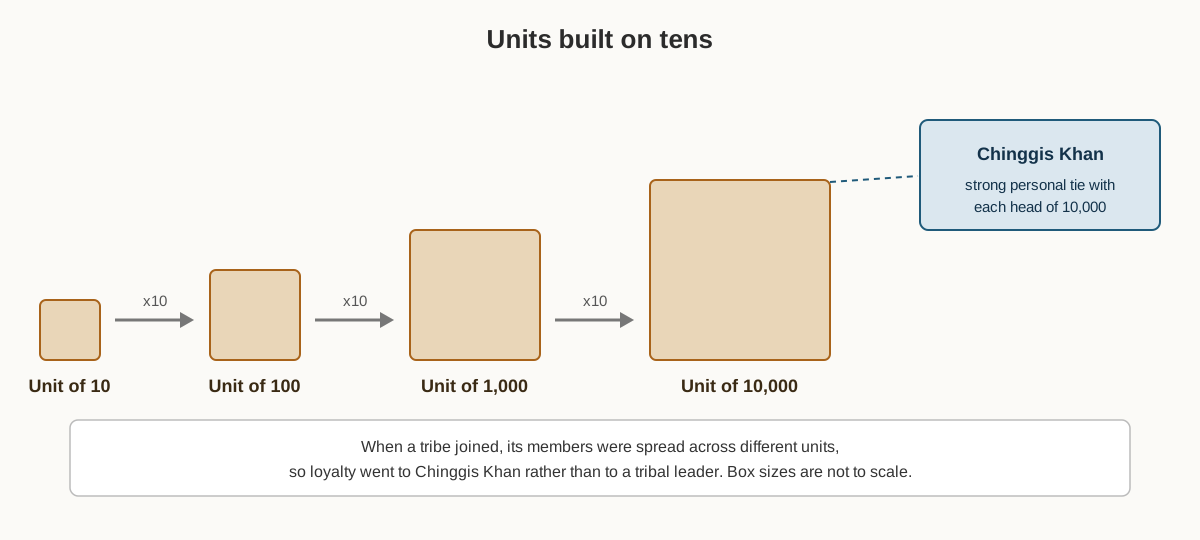
He kept that unity in an unusual way. When a tribe joined him, he spread its members across the different units under his command. Loyalty inside a tribe tended to flow to the tribal chief. He wanted it to flow to him instead.
Those units were built on tens. There were units of 10, 100, 1,000 and 10,000, and each head of a 10,000 unit had a strong personal tie with Chinggis Khan. This kind of loyalty became an important base for holding a vast realm together.
The state's framework took shape in the same years. In 1204, before he even held the title, Chinggis Khan had a Uyghur retainer create a Mongol script from the Uyghur alphabet. He also left a legal code, the Jasagh, a set of general moral rules and laws.
Three or four horses and a bow
The Mongol army was smaller than many people imagine. In a 1994 article, the historian Morris Rossabi wrote that the force under Chinggis Khan never went above 200,000 men. He points to the small but very tough Mongolian horse as the base of the conquests.
A cavalryman usually had three or four horses. On long marches he switched between them, so each horse got time without a rider. Against settled, farming societies, horses gave the Mongols a clear edge in mobility.
Weapons and gear were made for life in the saddle. Mongol riders were skilled at shooting a composite bow of sinew and horn from horseback. A saddle of wood and leather let them ride for long stretches, and a strong stirrup helped them sit steadier. Saddlebags held cooking pots, dried meat, yogurt and water bottles.
To those who faced them, this looked like an army that needed no supplies. Ibn al-Athir, a Muslim historian writing about the events of 1220–1221, recorded that they had no supply train. In his account they brought sheep, cows and horses to eat, and their horses dug with their hooves to reach plant roots. In fact the herds were the supply train: the army did have logistics, but it moved them on the hoof.
The 1223 fight at the Kalka River is often cited to show how such an army moved. According to Rossabi, after the conquest of Central Asia, Chinggis Khan sent Jebe and Subedei west with about 30,000 men to scout. In May 1223, Mstislav led 80,000 men on the Russian side, while the Mongols had no more than 20,000.
The Mongols fell back for more than a week, drawing their opponents into a long, stretched-out column, then turned to fight at the Kalka. The Russian side was badly beaten. This kind of feigned retreat was a method Chinggis Khan liked to use.
Relay stations: the roads that held the empire together
If horses made the army fast, relay stations stitched the empire together. The system was first set up to carry official mail from one end of the realm to the other. According to Columbia's materials, stations stood about every 20 miles along the main trade routes, stocked with food, horses and lodging.
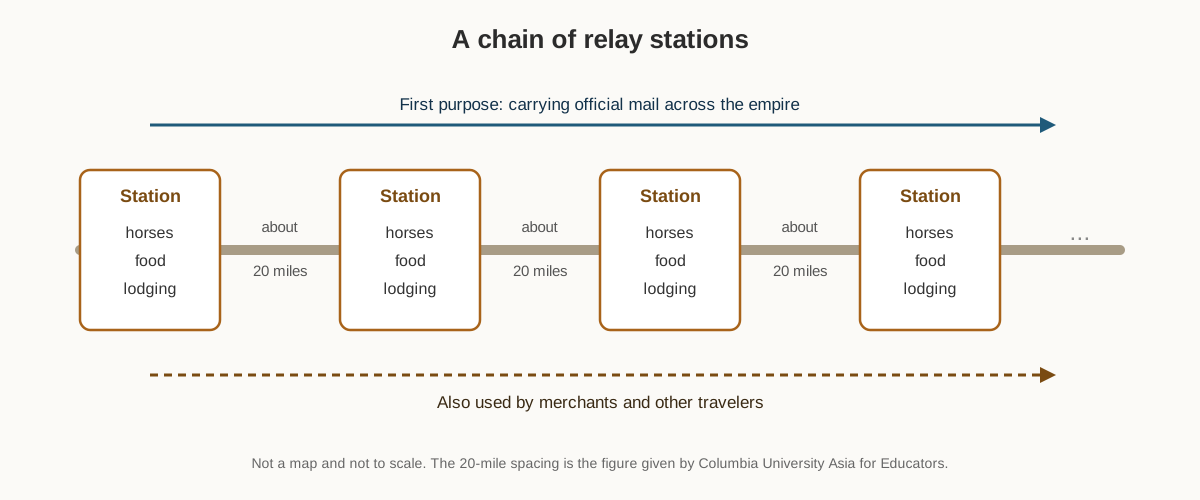
A road built for state mail soon served every traveler. Merchants could rest and resupply at the stations, and under Mongol rule they enjoyed a higher standing than under earlier Chinese dynasties. The khanates sometimes fought each other, but during the century or so of Mongol rule across Eurasia, traders were generally safe, the same source explains. This is often called the Pax Mongolica, the Mongol peace.
The stations also tied a divided empire together. The Encyclopedia of Korean Culture describes the ulus, the large Mongol realms, as linked by relay stations. Through them the realms kept core Mongol institutions such as the units of a thousand and the keshig guard, while borrowing local systems to govern.
The roads were not free, though. In China, the Mongols used their roads mainly to govern, and public works such as roads, the station network and a longer Grand Canal cost enormous sums. Those costs later weighed on the Yuan dynasty.
How the conquests unfolded, 1206 to 1279
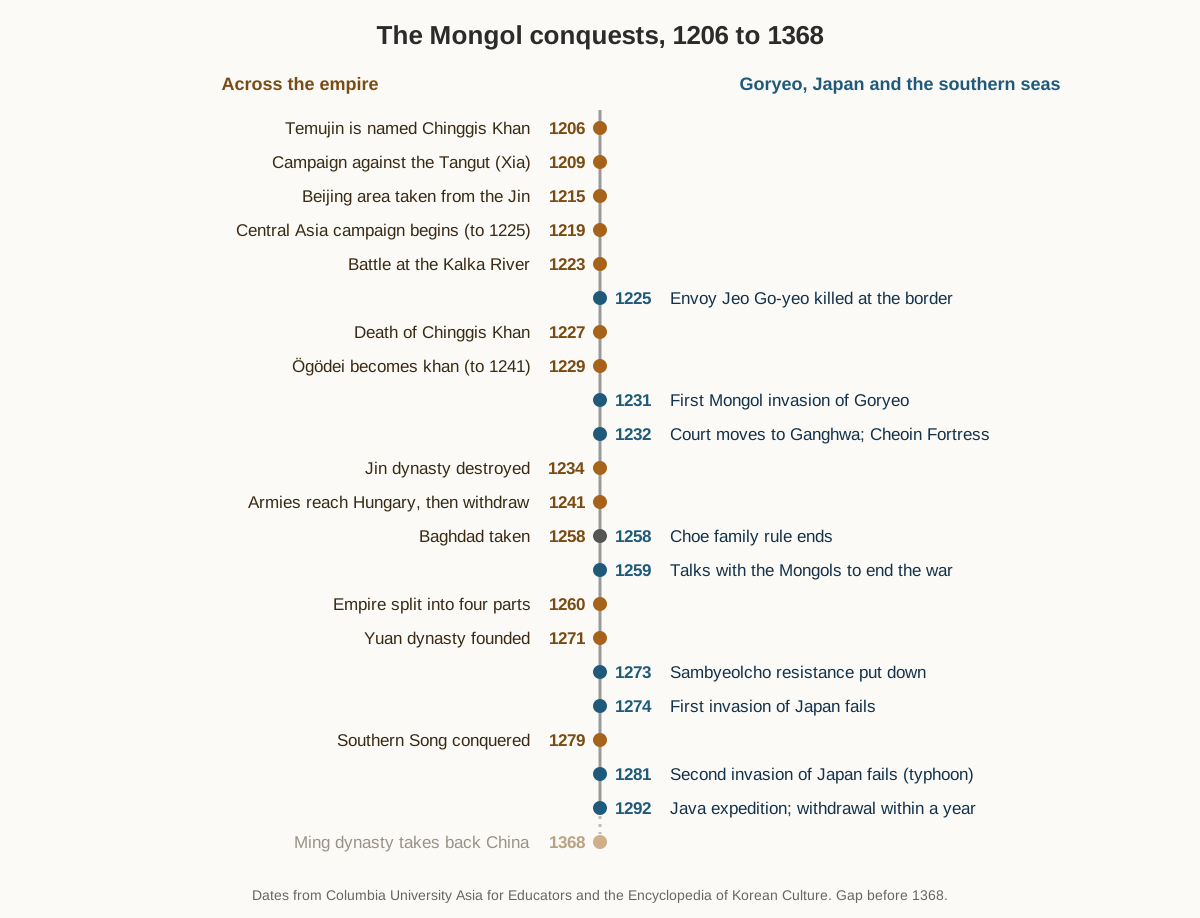
Chinggis Khan led three campaigns himself. In 1209 he struck the Xia, or Tangut, kingdom in northwest China, won lower tariffs on trade, and went home without taking land. By 1215 he had beaten the Jin, taken the area around today's Beijing and forced the Jin to move their capital south.
The third campaign was different. It began after envoys he had sent to Central Asia were murdered. The army set out in 1219, both sides carried out mass killings, and it took several years to take the great cities. When Chinggis Khan left Central Asia in 1225, he left troops behind to hold the land for the first time.
Chinggis Khan died in 1227. Columbia's materials say he died on the way back to Mongolia after the Central Asian campaign. The Encyclopedia of Korean Culture says he died during the campaign against the Tangut. He left no orderly rule for succession, so each new khan had to build his own personal bonds again.
Under his third son Ögödei, who reigned for 12 years (1229–1241), the empire grew the most. In the 1230s Mongol armies moved into Russia and took much of it, and they occupied Georgia and Armenia. In 1234 they destroyed the Jin completely, held every part of China above the Yangtze, and pushed into eastern Persia.
How did such a small group win so much land? Columbia's materials give two answers. One is that the Mongols took loyal members of conquered peoples into their armies, and Turkic peoples, including the Uyghurs, played a large part.
The other is that their neighbors were weak. China was split into at least three warring parts, and Russia was a scatter of city-states.
After Ögödei died in 1241, disputes over who should be Great Khan went on for 19 years. Conquest did not stop in the meantime. Khubilai's brother Hulegu took Baghdad in 1258 and ended the Abbasid dynasty.
Yet by 1260 the Mongol lands had split into four parts. Khubilai ruled China, Mongolia, Korea and Tibet. The others were Central Asia, the Ilkhanate in West Asia and the Golden Horde in Russia.
Khubilai founded the Yuan dynasty in 1271 and conquered the Southern Song by 1279. To cross the Yangtze for that campaign, the Mongols had to build a navy, and Columbia's materials call it the greatest victory of early Yuan rule. Rossabi writes that the conquests begun by Chinggis Khan stretched as far as Korea and Hungary, Russia, and today's Vietnam and Syria.
Goryeo and the Mongols: a war of nearly 30 years
The Korean Peninsula was not outside this story. In 1225 the Mongol envoy Jeo Go-yeo was killed at the border on his way back from Goryeo. The Mongols blamed Goryeo and cut off relations, and in August 1231 an army under Sartai invaded. When Gaegyeong was surrounded that December, the Goryeo court chose to surrender, and the Mongols withdrew, leaving 72 darughachi in the northern region.
Choe U, the military strongman who held power in Goryeo, chose another path. In June 1232 he moved the capital to Ganghwa Island and had people across the country move into mountain fortresses and onto islands to prepare for a long resistance. When Sartai invaded again that year, he was killed by an arrow at Cheoin Fortress, shot by Kim Yun-hu, a monk-general, and the Mongol army withdrew.
The war did not end there. Mongol armies came back in 1235–1239, 1247–1248, 1253–1254 and 1254–1259. Ordinary people kept fighting, but as the war dragged on, Goryeo's losses grew.
In 1258 Choe Ui, a ruler who had insisted on resistance, was killed, and the Choe family's rule ended. In 1259 the crown prince traveled to the Mongols to end the war, and Goryeo made peace on terms that included keeping its own customs. Later, the Sambyeolcho, who opposed the return to Gaegyeong, fought on until a joint Goryeo and Mongol force put them down in 1273. The Encyclopedia of Korean Culture describes Goryeo as a country that "resisted the Mongols for more than 30 years."
Campaigns that stalled at sea and in the south
At sea, horsemen from the steppe met a different problem. After Japan refused to submit, the Mongols prepared an invasion. Goryeo joined the first expedition in 1274 with more than 8,000 soldiers and warships, but the campaign failed with heavy losses. The weather was a major cause.
The second expedition of 1281, sent in summer, was much larger, but the result was the same. A severe typhoon wrecked the fleet and forced the Mongols to give up. In Japan the storm was seen as a wind sent by the gods and was called "kamikaze," the divine wind.
Things went much the same way in the south. In 1292 Mongol troops landed on Java, but the heat, the tropical climate, parasites and infectious disease drove them out within a year. In Burma, Cambodia and Vietnam they won some early battles but in the end withdrew because of weather and disease. Columbia's materials suggest the Mongols were not skilled at naval war, and that each failed campaign cost huge sums and weakened the empire further.
Destruction and exchange: two ways of remembering
People who lived through the Mongol conquests left records full of fear. Ibn al-Athir described them as "the greatest catastrophe" and wrote that the invaders took most of the inhabited world in about a year. As noted above, both sides carried out mass killings in the Central Asian campaign.
Scholarly views have widened over time. Until the 1980s, most studies of Mongol-era China stressed the damage done by Mongol rule. Older estimates of a catastrophic population collapse in North China have since been revised, but the fact of heavy damage and loss of life during the conquest stands. Columbia's materials sum it up: the brutality of the campaigns should not be played down or ignored, but their effect on the culture of Eurasia should not be overlooked either.
Exchange left its mark in the paths people traveled. Marco Polo and the Moroccan traveler Ibn Battuta both reached China in this period. Rabban Sauma, a Nestorian Christian from near Beijing, went to Europe, where he met the pope and the kings of France and England.
Alarmed by the 1241 attacks on Hungary and Poland, Europe sent John of Plano Carpini in 1245 and William of Rubruck in 1253–1255. Neither reached his religious or diplomatic goal, but both brought back the earliest reliable descriptions of the Mongols.
The Mongols also valued craftsmen. When Chinggis Khan attacked Samarkand, he ordered his soldiers not to harm artisans, and craftsmen across the empire received tax benefits and freedom from forced labor.
The end of the Yuan began under the weight of costly campaigns and public works. In the 1340s great floods moved the Yellow River into a new channel and left many people homeless, and rebellions broke out in the 1350s. In 1368 the Ming took back China, and the Yuan left. An empire born of conquest came apart under the costs of seas, roads and canals and the quarrels over who should rule.
What to read next
- Military logistics: performance must be sustainable: compares an army that drove its herds with how armies are supplied today.
- Resilient military communications: systems built to survive a lost link: looks at how armies today keep messages moving, as the relay stations once did.
- Turning points in military technology: modern examples of new technology changing how wars are fought.